


Form 79 under the Income Tax Act 2025: Investment Fund Filing Guide
Overview
Form 79 under the Income Tax Act is a statement used by investment funds to report income paid or credited to unit holders. It is furnished under Section 224 of the Income Tax Act, 2025 and prescribed under Rule 145 of the Income Tax Rules, 2026. Form 79 Investment Fund Filing is the new corresponding form for Form 64D under the Income Tax Rules, 1962.
This form helps the Income Tax Department track income distributed by investment funds and supports proper reporting under the pass-through taxation mechanism. In this article, we explain what Form 79 is, who should file it, its due date, documents required, the filing process, and its importance for investment fund compliance.
Form 79 under the Income Tax Act: Meaning and Purpose
Form 79 is a statement of income paid or credited by an investment fund to its unit holders. It is filed under Section 224 of the Income Tax Act, 2025 and Rule 145 of the Income Tax Rules, 2026. This form helps the Income Tax Department track income distributed by investment funds during a tax year.
Form 79 is the new corresponding form for earlier Form 64D under the Income Tax Act, 1961. It is mainly applicable to investment funds that distribute or credit income to persons liable to tax in respect of such income. The form supports proper income reporting and helps maintain compliance under the pass-through taxation mechanism.
Applicability of Form 79 under the Income Tax Act
Form 79 applies to investment funds covered under Section 224 of the Income tax Act, 2025 that pay or credit income to persons liable to tax in respect of such income.. It must be filed by the person responsible for making such payment or credit on behalf of the investment fund. The form is used to report income distributed to persons who are liable to tax in respect of such income.
Difference Between Form 64D and Form 79
|
Particulars |
Form 64D |
Form 79 |
|
Applicable Law |
Income Tax Act, 1961 |
Income Tax Act, 2025 |
|
Applicable Rules |
Income Tax Rules, 1962 |
Income Tax Rules, 2026 |
|
Relevant Section |
Section 115UB |
Section 224 |
|
Relevant Rule |
Rule 12CB |
Rule 145 |
|
Purpose |
Statement of income paid or credited by investment fund |
Statement of income paid or credited by investment fund |
|
Applicability |
Investment funds |
Investment funds |
Information Required for Form 79 Filing
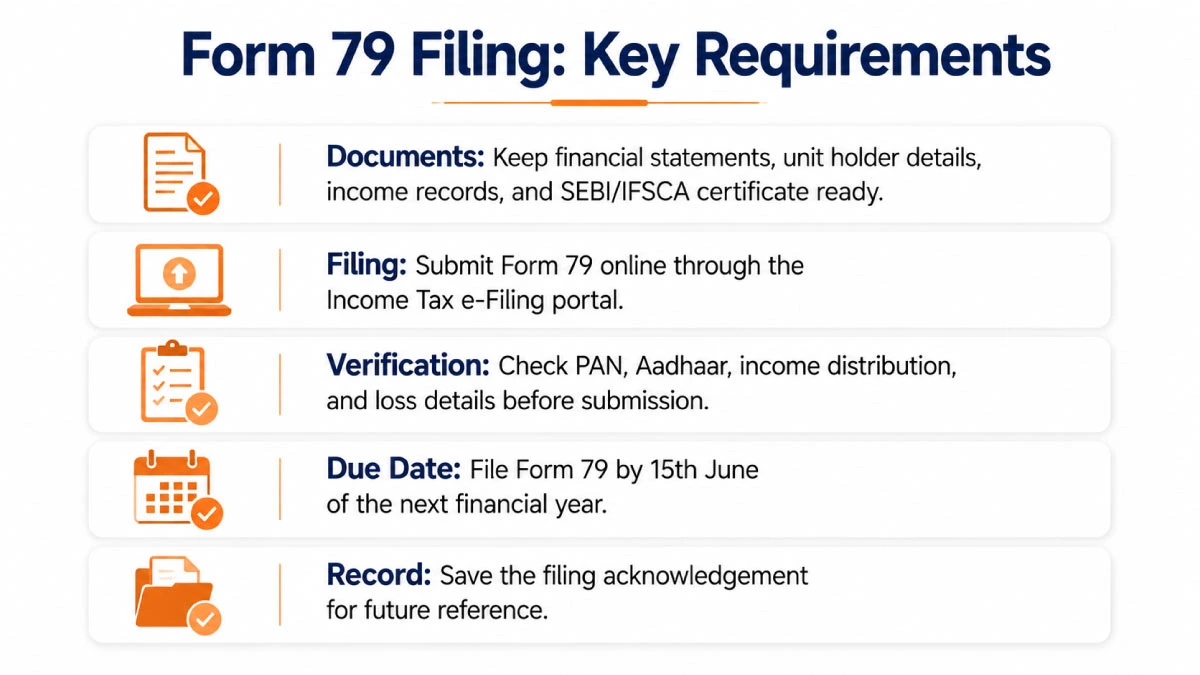
- Books of account and audited financial statements of the investment fund
- Details of income earned from various sources during the tax year
- Complete list of unit holders with PAN, address, and other prescribed identification details
- Income distribution details for each unit holder with the date of payment or credit
- Details of brought forward losses and set-off computations
- SEBI or IFSCA registration certificate
Form 79 Online Filing Process
- Gather income distribution details, unit holder information, and supporting documents.
- Log in to the Income Tax e-Filing portal.
- Go to e-File, then Income Tax Forms, select File Income Tax Forms, and select Form 79 from the applicable list, wherever available. Enter all required details accurately.
- Verify the information before submission.
- Submit the form as per the prescribed process.
- Save the acknowledgement for future reference.
Time Limit for Filing Form 79 under the Income Tax Act
Ebizfiling Assistance for Form 79 Compliance
Our assistance includes:
- Reviewing Form 79 applicability for investment funds
- Checking unit holder and income distribution details
- Verifying documents and supporting records
- Assisting with Form 79 online filing process
- Helping ensure timely and accurate compliance
Conclusion
Frequently Asked Questions
1. Is Form 79 required if income is credited but not actually paid to unit holders?
Form 79 under the Income Tax Act must be furnished when income is either paid or credited to unit holders during the relevant tax year. Even if the amount has not been physically paid but has been credited to the investor’s account, the investment fund is required to report the transaction as per the provisions of Section 224 of the Income Tax Act, 2025.
2. Can Form 79 be revised after submission?
If an investment fund discovers an error after Form 79 filing, it should check whether the Income Tax e-Filing portal permits the submission of a revised statement under the applicable rules. To avoid reporting discrepancies, all details relating to unit holders, income distribution, and tax information should be carefully verified before filing.
3. Does filing Form 79 result in the generation of any certificate for unit holders?
Yes. Once Form 79 is processed, individual Form 78 statements are generated for each unit holder from the details submitted in Form 79. These statements help unit holders report their income correctly and are required to be furnished by 30th June of the financial year following the relevant tax year.
4. Is Form 79 applicable when no income is distributed during the tax year?
The requirement to file Form 79 under the Income Tax Act generally arises when an investment fund has paid or credited income to its unit holders during the relevant tax year. If no income has been distributed or credited, the filing requirement should be determined based on the applicable provisions of the Income Tax Act, 2025 and the relevant rules.
5. Can incorrect PAN or Aadhaar details affect Form 79 filing?
Yes. Providing incorrect PAN, Aadhaar, or other identification details of unit holders may lead to reporting mismatches, delays in processing, or compliance issues. Investment funds should ensure that all investor information is accurate and updated before completing Form 79 filing to avoid unnecessary complications.
6. Are Alternative Investment Funds (AIFs) required to file Form 79?
Eligible Category I and Category II Alternative Investment Funds and other qualifying investment funds covered under Section 224 may be required to furnish Form 79 when they pay or credit income to unit holders.
7. Can one Form 79 include details of multiple unit holders?
Yes. A single Form 79 under the Income Tax Act is designed to capture the prescribed details of all eligible unit holders who have received or been credited income during the relevant tax year. This allows the investment fund to report all applicable transactions through one consolidated statement.
8. What are the common mistakes to avoid during Form 79 filing?
Some common mistakes include entering incorrect PAN or Aadhaar details, reporting inaccurate income amounts, selecting the wrong assessment details, or omitting information relating to unit holders. Before completing Form 79 online filing, investment funds should reconcile their financial records and verify all information to ensure accurate reporting.
9. How can investment funds ensure accurate Form 79 filing?
Investment funds should maintain updated books of account, reconcile income distribution records, and verify unit holder details before filing the statement. Reviewing all supporting documents in advance helps minimize errors and ensures timely compliance. Ebizfiling assists investment funds with accurate Form 79 filing, helping them meet statutory reporting requirements efficiently.
10. Why should investment funds seek professional assistance for Form 79 compliance?
Professional guidance can help investment funds understand the reporting requirements, avoid filing errors, and comply with the provisions of Form 79 under the Income Tax Act. Experts can also assist with document verification, data reconciliation, and timely submission of the statement. Ebizfiling offers end-to-end support for Form 79 compliance, making the filing process simpler and more efficient.





Expert Income Tax Return Filing
Simplify your Income Tax Return filing with professional guidance for accurate and timely compliance.
About Ebizfiling -



October 21, 2026 By Srishti M
Tax Planning for NRI Returning to India Before Becoming ROR Introduction Tax planning for NRI returning to India should start before the person becomes Resident and Ordinarily Resident, also known as ROR. Under the Income-tax Act, 2025, residential status decides […]
October 19, 2026 By Srishti M
October 21, 2026 By Srishti M
TDS and TCS Compliance Calendar November 2026: Compliance Guide Introduction The TDS and TCS Compliance Calendar November 2026 covers important tax deduction, collection, payment, certificate and reporting requirements applicable during the month. It helps businesses, government offices and other responsible […]