


-
June 25, 2026
-
BySteffy A
Form 41 for Non-Residents: Complete Filing Guide for 2026
In Brief
Form 41 for Non-Residents has become an important compliance requirement for foreign individuals and companies seeking DTAA benefits on income earned from India. If you have been claiming treaty benefits through Form 10F, there is a significant change you should be aware of. With the Income-tax Act, 2025 coming into effect from 1 April 2026, Form 10F has been replaced by Form 41, which now serves as the prescribed declaration for non-residents claiming relief under India’s Double Taxation Avoidance Agreements (DTAAs). While the objective remains largely unchanged, taxpayers must adapt to the new compliance framework to continue availing reduced or nil TDS rates. Let’s take a closer look at Form 41 and its filing requirements.
What is Form 41 for Non-Residents?
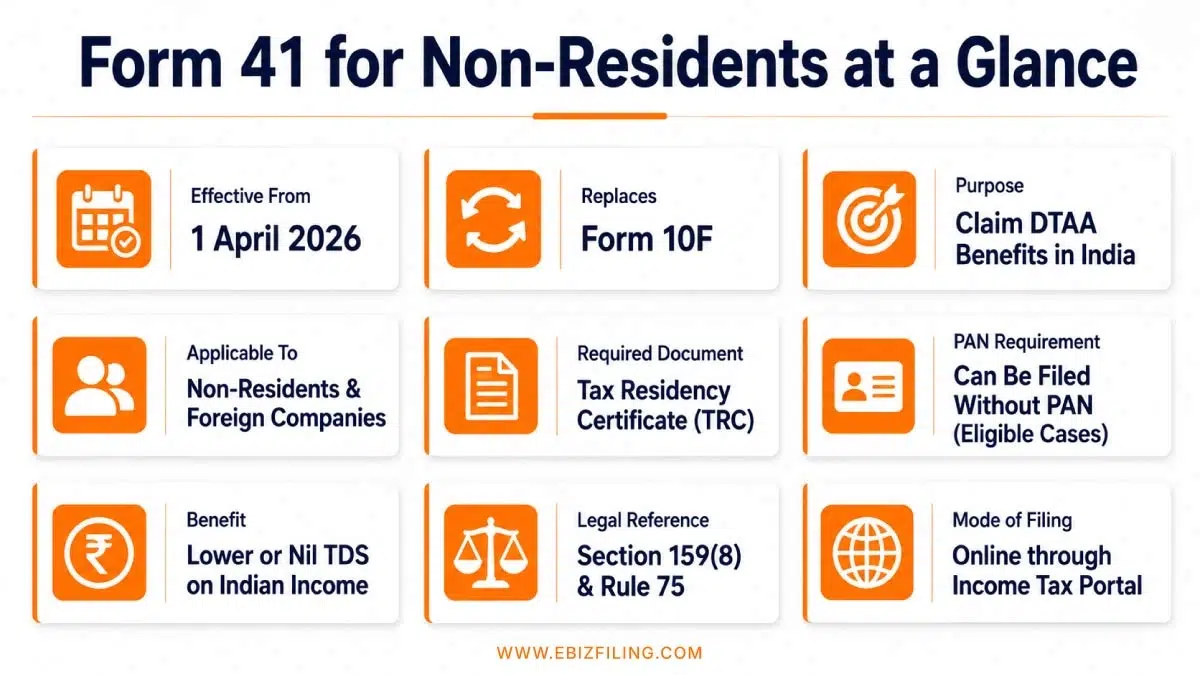
Form 41 for Non-Residents is a declaration prescribed under the Income-tax Act, 2025 for non-resident individuals and foreign companies seeking to claim benefits under a Double Taxation Avoidance Agreement (DTAA). Effective from 1 April 2026, Form 41 replaces Form 10F and serves as an important document for taxpayers looking to avail reduced or nil tax deduction at source (TDS) on income earned from India.
Taxpayers can access the official Form 41 PDF and related guidance issued by the Income Tax Department for reference and compliance purposes.
Purpose of Form 41 for Non-Residents
The primary purpose of Form 41 is to provide information that helps establish a non-resident taxpayer’s eligibility for treaty benefits under an applicable DTAA. It is generally used when a taxpayer receives income from India in the form of:
- Interest income
- Dividends
- Royalties
- Fees for technical services
- Capital gains
- Other taxable income from Indian sources
By furnishing Form 41 along with a valid Tax Residency Certificate (TRC), eligible taxpayers can claim concessional tax rates available under the relevant tax treaty and avoid excessive tax withholding.
Legal Basis Under the Income-tax Act, 2025
Form 41 has been introduced under Section 159(8) of the Income-tax Act, 2025, read with Rule 75 of the Income-tax Rules, 2026. It forms part of India’s updated tax compliance framework for non-residents and officially replaces the earlier Form 10F that was used under the Income-tax Act, 1961.
The introduction of Form 41 for Non-Residents does not change the underlying DTAA benefits available to taxpayers. Instead, it updates the compliance mechanism through which non-residents provide treaty-related information to Indian tax authorities.
Provisions Governing Form 41
The requirement to furnish Form 41 for Non-Residents is derived from Section 159(8) of the Income-tax Act, 2025 and Rule 75 of the Income Tax Rules, 2026.
|
Provision |
What It Means |
|
Section 159(8)(a) |
A non-resident taxpayer can claim DTAA benefits only if they obtain a valid Tax Residency Certificate (TRC) from the tax authorities of their country or specified territory of residence. |
|
Section 159(8)(b) |
In addition to the TRC, the taxpayer must furnish other prescribed documents and information as required under the Income Tax Rules. |
|
Rule 75, Income Tax Rules, 2026 |
Rule 75 prescribes Form 41 as the form through which non-residents provide the required information and supporting details for claiming treaty benefits. |
In simple terms, a Tax Residency Certificate (TRC) alone is not sufficient to claim treaty relief. Non-residents must also furnish the prescribed declaration and information through Form 41 to avail DTAA benefits and lower withholding tax rates in India.
Why Form 41 Matters for DTAA Claims
Claiming DTAA benefits India offers can significantly reduce the tax burden on non-resident taxpayers. However, these benefits are not granted automatically. Taxpayers must provide the necessary declarations and supporting documents to demonstrate their eligibility under the applicable tax treaty.
Form 41 for Non-Residents plays a key role in this process. Without a properly filed Form 41 and supporting TRC, Indian payers may deduct tax at the higher rates prescribed under domestic tax laws instead of the reduced treaty rates. For this reason, Form 41 has become an important compliance requirement for foreign company tax compliance in India and for any non-resident seeking lower or nil TDS on income received from India.
Form 10F vs Form 41: What’s Different?
|
Particulars |
Form 10F |
Form 41 |
|
Applicable Law |
Income-tax Act, 1961 | Income-tax Act, 2025 |
| Effective Period | Up to 31 March 2026 |
From 1 April 2026 onwards |
|
Purpose |
Claim DTAA benefits | Claim DTAA benefits |
| Relevant Provision | Sections 90(5) and 90A(5) |
Section 159(8) |
|
Supporting Document |
Tax Residency Certificate (TRC) | Tax Residency Certificate (TRC) |
| Eligible Taxpayers | Non-residents and foreign entities |
Non-residents and foreign entities |
|
Filing Requirement |
Mandatory for DTAA claims |
Mandatory for DTAA claims |
If you’re looking for a detailed explanation of the filing process, required documents, and practical filing considerations, you may also refer to our comprehensive guide to file Form 10F . While Form 41 has replaced Form 10F under the Income-tax Act, 2025, many of the underlying DTAA documentation requirements remain similar.
Need Guidance on DTAA Compliance?
Navigating the transition from Form 10F to Form 41 can be complex for non-resident taxpayers and foreign companies receiving income from India.
How Ebizfiling Can Help
- Form 10F filing assistance
- DTAA compliance support
- Tax Residency Certificate (TRC) guidance
- Non-resident tax compliance advisory
- Foreign company tax documentation support
Explore Ebizfiling’s Tax Consultancy Services and get expert guidance on DTAA compliance, non-resident taxation, and international tax matters.
Conclusion
The transition from Form 10F to Form 41 for Non-Residents under the Income-tax Act, 2025 reflects India’s updated approach to DTAA compliance. While the form has changed, the objective remains the same: helping eligible non-residents claim treaty benefits and avoid higher tax deductions on income earned from India. Understanding the new requirements and maintaining the necessary documentation can help ensure smoother compliance and timely access to DTAA benefits.
Frequently Asked Questions
1. Is Form 41 mandatory when claiming DTAA benefits in India?
Yes. Under the Income-tax Act, 2025, eligible non-residents claiming DTAA benefits are required to furnish Form 41 along with the prescribed information and supporting documents. Failure to do so may result in tax being deducted at the applicable domestic rates instead of the treaty rates.
2. Why has Form 10F been replaced by Form 41 for Non-Residents?
Form 10F Filing has been replaced by Form 41 as part of the transition to the Income-tax Act, 2025. While the purpose of claiming treaty benefits remains unchanged, Form 41 is now the prescribed declaration for non-residents seeking relief under a Double Taxation Avoidance Agreement (DTAA).
3. Can DTAA benefits be claimed with only a Tax Residency Certificate (TRC)?
No. A Tax Residency Certificate (TRC) establishes the taxpayer’s country of residence, but Section 159(8) also requires non-residents to furnish the prescribed information and documents through Form 41 to support their DTAA claim.
4. Which income types are covered under Form 41 for Non-Residents?
Form 41 for Non-Residents is commonly used when claiming DTAA benefits on income such as interest, dividends, royalties, fees for technical services, capital gains, and other taxable income earned from India.
5. When should Form 41 be submitted to claim lower or nil TDS?
To ensure that treaty rates are applied at the time of payment, Form 41 for Non-Residents should generally be furnished before the income is paid or credited. Delayed submission may lead to higher TDS deductions under domestic tax provisions.
6. Can a Foreign Company Claim DTAA Benefits Without Form 41?
No. Under the Income-tax Act, 2025, eligible foreign companies must furnish Form 41 along with a valid Tax Residency Certificate (TRC) to claim DTAA benefits in India. Without these documents, tax may be deducted at the applicable domestic rates, and treaty relief may need to be claimed later through tax filing procedures.
7. What happens if Form 41 is not furnished before receiving income from India?
If Form 41 and supporting documents are not provided in time, the payer may deduct tax at the higher domestic rates. Treaty benefits may then need to be claimed through subsequent tax procedures, which can increase compliance efforts.
8. Is Form 41 for Non-Residents required every year for DTAA claims?
Since tax residency and treaty eligibility are generally determined on a tax-year basis, non-residents claiming DTAA benefits should review and furnish Form 41 for Non-Residents for each relevant year in which treaty relief is sought.
9. How can Ebizfiling assist with DTAA compliance for non-residents?
Ebizfiling provides professional assistance with DTAA compliance, Tax Residency Certificate (TRC) requirements, international tax advisory, withholding tax matters, and documentation support for non-resident taxpayers earning income from India.
10. What tax consultancy services does Ebizfiling offer for foreign companies?
Ebizfiling assists foreign companies with international taxation, DTAA advisory, withholding tax compliance, cross-border tax matters, and other regulatory requirements related to earning income or conducting business activities in India.





Simplify Your Non-Resident Tax Filing
Complete your non-resident U.S. tax return efficiently with professional assistance and personalized support throughout the filing process.
About Ebizfiling -



October 12, 2026 By Srishti M
October 12, 2026 By Srishti M
Company Compliance Calendar November 2026: Key Due Dates & Filings Introduction The Company Compliance Calendar November 2026 highlights important annual return, dematerialisation and income tax compliances that companies may need to complete during the month. November 2026 is particularly […]
October 10, 2026 By Srishti M