


-
September 16, 2026
-
BySteffy A
Business Registration in India: How to Start a Business Legally
Introduction
Understanding business registration in India begins with choosing the right business structure and identifying the registrations that apply to the proposed activity.
Entrepreneurs may need to complete entity registration, obtain tax registrations and secure specific licences before starting operations. This guide explains the key steps, documents and compliance requirements involved in registering and setting up a business in India.
What Is Business Registration in India?
Business registration in India involves choosing an appropriate legal structure and completing the registration or incorporation requirements applicable to that structure.
There is no single registration process that applies to every type of business. A sole proprietorship, partnership firm, Limited Liability Partnership (LLP), One Person Company (OPC) and company follow different legal and procedural requirements.
The appropriate structure should generally be selected after considering ownership, liability, taxation, compliance requirements and future funding needs.
Which Business Structure Can You Choose in India?
Choosing the correct legal structure is an important part of business registration in India because it affects liability, ownership, taxation, compliance and fundraising.
|
Business Structure |
Generally Suitable For |
|
Sole Proprietorship |
Individuals running a small business independently |
| Partnership Firm |
Two or more persons carrying on business together |
|
Limited Liability Partnership |
Businesses seeking limited liability with a partnership structure |
| One Person Company |
A single eligible promoter seeking a corporate structure |
|
Private Limited Company |
Businesses seeking limited liability, investment and scalability |
| Public Limited Company |
Larger businesses with wider capital-raising requirements |
A sole proprietorship does not have a separate central incorporation process like a company or LLP. Companies and LLPs, on the other hand, are incorporated through the Ministry of Corporate Affairs under their respective legal frameworks.
Therefore, entrepreneurs should select the structure according to their business requirements rather than assuming that one form is suitable for every business.
What Is the Business Registration Process in India?
The business registration process in India differs according to the selected legal structure. However, the general process may include:
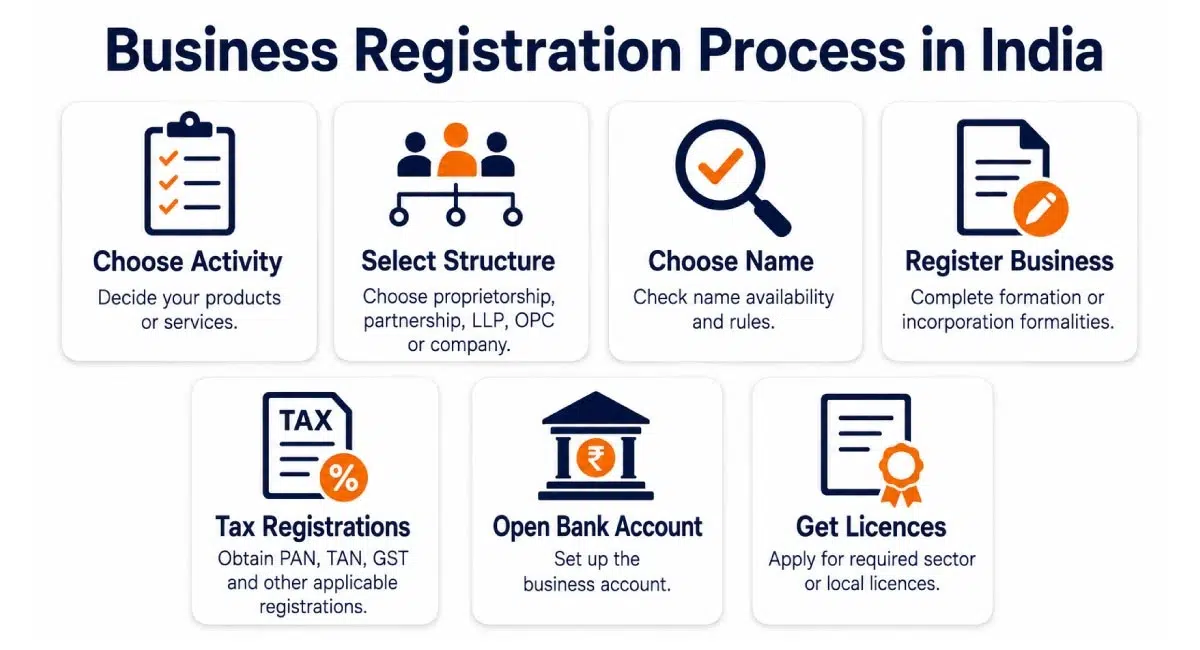
Decide the business activity: Identify the products or services the business will provide.
Choose the legal structure: Select a proprietorship, partnership, LLP, OPC or company based on business requirements.
Choose the business name: Check the applicable naming and registration requirements.
Complete formation or registration formalities: Complete the incorporation, registration or other formalities applicable to the selected structure.
Complete tax registrations: For companies, PAN and TAN are allotted through the incorporation process. GST registration may be obtained through the integrated process or separately where applicable.
Open the business bank account: Complete the banking requirements applicable to the selected entity.
Obtain applicable licences: Apply for state, local or sector-specific registrations according to the business activity.
For companies, the Ministry of Corporate Affairs uses the SPICe+ incorporation system. PAN and TAN form part of the incorporation process.
For companies incorporated through SPICe+, the linked AGILE-PRO-S form covers GSTIN, EPFO, ESIC, Professional Tax in specified states, bank account opening and applicable Shops and Establishments registration.
EPFO registration and, where applicable, ESIC registration are generally obtained through the integrated incorporation process for new companies. ESIC registration does not apply where the company is incorporated in an ESIC non-implemented area. Ongoing EPFO and ESIC compliance depends on the applicable statutory requirements and thresholds.
What Documents Are Required for Business Registration in India?
The documents required to start a business depend on the selected entity. Preparing the required documents before beginning business registration in India can help reduce filing errors and delays.
Common documents may include:
- PAN of Indian promoters or partners
- Passport for foreign nationals
- Identity and residential address proof
- Registered office or principal business address proof
- Recent utility bill
- Rent agreement and owner’s NOC, where applicable
- Digital Signature Certificate for applicable electronic filings
- Memorandum and Articles of Association for companies
- LLP Agreement or Partnership Deed, as applicable
- Documents required for specific registrations or licences
The exact document requirements vary depending on the selected legal structure, ownership and nature of the application. Entrepreneurs should confirm the applicable document list before filing.
Which Registrations and Licences May Be Required?
Completing business registration in India may also require checking additional registrations or licences that apply after or alongside entity registration.
Depending on the nature, size and location of the business, these may include:
- GST Registration
- Udyam Registration for eligible MSMEs
- Import Export Code for applicable import-export activities
- FSSAI registration or licence for food businesses
- Shops and Establishments registration under applicable state law
- Professional Tax registration in applicable states
- EPFO and ESIC registration or compliance, as applicable
- Sector-specific approvals
GST registration is not compulsory merely because a new business has been formed. Its applicability depends on turnover, nature of supplies and other statutory triggers.
Similarly, IEC, FSSAI and local licences apply only where the relevant business activity requires them. Therefore, business registration in India should include a review of activity-specific and location-specific requirements.
Can a Foreign National Complete Business Registration in India?
Yes. Foreign promoters may establish or invest in eligible Indian business entities subject to FEMA, the Foreign Exchange Management (Non-Debt Instruments) Rules, FDI Policy and sector-specific conditions.
Foreign investment may be permitted under the automatic route in eligible sectors or activities, subject to applicable sectoral caps and conditions. Some sectors may require government approval or may be subject to additional restrictions.
For foreign entrepreneurs considering business registration in India, an Indian Subsidiary may be one available structure.
The final structure should be selected after considering ownership, FEMA requirements, sectoral restrictions and taxation.
Is Startup India Registration Mandatory?
No. DPIIT Startup Recognition is optional and separate from normal business registration in India.
Entrepreneurs should not treat Startup India recognition as a compulsory requirement for starting business operations. An eligible entity must separately satisfy the prescribed conditions and apply for recognition.
Under DPIIT Notification G.S.R. 108(E), dated 4 February 2026, a regular startup must generally:
- Be incorporated or registered as an eligible Private Limited Company, registered partnership firm, LLP, Cooperative Society or Multi-State Cooperative Society.
- Be within 10 years from incorporation or registration.
- Have turnover not exceeding ₹200 crore in any financial year since incorporation or registration.
- Work towards innovation, development or improvement of products, processes or services, or have a scalable business model with high potential for employment generation or wealth creation.
- Not be formed by splitting up or reconstructing an existing business.
The notification also provides separate criteria for recognised Deep Tech Startups, including up to 20 years of recognition and a ₹300 crore turnover ceiling.
Individual tax benefits or incentives may have separate eligibility conditions.
Therefore, DPIIT recognition should be considered separately after completing the applicable business registration in India.
What Compliance Applies After Business Registration?
Registration or incorporation is not necessarily the final compliance step.
After completing business registration in India, the entity may need to comply with requirements relating to:
- Income tax filing
- GST returns, where registered
- Accounting and maintenance of records
- MCA annual filings for companies and LLPs
- Statutory registers and records
- EPFO and ESIC compliance, where applicable
- Renewal of applicable licences
- Event-based corporate filings
- Other sector-specific requirements
For a company having share capital, applicable commencement-of-business requirements should also be reviewed, including Form INC-20A where Section 10A of the Companies Act, 2013 applies.
The exact post-registration requirements depend on the legal structure, business activity, employee strength and other applicable conditions.
Professional Assistance for Business Registration in India
Professional assistance with business registration in India can be useful because registration and compliance requirements vary according to the entity, business activity and ownership structure.
Ebizfiling can assist with:
- Comparing suitable business structures
- Preparing incorporation and registration documents
- Assisting with company, LLP, OPC, partnership or proprietorship registration
- Supporting applicable GST, IEC and other registrations
- Assisting eligible entities with DPIIT Startup Recognition
- Supporting foreign promoters with Indian business setup requirements
- Providing post-registration compliance support
Planning to register a business in India? Ebizfiling can assist with selecting a suitable structure, preparing incorporation documents, completing registration filings and supporting post-registration requirements through its Starting a Business in India service.
Conclusion
Business registration in India involves selecting the appropriate legal structure and completing the registrations and licences applicable to the business. The selected structure should match the ownership, liability, funding and compliance requirements of the promoters.
Companies and LLPs follow the MCA incorporation framework, while proprietorships and partnership firms have different registration requirements. Businesses should also separately check the applicability of GST, Udyam, IEC, FSSAI and other activity-specific licences.
Completing the registration process correctly and identifying applicable post-registration compliance can help the business operate within the legal framework and support future growth.
Frequently Asked Questions
1. Is business registration in India mandatory for every business?
The requirement depends on the chosen legal structure and business activity. Companies and LLPs require incorporation under their respective legal frameworks, while a sole proprietorship does not have a separate central incorporation process. Tax, state or sector-specific registrations may still apply.
2. Does the business registration process in India differ for an LLP and a Private Limited Company?
Yes. The business registration process in India differs because LLPs and companies are governed by separate legal frameworks and use different incorporation documents and filings. Their compliance, ownership and management requirements also differ after registration.
3. Can one person register a business in India?
Yes. A person may operate as a sole proprietor or consider a One Person Company if the applicable eligibility requirements are satisfied. A sole proprietorship does not provide a separate corporate legal identity.
4. Are the documents required for business registration in India the same for every entity?
No. The documents required for business registration in India vary according to the selected structure. Companies may require incorporation documents such as the MOA and AOA, while LLPs and partnership firms require documents specific to their respective structures.
5. Can business registration in India be completed using a residential address?
A residential address may generally be used as the registered office or principal place of business where permitted, provided the required address proof, utility bill and owner consent or NOC are available. Additional requirements may depend on the entity, state and business activity.
6. Does business registration in India include local licences?
The entity registration process and local licences are separate requirements. Depending on the activity and location, a business may need Shops and Establishments registration, Professional Tax, FSSAI, trade licences or other sector-specific approvals.
7. Is Startup India registration automatically granted after company incorporation?
No. Startup India registration or DPIIT Startup Recognition is a separate process. Incorporating a company, LLP or another eligible entity does not automatically provide DPIIT recognition.
8. Can an existing business change its structure after registration?
Yes, restructuring may be possible depending on the existing and proposed business structures. However, the process, tax impact, transfer of assets, licences and compliance requirements should be reviewed before making the change.
9. How can Ebizfiling help a foreign promoter with business registration in India?
Ebizfiling can assist foreign promoters with evaluating suitable entity structures, preparing incorporation documents and supporting the applicable business registration in India process. Assistance may also cover related registrations and FEMA-linked setup requirements.
10. Can Ebizfiling assist with DPIIT Startup Recognition after business registration?
Yes. Ebizfiling can assist eligible entities with reviewing the requirements for DPIIT Startup Recognition, preparing the application and supporting the filing process. Recognition is granted by the competent authority only if the prescribed conditions are satisfied.





Indian Subsiddiary
Start a business in India with Ease.
About Ebizfiling -



Reviews
Amrish Ganatra
28 Nov 2017"Our Company being an Indian Subsidiary requires much compliance, but ebizfiling has provided us end to end services. They are very important part of our business. They handle all of the legal tasks in India. I highly recommend ebizfiling for non-residents thinking of starting a project in India."
August 18, 2026 By Steffy A
Independent Director in India: Eligibility and Registration Process Overview Becoming an independent director in India is increasingly recognized as a professional opportunity in corporate governance. Experienced professionals can use their knowledge to contribute to Board-level discussions, business strategy, risk management, […]
June 25, 2026 By Steffy A
The Independent Director Data Bank : Zero to Board Member Introduction Dreaming of sitting on a company’s board? The Independent Director Data Bank is your easiest first step to becoming a board member in India. If you’re wondering how to […]
January 2, 2026 By Dhruvi D
Why TRPs should collaborate with ROC & legal experts? It Often Starts With a Filing That Doesn’t Feel Right Most Tax Return Preparers and GST Practitioners begin their day with numbers. Returns, reconciliations, GST filings, income details. That is the […]