

-
September 7, 2026
-
BySteffy A
Section 123 of the Income tax Act, 2025: ₹1.5 Lakh Deduction Limit
Introduction
Section 123 of the Income Tax Act, 2025 allows individuals and Hindu Undivided Families to claim a deduction for specified investments and payments. It broadly continues the tax-saving framework earlier covered by Section 80C and certain connected provisions of the Income tax Act, 1961. The maximum deduction available under Section 123 is ₹1,50,000 in a tax year. The Income tax Act, 2025, came into force on April 1, 2026. Therefore, Section 123 applies from Tax Year 2026-27 onwards.
This article explains the new provision, the role of Schedule XV, its treatment under the new tax regime and the transition from Section 80C.
What Is Section 123 of the Income Tax Act?
Section 123 of the Income Tax Act allows an individual or HUF to deduct eligible amounts paid or deposited during the relevant tax year. The qualifying payments and their conditions are listed in Schedule XV.
The deduction is restricted to the lower of:
- The actual eligible amount paid or deposited during the tax year; or
- ₹1,50,000.
The ₹1,50,000 limit applies collectively to all eligible investments and payments. It is not a separate limit for every investment.
For example, suppose a taxpayer contributes ₹70,000 to PPF, pays ₹40,000 as a life insurance premium and repays ₹60,000 as eligible home loan principal. The total payment is ₹1,70,000, but the Section 123 deduction will be restricted to ₹1,50,000.
Who Can Claim the Section 123 Deduction?
The Section 123 of the Income Tax Act deduction is available to:
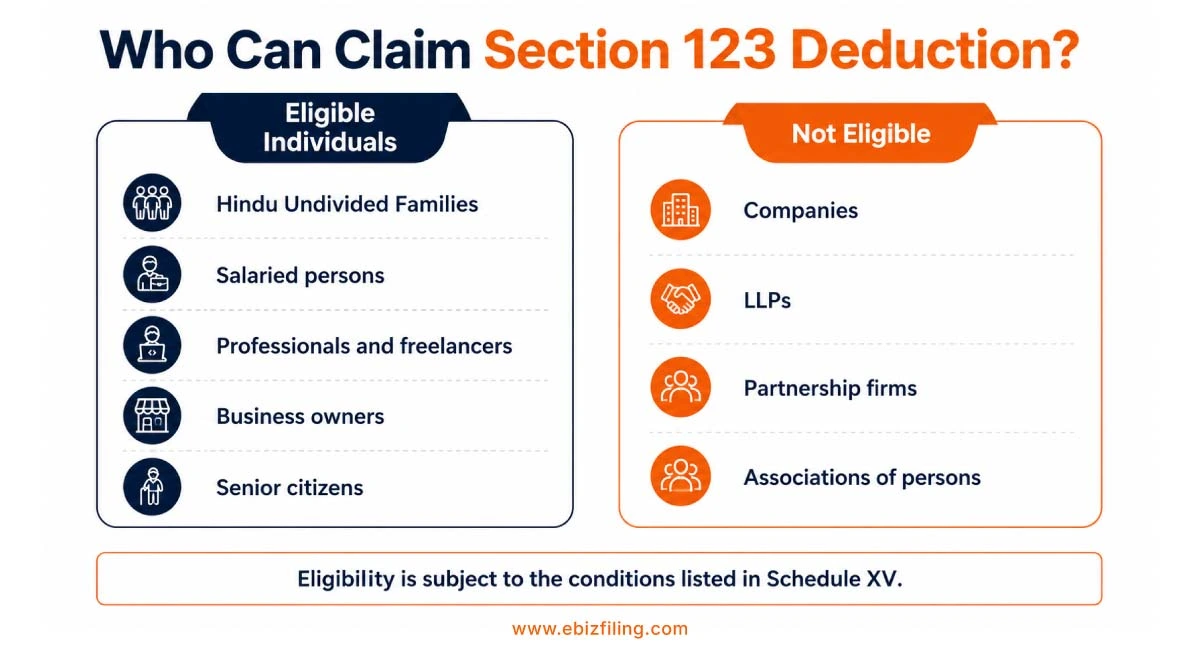
- Individuals
- Hindu Undivided Families
It may be claimed by salaried individuals, professionals, freelancers, business owners and senior citizens, subject to the conditions prescribed in Schedule XV.
Section 123 is available only to individuals and Hindu Undivided Families. Therefore, companies, LLPs, partnership firms, associations of persons and other taxpayers assessed under a different status cannot claim this deduction.
What Is Schedule XV?
Section 123 of the Income Tax Act provides the overall deduction rule. Schedule XV contains the list of qualifying payments and the conditions attached to them.
Schedule XV covers specified payments relating to:
- Life insurance premiums and deferred annuity
- Provident fund and approved superannuation fund contributions
- Notified pension schemes
- National Savings Certificates
- Specified ULIPs and mutual fund schemes
- Tax-saving bank and post office deposits
- Sukanya Samriddhi deposits
- Senior Citizens’ Savings Scheme deposits
- Housing loan principal repayment
- Stamp duty and registration charges
- Tuition fees for children
- Other notified investments
A payment does not qualify merely because it is commonly described as a tax-saving investment. It must be included in Schedule XV and satisfy the applicable conditions.
For a detailed explanation of PPF, ELSS, life insurance premiums, tax-saving fixed deposits, tuition fees and home loan principal, read our guide on Section 80C of the Income Tax Act.
Section 80C vs Section 123 of the Income Tax Act
Section 123 of the Income Tax Act, 2025 broadly carries forward the earlier deduction framework. However, the Income tax Act, 2025 reorganises the provision by placing the list of qualifying payments and detailed conditions in Schedule XV.
|
Basis |
Section 80C |
Section 123 |
|
Governing law |
Income tax Act, 1961 | Income tax Act, 2025 |
| Applicable period | Up to Financial Year 2025-26 |
Tax Year 2026-27 onwards |
|
Maximum aggregate deduction |
₹1,50,000 | ₹1,50,000 |
| Eligible taxpayers | Individuals and Hindu Undivided Families |
Individuals and Hindu Undivided Families |
|
Eligible payments |
Section 80C and connected provisions | Section 123 read with Schedule XV |
| Relevant terminology | Previous year and assessment year |
Tax year |
The main change is the structure and legal reference under the new Act. Schedule XV also incorporates certain annuity and individual pension contributions that were previously covered under Section 80C and connected provisions, subject to the specific category, limit and conditions prescribed under the Income tax Act, 2025.
Therefore, Section 123 should not be described only as a renumbered version of Section 80C. It forms part of a reorganised deduction framework under the Income tax Act, 2025.
Is Section 123 Available Under the New Tax Regime?
Section 123 of the Income tax Act, 2025 is not available when income is calculated under the default new tax regime provided under Section 202.
Section 202 requires total income to be calculated without most deductions available under Chapter VIII. Section 123 is not included in the specified deductions that remain available under the default regime.
A taxpayer who wants to claim the Section 123 deduction must opt out of the default tax regime under Section 202(4), within the applicable time and in the prescribed manner.
Taxpayers having income from business or profession should also consider the specific conditions relating to opting out of and re-entering the default regime.
Taxpayers should compare both regimes before making a decision. The default regime may offer lower tax rates, while the normal tax regime may be more suitable for taxpayers with substantial eligible investments, payments, and deductions.
Read our detailed guide on Section 202 of the Income tax Act to understand the applicable tax rates, available deductions and procedure for opting out of the default regime.
Important Conditions Under Section 123 of the Income Tax Act
Every payment remains subject to its own conditions. Before claiming the deduction, taxpayers should check:
- Whether the payment is listed in Schedule XV
- Whether it was made during the relevant tax year
- Whether the policyholder, account holder, or beneficiary is eligible
- Whether a lock-in period applies
- Whether the payment is subject to a percentage limit
- Whether the correct tax regime has been selected
- Whether the same amount has already been claimed elsewhere
Premature termination, withdrawal, or transfer may result in the reversal of a deduction claimed in an earlier tax year.
For example, Schedule XV contains reversal conditions for certain life insurance policies, ULIPs, residential house property payments and specified shares or debentures.
How to Claim the Section 123 Deduction
A taxpayer should follow these steps:
- Identify payments covered by Schedule XV.
- Check the conditions applicable to each payment.
- Calculate the total eligible amount paid during the tax year.
- Restrict the deduction to ₹1,50,000.
- Exercise the applicable option under Section 202(4) to opt out of the default tax regime, where required.
- Report the amount in the relevant return schedule.
- Retain supporting documents for verification.
Ebizfiling can assist individuals and HUFs with reviewing eligible deductions, comparing tax regimes and correctly reporting the deduction through its Income Tax Return Filing Service.
Conclusion
Section 123 of the Income Tax Act, 2025 allows individuals and HUFs to claim a deduction of up to ₹1,50,000 for eligible payments listed in Schedule XV. The provision broadly continues the earlier Section 80C framework but reorganises the detailed list and conditions under a separate schedule. It applies from Tax Year 2026-27 and is not available under the default new tax regime under Section 202. Taxpayers should check the conditions attached to each payment, select the appropriate tax regime and maintain proper supporting documents before claiming the Section 123 deduction.
Suggested Reads:
RERA and Income Tax Factors Every Home Buyer Should Know
Frequently Asked Questions
1. Can the Section 123 deduction be claimed without referring to Schedule XV?
No. Section 123 of the Income Tax Act only provides the overall deduction and ₹1,50,000 ceiling. The taxpayer must refer to Schedule XV to determine whether a payment is eligible and whether its specific conditions have been satisfied.
2. Will every investment eligible under Section 80C automatically qualify under Section 123?
Not automatically. A payment can be claimed under Section 123 of the Income Tax Act only when it is included in Schedule XV and satisfies the applicable conditions. Taxpayers should not rely only on its earlier treatment under Section 80C.
3. How is the Section 123 deduction limit applied when a taxpayer has multiple eligible investments?
All qualifying payments under Schedule XV must first be added together. The final Section 123 deduction is then restricted to ₹1,50,000, even when each investment independently satisfies its eligibility conditions.
4. Can an HUF claim every payment listed in Schedule XV of Income Tax Act 2025?
No. Although Section 123 of the Income Tax Act is available to both individuals and HUFs, the eligibility of each payment depends on the wording and conditions in Schedule XV. Certain payments may have conditions relating to the taxpayer, beneficiary, policyholder, or account holder.
5. Can the Section 123 deduction exceed the taxpayer’s gross total income?
No. Apart from the ₹1,50,000 Section 123 deduction limit, the aggregate deductions under Chapter VIII cannot exceed the taxpayer’s gross total income. Therefore, a taxpayer with a lower gross total income cannot use the deduction to create a negative total income.
6. Can a taxpayer claim Section 123 under the default regime provided by Section 202?
No. The Section 123 deduction is not available while total income is computed under the default new tax regime under Section 202. The taxpayer must exercise the prescribed option for the normal tax regime to claim eligible payments under Section 123 of the Income Tax Act.
7. What happens if a taxpayer violates a lock-in condition after claiming Section 123?
Where Schedule XV prescribes a minimum holding or contribution period, premature withdrawal, termination or transfer may result in the earlier deduction being reversed. The amount may become taxable in the year in which the applicable condition is violated.
8. Which provision applies to an investment made before April 1, 2026 but reported later?
The Income tax Act, 2025, came into force on April 1, 2026. Payments relating to periods governed by the Income tax Act, 1961 continue to be examined under Section 80C and the connected provisions, while eligible payments made during Tax Year 2026-27 onwards are examined under Section 123 and Schedule XV, subject to the transition provisions.
9. Can Ebizfiling check whether a payment satisfies Schedule XV conditions?
Yes. Ebizfiling can review the nature and date of the payment, the person for whom it was made, applicable lock-in requirements and supporting records. Our experts can help identify ineligible, excessive, or duplicate claims before filing the income tax return.
10. How can Ebizfiling help where the taxpayer is unsure about Section 123 vs Section 80C?
Ebizfiling can determine whether the payment is governed by Section 80C or Section 123, calculate the eligible deduction, compare the normal and new tax regimes and report the claim correctly in the applicable income tax return. This is particularly useful during the transition to the Income tax Act, 2025.




Expert Income Tax Return Filing
Maximize eligible tax deductions with expert Income Tax Return filing and accurate tax compliance support.
About Ebizfiling -



September 17, 2026 By Siddhi R
EPFO Wage Ceiling Increased to ₹25,000: Key Impact Explained Introduction The EPFO wage ceiling increased proposal has been approved by the Union Cabinet based on the recommendation of the Ministry of Labour & Employment to enhance the mandatory EPFO coverage […]
September 17, 2026 By Riyansh S
Defective Return Notice: Resolve Schedule BS & PL Errors Introduction Receiving a Defective Return Notice from the Income Tax Department means that the filed Income Tax Return (ITR) contains incomplete, inconsistent, or incorrect information that requires correction. Such notices are […]
September 17, 2026 By Srishti M
Property Sale Tax Planning in India 2026: LTCG & Key Rules Introduction Selling a property is not only about negotiating the right price. The date of transfer, holding period, stamp-duty value, residential status, reinvestment strategy and TDS can materially change […]