

-
September 21, 2026
-
BySteffy A
Section 80C of the Income Tax Act: Limit and Eligible Investments
Introduction
Section 80C of the Income Tax Act is a widely used tax-saving provision for individuals and HUFs. It allows deductions for eligible investments and expenses such as provident fund contributions, life insurance premiums, tuition fees, and home loan principal repayment. The maximum combined deduction under Sections 80C, 80CCC and 80CCD(1) is ₹1.5 lakh in a financial year. The Section 80C deduction is available only under the old tax regime. It cannot be claimed by taxpayers choosing the new tax regime.
This article covers the Section 80C deduction limit, eligible investments, qualifying expenses, and important conditions.
What Is Section 80C of the Income Tax Act?
Section 80C applies to income earned up to Financial Year 2025-26 under the Income-tax Act, 1961. From Tax Year 2026-27, the corresponding deduction is governed by Section 123 read with Schedule XV of the Income-tax Act, 2025. The ₹1.5 lakh limit and the basic eligibility framework continue under the new provision.
The Section 80C deduction is available only under the old tax regime. Taxpayers choosing the new tax regime cannot claim it. However, specified deductions such as Section 80CCD(2) and Section 80CCH may still be available, subject to applicable conditions.
Section 80C Deduction Limit
The 80C deduction limit is ₹1.5 lakh for a financial year. However, this is a combined limit for deductions claimed under Sections 80C, 80CCC and 80CCD(1).
|
Section |
Eligible contribution |
Deduction treatment |
|
Section 80C |
Specified investments, payments, and expenses | Included in the ₹1.5 lakh limit |
| Section 80CCC | Contribution to an eligible annuity or pension plan |
Included in the ₹1.5 lakh limit |
|
Section 80CCD(1) |
Individual contribution to an eligible NPS account | Included in the ₹1.5 lakh limit |
| Section 80CCD(1B) | Additional individual contribution to NPS |
Separate deduction of up to ₹50,000 |
|
Section 80CCD(2) |
Employer’s contribution to NPS |
Separate deduction subject to applicable limits |
Sections 80CCC and 80CCD are separate provisions. They are not subsections of Section 80C of the Income Tax Act. However, the aggregate deduction under Sections 80C, 80CCC and 80CCD(1) cannot exceed ₹1.5 lakh.
Investing more than ₹1.5 lakh in eligible schemes does not increase the Section 80C of the Income Tax Act deduction. Any amount exceeding the limit cannot be carried forward for claiming in a subsequent year.
Tax-Saving Investments Under Section 80C
The following are the major eligible investments under Section 80C of the Income Tax Act.
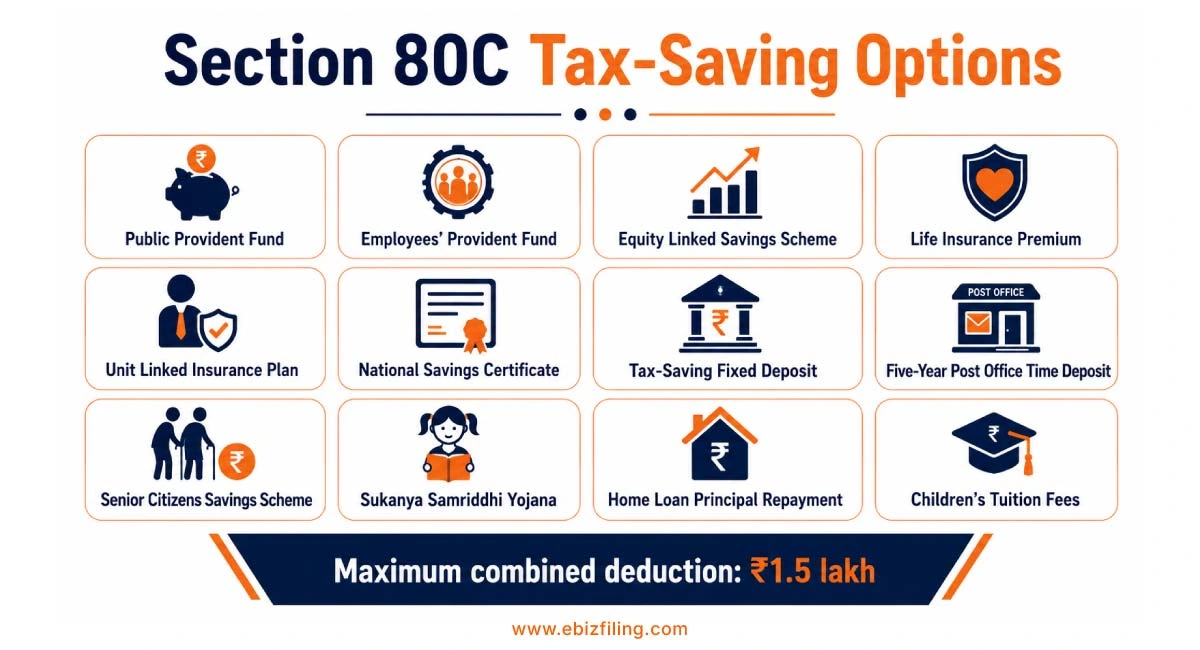
1. Public Provident Fund
A contribution made to a Public Provident Fund account qualifies for the Section 80C deduction.
An individual may generally claim a contribution made to a PPF account held in the name of:
- The individual
- The individual’s spouse
- Any child of the individual
PPF is a long-term government-backed savings scheme with a maturity period of 15 years. The amount deposited during the year is included within the overall 80C deduction limit.
2. Employee Provident Fund
The employee’s contribution to a recognised Employee Provident Fund qualifies for tax savings under Section 80C.
Any voluntary contribution made by an employee to an eligible provident fund may also qualify. However, the employer’s contribution to EPF cannot be claimed by the employee under Section 80C of the Income Tax Act.
3. Equity Linked Savings Scheme
Investment in an eligible Equity Linked Savings Scheme qualifies for deduction.
ELSS is a market-linked mutual fund investment with a lock-in period of three years. Each investment is subject to a separate lock-in period calculated from its respective investment date.
Returns from ELSS are not guaranteed and depend on market performance. Therefore, taxpayers should consider their investment goals and risk capacity instead of selecting ELSS only for obtaining a tax deduction.
4. Life Insurance Premium
A premium paid to maintain an eligible life insurance policy may qualify under Section 80C of the Income Tax Act.
An individual may claim a premium paid for a policy covering:
- The individual
- The individual’s spouse
- Any child of the individual
An HUF may claim an eligible premium paid for a policy covering one of its members.
The deductible premium may be restricted according to the issue date of the policy and its actual capital sum assured. Premature termination of the policy may also result in the reversal of deductions claimed in earlier years.
5. Unit Linked Insurance Plan
A contribution to an eligible Unit Linked Insurance Plan may qualify for the Section 80C deduction.
ULIPs combine life insurance with market-linked investments. They generally carry a minimum lock-in period of five years.
The tax treatment of maturity proceeds may depend on the issue date, annual premium, and terms of the policy. The deduction available at the investment stage should not be confused with the tax treatment applicable when the amount is received.
6. National Savings Certificate
An investment in an eligible National Savings Certificate qualifies under Section 80C of the Income Tax Act.
The amount invested is included within the ₹1.5 lakh limit. Interest accrued on the certificate is generally taxable.
Interest accrued during eligible years may be treated as reinvested and may qualify for a deduction, subject to the overall limit. Interest relating to the final year is generally not treated as reinvested because it becomes payable at maturity.
7. Tax-Saving Fixed Deposit
An investment in a notified tax-saving fixed deposit with a scheduled bank may qualify under Section 80C of the Income Tax Act.
The deposit must generally have a fixed tenure of at least five years. An ordinary bank fixed deposit or a deposit with a shorter tenure does not qualify for the deduction.
Interest earned on the tax-saving fixed deposit remains taxable in accordance with the applicable provisions.
8. Five-Year Post Office Time Deposit
An investment in a five-year Post Office Time Deposit is one of the eligible investments under Section 80C of the Income Tax Act.
Post office deposits with a shorter tenure do not qualify. The amount invested is eligible for deduction, but the interest earned is generally taxable.
9. Senior Citizens Savings Scheme
An eligible deposit under the Senior Citizens Savings Scheme qualifies for deduction within the overall limit of ₹1.5 lakh.
The scheme is primarily available to eligible senior citizens and certain retired individuals who satisfy the prescribed conditions.
Interest received under the scheme is taxable. Premature withdrawal may also have tax consequences depending on the applicable rules and period for which the deposit was maintained.
10. Sukanya Samriddhi Yojana
A contribution made to an eligible Sukanya Samriddhi account may be claimed under Section 80C of the Income Tax Act.
The account must be opened and operated for an eligible girl child in accordance with the scheme rules. The contribution is included within the combined Section 80C of the Income Tax Act deduction limit.
11. Home Loan Principal Repayment
The principal portion of an eligible housing loan repayment may qualify under Section 80C of the Income Tax Act.
Eligible amounts may include:
- Principal component of the home loan EMI
- Stamp duty paid on the purchase of a residential property
- Registration charges
- Certain other expenses incurred for transferring the property to the taxpayer
The housing loan should generally be obtained from a specified lender, such as a bank, government, LIC, National Housing Bank, eligible housing finance company, cooperative society or specified employer. Principal repayment of a loan obtained from friends, relatives or other non-specified persons may not qualify for the deduction.
Stamp duty and registration charges can generally be claimed only in the financial year in which they are actually paid.
If the taxpayer transfers the property before the expiry of five years from the end of the financial year in which possession was obtained, no deduction is allowed for the year of transfer, and the deductions allowed in earlier years are treated as income of the year in which the property is transferred.
12. Tuition Fees for Children
Tuition fees paid by an individual for the full-time education of children may qualify for the Section 80C deduction.
The following conditions apply:
- The deduction is available only to an individual.
- It can be claimed for a maximum of two children.
- The educational institution must be situated in India.
- The course must involve full-time education.
- Only the tuition fee component is eligible.
Development fees, donations, transport charges, hostel expenses, late fees, and other similar payments are not eligible.
Tuition fees paid for the taxpayer’s own education, the spouse’s education, or any person other than the taxpayer’s children cannot be claimed under this provision.
Ebizfiling Assistance for Section 80C Deduction Claims
Ebizfiling assists individuals and HUFs with income tax return filing and the correct reporting of eligible deductions under Section 80C of the Income Tax Act.
Our experts can help with:
- Reviewing eligible investments and expenses under Section 80C
- Calculating the available deduction within the ₹1.5 lakh limit
- Checking deductions under Sections 80CCC, 80CCD(1) and 80CCD(1B)
- Selecting the appropriate tax regime
- Reporting eligible deductions in the income tax return
Proper reporting of deductions can reduce the risk of mismatches, incorrect adjustments, and follow-up queries from the Income Tax Department. Ebizfiling provides expert-assisted online income tax return filing services for individuals and HUFs.
Conclusion
Section 80C of the Income Tax Act provides individuals and HUFs with an opportunity to reduce their taxable income through approved investments, payments and expenses. The overall Section 80C of the Income Tax Act deduction is limited to ₹1.5 lakh, including eligible amounts claimed under Sections 80CCC and 80CCD(1). Before claiming the deduction, taxpayers should check the applicable tax regime, eligibility conditions, lock-in period, and required documents. From Tax Year 2026-27, the corresponding deduction is governed by Section 123 read with Schedule XV of the Income-tax Act, 2025. Maintaining proper records can help prevent incorrect, duplicate or unsupported claims.
Suggested Reads:
RERA and Income Tax Factors Every Home Buyer Should Know
Section 80EE of the Income Tax Act
Frequently Asked Questions
1. Is the Section 80C deduction available under the new tax regime?
No. The Section 80C deduction is not available under the new tax regime. However, specified deductions such as the employer’s NPS contribution under Section 80CCD(2) and eligible contributions under Section 80CCH may still be claimed, subject to applicable conditions.
2. Is the ₹1.5 lakh limit separate for Sections 80C, 80CCC and 80CCD(1)?
No. The 80C deduction limit of ₹1.5 lakh is a combined limit for deductions claimed under Sections 80C, 80CCC and 80CCD(1). Section 80CCD(1B) provides a separate deduction of up to ₹50,000 for eligible NPS contributions.
3. Can an amount exceeding the 80C deduction limit be carried forward?
No. When eligible investments under Section 80C of the Income Tax Act exceed ₹1.5 lakh, the excess amount cannot be carried forward and claimed in a subsequent financial year.
4. Can both home loan principal and interest be claimed under Section 80C?
Only the principal repayment of an eligible home loan can be claimed under Section 80C of the Income Tax Act. Home loan interest is claimed separately under the provisions relating to income from house property.
5. Can tuition fees paid for more than two children be claimed under Section 80C?
No. An individual can claim a Section 80C deduction for tuition fees paid for a maximum of two children. Only tuition fees for full-time education in India qualify, while donations, transport charges, and hostel fees are excluded.
6. Does every bank fixed deposit qualify as a tax-saving investment under Section 80C?
No. Only a notified tax-saving fixed deposit with a minimum lock-in period of five years qualifies. Regular fixed deposits and deposits with shorter tenures are not eligible investments under Section 80C of the Income Tax Act.
7. Does each ELSS investment have a separate lock-in period?
Yes. Every ELSS investment has a three-year lock-in period calculated separately from its investment date. Therefore, every instalment made through a systematic investment plan becomes eligible for redemption on a different date.
8. What details are required in the ITR for claiming Section 80C benefits?
Taxpayers must report the eligible deduction amount and provide the relevant policy number, account number, or document identification number, wherever applicable. Investment proofs, receipts, and payment records should also be retained.
9. Can Ebizfiling verify whether an investment qualifies under Section 80C?
Yes. Ebizfiling can review investments and expenses such as insurance premiums, provident fund contributions, tuition fees, tax-saving deposits and home loan principal repayment to identify eligible Section 80C of the Income Tax Act claims.
10. How can Ebizfiling assist with claiming the Section 80C deduction?
Ebizfiling can help calculate the available deduction, review the applicable tax regime, verify supporting documents and correctly report eligible tax-saving investments under Section 80C while filing the income tax return.





Income Tax Returns
Filing of Income Tax return is necessary if you have earned any income. File your ITR with EbizFiling
About Ebizfiling -



Reviews
Dr. Shilpa Jerurkar
16 Jul 2020I would give them a 10 star. The staff is really praiseworthy. I would like to mention specially for Ms Lata. She was available always whenever I required her. Very efficient and kept us updated about the proceedings. I strongly recommend the services of Ebizfiling India Pvt LTD for all types of Company related affairs
Nisha Swaroop
11 Oct 2019It was fantastic working with EbizFiling. They are friendly and supportive. Everything done smoothly and on timely basis. I would love to work with them again.
Sachin Chokshi
04 Jan 2018"ebizfiling has given us a one stop solution. The accuracy, technical expertise and personal assistance are consistent. They have professional approach and provide innovative solutions. I could focus on my operations and my compliance would be done from time to time. Kudos to the team."
September 28, 2026 By Srishti M
September 29, 2026 By Srishti M
Income Tax Compliance Calendar October 2026: Filing Guide Introduction The Income Tax Compliance Calendar October 2026 highlights important income tax obligations applicable to taxpayers, businesses and entities covered under audit and transfer pricing provisions. October 2026 includes key compliance […]
September 25, 2026 By Steffy A