

EPFO wage ceiling increase and new PF rules explained

EPFO Wage Ceiling Increased to ₹25,000: Employee and Employer Impact

Introduction

The EPFO wage ceiling for mandatory coverage has been increased from ₹15,000 to ₹25,000 per month with effect from 17 September 2026. The Union Cabinet approved the revision on 16 September 2026. According to the Ministry of Labour & Employment, the change is expected to bring more than 51 lakh additional employees within the ambit of mandatory EPFO coverage.


The wage ceiling had remained unchanged at ₹15,000 since September 2014. The revised ceiling was notified by the Ministry of Labour and Employment through Notification S.O. 5109(E), published in the Official Gazette on 17 September 2026, for the purposes of Chapter III of the Code on Social Security, 2020.The revised ceiling is intended to expand access to EPF, pension and insurance-linked social security benefits for eligible employees, subject to the applicable statutory and EPFO scheme provisions.


The increase in the wage ceiling does not mean that every employee earning ₹25,000 will automatically have ₹3,000 deducted as PF. The actual contribution depends on the employee’s applicable PF wages, EPFO membership status, contribution arrangement and other applicable provisions.


For employers, the revision requires an employee-wise review of EPFO applicability, payroll configuration, contribution calculations and statutory records.


Important: The ₹25,000 figure is a statutory wage ceiling for mandatory EPFO coverage. It should not automatically be treated as an employee’s gross salary, CTC or PF wage.


Key Points

  • The EPFO wage ceiling increased from ₹15,000 to ₹25,000 per month, effective 17 September 2026.
  • The revision may bring more than 51 lakh additional employees under mandatory EPFO coverage, subject to applicable EPF provisions.
  • Employees in the ₹15,001–₹25,000 wage range may require a fresh PF coverage review.
  • The applicable PF contribution rate is not changed merely because of the wage ceiling revision, and ₹3,000 is not an automatic PF deduction for every employee.
  • Employers should review PF applicability and payroll employee-wise, as the change may affect both take-home salary and employer contribution costs.


What Does the New ₹25,000 EPFO Wage Ceiling Mean?

Now that the EPFO wage ceiling increased to ₹25,000 per month, the threshold relevant for mandatory EPFO coverage has widened from the earlier ₹15,000 limit.


This means employees who were outside mandatory coverage because their wages exceeded the earlier ₹15,000 ceiling may now require a fresh EPFO coverage review if their applicable wages fall within the revised limit.


However, the ₹25,000 threshold should not automatically be compared with an employee’s gross salary or CTC. The applicable statutory “wages” should be determined under the relevant social security provisions. Employers should therefore review the employee’s salary components and applicable wage definition before deciding whether the employee falls within the revised threshold.
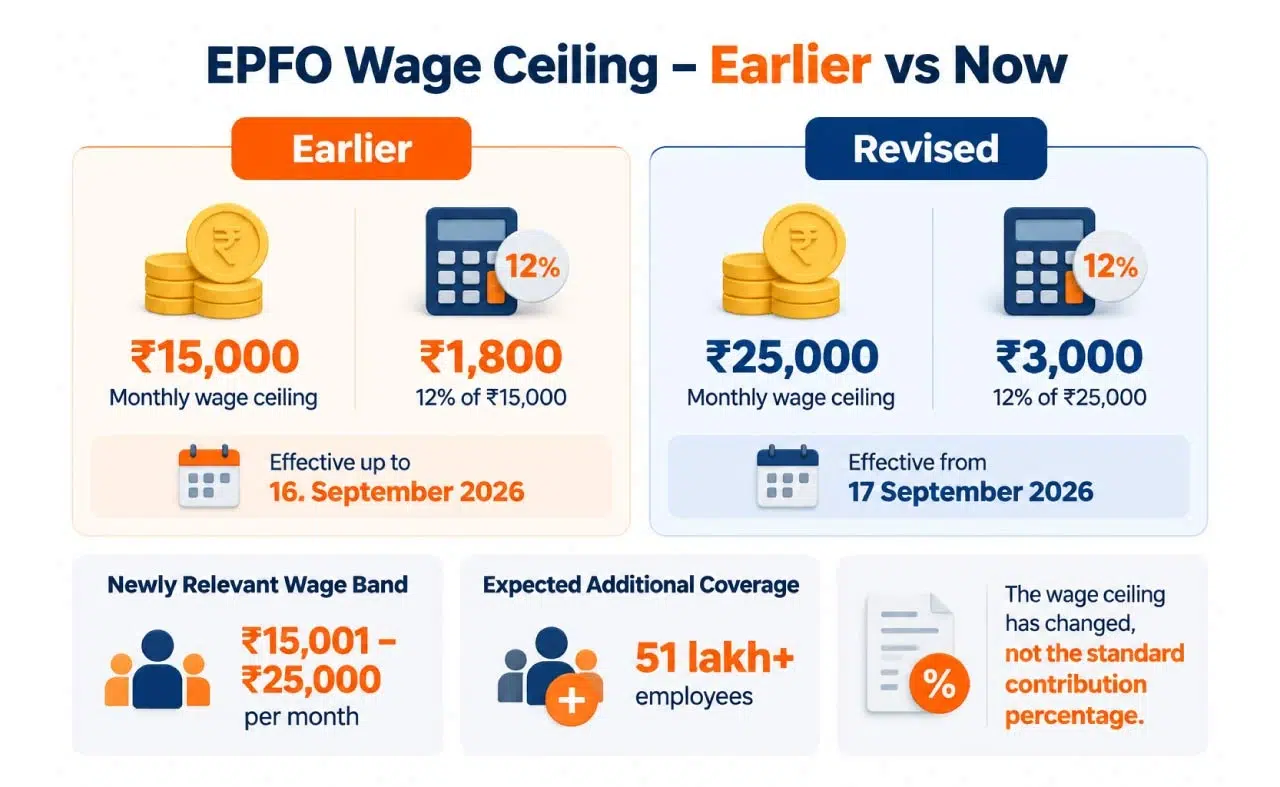
 

EPFO wage ceiling and its impact on PF contributions


Which Employees May Be Affected?

The impact of the revised ceiling can differ from employee to employee. Employers should consider applicable wages, existing EPFO membership and the employee’s current contribution arrangement.


1. Employees with applicable PF wages up to ₹15,000

Employees who were already covered under EPFO may generally not experience a change merely because the ceiling has increased.


2. New employees with applicable wages between ₹15,001 and ₹25,000

Such employees may now fall within mandatory EPFO coverage where the establishment is covered and the applicable statutory conditions are satisfied.


3. Existing EPFO members

An employee who is already an EPFO member does not automatically cease to be a member merely because their wages later exceed the applicable wage ceiling.


4. Employees are already contributing on higher wages

Employees who are already contributing on higher wages may not necessarily see a change in their PF deduction merely because the statutory ceiling has been revised.


5. New employees earning above ₹25,000

Employees joining with applicable wages above ₹25,000 do not automatically become mandatorily covered solely because of the revised ceiling. Their previous EPFO membership, exclusion status and other applicable statutory provisions should be checked.


How Much Can the PF Contribution Change?

Because the EPFO wage ceiling increased from ₹15,000 to ₹25,000, the monthly contribution base may increase in applicable cases. For establishments where the 12% contribution rate applies, the illustrative contribution may change as follows:


Earlier Ceiling


₹15,000 × 12% = ₹1,800


Revised Ceiling


₹25,000 × 12% = ₹3,000


Maximum Ceiling-Based Difference


₹3,000 − ₹1,800 = ₹1,200 per month


However, ₹1,200 is not the increase for every employee.


Note: The following illustrations assume that the employee is already an EPFO member and the contribution was earlier restricted to the ₹15,000 statutory wage ceiling. Actual PF contribution may differ depending on employee membership status, applicable PF wages and existing contribution arrangements.


Salary-Wise PF Illustration


Applicable PF Wages

Earlier Contribution

Illustrative Employee PF Contribution

Monthly Difference

₹12,000

₹1,440 ₹1,440 Nil
₹18,000 ₹1,800 ₹2,160

₹360

₹20,000

₹1,800 ₹2,400

₹600

₹22,000 ₹1,800 ₹2,640

₹840

₹25,000

₹1,800 ₹3,000

₹1,200


Note: The above figures are illustrative and assume a 12% contribution rate. Actual contribution treatment depends on the applicable statutory rate, PF wages, membership status and existing contribution arrangement.


The employer’s contribution is subject to allocation between EPF, EPS and other applicable scheme provisions. Therefore, the entire employer contribution should not be treated as an EPF credit.


💡 Important

₹25,000 Salary Does Not Always Mean ₹3,000 PF

Gross salary, CTC and applicable PF wages are not necessarily the same.

Therefore:

Gross Salary = ₹25,000

does not automatically mean:

PF Wages = ₹25,000

or:

PF Contribution = ₹3,000

The applicable statutory wage base and existing contribution arrangement should be checked first.

Check Your PF Contribution: Use Ebizfiling’s PF Calculator below to estimate how the revised wage ceiling may affect your monthly PF contribution based on your applicable PF wages.

Effective 17 Sep 2026

EPFO Wage Ceiling Impact Calculator 2026

See how the ₹25,000 wage ceiling changes your employee PF contribution.

Before Revision · ₹15,000 Ceiling ₹1,800
After Revision · ₹25,000 Ceiling ₹3,000
Monthly PF Increase ₹1,200
Annual Impact ₹14,400

Note: Illustrative employee-PF calculation using the applicable statutory wage ceiling. Actual PF may differ based on PF wages, membership status, higher-wage/VPF arrangements and applicable EPFO provisions.

Get EPF Compliance Support

Will the New Ceiling Affect Take-Home Salary?

If the employee’s PF contribution increases while all other salary components remain unchanged, the employee’s monthly take-home salary can reduce by a similar amount.


For example, for applicable PF wages of ₹20,000:


Earlier contribution: ₹1,800


Illustrative revised contribution: ₹2,400


Difference: ₹600


The employee may therefore receive approximately ₹600 less as monthly take-home salary, while the additional amount goes towards PF savings.


At the full ₹25,000 ceiling, the difference can be up to ₹1,200 per month compared with the earlier ₹15,000 ceiling.


What If Employer PF Is Part of CTC?

Many employers include their PF contribution within the employee’s total CTC. If the employer’s PF contribution increases but the total CTC remains unchanged, other salary components may need to be adjusted. If the employer absorbs the additional PF cost separately, the employee may not face the same impact on the cash component of salary. The result therefore depends on the employee’s salary structure.


How Does the Wage Ceiling Increase Affect Employees and Employers?

The revised wage ceiling can affect both employee contributions and employer payroll costs where the applicable PF contribution base increases. The actual impact will depend on the employee’s PF wages, existing EPFO membership, applicable contribution rate and current contribution arrangement.


Impact on Employees

For employees whose applicable PF contribution base increases, the revised ceiling may result in:

  • Higher monthly PF contributions in applicable cases
  • Higher long-term provident fund accumulation
  • A possible reduction in take-home salary where the employee contribution increases
  • Wider access to EPFO-linked social security benefits for employees who newly come within mandatory coverage

The actual impact should be assessed employee-wise because applicable PF wages, existing membership and contribution arrangements may differ.


Impact on Employers

For employers, the revised EPFO wage ceiling increases the wage range that may need to be reviewed for mandatory coverage and statutory payroll costs. It may also require changes to payroll and compliance processes.


Employers should:

  • Review employee-wise PF applicability
  • Check existing EPFO membership and UAN details
  • Update payroll configurations where required
  • Review the applicable PF contribution rate
  • Verify EPS and EDLI treatment separately
  • Reconcile contribution calculations before ECR filing
  • Maintain supporting employee-wise payroll records

Employers should avoid applying a uniform contribution amount across all employees without first checking the applicable wage base and contribution position.


What Happens to EPF, EPS and EDLI?

The revised wage ceiling can affect employees’ access to EPFO-linked social security benefits.


Employees’ Provident Fund (EPF)

EPF helps employees build long-term retirement savings through contributions during employment.


As the EPFO wage ceiling increased, more employees may enter the EPFO framework where the applicable coverage conditions are satisfied. Existing employees may also accumulate a higher PF balance where their contribution base increases.


Employees’ Pension Scheme (EPS)

EPS provides pension benefits to eligible EPFO members. For employees eligible for EPS membership, a portion of the employer’s PF contribution may be allocated towards EPS as per applicable EPS provisions, subject to the prescribed wage ceiling and scheme conditions. The remaining portion of the employer contribution is credited towards EPF.


With the wage ceiling revised to ₹25,000, the illustrative EPS allocation at the full ceiling may be calculated as:


₹25,000 × 8.33% = approximately ₹2,083 per month


This calculation is only an illustration based on the applicable EPS contribution rate. The actual EPS allocation depends on the employee’s eligibility, date of EPFO membership, applicable wage ceiling rules and EPFO scheme provisions.


The EPS contribution forms part of the employer’s overall PF contribution and is not an additional 8.33% contribution over and above the employer’s 12% contribution.


Employers should verify the applicable EPF, EPS and EDLI calculations under the relevant scheme provisions and EPFO implementation instructions before updating payroll.


Read more about the difference between EPF and EPS.


Employees’ Deposit Linked Insurance (EDLI)

EDLI provides insurance-linked protection to eligible EPFO members.


The fact that the EPFO wage ceiling increased may also bring additional eligible employees within EPFO-linked insurance protection. However, scheme-specific contribution and benefit limits should be checked separately.


Employers can also read the detailed comparison of PF vs ESIC to understand the difference between employee welfare schemes.

What Should Employers Do for September 2026 Payroll?

Since the revised EPFO wage ceiling became effective from 17 September 2026, employers should not automatically apply the new ₹25,000 ceiling for the entire month.

For example, if applicable PF wages are ₹20,000, the full-month contribution at 12% is ₹2,400. However, September contribution should be calculated after considering the 17 September effective date and applicable EPFO/ECR instructions.

From the following full month, the revised contribution can be calculated normally on applicable PF wages, subject to the ₹25,000 ceiling.

Manage EPFO Compliance With Ebizfiling

The revised Employee Provident Fund wage ceiling can affect employee coverage, payroll calculations, statutory records and employer compliance costs.


Ebizfiling can assist businesses with:

  • EPF registration and applicability review
  • Employee coverage assessment
  • Payroll compliance support
  • UAN and employee-related documentation
  • PF compliance records
  • Labour and employee compliance requirements

Businesses requiring professional assistance can explore EPF Registration Services for support with applicable EPFO registration and compliance requirements.


Conclusion

The EPFO wage ceiling for mandatory coverage has increased from ₹15,000 to ₹25,000 per month with effect from 17 September 2026. The change is expected to bring more than 51 lakh additional employees within the mandatory EPFO coverage framework.


For employees, the revision may affect EPF contributions, retirement savings, take-home salary and access to applicable EPFO-linked social security benefits.


For employers, the change requires an employee-wise review of EPFO applicability, PF wages, membership status, payroll configuration and statutory contribution calculations.


However, ₹3,000 should not be treated as a standard PF deduction for every employee. Employers should first check the employee’s applicable PF wages, EPFO membership, contribution arrangement and relevant statutory provisions before updating payroll.


Frequently Asked Questions

1. Which salary components should be considered for the ₹25,000 EPFO wage ceiling?

The ₹25,000 ceiling should be tested against the applicable statutory wage definition rather than simply against gross salary or CTC. Employers should review the employee’s salary components and applicable wage treatment before determining PF coverage.


2. Will a new employee earning ₹24,000 per month come under mandatory EPFO coverage?

Where the establishment is covered under EPFO provisions and the employee’s applicable statutory wages fall within the prescribed ceiling, the employee may come within mandatory coverage, where no exclusion applies and subject to applicable membership conditions.


3. What happens if a new employee earns above ₹25,000 but is already an EPFO member?

Existing EPFO membership is important. An employee who is already an EPFO member does not automatically cease to be a member merely because the employee’s wages are above the statutory wage ceiling. Employers should verify the employee’s previous membership and UAN before determining contribution treatment.


4. What if an employee joining at wages above ₹25,000 has never been an EPFO member?

The employee’s status should be examined under applicable EPF provisions relating to excluded employees and membership eligibility. Employers should not determine exclusion solely from gross salary without checking the statutory wage amount and previous EPFO membership.


5. Now that the EPFO wage ceiling increased to ₹25,000, does it also affect the Voluntary Provident Fund limit?

The statutory wage ceiling revision and Voluntary Provident Fund contributions serve different purposes. Employees making voluntary contributions should review the applicable VPF, payroll and income-tax rules separately.


6. Does the revised EPFO wage ceiling also apply when workers are engaged through contractors?

Eligible contract workers may also fall within EPFO compliance requirements. Principal employers should review whether contractors are correctly covering eligible employees, depositing contributions, and maintaining applicable PF records.


7. Does an existing employer need a new EPFO registration because the wage ceiling has increased?

Even though the EPFO wage ceiling increased, an existing establishment does not require a new EPFO registration merely because of this change. However, employers may need to review employee coverage, payroll configuration, UAN records and contribution calculations.


8. Will employees earning above ₹25,000 be covered under EPFO?

The revised ₹25,000 wage ceiling primarily expands mandatory EPFO coverage to employees falling within the applicable ₹15,000–₹25,000 wage band. Employees whose applicable wages exceed ₹25,000 will continue to be governed by the applicable EPFO membership and exclusion provisions. Employers should evaluate each employee based on the applicable statutory rules rather than salary/CTC alone.


9. Can Ebizfiling help employers identify employees affected by the ₹25,000 PF wage ceiling?

Yes. Ebizfiling can assist businesses in reviewing employee-wise EPF applicability, existing membership records, documentation and related statutory compliance requirements.


10. Can Ebizfiling assist with payroll and PF compliance after the EPFO wage ceiling revision?

Yes. Ebizfiling can support businesses with payroll compliance reviews, employee classifications, PF-related documentation and other applicable labour and employee compliance requirements.

About Ebizfiling -

EbizFiling is a concept that emerged with the progressive and intellectual mindset of like-minded people. It aims at delivering the end-to-end corporate legal services 0f incorporation, compliance, advisory, and management consultancy services to clients in India and abroad in all the best possible ways.
 
To know more about our services and for a free consultation, get in touch with our team on  info@ebizfiling.com or call 9643203209.
 
Ebizfiling

Author: siddhi

Siddhi Rathi is a Legal Content Writer at Ebizfiling, a Legal Researcher, and an Advocate, currently pursuing her Ph.D. in Law at Nirma University, Ahmedabad. Her expertise lies in legal research and content development, with a focus on taxation, tax compliance, corporate and regulatory laws, and emerging legal developments. She brings a research-driven approach to her work, producing precise and reader-friendly content that makes complex legal and tax matters easier to understand.

Follow Author

Leave a Reply

Your email address will not be published. Required fields are marked *

  • Rating

Hi, Welcome to EbizFiling!

Hello there!!! Let us know if you have any Questions.

Thank you for your message.

☎
whatsapp