


-
September 7, 2026
-
BySteffy A
RERA and Income Tax Factors Every Home Buyer Should Know
Introduction
Buying a house involves both legal and tax considerations. Home buyers should understand RERA and Income Tax Factors before verifying a project, arranging finance, or making property payments. RERA helps buyers check project details and promoter obligations, while income tax provisions determine deductions, TDS, and capital gains relief. Reviewing these factors early can help buyers make informed property decisions.
Summary
- Check the RERA registration and project details before buying a house.
- Review the promoter, carpet area, approvals, and expected possession date.
- Eligible home buyers can claim home loan tax benefits on interest and principal repayment.
- Joint owners may claim tax benefits based on ownership and loan contribution.
- Property purchases may attract TDS when the prescribed value limit is met.
- Eligible long-term capital gains may qualify for relief when reinvested in a residential house.
Understanding RERA for Home Buyers
The Real Estate (Regulation and Development) Act, 2016 was introduced to regulate India’s real estate sector and protect the interests of property buyers. It promotes greater transparency by requiring promoters to disclose important information about registered projects.
Under the RERA rules for home buyers, promoters of covered projects must register the project with the applicable State or Union Territory RERA authority before advertising or selling units.
Before buying a property, buyers should verify:
- RERA registration number
- Promoter and project details
- Approved layout and building plans
- Carpet area of the property
- Project completion timeline
- Required approvals and permissions
- Current construction status
RERA also requires promoters to update prescribed project information on the RERA portal. This allows buyers to review the project before committing funds.
Checking these disclosures is one of the important RERA and Income Tax Factors before purchasing a new house.
How Can Buyers Check RERA Registration?
Buyers can visit the relevant State or Union Territory RERA portal and search using the project name, promoter name, or RERA registration number.
They should compare the information available on the portal with the brochure, agreement for sale, and details provided by the developer.
Rights and Responsibilities Under RERA
Understanding buyer rights is an important part of RERA and Income Tax Factors when purchasing a new house.
RERA gives eligible home buyers several protections, including:
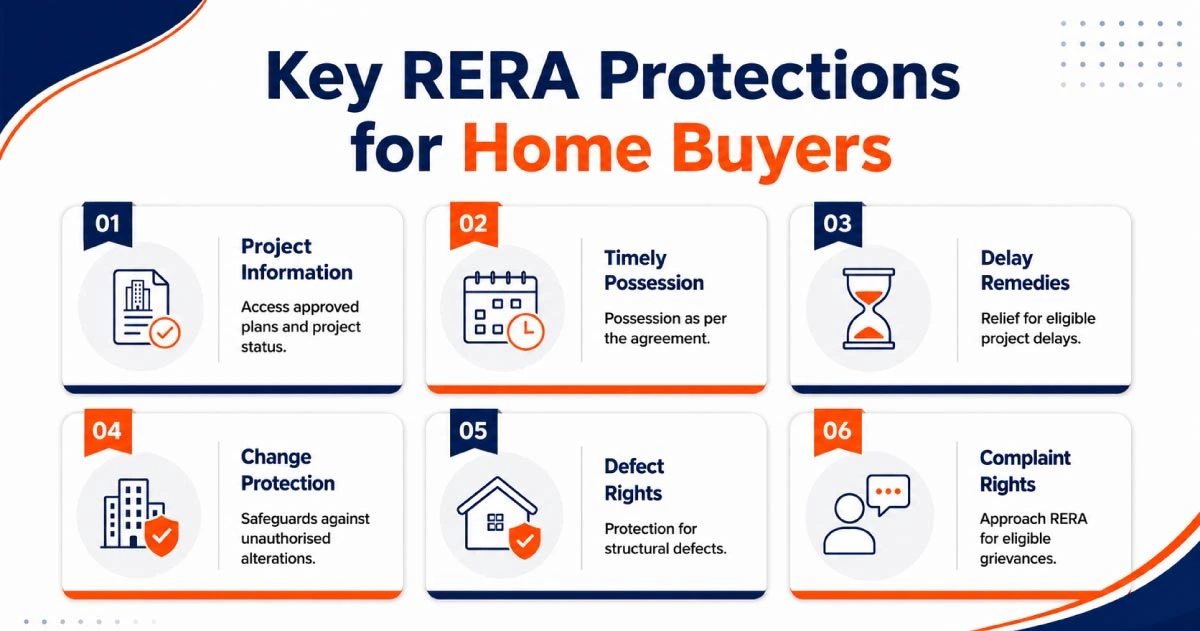
- Access to approved project plans and specifications
- Information about the stage of project completion
- Possession according to the agreement for sale
- Remedies for qualifying delays or promoter defaults
- Protection against certain unauthorised changes
- Rights relating to structural defects
- Right to approach the appropriate RERA authority for eligible complaints
Promoters must also follow the specifications and commitments stated in the agreement for sale. These buyer protections form an important part of the RERA and Income Tax Factors that should be reviewed before signing the agreement.
How Does RERA Protect Money Paid by Home Buyers?
RERA requires promoters to deposit 70% of the amounts realised from allottees, from time to time, into a separate account maintained in a scheduled bank. The amount must be used for the land and construction costs of that project, subject to the prescribed withdrawal and certification requirements.
This rule helps limit the diversion of buyer funds from one project to unrelated activities.
Home Loan Tax Benefits on Interest
Home loan tax benefits can reduce the taxable income of eligible property owners. Among the RERA and Income Tax Factors, loan interest is one of the main tax points buyers should review.
Under the Income-tax Act, 2025, Section 22 provides deductions for interest payable on borrowed capital used for acquiring, constructing, repairing, renewing, or reconstructing house property. It broadly replaces the earlier Section 24(b) framework.
For qualifying self-occupied properties, Section 22 can allow a deduction of up to ₹2 lakh for interest on borrowed capital where the prescribed conditions are satisfied. The acquisition or construction must generally be completed within five years from the end of the tax year in which the capital was borrowed. However, this deduction is not available for a self-occupied property when income is computed under the default tax regime under Section 202.
The taxpayer should furnish a certificate from the person to whom the interest is payable, containing the required interest details.
What Factors Affect Home Loan Interest Deduction?
The actual tax benefit depends on factors such as:
- Purpose of the loan
- Nature of the propert
- Completion period
- Tax regime selected
- Interest paid or payable
- Compliance with prescribed conditions
Therefore, tax benefits on home loan interest should not be assumed only on the basis of EMI payments.
Tax Deductions on Home Loan Principal
Principal repayment may also qualify for an income tax deduction. These RERA and Income Tax Factors should be checked together because interest and principal deductions follow different conditions.
Under the Income-tax Act, 2025, Section 123 read with Schedule XV covers eligible investments and payments. It broadly replaces the earlier Section 80C framework.
An individual or HUF may claim an aggregate deduction of up to ₹1.5 lakh under Section 123, subject to the applicable tax regime and the conditions in Schedule XV. This deduction is not available when income is computed under the default new tax regime under Section 202.
Schedule XV specifically includes qualifying payments made towards the purchase or construction of a residential house, including repayment of specified housing loans and certain stamp duty and registration payments.
The ₹1.5 lakh limit is an overall limit. It also includes other eligible investments and payments covered under Section 123 of Income Tax Act.
Tax Benefits for Joint Home Buyers
Joint ownership can help eligible taxpayers claim home loan tax benefits separately, but certain conditions must be satisfied. For joint purchasers, RERA and Income Tax Factors also include ownership share and actual loan contribution.
Being only a co-borrower does not automatically allow a person to claim the deduction. The person should generally also have ownership in the property and contribute towards repayment of the loan.
For example, if a husband and wife jointly own a house and both repay the loan, eligible deductions may be claimed according to their ownership share, repayment contribution, and applicable tax provisions.
TDS on Property Purchase
Income tax on property purchase is not limited to home loan deductions. Buyers may also have a responsibility to deduct tax at source. TDS is therefore another of the RERA and Income Tax Factors that should be checked before making the purchase payment.
Under Section 393 of the Income-tax Act, 2025, a buyer purchasing specified immovable property other than agricultural land from a resident seller may have to deduct TDS at 1%.
The provision applies when the prescribed ₹50 lakh threshold is met. TDS is calculated with reference to the consideration or stamp duty value, whichever is higher, subject to applicable conditions. For determining the threshold, the consideration is considered on an aggregate basis where there are multiple transferees or transferors.
Buyers should also understand the compliance requirements for TDS on purchase of property before making payment to the seller.
Why Should Buyers Check the Seller’s Residential Status?
Buyers should verify whether the seller is resident or non-resident because different TDS provisions can apply when the property is purchased from a non-resident seller.
Checking this before making payment can help avoid incorrect TDS deduction and related compliance issues.
Different withholding rules apply to TDS on property purchase from NRI, so buyers should confirm the seller’s residential status before making payment.
Capital Gains Tax Benefits on Buying a New House
An individual or HUF may sell an existing residential property or another qualifying long-term capital asset and invest the amount in a new residential house, subject to the conditions prescribed under Sections 82 or 86. Capital gains planning is one of the RERA and Income Tax Factors that becomes relevant when the new purchase is funded from an earlier asset sale.
Under the earlier Income-tax Act, 1961, Section 54 provided an exemption for eligible long-term capital gains arising from the sale of a residential house.
From 1 April 2026, the corresponding provision is Section 82 of the Income-tax Act, 2025.
The new residential house generally needs to be:
- Purchased within one year before the transfer
- Purchased within two years after the transfer
- Constructed within three years after the transfer
The earlier Section 54F framework is now covered under Section 86. It applies to eligible long-term capital gains from the transfer of a capital asset other than a residential house when the prescribed investment is made in a residential house in India.
These provisions deal with qualifying long-term capital gains. They should not be treated as general exemptions for short-term capital gains.
Ebizfiling Support for Property Tax and TDS Compliance
Ebizfiling helps home buyers understand the tax and compliance requirements connected with a property purchase. The support can include:
- Reviewing whether property purchase TDS applies to the transaction.
- Checking applicable home loan interest and principal deduction provisions.
- Reviewing the selected tax regime before estimating available tax benefits.
- Assessing joint ownership and repayment structure for co-owners.
- Reviewing capital gains implications when another asset is sold to fund the purchase.
- Assisting with relevant TDS and income tax compliance requirements.
Need expert guidance on property taxes? Ebizfiling’s Tax Consultancy Services can help you understand property TDS, home loan deductions, capital gains tax implications, and other applicable tax requirements before completing your property transaction.
Conclusion
RERA and Income Tax Factors affect both the legal and tax aspects of buying a property. Buyers should verify RERA details, home loan deduction eligibility, property TDS, and capital gains provisions before completing the purchase. Since the Income-tax Act, 2025 applies from 1 April 2026, taxpayers should check the current provisions and applicable tax regime before claiming any benefit.
Frequently Asked Questions
1. What if a builder claims RERA registration but no number is shown?
The buyer should verify the project directly on the relevant State or Union Territory RERA portal before making a major payment. The RERA guidelines for property buyers make independent verification important because marketing material alone should not be used to confirm registration. This is one of the first RERA and Income Tax Factors to check.
2. Which home loan tax benefits apply to a self-occupied property?
The buyer should first check eligibility for interest deduction under Section 22 of the Income-tax Act, 2025 and then review whether principal repayment qualifies under Section 123 read with Schedule XV. The tax regime selected can also affect the available home loan tax benefits. These RERA and Income Tax Factors should be reviewed before estimating tax savings.
3. Can home loan tax benefits be claimed during construction?
Interest relating to the period before acquisition or construction is generally not claimed as a regular annual home loan interest deduction during the construction period. Section 22 allows qualifying prior-period interest in five equal instalments starting from the tax year in which the property is acquired or construction is completed, subject to the applicable conditions and tax regime.
4. Can both co-borrowers claim home loan tax deductions?
Not automatically. For tax deductions on home loan, ownership and actual repayment contribution both matter. A person who is only a co-borrower but has no ownership interest may not qualify for the same deduction as a co-owner.
5. How can Ebizfiling help with tax benefits before buying property?
Ebizfiling can help review the buyer’s ownership structure, home loan details, applicable tax regime, TDS requirements, and available income tax benefits for home buyers. This can help the buyer understand the tax impact before finalising the transaction or filing the return.
6. Is TDS applicable if the stamp duty value is ₹50 lakh or more?
Yes, TDS may apply even where the stated purchase consideration is below ₹50 lakh if the stamp duty value reaches the prescribed ₹50 lakh threshold. Under Section 393(1) of the Income-tax Act, 2025, the buyer should consider the higher of the sale consideration and stamp duty value while determining the TDS amount, subject to the applicable conditions.
7. What if the RERA and developer possession dates are different?
The buyer should compare the agreement, RERA disclosures, and current project status. Under the RERA rules for home buyers, registered project information is an important reference point, so any difference should be clarified before making further payment.
8. Does buying a new house automatically give capital gains exemption?
No. The buyer must check whether the gain is a qualifying long-term capital gain, whether the new property meets the prescribed conditions, and whether the investment is made within the permitted period. Simply purchasing another house does not automatically create an exemption.
9. Can a promoter change sanctioned plans after RERA registration?
RERA restricts promoters from making certain changes to sanctioned plans, layout plans, and project specifications without complying with the prescribed requirements. For major alterations or additions to sanctioned plans, layout plans, or project specifications, the promoter generally requires written consent from at least two-thirds of the allottees, excluding the promoter. For calculating the two-thirds requirement, each allottee is counted once irrespective of the number of apartments or plots held.
10. What should buyers compare before choosing between two properties?
The buyer should compare registration status, project disclosures, possession timelines, financing cost, RERA guidelines for property buyers, expected tax deductions, and any TDS or capital gains impact. Comparing these RERA and Income Tax Factors can give a clearer picture of the legal and financial cost of each property.





File Income Tax Return
Filing of an Income Tax return is necessary if you have earned any income. File your ITR with EbizFiling at INR 1199/- only.
About Ebizfiling -



Reviews
Aditya Raje
23 Apr 2022Have used their services to open an MSME firm and FSSAI aswell. Mr. Shubham and Mr. Pulkit were extremely helpful and I got my work done smoothly and on time. Recommended.
Ateek Mohd
23 Apr 2022Ebizfiling India pvt ltd is leading account services provider across the country. They have a very good and genuine staff. They give all the services in given time frame. My two company’s accountability done by this firm. Awesome service ..!
Mamta Tanna
20 Dec 2017More power to the Ebizfiling team for being so generous and systematic in the whole process of ESIC registration.
October 6, 2026 By Srishti M
October 7, 2026 By Srishti M
October 3, 2026 By Srishti M
Revised ITR Under Old Tax Regime: Change Rules Explained Overview A salaried taxpayer may file an Income Tax Return under the new tax regime and later realise that the old tax regime could be more suitable because of eligible deductions […]