

-
September 12, 2026
-
BySteffy A
Difference Between 12A and 80G Registration in India for NGOs
Introduction
Sections 12A and 80G are commonly used terms for tax benefits available to eligible non-profit organizations in India. Although both relate to charitable activities, they benefit different persons. The main difference between 12A and 80G is that 12A-related registration helps an organization claim exemption on eligible income, while 80G-related approval allows eligible donors to claim a deduction for qualifying donations.
What Is Section 12A?
12A registration is the commonly used name for income-tax registration obtained by an eligible charitable or religious organization. Under the Income-tax Act, 2025, applicable from 1 April 2026, the corresponding registration is covered under Section 332.
The registration allows an organization to claim exemption on qualifying income applied towards its approved charitable or religious objects. The organization must use its income for permitted purposes, maintain proper books, file the applicable return, and submit an audit report where required.
The difference between 12A and 80G becomes clear here because 12A-related registration concerns the organization’s own income and tax liability.
Who Can Apply for 12A Registration?
Public charitable trusts, registered societies, Section 8 companies, charitable or religious institutions, eligible educational or medical institutions and other qualifying non-profit organizations may apply, subject to their objects and activities.
The organization must first be legally formed under the applicable law. 12A registration does not create a trust, society or Section 8 company. It becomes important when the organization wants to claim income-tax exemption.
Benefits of 12A Registration
- Tax exemption: An eligible organization may claim exemption on qualifying income when it applies or accumulates the income according to law.
- Better use of funds: More resources can be used for charitable, educational, medical, religious or social activities.
- Improved credibility: A valid registration may strengthen confidence among donors and grant-making organizations.
- Compliance support: The registration can help establish the organization’s tax compliance history.
12A registration does not permit an organization to receive foreign contributions. Foreign funding requires the applicable FCRA registration or prior permission.
What Is Section 80G?
80G approval allows eligible donors to claim a deduction for qualifying monetary donations made to an approved organization. Under the Income-tax Act, 2025, the corresponding approval is covered under Section 354, while the donor deduction is linked with Section 133(1)(b)(ii).
The primary difference between 12A and 80G is therefore the beneficiary. The organization receives the direct tax benefit under 12A-related registration, while the donor receives the deduction under 80G-related approval.
Not every donation qualifies automatically. Eligibility depends on the approved recipient, payment mode, applicable limit, donor’s tax regime and other conditions.
Donations in kind are not eligible. Donors should verify the organization’s approval and retain the prescribed donation certificate.
Who Can Apply for 80G Approval?
Public charitable trusts, registered societies carrying out charitable activities, Section 8 companies, eligible educational or medical institutions and other qualifying non-profit organizations may apply.
Benefits of 80G Approval
- Tax deduction for donors: Eligible donors may reduce their taxable income by claiming the applicable deduction.
- Better fundraising potential: Valid approval may attract donors because qualifying contributions can provide a tax benefit.
- Greater donor confidence: Approval, reporting and certification improve transparency.
- Proper donation records: Approved organizations must maintain donor details, report eligible donations and issue the prescribed certificate. Form 10BD and Form 10BE under the earlier framework have been renumbered as Form 113 and Form 114 from 1 April 2026.
This reporting requirement further explains the difference between 12A and 80G, as 80G focuses on donations and donor documentation.
Key Difference Between 12A and 80G
|
Basis |
Section 12A |
Section 80G |
|
Purpose |
Helps an eligible organization claim exemption on its income | Allows eligible donors to claim a deduction |
| Beneficiary | Trust, society, Section 8 company or institution |
Individual, company, firm or another donor |
|
Corresponding provision from 1 April 2026 |
Section 332 of the Income-tax Act, 2025 | Section 354, with deduction under Section 133(1)(b)(ii) |
| Tax impact | Reduces the organization’s taxable income, subject to conditions |
Reduces the donor’s taxable income, subject to limits |
|
Main compliance |
Application of income, books, returns and audit | Donation records, reporting and certificates |
| Foreign funding | Does not provide FCRA permission |
Does not provide FCRA permission |
|
Nature of benefit |
Direct benefit to the organization |
Direct benefit to the donor |
The table clearly shows the difference between 12A and 80G. The registrations complement each other but are not interchangeable.
Is 12A Registration Required Before 80G?
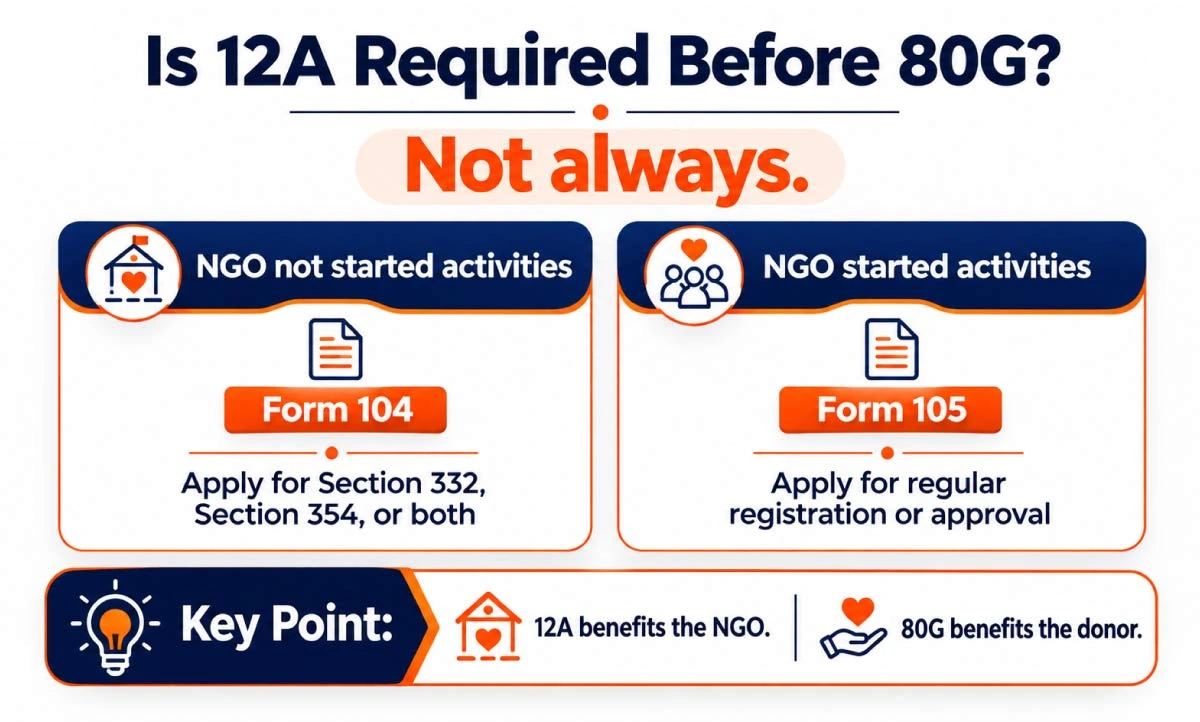
It is not always necessary to complete one application before starting the other. An eligible organization that has not commenced activities may use Form 104 to apply for provisional registration under Section 332, provisional approval under Section 354, or both.
An organization that has already commenced activities generally uses Form 105 for regular registration or approval. Form 104 and Form 105 replace the earlier Form 10A and Form 10AB. The official mapping guide confirms that forms under the Income-tax Act, 2025 were renumbered from 1 April 2026.
Many organizations obtain both because the difference between 12A and 80G means that one supports exemption for organizational income while the other supports deductions for donors.
Get Expert Support for 12A and 80G Registration
Ebizfiling helps charitable trusts, registered societies and Section 8 companies complete their 12A and 80G registration with proper documentation and filing support.
- Eligibility check for 12A and 80G registration
- Review of trust deed, MOA and supporting documents
- Assistance with Form 104 and Form 105 filing
- Support for application submission and departmental queries
Start your 12A and 80G registration with Ebizfiling today.
Conclusion
The central difference between 12A and 80G lies in who receives the tax benefit. 12A-related registration helps an eligible organization claim exemption on qualifying income, whereas 80G-related approval allows eligible donors to claim a deduction on qualifying donations. Both registrations can support the long-term sustainability of a non-profit organization. However, neither replaces legal formation, FCRA approval or ongoing income-tax compliance.
Suggested Reads:
How to Download 12A and 80G Certificate?
Section 12AB and 80G Registration
Exemptions under Section 80G and 12A / 12AA
Documents Required for Section 12A and 80G Registration
Changes in Section 12A and 80G
Form 10B and 10BB Applicability: Updated Rules for Trusts
Frequently Asked Questions
1. Can an NGO with 12A registration issue an 80G donation certificate?
No. Holding 12A-related registration alone does not allow an NGO to provide tax deduction benefits to donors. The organization must separately obtain 80G-related approval and complete the prescribed donation reporting before issuing the applicable donation certificate.
2. Which form should a new NGO file if it has not started activities?
An organization that has not commenced its activities may file Form 104 for provisional registration under Section 332, provisional approval under Section 354, or both. Once activities have commenced, the organization must generally apply through Form 105 for regular registration or approval.
3. Can a donor claim an 80G deduction for a cash donation above ₹2,000?
No. If a donation exceeding ₹2,000 is made in cash, no deduction is available for that cash donation. Donors should use a banking or permitted electronic payment method and retain proper payment records.
4. Are donations of food, clothes or equipment eligible under 80G?
No. Donations in kind, such as food, medicines, clothes, equipment, or property, do not qualify for the deduction. Only eligible monetary donations are considered under the applicable provisions.
5. Does every donation to an 80G-approved NGO qualify for a 100% deduction?
No. Depending on the approved fund or institution, the deduction may be 50% or 100%, with or without a qualifying limit. Donors must check the applicable category instead of assuming that the entire donation is deductible.
6. What happens if the NGO reports the donor’s PAN or donation amount incorrectly?
The organization should correct the error by filing a revised Form 113. Correct donor details are important because the information reported by the NGO is used to generate the donation certificate and verify the deduction claimed by the donor.
7. Which donation certificate applies from 1 April 2026?
For eligible donations governed by the Income-tax Act, 2025, the organization files the donation statement in Form 113. After filing, it must generate and issue Form 114 containing the NGO’s registration details, donor information, and donation amount.
8. Can 12A and 80G registration for NGOs replace FCRA approval?
No. The difference between 12A and 80G relates to income exemption and donor deductions, not foreign contributions. An NGO must separately obtain FCRA registration or prior permission before accepting eligible foreign contributions.
9. How can Ebizfiling help when an NGO receives a departmental query?
Ebizfiling can review the application, trust deed, MOA, activity documents and supporting records to identify the issue. Our experts can also assist in preparing and submitting an appropriate response to the Income Tax Department.
10. Can Ebizfiling assist with NGO registration in India and tax registration?
Yes. Ebizfiling can assist with setting up a charitable trust, registered society or Section 8 company and provide further support for 12A and 80G registration. This helps the organization manage its legal formation and tax registration requirements through one professional service provider.





Registration under Section 80G Income tax act
Register under Section 80G of income tax act in simple steps with Ebizfiling
About Ebizfiling -



October 15, 2026 By Srishti M
TDS and TCS Compliance Calendar November 2026: Compliance Guide Introduction The TDS and TCS Compliance Calendar November 2026 covers important tax deduction, collection, payment, certificate and reporting requirements applicable during the month. It helps businesses, government offices and other responsible […]
October 14, 2026 By Srishti M
GST Compliance Calendar November 2026: Key Due Dates & Filings Introduction The GST Compliance Calendar November 2026 highlights the major GST return filing, tax payment, invoice reporting and year-end adjustment deadlines applicable during the month. It covers regular taxpayers, QRMP […]
October 13, 2026 By Srishti M