


-
August 21, 2026
-
BySteffy A
Section 12AA Registration: Process, Documents and Eligibility
Introduction
Section 12AA Registration was the earlier income-tax registration framework for eligible charitable trusts, religious trusts, societies, Section 8 companies, and other non-profit organizations. However, Section 12AA registration did not automatically make the entire income of an organization tax-free. The organizations were required to fulfill conditions relating to the application of income, maintenance of accounts, audit, return filing, permitted investments, and use of funds.
Section 12AA was replaced by Section 12AB from 1 April 2021. Under the Income-tax Act, 2025, effective from 1 April 2026, the corresponding registration framework is primarily covered under Section 332. The application forms have also been renumbered under the Income-tax Rules, 2026.
What Is Section 12AA of the Income Tax Act?
Section 12AA of the Income-tax Act, 1961 laid down the procedure for granting registration to eligible charitable and religious trusts or institutions.
Under the earlier provision, the Commissioner or Principal Commissioner of Income Tax examined the objects of the organizations and the genuineness of their activities. The authority could request documents, accounts, activity reports, and other information before approving the registration.
Registration under Section 12AA allowed an eligible organization to claim exemption under Sections 11 and 12 of the Income-tax Act, 1961. The availability of the exemption depended on whether the organizations complied with the prescribed conditions.
Section 12AA should not be confused with an organization’s legal incorporation. A trust, society, or Section 8 company must first be constituted under the relevant law. Income-tax registration is a separate process undertaken to claim tax benefits.
Is Section 12AA Registration Still Applicable?
Section 12AA is now mainly relevant to registrations granted under the earlier tax framework.
The registration process up to 31 March 2021 was governed by Section 12AA. From 1 April 2021, Section 12AB introduced a new registration and re-registration framework. organizations holding old registrations under Section 12A or Section 12AA were required to migrate to the new system.
Regular registration under Section 12AB was generally granted for a specified period instead of permanently. The provision empowered the registering authority to examine the organization’s objects, genuine activities, and compliance with laws material to achieving its objects.
Transition from Section 12AA and Section 12AB to Section 332
Section 12AA governed the earlier registration procedure for charitable and religious organizations. It was replaced by Section 12AB from 1 April 2021. From 1 April 2026, the registration framework for eligible non-profit organizations is governed by Section 332 of the Income tax Act, 2025.
The old and new provisions may be understood as follows:
|
Earlier provision or form |
Current provision or form |
|
Sections 12A, 12AA, and 12AB |
Section 332 of the Income-tax Act, 2025 |
| Form 10A |
Form 104 for provisional registration |
|
Form 10AB |
Form 105 for regular registration and specified registration events |
| Form 10AC |
Form 106 for provisional registration order |
|
Form 10AD |
Form 107 for regular registration order |
Registration under Section 332 enables an eligible non-profit organization to claim the tax benefits available to registered non-profit organizations. Approval under Section 354 is a separate approval that allows eligible donors to claim deductions under Section 133(1)(b)(ii). Forms 104 and 105 are common application forms and may cover registration, approval, or both, depending on the section code selected.
Who Can Apply for Registration?
The following organizations may apply for registration, subject to their objects and activities:
- Public charitable trusts
- Public religious trusts
- Registered societies
- Section 8 companies
- Educational institutions
- Organizations engaged in environmental protection
- Other eligible non-profit institutions
A private or family trust created mainly for the benefit of specified individuals will generally not qualify for charitable registration.
The organizations should have genuine charitable or religious objects. Its income and assets should not be used for the private benefit of founders, trustees, directors, members, or related persons, except where permitted by law.
Activities Treated as Charitable Purposes
Charitable purposes generally include:
- Relief of the poor
- Education
- Yoga
- Medical relief
- Preservation of the environment
- Preservation of monuments or places of historic interest
- Advancement of any other object of general public utility
The organization’s activities should be consistent with the objects stated in its trust deed, memorandum of association, or other governing document.
A registered non-profit organization, other than one advancing an object of general public utility, may carry on a commercial activity only where it is incidental to achieving its objects. Where the organization advances an object of the general public.
Documents Required for Registration
The following documents may be required, depending on the organizations and application category:
- Self-certified copy of the trust deed, memorandum, articles, rules, or founding document.
- Registration certificate issued by the Registrar of Trusts, Registrar of Societies, Registrar of Companies, or another competent authority.
- PAN of the organizations.
- Details of trustees, directors, founders, members, and office bearers.
- Self-certified annual accounts for up to three tax years immediately preceding the tax year of application, where applicable.
- Audit reports, where applicable.
- Notes describing the organizations’ existing and proposed activities.
- Details of business activities and separate accounts, where applicable.
- Copy of an earlier registration, approval, rejection, or cancellation order.
- Documents relating to any modification of the organization’s objects.
- Self-certified copy of the FCRA registration certificate, where the organization is registered under the Foreign Contribution (Regulation) Act, 2010.
- NGO DARPAN details, only where specifically applicable or requested.
How to apply for Section 12AA Registration?
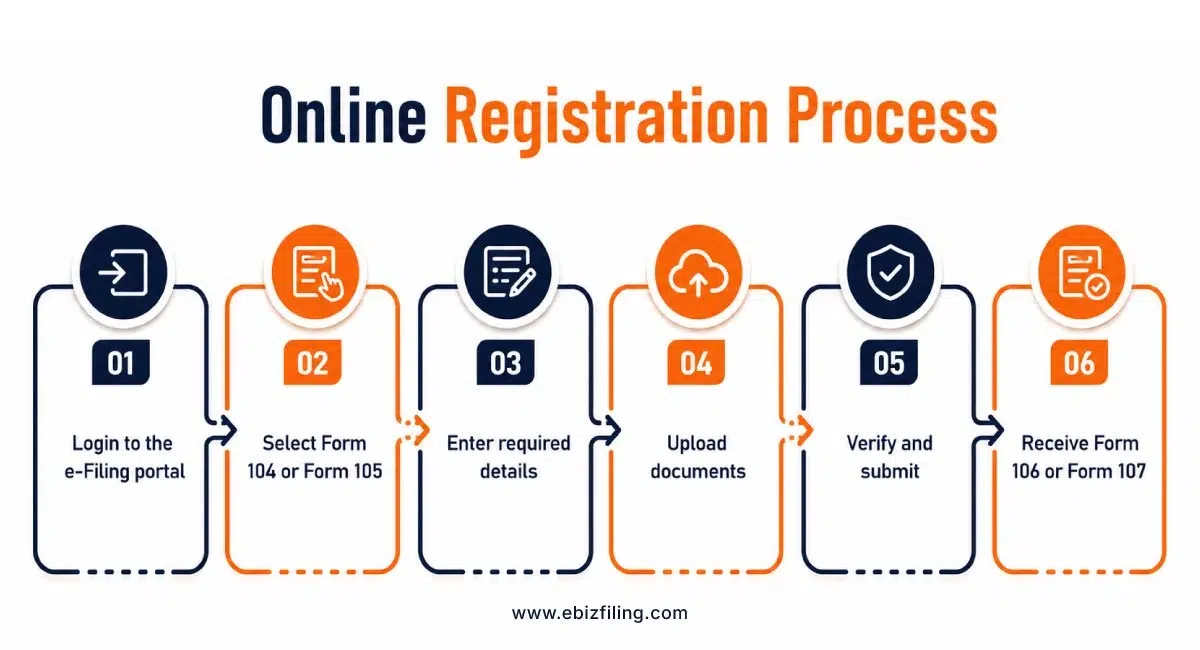
Access the e-Filing portal
The organization must have a valid PAN and an active account on the Income Tax e-Filing portal.
Select the applicable form
Select Form 104 for provisional registration or Form 105 for regular registration, depending on the organization’s status. The Income Tax Department has organized forms under separate tabs for the Income-tax Act, 1961 and the Income-tax Act, 2025.
Choose the correct section code
Select the applicable section code based on whether the organization:
- Has not commenced its activities;
- Has already commenced its activities;
- Holds an existing registration;
- Is applying for renewal;
- Has modified its objects; or
- Is converting provisional registration into regular registration.
Enter the required details
Provide information relating to the organization’s legal status, registered address, objects, activities, financial position, bank accounts, office bearers, and earlier registrations.
Upload documents
Upload clear and self-certified copies of the applicable documents. Incomplete or incorrect attachments may result in additional queries or rejection.
Verify and submit the form
The form must be verified through the prescribed electronic verification method. The application must be submitted electronically using a digital signature or electronic verification code, as applicable to the applicant, and verified by the person authorized to verify the organization’s income-tax return.
Respond to departmental notices
The Income Tax Department may seek additional information to examine the organization’s objects, genuine activities, accounts, or compliance with applicable laws.
Receive the Registration Order
For a valid Form 104 application, the Commissioner of Income Tax (CPC) issues provisional registration in Form 106 within one month from the end of the month in which the application is filed.
For Form 105, the Principal Commissioner or Commissioner may examine the organization’s objects, activities, accounts, and compliance records. The authority may grant registration, request additional information, or reject the application after providing an opportunity to be heard. The final order is issued in Form 107.
EbizFiling Support for Section 12AA Registration
EbizFiling assists charitable trusts, societies, Section 8 companies, and other non-profit organizations with Section 12AA Registration and related income-tax compliance.
EbizFiling Support Includes
- Eligibility review
- Document preparation
- Registration application filing
- Form 104 or Form 105 filing, as applicable
- Reply to departmental notices
- Registration renewal and compliance support
EbizFiling can help charitable organizations complete the Section 12AA Registration process with proper documentation and filing support.
Conclusion
Section 12AA was the earlier registration provision for charitable and religious organizations under the Income-tax Act, 1961. It was replaced by Section 12AB from 1 April 2021. From 1 April 2026, the corresponding registration framework is governed by Section 332 of the Income-tax Act, 2025. Eligible organizations must use Form 104 for provisional registration or Form 105 for regular registration and specified registration events.
Registration provides access to tax benefits, but the organization must continuously satisfy conditions relating to genuine activities, application of income, accounting, audit, return filing, and statutory compliance.
Suggested Reads:
Changes in Section 12A and 80G
Benefits of NGO Donation Tax Exemption under Section 12A and 80G
Frequently Asked Questions
1. Is Section 12AA Registration still available for new charitable organizations?
No. Section 12AA Registration is now relevant mainly for registrations granted under the earlier Income-tax Act, 1961. Section 12AA was replaced by Section 12AB from 1 April 2021. From 1 April 2026, eligible non-profit organizations must follow the registration framework prescribed under Section 332 of the Income-tax Act, 2025.
2. How can an NGO apply for Section 12AA Registration after 1 April 2026?
An organization searching for 12AA registration for NGO must now apply under Section 332 of the Income-tax Act, 2025. The application is filed electronically through the Income Tax e-Filing portal using Form 104 for provisional registration or Form 105 for regular registration, depending on the organizations’ status. EbizFiling can assist NGOs, trusts, societies, and Section 8 companies with document preparation, form filing, and compliance throughout the registration process.
3. Which form is required for Section 12AA registration online?
The form used for Section 12AA registration online depends on the applicable legal framework. Under the earlier framework, Form 10A or Form 10AB was used. From 1 April 2026, Form 104 is generally used for provisional registration, while Form 105 applies to regular registration and other specified registration cases.
4. What is the difference between Form 104 and Form 105?
Form 104 is used for provisional registration where activities have not commenced. Provisional registration is valid for three tax years or six months from the commencement of activities, whichever is earlier. Form 105 is used for regular registration and specified registration events. Regular registration is generally valid for five tax years and may extend to ten tax years in qualifying cases.
5. Can a newly formed charitable trust directly obtain regular registration?
A newly formed trust that has not commenced charitable activities will generally apply for provisional registration. Where the trust has already started its activities and can provide supporting records, financial information, and evidence of genuine operations, it may be required to apply through the regular registration route.
6. What documents are important for 12AA registration for a charitable trust?
For 12AA registration for charitable trust, the applicant may need to submit the trust deed, registration certificate, PAN, details of trustees, activity notes, financial statements, audit reports, bank details, previous registration orders, and documents relating to any modification of objects. FCRA and NGO DARPAN details may also be required where applicable.
7. Does Section 12AA Registration make all NGO income tax-free?
Section 12AA Registration does not provide an automatic exemption for every receipt earned by an NGO or charitable trust. The organization must hold a valid registration and comply with the conditions relating to the application of income, permitted accumulation, investments, audit, return filing, and transactions with specified persons.
8. Can a charitable organization carry on business activities after registration?
A registered charitable organization may carry on a business activity where it is incidental to the achievement of its charitable objects. Separate books of account may be required for such activity.
9. Can the Income Tax Department reject a Section 12AA registration application?
Yes. During the Section 12AA registration process, the authority may examine the organization’s objects, genuineness of activities, financial records, and compliance with laws material to its objects.
10. Can EbizFiling help with Section 12AA Registration and related compliance?
Yes. EbizFiling assists charitable trusts, societies, Section 8 companies, and other eligible organizations with Section 12AA Registration guidance under the current registration framework.





Section 12AA
Get the benefits of Income Tax exemption under Section 12AA of the Income Tax Act by registering your Trust or Organization with Ebizfiling
About Ebizfiling -



Reviews
DEEPAK BAGRA
08 Sep 2018I find the service, working approach and commitments very professional. Their progress updates are commendable. I really liked working with them.
Harshit Gamit
19 Apr 2018My GST process was made easier with Ebizfiling. I really appreciate the hard work by your team. Keep up the same in the future. Good Luck!
Mukesh Kumar
23 Jan 2019Good work.
September 12, 2026 By Srishti M
Form 10B and 10BB Applicability: Updated Rules for Trusts Introduction The Form 10B and 10BB Applicability rules are important for charitable and religious trusts, institutions and other registered non-profit organisations required to furnish an audit report for income-tax purposes. The […]
September 12, 2026 By Steffy A
80G & 12A Registration Rules in India: What NGOs Must Know Introduction The 80G and 12A Registration Rules in India help eligible NGOs claim income tax benefits and allow donors to claim deductions on qualifying donations. These registrations are important […]
September 12, 2026 By Steffy A
Difference Between 12A and 80G Registration in India for NGOs Introduction Sections 12A and 80G are commonly used terms for tax benefits available to eligible non-profit organizations in India. Although both relate to charitable activities, they benefit different persons. The […]