


-
September 10, 2026
-
BySiddhi R
Warranty and Provision Allowability Under Income Tax Law
Introduction
Warranty and Provision Allowability is an important tax consideration for businesses that provide warranties on products or services. Businesses often create provisions for expected warranty expenses to recognise the estimated cost of fulfilling warranty obligations in the relevant accounting period.
However, creating a warranty provision in the books does not automatically make it deductible for income-tax purposes. The allowability depends on whether a genuine liability has arisen, whether the amount can be reasonably estimated, and whether the calculation is supported by historical data and relevant documents.
For FY 2025-26 and earlier years, the provisions of the Income-tax Act, 1961 continue to apply. From Tax Year 2026-27, deductions for business expenditure will be governed by the applicable provisions of the Income-tax Act, 2025, including Section 34 relating to general deductions, subject to the conditions prescribed under the Act.
Key Highlights
- Warranty and Provision Allowability depends on whether a present obligation arises from a past business event.
- Warranty provisions should be based on historical claims, experience, and a reliable estimation method.
- Provisions created without proper supporting evidence or reasonable calculations may not qualify for deduction.
- ICDS X provides rules for recognising provisions for income computation and does not allow recognition of contingent liabilities.
- The Supreme Court ruling in Rotork Controls India (P) Ltd. v. Commissioner of Income Tax explains the conditions under which warranty provisions may be deductible.
What Is Warranty and Provision Allowability Under Income Tax?
Under the Income-tax Act, 1961, warranty expenditure was generally examined under Section 37(1), which allows business expenditure incurred wholly and exclusively for business purposes, subject to applicable conditions.
From Tax Year 2026-27, business expenditure deductions are governed by the relevant provisions of the Income-tax Act, 2025, including Section 34 for general deductions, subject to the conditions prescribed under the Act. A business expense must satisfy the conditions prescribed under the law to qualify as an allowable deduction.
The Warranty and Provision Allowability depends on whether the warranty provision represents an accrued liability rather than a future or uncertain expense.
A warranty provision may qualify for deduction where:
- The business has a present obligation due to warranties already provided.
- The expected expenditure can be reasonably estimated.
- The calculation is based on past warranty claims and reliable business data.
- The provision reflects actual business obligations.
A provision created only as a fixed percentage of turnover without supporting records may not satisfy the conditions for deduction.
Supreme Court Ruling on Warranty Provision
An important judgment related to Warranty and Provision Allowability is the Supreme Court decision in Rotork Controls India (P) Ltd. v. Commissioner of Income Tax.
The Supreme Court held that a warranty provision may be allowable where a present obligation exists, the liability can be reasonably estimated, and the estimation is supported by reliable historical data and facts of the case.
The Court observed that:
- A present obligation existed due to products already sold.
- Settlement of the obligation would require an outflow of resources.
- The amount of liability could be reasonably estimated.
- The estimate was supported by past warranty claims and historical trends.
The decision highlights that businesses should maintain proper records showing the connection between sales, warranty claims, actual expenses and the provision created.
Therefore, the tax treatment of warranty provision depends on the quality of estimation and supporting evidence maintained by the business.
Factors Affecting Warranty and Provision Allowability
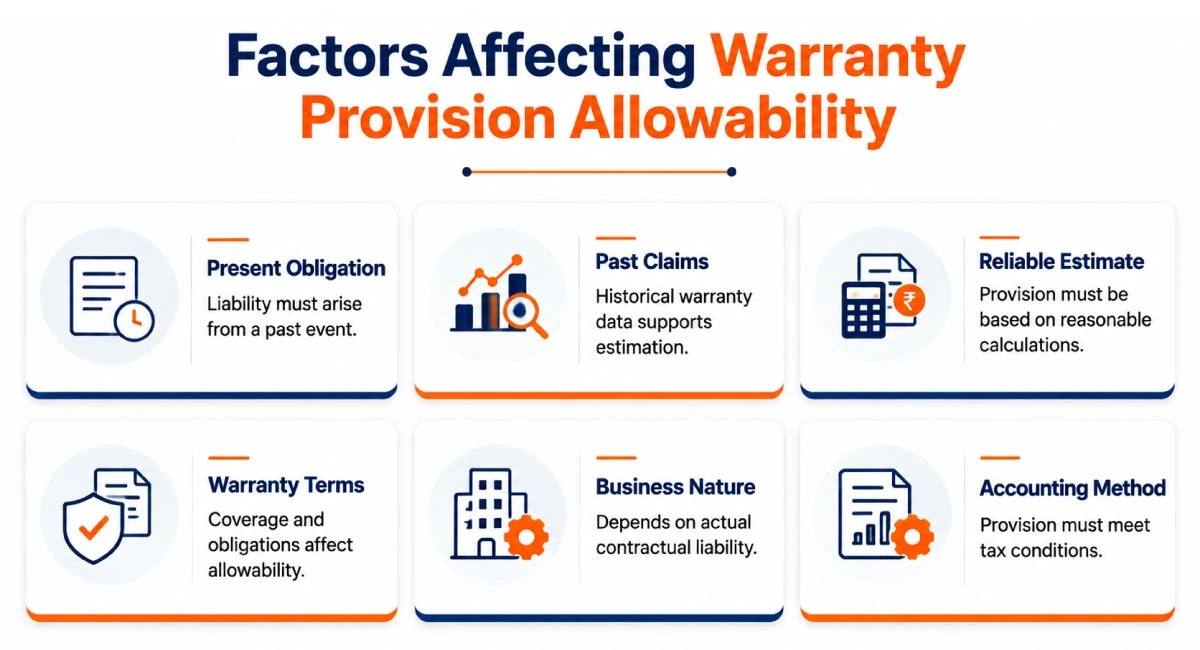
1. Existence of Present Obligation
The first condition for Warranty and Provision Allowability is the existence of a present obligation arising from a past event.
For example, when a company sells a product with a warranty period, it may have an obligation to repair or replace the product if customers raise valid warranty claims.
However, a provision created for products that may be sold in the future does not generally represent an existing liability. Such an amount may be considered a future operating expense rather than an accrued obligation.
2. Historical Warranty Claims
Past warranty experience plays an important role in determining the reasonableness of the provision.
Businesses should evaluate factors such as:
- Number of products sold
- Number of warranty claims received
- Product failure rates
- Average repair costs
- Replacement expenses
- Warranty period
- Previous provisions and reversals
A consistent record of historical claims helps establish that the provision for warranty expenses is based on a reliable estimation method.
Proper maintenance of financial records through Accounting and Bookkeeping Services helps businesses support their expense claims during tax assessments.
3. Reliable Estimation of Warranty Expenses
A reliable estimate is an essential requirement for warranty provision allowability.
For example, if past records show that a certain percentage of products require repairs during the warranty period, the business may use this information while calculating the expected liability.
Businesses should review the estimate regularly based on:
- Changes in product quality
- Customer claim patterns
- Repair costs
- Market conditions
- Actual warranty expenses incurred
A business should revise its estimation method whenever circumstances change.
4. Warranty Terms and Conditions
The terms of the warranty agreement also influence the calculation of warranty provisions.
Relevant factors include:
- Duration of warranty
- Type of defects covered
- Repair or replacement obligations
- Exclusions under warranty terms
- Expected number of claims
- Cost of fulfilling warranty obligations
The existence of a warranty period alone does not establish deductibility. The liability must also satisfy the requirements for Warranty and Provision Allowability.
5. Nature of Business Activity
Warranty provisions are not restricted only to manufacturing businesses.
The allowability depends on the actual contractual obligation and facts of each case. A service provider may also create a provision where it has a genuine obligation to rectify services already provided and the expected cost can be reasonably estimated.
The nature of business is relevant; however, the primary consideration is whether an identifiable and measurable liability exists.
6. Method of Accounting
The accounting method followed by the taxpayer is also relevant for Warranty and Provision Allowability.
Under the mercantile system of accounting, expenses are generally recognised when the liability arises, even if payment is made at a later date. However, tax deduction depends on whether the liability satisfies income-tax conditions. Merely recording a provision in the financial statements does not automatically make it deductible.
However, merely recording a provision in the financial statements does not automatically make it deductible. The underlying liability must satisfy the conditions prescribed under income-tax law.
Warranty Provision Under ICDS X
ICDS X deals with provisions, contingent liabilities and contingent assets for income computation purposes where applicable. ICDS X applies to taxpayers covered under the Income Computation and Disclosure Standards while computing taxable income under the Income-tax Act.
Under ICDS X, a provision is recognised when:
- There is a present obligation arising from a past event.
- There is a probable outflow of resources required to settle the obligation.
- The amount of liability can be reasonably estimated.
These conditions are relevant for taxpayers to whom ICDS X applies while computing taxable income under the Income-tax Act.
If these conditions are not satisfied, the amount should not be recognised as a provision for income-tax purposes.
ICDS X requires businesses to measure provisions based on the best estimate available at the end of the relevant financial year. The provision should also be reviewed regularly and adjusted according to updated facts.
Are Contingent Liabilities Allowable as Deduction?
A warranty provision and a contingent liability are different concepts.
A contingent liability generally exists where:
- The occurrence of an obligation depends on uncertain future events.
- The possibility of an outflow of resources is uncertain.
- The amount cannot be reliably estimated.
Under ICDS X, contingent liabilities are not recognised as provisions.
Therefore, a business cannot claim deduction merely because an amount has been disclosed as a possible liability in its financial statements.
For Warranty and Provision Allowability, the business must establish that the liability has already arisen and that the estimated amount is based on reasonable assumptions and supporting records.
Documents to Maintain for Warranty Provision
Businesses claiming deduction for warranty provisions should maintain adequate supporting documents to establish the basis of calculation.
Important records include:
- Warranty terms and conditions
- Product or service-wise sales details
- Historical warranty claim records
- Actual repair and replacement expenses
- Calculation basis for the provision
- Previous year warranty provisions
- Reversal of unused provisions
- Product defect and failure data
Proper documentation supports the position that the provision for warranty expenses is based on actual business experience rather than an estimated reserve created without evidence.
How Does Tax Treatment of Warranty Provision Work?
The tax treatment of warranty provision depends on whether the provision represents an actual business liability.
A business claiming a warranty deduction under income tax should demonstrate:
- The obligation arises from warranties already issued.
- The liability relates to past sales or services.
- The estimation method is consistent and reasonable.
- The calculation is supported by historical trends.
A provision that does not satisfy these conditions may be disallowed during assessment proceedings.
Therefore, businesses should review their warranty calculation process regularly to ensure compliance with applicable tax provisions.
Proper reporting of such provisions is also important while completing Income Tax Return Filing Services, as incorrect treatment may impact taxable income.
Ebizfiling Support for Warranty Provision Tax Compliance
Ebizfiling can assist businesses in reviewing the tax treatment of warranty provisions and related business expenses.
The assistance may include:
- Review of warranty provision calculations
- Analysis of supporting documents and historical data
- Guidance on tax treatment of warranty provision
- Review of business expense deductions
- Tax computation support
- Assistance with income-tax compliance requirements
For expert guidance on tax treatment of business expenses and compliance requirements, businesses can explore Tax Consultancy Services by Ebizfiling.
Proper documentation and a reasonable estimation method help businesses support Warranty and Provision Allowability during tax assessments.
Conclusion
Warranty and Provision Allowability depends on whether a genuine business obligation exists and whether the estimated liability is supported by reliable data. A warranty provision based on historical claims, contractual obligations, and a reasonable estimation method may qualify for deduction under applicable income-tax provisions. Businesses should maintain proper records, review their estimation methodology, and ensure that provisions represent actual liabilities rather than uncertain future expenses.
Frequently Asked Questions
1. Can a business calculate warranty provision as a fixed percentage of sales?
Yes, a percentage-based method may support Warranty and Provision Allowability if the percentage is calculated using historical warranty claims, repair costs and past experience. A percentage selected without supporting data may not qualify as a reasonable estimate.
2. What happens if actual warranty expenses are higher than the provision created?
If actual warranty expenses exceed the provision created, the additional expenditure may be considered based on the applicable accounting and tax principles. The business should ensure that the same expense is not claimed twice.
3. What should a business do with unused warranty provisions?
If the warranty period expires and the liability no longer exists, the unused provision should generally be reviewed and reversed. Regular review of provisions is required to ensure accurate tax treatment.
4. Is reversal of a disallowed warranty provision taxable?
Where the original warranty provision was not allowed as a deduction, the tax treatment of its reversal depends on the facts of the case. Businesses should evaluate whether taxing the reversal would result in a double impact.
5. Can actual warranty expenses be claimed if the provision was earlier disallowed?
Yes, genuine warranty expenses incurred later may be considered for deduction if they satisfy applicable tax conditions. However, the taxpayer should avoid claiming duplicate deductions.
6. Can warranty provisions be used for unrelated expenses?
No. A warranty provision should only be used for expenses relating to warranty obligations. It should not be adjusted against unrelated business expenses.
7. How does reimbursement affect warranty provision allowability?
If another party is expected to reimburse warranty expenses, such reimbursement should be considered according to applicable accounting and tax rules. The recognised amount should not exceed the related obligation.
8. Can warranty provisions be discounted to present value?
Under ICDS X, provisions are measured based on the best estimate of expenditure required to settle the obligation. ICDS X requires provisions to be measured based on the best estimate of expenditure required to settle the obligation and does not provide for discounting of provisions.
9. Does accounting recognition automatically allow warranty deduction under income tax?
No. Accounting recognition alone does not make a warranty provision deductible. The provision must satisfy the conditions under applicable income-tax provisions, including Section 37(1) of the Income-tax Act, 1961 for earlier years.
10. Can a new product have an allowable warranty provision without past claim history?
A lack of product-specific history does not automatically prevent a provision. However, the business should have a reasonable basis, such as comparable product data, technical estimates, or contractual obligations, to support the calculation.





File Income Tax Returns
File your ITR with EbizFiling at INR 1199/- only.
About Ebizfiling -



Reviews
Devang Panchal
09 Sep 2018They helped me with my company’s name change and I was quite satisfied with the way they served me. I am surely coming back to you in case of any compliance problem.
Kalla swathi
09 Apr 2022Excellent service indeed.. I appreciate the entire team for incorporating my company very well
Neeta Vakhariya
09 Mar 2018Delighted to work with them. Very efficient and hardworking staff.
September 30, 2026 By Srishti M
September 30, 2026 By Srishti M
Compliance Calendar October 2026: Key Filing Dates Introduction The Compliance Calendar October 2026 provides a consolidated view of important statutory deadlines applicable to businesses and taxpayers across GST, income tax, TDS/TCS, ROC, LLP, OPC, PF, and ESI compliances. October […]
September 30, 2026 By Srishti M
GST Appeal Against NIL Demand Now Allowed on GST Portal Introduction The Goods and Services Tax Network (GSTN) has introduced a portal-level update allowing eligible taxpayers to file appeals against GST demand orders where the demand amount is reflected as […]