

-
August 21, 2026
-
BySteffy A
Types of Charges Registered with ROC: Process, Forms and Timelines
Introduction
A company may create security over its property, assets or undertaking when it obtains a loan, working-capital facility or other secured finance. This security interest is called a charge. Understanding the types of Charge Registration with ROC helps a company select the correct MCA form and meet the filing deadline.
For clarity, this subject is governed by Chapter VI, Sections 77 to 87 of the Companies Act, 2013, read with the Companies (Registration of Charges) Rules, 2014. It is not governed by the Income-tax Act, 2025. Section 77 requires a company to register a charge created within or outside India over its property, assets or undertakings, whether tangible or otherwise and whether situated in India or outside India.
This article explains the types of Charge Registration with ROC, applicable forms, documents, process, timelines and consequences of non-compliance.
What Is a Charge Under the Companies Act, 2013?
Section 2(16) of the Companies Act, 2013 defines a charge as an interest or lien created on the property or assets of a company, or any of its undertakings, as security. It includes a mortgage.
A charge usually arises when a company borrows money and gives the lender rights over identified assets or a class of assets. The types of Charge Registration with ROC describe the event reported to the Registrar. Fixed charge, floating charge, mortgage and hypothecation describe the nature of the security.
Why Is Charge Registration Important?
The types of Charge Registration with ROC create a public record of the charge holder, amount secured, creation date and assets covered. This information helps creditors and investors identify assets already offered as security.
Under Section 77(3) of the Companies Act, 2013, an unregistered charge is not taken into account by the liquidator or another creditor. However, non-registration does not cancel the company’s contractual obligation to repay the secured money.
Types of Charge Registration with ROC
1. Creation of a Charge
Creation is the first of the types of Charge Registration with ROC. It occurs when a company creates a new security interest in favour of a bank, financial institution, debenture trustee or another lender.
The types of Charge Registration with ROC record the creation date, secured amount, charge holder, facility terms and assets. CHG-1 applies to a charge not relating to debentures. CHG-9 applies where the charge relates to debentures.
2. Modification of a Registered Charge
Modification is another of the types of Charge Registration with ROC. It applies when the terms, conditions, extent or operation of an existing registered charge change.
- Common modifications include:
- Increase or reduction in the secured amount
- Addition or release of assets
- Change in interest or repayment terms
- Assignment or change of charge holder
- Change in ranking or extent of security
Section 79 of the Companies Act, 2013 applies Section 77 to modification. The company should quote the existing Charge Identification Number. CHG-1 or CHG-9 applies depending on whether the charge relates to debentures.
3. Acquisition of Property Subject to a Charge
The types of Charge Registration with ROC also cover property acquired by a company when that property is already charged. Section 79 expressly applies the registration provisions to such acquisitions.
For these types of Charge Registration with ROC, the filing should identify the property, charge holder, amount, acquisition date and supporting instruments. This keeps the acquiring company’s public charge record complete.
4. Charge Relating to Debentures
Debenture-related security is a separate category within the types of Charge Registration with ROC. A company issuing secured debentures may create security over specified assets or undertakings for the benefit of debenture holders.
CHG-9 is used for creation or modification of a debenture-related charge. It generally contains details of the debenture trustee, issue amount, secured assets and charge instrument.
5. Satisfaction of a Charge
Satisfaction is the closing stage among the types of Charge Registration with ROC. It occurs when the debt secured by a registered charge is paid or satisfied in full.
Section 82 of the Companies Act, 2013 requires the company to intimate the Registrar. CHG-4 is used for this purpose. After satisfaction is recorded, the Registrar issues a certificate in CHG-5.
Partial repayment should not be reported as full satisfaction. A release of part of the secured amount or property may require a modification filing.
Forms of Security
Security reported through the types of Charge Registration with ROC may take the following forms:
Fixed Charge: A fixed charge generally covers a specific asset, such as land, a building, machinery or a vehicle. The company’s right to dispose of that asset may be restricted by the charge instrument.
Floating Charge: A floating charge generally covers a changing class of assets, such as stock, inventory or receivables. The company may usually deal with those assets in ordinary business until the charge crystallises under the agreed terms.
Mortgage and Hypothecation: A mortgage generally creates security over immovable property. Hypothecation commonly covers movable assets while possession remains with the company, such as vehicles, machinery, equipment, stock or receivables.
Forms Used for Charge Registration
The correct form depends on the types of Charge Registration with ROC being reported.
|
Form |
Purpose |
|
CHG-1 |
Creation or modification of a charge not relating to debentures |
| CHG-9 |
Creation or modification of a debenture-related charge |
|
CHG-4 |
Intimation of full satisfaction |
| CHG-6 |
Appointment or cessation of a receiver or manager |
|
CHG-8 |
Extension or rectification application under Section 87 |
| CHG-2 |
Certificate for registration of creation |
|
CHG-3 |
Certificate for registration of modification |
| CHG-5 |
Certificate for registration of satisfaction |
|
CHG-7 |
Register of charges maintained by the company |
Note: CHG-2, CHG-3 and CHG-5 are certificates issued by the Registrar. They are not initial application forms for the types of Charge Registration with ROC.
Time Limit for Creation or Modification
The normal period for registering the creation of a charge is 30 days from its creation.
For charges governed by the current Section 77 framework, the Registrar may allow registration within 60 days from the creation date on payment of additional fees.
If registration is still not completed, a further 60 days may be allowed on payment of the prescribed ad valorem fee. The outer period is therefore generally 120 days from creation for such charges.
Section 79 extends Section 77 to modifications. Companies should complete the types of Charge Registration with ROC promptly because subsequent registration does not affect rights acquired in the property before the charge was actually registered.
Time Limit for Satisfaction
Section 82 requires intimation of full payment or satisfaction within 30 days from that event.
After 300 days, an application for extension under Section 87 and the applicable rules may be required. Repayment does not automatically close the charge on MCA records. Filing CHG-4 completes this part of the types of Charge Registration with ROC.
Documents Required for Charge Registration
Documents for the types of Charge Registration with ROC commonly include:
- Loan or facility agreement
- Instrument creating or modifying the charge
- Mortgage deed or hypothecation agreement
- Board resolution, where applicable
- Charge holder’s details
- Amount and terms of the secured facility
- Description of charged assets
- Existing Charge Identification Number for modification
- Debenture documents, where applicable
- Repayment evidence and charge-holder confirmation for satisfaction
Documents for the types of Charge Registration with ROC should contain matching dates, amounts and asset descriptions.
Process of Charge Registration with ROC
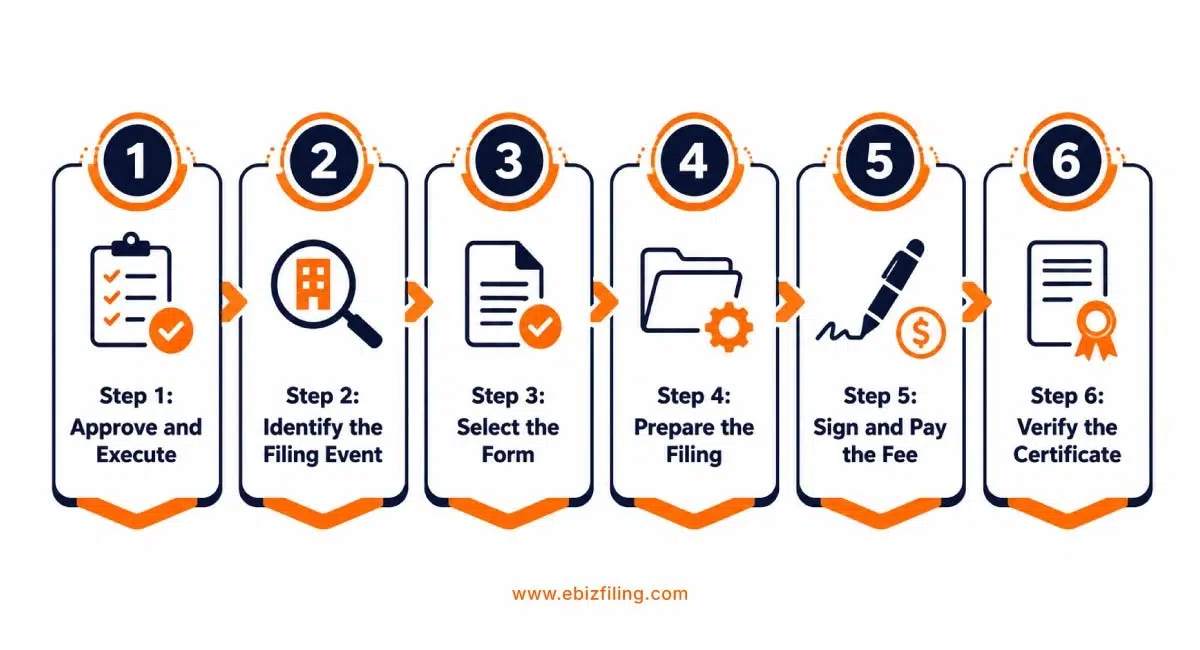
Step 1: Approve and Execute
Obtain the required corporate approval and execute the loan agreement, mortgage deed, hypothecation agreement, debenture trust deed or other security instrument.
Step 2: Identify the Filing Event
Determine whether the transaction concerns creation, modification, acquisition of charged property or satisfaction. This identifies the applicable types of Charge Registration with ROC.
Step 3: Select the Form
Use CHG-1 for non-debenture charges, CHG-9 for debenture-related charges and CHG-4 for full satisfaction.
Step 4: Prepare the Filing
Enter the charge holder’s details, secured amount, instrument date, facility terms and asset description. Attach the executed instrument and supporting records.
Step 5: Sign and Pay the Fee
Complete the required digital signatures and professional certification, where applicable. Pay the normal, additional or ad valorem fee according to the filing date.
Step 6: Verify the Certificate
After approval, review the types of Charge Registration with ROC by checking the Charge Identification Number, holder, amount, assets and relevant date.
Register of Charges Maintained by the Company
Section 85 of the Companies Act, 2013 requires every company to maintain a register of charges at its registered office. It must include charges and floating charges affecting the company’s property, assets or undertakings. Copies of the charge instruments must also be kept with the company’s records.
The types of Charge Registration with ROC appearing on MCA records should match the company’s CHG-7 register.
Charge registration is separate from Company Annual Filing. Filing Form DPT-3 for reportable outstanding receipts also does not replace registration under Section 77 where a charge has been created.
Can the Charge Holder Apply?
The company has the primary responsibility to register a charge. However, Section 78 of the Companies Act, 2013 allows the person in whose favour the charge was created to apply when the company fails to register it within the Section 77 period.
The Registrar may give notice to the company and allow registration unless the company registers the charge itself or shows sufficient cause. The charge holder may recover the applicable filing fees from the company. This mechanism supports the types of Charge Registration with ROC where the company has not completed its duty.
Consequences of Non-Compliance
Failure to complete the types of Charge Registration with ROC may result in:
- The charge not being recognised against the liquidator or other creditors
- Risk to the lender’s priority
- Inaccurate MCA records
- Problems during due diligence, refinancing or asset transfer
- Statutory penalties
Under Section 86 of the Companies Act, 2013, the company is liable to a penalty of ₹5 lakh and every officer in default is liable to a penalty of ₹50,000. Wilfully providing false or incorrect information, or knowingly suppressing material information required under Section 77, may also lead to action under Section 447.
Filing Mistakes During Charge Registration
Companies handling the types of Charge Registration with ROC should avoid:
- Selecting CHG-1 instead of CHG-9
- Missing the filing period
- Entering an incorrect secured amount or instrument date
- Giving an incomplete asset description
- Using the wrong Charge Identification Number
- Failing to register a modification
- Reporting partial repayment as full satisfaction
- Not updating CHG-7
- Assuming DPT-3 or annual filing replaces the types of Charge Registration with ROC
Simplify Charge Registration with Ebizfiling
Ebizfiling assists companies with the creation, modification and satisfaction of charges through the applicable MCA forms, including CHG-1, CHG-9 and CHG-4. The team reviews the secured amount, charge holder details, asset description and supporting documents to help maintain accurate ROC records.
Companies can also obtain support for Private Limited Company Registration and ongoing Company Compliance Services.
Need assistance with a new charge, modification or satisfaction filing? Get professional support for Charge Registration on Company Property from Ebizfiling today.
Conclusion
Creation, modification, acquisition of charged property, debenture-related security and satisfaction are the main types of Charge Registration with ROC. The applicable form depends on the event and whether the charge relates to debentures.
A company should execute proper security documents, file the correct form within the permitted period, verify the ROC certificate and update its register. Timely completion of the types of Charge Registration with ROC protects the lender’s position and keeps the company’s public records accurate.
Frequently Asked Questions
1. Does ROC charge registration transfer ownership of the asset to the lender?
No. ROC charge registration records the lender’s security interest over the asset but does not normally transfer ownership to the lender. The company continues to own the asset, subject to the enforcement rights and restrictions mentioned in the loan and security documents.
2. Can the same company asset be charged to multiple lenders?
Yes. The same asset may be charged in favour of more than one lender, subject to the existing loan agreement, lender consent and agreed security ranking. The lenders may hold a first charge, second charge or pari passu charge, and each creation or modification must be correctly registered with the Registrar of Companies.
3. Does delayed charge registration affect earlier rights over the asset?
Yes. Delayed registration does not prejudice rights acquired over the property before the charge was actually registered. A company should therefore register the charge promptly instead of relying only on the extended filing period under Section 77 of the Companies Act, 2013.
4. Can the ROC record satisfaction without Form CHG-4?
Yes. Under Section 83 of the Companies Act, 2013, the Registrar of Companies may record full or partial satisfaction of a registered charge even if the company has not filed Form CHG-4. The Registrar must have satisfactory evidence that the secured debt has been paid or satisfied, wholly or partly, or that the charged property has been released or no longer forms part of the company’s property. The Registrar must inform the affected parties within 30 days after making the entry in the register of charges.
5. What happens if a charge holder objects to CHG-4?
The Registrar may ask the charge holder to show cause within a period not exceeding 14 days as to why the satisfaction should not be recorded. If the charge holder raises an objection, the Registrar records a note in the register of charges and informs the company. A separate notice is generally unnecessary when the satisfaction form has been signed by the charge holder.
6. Is Form CHG-6 required when a receiver or manager is appointed?
Yes. Form CHG-6 is used to report the appointment or cessation of a receiver or manager in relation to charged property. Section 84 of the Companies Act, 2013 requires the relevant appointment to be intimated to the company and the Registrar of Companies within 30 days.
7. Who can inspect a company’s register of charges?
Members and creditors may inspect the company’s register of charges and the related charge instruments during business hours without paying a fee. Other persons may inspect them after paying the prescribed fee, subject to reasonable restrictions imposed by the company. This register is maintained under Section 85 of the Companies Act, 2013.
8. How can errors in CHG-1 or CHG-9 be corrected?
An omission or incorrect particular in a charge filing may be rectified under Section 87 of the Companies Act, 2013. The Central Government may permit rectification where the error was accidental, caused by inadvertence or another sufficient reason, or where it does not prejudice the company’s creditors or shareholders. Approval depends on the facts and supporting documents.
9. Can Ebizfiling assist with pari passu or consortium charge registration?
Yes. Ebizfiling can assist with reviewing the joint-charge documents, compiling the particulars of participating lenders and preparing the applicable CHG-1 or CHG-9 filing. The company must provide complete security documents, lender details and the agreed charge ranking for accurate registration.
10. Can Ebizfiling help modify, satisfy or rectify an existing MCA charge?
Yes. Ebizfiling can review the existing MCA charge record and supporting documents to identify whether a modification, satisfaction or rectification filing is required. It can assist with preparing and submitting the relevant charge form, while approval remains subject to review by the competent authority.





Create A Charge
Create charge on the property or assets of a company or any of your undertakings with Ebizfiling.
About Ebizfiling -



Reviews
Akshay Sharma
18 Apr 2022I took a TM service for my Tea Brand, wonderful service with humble staff, and provided solutions on time. Recommended for all
Ateek Mohd
23 Apr 2022Ebizfiling India pvt ltd is leading account services provider across the country. They have a very good and genuine staff. They give all the services in given time frame. My two company’s accountability done by this firm. Awesome service ..!
Kalla swathi
09 Apr 2022Excellent service indeed.. I appreciate the entire team for incorporating my company very well
July 9, 2026 By Steffy A
AML obligations for Practicing CS under FIU-IND Framework Introduction AML obligations for Practicing CS are becoming increasingly important in today’s evolving regulatory environment, where the role of Practicing Company Secretaries has expanded beyond traditional compliance functions into areas involving corporate […]
June 26, 2026 By Steffy A
Why Online Legal Services Are Growing in India? Introduction The legal industry is evolving rapidly as technology reshapes how legal assistance is delivered. In India, online legal services are growing because they address historical challenges such as court backlogs, complex […]
June 26, 2026 By Steffy A
Why More Businesses Are Choosing Outsourcing Legal Work? Introduction Businesses are increasingly turning to outsourcing legal work to manage compliance, contracts, and regulatory responsibilities more efficiently. Through Legal Process Outsourcing, companies can reduce operational costs while gaining access to experienced […]