

-
September 25, 2026
Trademark Registration in Mumbai: Process Guide
Introduction
Mumbai is one of India’s largest commercial centres, with businesses operating across finance, technology, entertainment, fashion, hospitality, FMCG, consulting and global services. In such a competitive business environment, protecting a brand identity becomes an important part of long-term growth.
Trademark Registration in Mumbai helps eligible businesses protect their brand names, logos, product names, service names and other distinctive marks used for their goods or services under the Trade Marks Act, 1999.
For startups, established companies and growing businesses, trademark protection can help create ownership over valuable brand assets and reduce the risk of third parties using similar marks.
Businesses planning brand protection can review Ebizfiling’s Trademark Registration Service for assistance with the filing process.
Quick Insights
- Trademark applications are generally filed through Form TM-A.
- Maharashtra-based applicants generally fall under the jurisdiction of the Mumbai Trade Marks Registry.
- Trademark protection depends on correct class selection and accurate goods/services description.
- A trademark search before filing helps identify possible conflicts.
- Government fees are charged per mark and per class.
- A registered trademark is valid for 10 years and can be renewed for further periods of 10 years.
Why Should Businesses Consider Trademark Registration in Mumbai?
The business ecosystem of Mumbai includes startups, financial institutions, technology companies, entertainment brands and consumer businesses. For these businesses, a trademark can become an important commercial asset.
Trademark Registration in Mumbai can be relevant for:
- Fintech companies
- Financial service providers
- Technology startups
- Software and SaaS businesses
- Fashion and lifestyle brands
- Restaurants and hospitality businesses
- Media and entertainment companies
- FMCG brands
- Consulting firms
- Export-oriented businesses
A registered trademark gives the proprietor exclusive rights to use the trademark in relation to the goods or services for which it is registered, subject to the provisions, conditions and limitations of the Trade Marks Act, 1999.
Businesses often invest heavily in marketing, customer acquisition and brand development. Protecting the brand early can help avoid disputes and strengthen business value.
Which Trade Marks Registry Handles Trademark Registration in Mumbai?
For an applicant whose principal place of business in India is in Maharashtra, the relevant office is generally the Mumbai Trade Marks Registry.
IP India has designated territorial jurisdictions for different Trade Marks Registry offices, and Maharashtra falls under the Mumbai Trade Marks Registry.
Therefore, businesses based in Mumbai can file and manage trademark applications through the appropriate Registry jurisdiction.
However, the application process itself is carried out through the official trademark filing system, and businesses can submit applications online.
Who Can Apply for Trademark Registration in Mumbai?
A person claiming to be the proprietor of a trademark may apply for registration.
Depending on the business structure, an applicant for Trademark Registration in Mumbai may be:
- Individual
- Sole proprietorship
- Partnership firm
- Limited Liability Partnership (LLP)
- Private Limited Company
- One Person Company (OPC)
- Startup
- Small Enterprise
- Other eligible legal entities
The trademark application should be filed in the name of the actual proprietor of the mark.
For example, if a brand is owned and operated by a company, the company should generally be reflected as the trademark applicant rather than an individual founder unless there is a valid ownership arrangement.
Businesses can review Ebizfiling’s Private Limited Company Registration Service and LLP Registration Service when deciding the appropriate ownership structure for their business.
Eligible startups and small enterprises may also review DPIIT Startup India Recognition and MSME-related registrations where applicable.
What Types of Brands Can Mumbai Businesses Protect Through Trademark Registration?
A trademark application can cover eligible marks that help customers identify the source of goods or services.
Trademark Registration in Mumbai may be considered for:
- Brand names
- Word marks
- Logos
- Product names
- Service names
- Taglines
- Labels
- Device marks
- Other distinctive marks
Different industries may have different trademark protection requirements.
Technology and Digital Brands
Mumbai-based technology businesses may seek protection for:
- Software brands
- Mobile applications
- SaaS platforms
- Digital services
Financial and Professional Brands
Financial and consulting businesses may consider protection for:
- Service names
- Advisory brands
- Financial technology platforms
- Professional service identities
- Consumer and Lifestyle Brands
Businesses in fashion, food, hospitality and lifestyle sectors may protect:
- Product brands
- Restaurant names
- Fashion labels
- Consumer product identities
The ability to register a trademark depends on whether the mark satisfies the requirements of the Trade Marks Act, including distinctiveness and other applicable legal conditions.
Why Conduct a Trademark Search Before Filing in Mumbai?
A trademark search is one of the important steps before filing an application.
Before applying for Trademark Registration in Mumbai, businesses should check whether similar trademarks already exist.
A search can help identify:
- Identical trademarks
- Similar brand names
- Similar logos
- Phonetically similar marks
- Existing applications
- Registered trademarks in related classes
This is especially important for Mumbai businesses investing in:
- Advertising campaigns
- Packaging
- Website development
- Mobile applications
- Product launches
- Market expansion
A trademark search does not guarantee registration, but it helps businesses understand possible risks before filing.
Businesses can use Ebizfiling’s Trademark Search and Registration Service to review trademark availability and filing requirements.
How to Select the Correct Trademark Class for a Mumbai Business?
Trademark protection is linked to the goods and services mentioned in the application.
Selecting the correct class is an important part of Trademark Registration in Mumbai because protection is granted only for the goods and services specified in the application.
Mumbai businesses may require different classes depending on their industry.
Technology Businesses
Examples:
- Software products
- IT services
- SaaS platforms
- Digital solutions
Financial Businesses
Examples:
- Financial services
- Consulting services
- Fintech platforms
Fashion and Lifestyle Businesses
Examples:
- Clothing
- Accessories
- Lifestyle products
Food and Hospitality Businesses
Examples:
- Restaurants
- Food products
- Catering services
Media and Entertainment Businesses
Examples:
- Production services
- Entertainment brands
- Digital content
Businesses should select classes based on actual goods or services rather than selecting classes only because another company has used them.
Companies planning multi-category protection can also consider whether a multi-class trademark application is suitable.
Businesses can use Ebizfiling’s Trademark Class Finder to understand relevant trademark classes before filing.
Trademark Registration Process in Mumbai
The process for Trademark Registration in Mumbai generally involves the following stages:
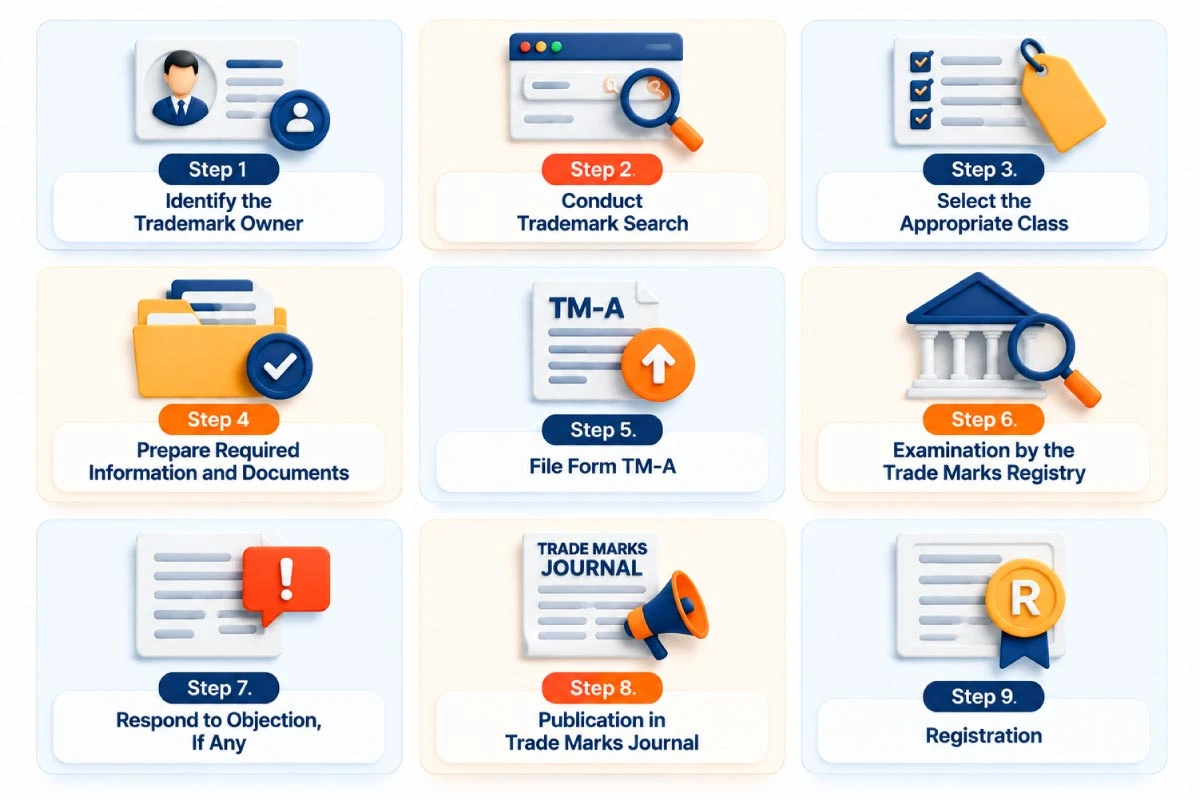
Step 1: Identify the Trademark Owner
The applicant should determine the actual proprietor of the trademark.
Ownership details should match the person or entity that owns and controls the brand.
Step 2: Conduct Trademark Search
A search should be performed to identify possible conflicts with existing trademarks.
Step 3: Select the Appropriate Class
The applicant should identify the correct goods or services classification.
Step 4: Prepare Required Information and Documents
Common requirements include:
- Applicant details
- Trademark representation
- Goods/services description
- User details
- Supporting documents, where applicable
Step 5: File Form TM-A
A new trademark application is generally filed through Form TM-A under the Trade Marks Rules, 2017.
The application should include accurate information regarding:
- Applicant
- Trademark
- Class
- Goods/services
- User status
Step 6: Examination by the Trade Marks Registry
After filing, the Registry examines the application.
The Registry may issue an examination report if objections arise.
Step 7: Respond to Objection, If Any
Where objections are raised, the applicant may need to submit a response and attend a hearing where required.
Step 8: Publication in Trade Marks Journal
If accepted, the application is published in the Trade Marks Journal.
Third parties may oppose the application within the prescribed period.
Step 9: Registration
If no opposition is filed or opposition proceedings are resolved in favour of the applicant, the trademark may proceed towards registration.
Documents Required for Trademark Registration in Mumbai
The documents required for Trademark Registration in Mumbai depend on the applicant type, ownership structure and filing basis.
Commonly required information and documents may include:
|
Applicant Type |
Common Requirements |
|
Individual |
Identity proof, address proof and trademark details |
| Proprietorship |
Proprietor details and business-related information |
|
Partnership Firm |
Partnership details and applicant information |
| LLP |
LLP details and authorised applicant information |
|
Private Limited Company |
Incorporation details and authorised signatory information |
| Prior Use Claim |
User affidavit and supporting evidence, where applicable |
Other commonly required details include:
- Trademark representation
- Description of goods or services
- Applicant address
- User status of the trademark
- Power of Attorney, where an authorised agent is appointed
Where prior use of a trademark is claimed, supporting evidence should be maintained to support the use claim.
Applicants should ensure that all information submitted in the application is accurate because incorrect ownership or user details can create complications during examination or later enforcement.
Trademark Registration Fees in Mumbai
The government fee for Trademark Registration in Mumbai depends on the applicant category and number of classes covered.
|
Applicant Category |
Government E-Filing Fee |
|
Individual / Startup / Small Enterprise |
₹4,500 per mark per class |
| Other Applicants |
₹9,000 per mark per class |
These are official government filing fees. Professional charges, if applicable, are separate.
For example, if a business files one trademark in three classes, the applicable government fee is payable separately for each class.
Businesses should also consider whether their application requires single-class or multi-class protection based on their actual goods and services.
How Long Does Trademark Registration Take in Mumbai?
There is no fixed timeline for completing Trademark Registration in Mumbai because the process depends on multiple factors.
The timeline may be affected by:
- Examination by the Trade Marks Registry
- Objections raised by the Registry
- Response submissions
- Hearing requirements
- Third-party opposition
- Procedural delays
The general stages include:
- Filing of trademark application
- Formal examination
- Substantive examination
- Objection response, if required
- Journal publication
- Opposition period
- Registration
Businesses should avoid assuming that filing an application automatically results in registration.
Trademark Challenges Faced by Mumbai Businesses
Mumbai businesses operate across highly competitive sectors, which can create specific trademark challenges.
Similar Brand Names in Competitive Markets
With multiple businesses operating in similar industries, similar brand names may already exist.
This is common in sectors such as:
- Food and beverages
- Fashion
- Technology
- Consulting
- Financial services
A detailed trademark search before filing can help identify possible conflicts.
Digital Brand Conflicts
Mumbai has a growing ecosystem of digital businesses, startups and online brands.
Common issues include:
- Similar app names
- Similar domain-based brands
- Digital service names already in use
- Social media brand conflicts
Businesses should evaluate trademark protection along with their digital branding strategy.
Incorrect Trademark Class Selection
Different businesses require different classes depending on their activities.
For example:
- A fashion business may require protection for clothing-related goods.
- A software company may require protection for technology services.
- A restaurant may require protection for food and hospitality-related services.
Selecting the wrong class can limit the protection available.
Ownership Issues
Many businesses face ownership-related issues when trademarks are filed without considering the actual brand owner.
Examples include:
- Founder filing a trademark personally when the company owns the brand
- Partnership changes
- Business restructuring
- Transfer of ownership
Correct ownership details should be considered before filing.
Trademark Registration for Mumbai Startups and Growing Businesses
Mumbai has a strong startup ecosystem across fintech, technology, consumer brands and professional services.
For startups, Trademark Registration in Mumbai can support:
- Brand identity protection
- Business expansion
- Investor discussions
- Market positioning
- Long-term intellectual property strategy
Startups should consider trademark protection at an early stage, especially before investing heavily in marketing, product development or customer acquisition.
International Trademark Protection for Mumbai Businesses
Many Mumbai-based businesses operate beyond Indian markets through exports, online platforms and international partnerships.
International trademark protection may be relevant for:
- Export businesses
- Global startups
- Technology companies
- D2C brands
- International service providers
The Madrid System allows eligible applicants to seek trademark protection in multiple member countries through a centralised international filing mechanism.
However, international registration does not automatically guarantee protection in every country. Each designated member examines protection according to its own trademark laws.
Businesses planning global expansion can review Ebizfiling’s International Trademark Registration under Madrid Protocol for understanding international filing options.
Trademark Objection and Opposition: What Mumbai Businesses Should Know
Trademark registration does not always proceed directly from filing to registration.
Two common challenges are:
Trademark Examination Objection
An examination objection may be raised by the Trade Marks Registry.
Reasons may include:
- Lack of distinctiveness
- Similar earlier trademark
- Incorrect application details
- Other legal grounds
The applicant may need to submit a response addressing the objections.
Businesses facing examination issues can review Ebizfiling’s Trademark Objection Reply Service for assistance.
Trademark Opposition
After publication in the Trade Marks Journal, third parties may oppose the application within the prescribed period.
Opposition proceedings may involve:
- Notice of opposition
- Counter-statement
- Evidence
- Hearing
- Decision by the Registry
Businesses should continue monitoring their applications even after acceptance and publication.
Trademark Renewal and Long-Term Brand Protection
Trademark protection does not end after registration.
A registered trademark is generally valid for 10 years and can be renewed for further periods of 10 years.
Businesses should maintain:
- Renewal schedules
- Ownership records
- Trademark portfolio details
- Monitoring systems for conflicting marks
Long-term trademark management is especially important for businesses with multiple brands, products or international operations.
Businesses can review Ebizfiling’s Trademark Renewal Service for renewal-related assistance.
Common Mistakes to Avoid During Trademark Registration in Mumbai
Businesses should avoid:
- Filing without conducting a trademark search
- Selecting incorrect trademark classes
- Filing under the wrong proprietor name
- Ignoring examination reports
- Delaying trademark filing after brand launch
- Assuming company registration protects the brand
- Ignoring renewal deadlines
- Failing to monitor similar trademark applications
A well-planned trademark strategy can help businesses protect their brand more effectively.
How Ebizfiling Can Help With Trademark Registration in Mumbai
Trademark Registration in Mumbai involves more than submitting an application. Correct trademark search, class selection, ownership details, documentation and ongoing monitoring all play an important role.
Ebizfiling can assist businesses with:
- Trademark search
- Class identification
- Application filing
- Documentation support
- Examination objection assistance
- International trademark guidance
- Renewal support
With experience supporting businesses across industries, Ebizfiling helps entrepreneurs and companies understand the requirements for protecting their brands.
Planning to protect your brand in Mumbai? Connect with Ebizfiling experts for trademark registration support and understand the right filing approach for your business.
Conclusion
Trademark Registration in Mumbai is important for businesses operating in one of India’s most competitive commercial markets. From startups and technology companies to fashion brands, financial businesses and consumer enterprises, protecting a brand can support long-term growth.
Businesses should focus on conducting proper searches, selecting appropriate classes, maintaining accurate ownership details and managing trademarks after registration. A strategic approach to Trademark Registration in Mumbai can help businesses build stronger brand protection and reduce avoidable trademark-related challenges.
Frequently Asked Questions
1. Which Trade Marks Registry handles trademark applications filed by businesses in Mumbai?
For an applicant whose principal place of business in India is in Mumbai, the relevant office is generally the Mumbai Trade Marks Registry. The jurisdiction of the Trade Marks Registry is determined based on the applicant’s principal place of business in India or, where applicable, the address for service in India.
2. Does a trademark registered in Mumbai provide protection only within Maharashtra?
No. The location of filing determines the appropriate Trade Marks Registry but does not restrict the protection area. A registered trademark provides rights throughout India in relation to the goods or services covered by the registration, subject to the provisions of the Trade Marks Act, 1999.
3. Which trademark classes are commonly relevant for Mumbai-based technology and startup businesses?
The appropriate trademark class depends on the actual goods or services offered by the business. Technology startups may require protection for software, IT services, SaaS platforms, consulting services or other relevant categories. Businesses should select classes based on their current and intended activities rather than the industry name alone.
4. Should Mumbai businesses conduct a trademark search before launching a brand?
Yes. A trademark search before filing can help identify identical or similar trademarks, related goods/services conflicts and possible objection risks. This is especially important for Mumbai businesses investing in marketing campaigns, digital platforms, packaging and brand launches.
5. Can a Mumbai business file one trademark application for multiple products or services?
Yes. A single trademark application can cover multiple classes where the same mark is used or proposed to be used for different goods or services. However, the prescribed government fee is payable separately for each class and each mark.
6. Can a Mumbai startup register a trademark before launching its product?
Yes. A trademark application can generally be filed on a proposed-to-be-used basis where the mark has not yet been commercially used. However, the applicant should ensure that the proposed trademark is capable of registration and does not conflict with existing trademarks.
7. What happens if a Mumbai trademark application receives an examination objection?
An examination objection does not automatically mean that the trademark application will be rejected. The applicant may need to submit a response addressing the objections raised by the Trade Marks Registry along with relevant supporting documents or arguments. If required, a hearing may also be scheduled.
8. How can Mumbai businesses protect their brand internationally after trademark registration in India?
Businesses expanding internationally can explore international trademark protection through systems such as the Madrid Protocol, where eligible applicants can seek protection in multiple member countries through a centralised filing mechanism. However, each designated member examines protection according to its own trademark laws.
9. Can Ebizfiling help Mumbai businesses choose the correct trademark class before filing?
Yes. Ebizfiling can assist businesses with trademark class identification, search review and filing strategy before submitting an application. Selecting the correct class is important because trademark protection is linked to the goods and services mentioned in the application.
10. Can Ebizfiling assist Mumbai businesses with trademark objection and registration support?
Yes. Ebizfiling can assist with reviewing examination objections, preparing responses, supporting trademark filing requirements and providing guidance throughout the registration process. Businesses can also get support for search, filing, objection handling and post-registration requirements.





Trademark Registration
Protect your name and logo from unauthorised usage. Apply for trademark with EbizFiling
About Ebizfiling -



Reviews
Debasis Mishra
28 Jul 2020Very good Service. The staffs are very cooperative. Particularly Nilesh is very cooperative and punctual. They deliver all the documents on time. Thank you all for your support.
Priyanka
19 Mar 2019Great work by ebiz team. Very supportive. Highly recommended.
Raj
03 Sep 2019Very cooperative Team.
October 15, 2026 By Srishti M
TDS and TCS Compliance Calendar November 2026: Compliance Guide Introduction The TDS and TCS Compliance Calendar November 2026 covers important tax deduction, collection, payment, certificate and reporting requirements applicable during the month. It helps businesses, government offices and other responsible […]
October 14, 2026 By Srishti M
GST Compliance Calendar November 2026: Key Due Dates & Filings Introduction The GST Compliance Calendar November 2026 highlights the major GST return filing, tax payment, invoice reporting and year-end adjustment deadlines applicable during the month. It covers regular taxpayers, QRMP […]
October 13, 2026 By Srishti M