

-
August 27, 2026
-
BySteffy A
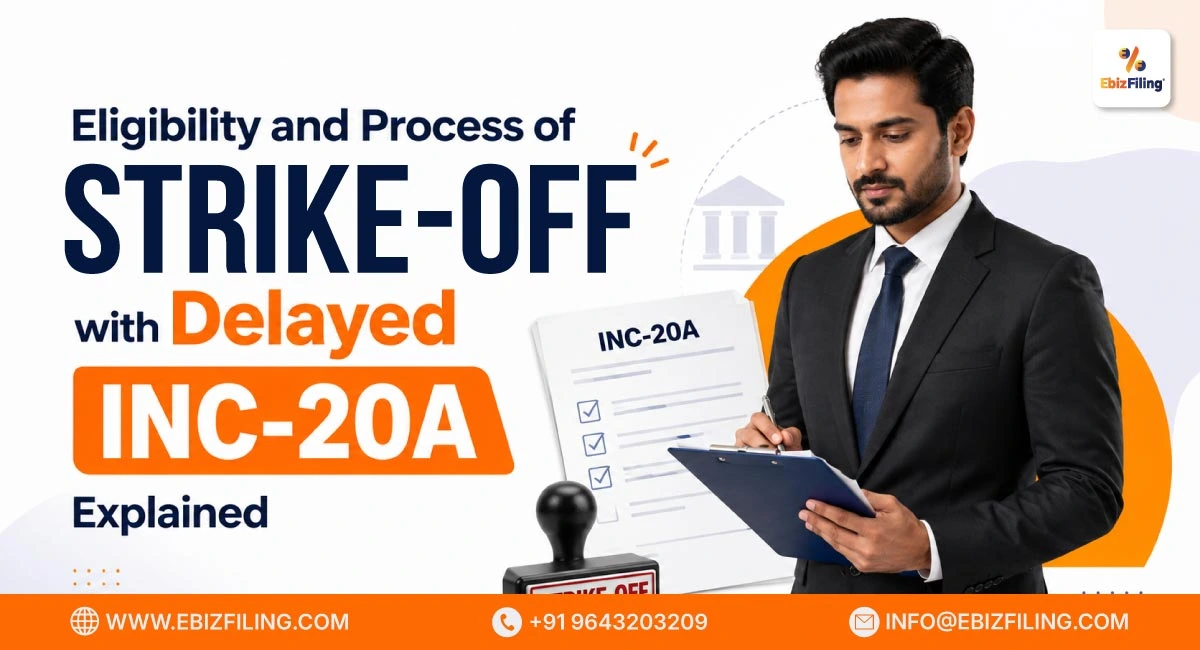
Strike-Off with Delayed INC-20A: Eligibility and Process
Introduction
A newly incorporated company may sometimes remain inactive because it is unable to open a bank account, receive subscription money, or complete initial compliance requirements. The situation can become more complicated when a foreign director is located outside India and banking or document execution takes additional time. In such cases, Strike-Off with Delayed INC-20A becomes an important compliance question.
For companies incorporated after 2 November 2018 and having share capital, Section 10A of the Companies Act, 2013 requires the prescribed declaration for commencement of business within 180 days from incorporation. However, an INC-20A filing delay does not automatically make a company eligible for closure. For Strike-Off with Delayed INC-20A, the company must examine its subscription money, business activity, age and the applicable ground under Section 248.
What Is the INC-20A Filing Requirement?
INC-20A is the prescribed declaration relating to commencement of business under Section 10A of the Companies Act, 2013. It applies to companies incorporated after 2 November 2018 and having share capital. Companies can also understand the detailed INC-20A filing requirements before determining how a filing delay affects their compliance position.
A director must file the declaration within 180 days from the date of incorporation, confirming that every subscriber to the memorandum has paid the value of the shares agreed to be taken by them.
The INC-20A 180 days timeline therefore becomes important in cases involving Strike-Off with Delayed INC-20A. An INC-20A filing delay may arise where a company cannot open a bank account, subscribers are unable to bring in subscription money, or practical difficulties delay completion of the required formalities.
However, a delayed INC-20A filing should not be considered in isolation. The company must also examine whether subscription money has been paid, whether any business activity has commenced and whether an appropriate legal ground exists for Strike-Off with Delayed INC-20A.
When Does Strike-Off Eligibility Arise?
Strike-off eligibility under Section 248 depends on the circumstances of the company. Businesses considering closure should first understand the broader strike-off eligibility for companies before determining which statutory ground applies to their case.
One of the grounds under Section 248 applies where a company has failed to commence its business within one year of incorporation. Another applies where a company has not carried on any business or operation for two immediately preceding financial years and has not applied for dormant company status.
For Strike-Off with Delayed INC-20A, Section 248(1)(d) is especially relevant. It applies where the subscribers to the memorandum have not paid the subscription amount they undertook to pay at the time of incorporation and the declaration required under Section 10A has not been filed within 180 days from incorporation.
Both conditions are important. Section 10A non-compliance alone should not be treated as automatic strike-off eligibility.
Therefore, simply completing 180 days without filing INC-20A does not automatically entitle every company to Strike-Off with Delayed INC-20A.
Can a Company Apply for Strike-Off Before 180 Days?
Consider a newly incorporated company that is approximately 146 days old. At that stage, the INC-20A 180 days period has not yet expired.
Accordingly, Strike-Off with Delayed INC-20A cannot yet be based on Section 248(1)(d), because the statutory condition relating to failure to file the Section 10A declaration within 180 days has not been completed.
The separate ground relating to failure to commence business within one year of incorporation has also not arisen merely because the company is inactive at day 146. Similarly, the two-financial-year inactivity ground would not ordinarily apply to such a recently incorporated entity.
For a strike-off of newly incorporated company, the company must identify a Section 248 ground that has actually arisen before making an application. Filing before the relevant statutory conditions are satisfied may therefore be premature.
Can a Company Be Struck Off Without Filing INC-20A?
Company strike-off without INC-20A may be possible where the company satisfies an applicable ground under Section 248 and complies with the requirements for voluntary strike-off.
INC-20A does not necessarily have to be filed merely for the purpose of closing an inactive company.
This is particularly relevant to Strike-Off with Delayed INC-20A because Section 248(1)(d) itself recognises a situation where the Section 10A declaration has not been filed within 180 days and the subscribers have also not paid their subscription money.
However, company closure without INC-20A does not become automatic when 180 days are completed. The company must still satisfy the applicable Section 248 ground, extinguish its liabilities, obtain the required approval and complete the prescribed filing requirements.
Why Subscription Money Is Important?
Subscription money is a key factor in Strike-Off with Delayed INC-20A.
Section 248(1)(d) links two conditions:
- Subscribers have not paid the subscription money they undertook to pay at the time of incorporation; and
- The declaration under Section 10A has not been filed within 180 days.
Therefore, Section 10A non-compliance should not be confused with automatic eligibility for strike-off.
For example, if subscription money has already been paid but INC-20A remains unfiled, Section 248(1)(d) should not automatically be assumed to apply merely because there is a delayed INC-20A filing.
Before considering company closure without INC-20A, the company should verify its subscription records and understand the reason for non-filing. This helps ensure that Strike-Off with Delayed INC-20A is being considered on the correct statutory basis.
What If the Company Could Not Open a Bank Account?
A company may face difficulty opening a bank account because of KYC requirements, the location of directors, documentation issues or other banking procedures.
Where a bank account has not been opened, subscribers may also be unable to bring in subscription money. This can result in an INC-20A filing delay.
If the company has not started business and the subscription money remains unpaid, the 180-day timeline should be monitored carefully. Once the prescribed period has expired, Strike-Off with Delayed INC-20A may be examined if the conditions under Section 248(1)(d) are actually satisfied.
The inability to open a bank account is not, by itself, an independent statutory ground for strike-off. Therefore, for company strike-off without INC-20A, the company should focus on the applicable Section 248 ground and other legal requirements rather than the banking difficulty alone.
Where the company intends to continue operations instead of proceeding with closure, professional assistance with INC-20A filing can help in completing the commencement of business compliance.
Does a Foreign Director Affect the Strike-Off Process?
A company strike-off with foreign director is not prohibited merely because one or more directors are located outside India. Companies dealing with overseas directors may also refer to the compliance requirements relating to a foreign director in an Indian company.
The location or nationality of a director does not change the basic legal grounds for Strike-Off with Delayed INC-20A. However, it can create practical requirements relating to execution and authentication of documents.
Depending on the document and the circumstances, documents executed outside India may require notarisation, apostillisation or consularisation, as applicable.
The company should also ensure that the authorised director can complete the applicable signing requirements for Form STK-2, including digital or other permitted execution requirements.
Therefore, a company strike-off with foreign director may require additional planning, but it does not create a separate strike-off ground or change the fundamental requirements for Strike-Off with Delayed INC-20A.
How Should STK-2 Filing Be Approached?
Form STK-2 is used by a company for making a voluntary application for removal of its name under Section 248(2). Such applications are presently processed through the Centre for Processing Accelerated Corporate Exit, commonly known as C-PACE. Companies can review the detailed process to file Form STK-2 for closing a company before preparing the application.
Before STK-2 filing, the company must extinguish its liabilities.
The company must also obtain the required member approval. Section 248(2) provides for a special resolution or consent of 75% of members in terms of paid-up share capital, subject to the applicable legal requirements.
For Strike-Off with Delayed INC-20A, the appropriate statutory ground should be identified before submitting the application.
If Section 248(1)(d) is being relied upon, the company should confirm that both conditions are present: subscription money remains unpaid and the Section 10A declaration has not been filed within the prescribed 180-day period.
Careful STK-2 filing is especially important in a strike-off of newly incorporated company, since the applicable eligibility period may only recently have been completed.
Section 249 Restrictions Should Also Be Checked
Even where strike-off eligibility under Section 248 appears to exist, the company must also consider the restrictions contained in Section 249 of the Companies Act, 2013.
Section 249 restricts a company from making a voluntary strike-off application in certain situations, including specified activities carried out during the three months immediately preceding the application.
Restrictions may also arise in certain cases involving a pending compromise or arrangement or where the company is being wound up under the applicable law.
Therefore, Strike-Off with Delayed INC-20A should not be evaluated solely on the basis of Section 248. The company should also ensure that no restriction under Section 249 prevents the proposed application.
This review is important because satisfying a ground under Section 248 does not automatically remove the restrictions applicable to an STK-2 filing.
Practical Timeline for a Newly Incorporated Company
For a company that is around 146 days old, Strike-Off with Delayed INC-20A cannot yet be based on the specific 180-day ground under Section 248(1)(d).
Until the expiry of 180 days, the company should assess whether subscription money will be paid, whether the required declaration can be filed and whether the company intends to commence business.
After 180 days, if the subscribers have not paid their subscription money and the Section 10A declaration remains unfiled, strike-off eligibility under Section 248 may be examined under Section 248(1)(d).
At that stage, company closure without INC-20A may be considered, subject to the requirements of Section 248(2), the restrictions under Section 249 and the prescribed procedural requirements.
Completion of 180 days should therefore be treated as a point at which eligibility can be examined. It should not be treated as an automatic approval for Strike-Off with Delayed INC-20A.
Key Checks Before Strike-Off with Delayed INC-20A
Before proceeding with Strike-Off with Delayed INC-20A, the company should confirm:
- Whether 180 days have passed from the date of incorporation;
- Whether subscribers have paid the agreed subscription money;
- Whether INC-20A remains unfiled;
- Whether the company has commenced any business or operations;
- Whether all liabilities have been extinguished;
- Whether the required member approval has been obtained;
- Whether any restriction under Section 249 applies;
- Whether the foreign director can complete the required document execution and authentication; and
- Whether the necessary documents for STK-2 filing are ready.
These checks are particularly important in a strike-off of newly incorporated company, where the statutory timelines may not yet have been completed.
They also help distinguish genuine Section 10A non-compliance from a situation where Strike-Off with Delayed INC-20A is not yet available.
For a company strike-off with foreign director, adequate time should also be allowed for execution and authentication of documents, wherever required.
Need Assistance with Company Strike-Off?
Ebizfiling provides professional support for company strike-off, STK-2 filing, INC-20A compliance, eligibility review, and related MCA documentation. Whether the company has delayed INC-20A filing, unpaid subscription money, or a foreign director, Ebizfiling can assist in reviewing the applicable requirements and completing the closure process correctly.
Get expert assistance from Ebizfiling for your company strike-off and MCA compliance requirements.
Conclusion
A careful legal review is essential before proceeding with Strike-Off with Delayed INC-20A. The availability of Strike-Off with Delayed INC-20A depends on the date of incorporation, payment of subscription money, business activity and the specific ground available under Section 248.
A company that is only around 146 days old should not rely on the specific 180-day ground before that statutory period expires.
After 180 days, unpaid subscription money together with non-filing of the Section 10A declaration may support consideration of Section 248(1)(d). However, a delayed INC-20A filing alone does not create an automatic right to close the company.
Before proceeding with Strike-Off with Delayed INC-20A, the company should confirm its eligibility, extinguish liabilities, obtain the required approvals, check Section 249 restrictions and complete the prescribed documentation. Companies requiring professional assistance can use Ebizfiling’s company strike-off service for eligibility review, documentation and filing support. Where a company strike-off with foreign director is involved, additional attention should also be given to proper execution and authentication of documents.
Frequently Asked Questions
1. Are overdue annual returns and financial statements required before filing Form STK-2?
Yes. Under the current Removal of Names Rules, a company applying for strike-off must file overdue financial statements and annual returns up to the end of the financial year in which it ceased carrying on business operations. This requirement should be checked before submitting Form STK-2.
2. Can a Section 8 company apply for voluntary strike-off through Form STK-2?
No. Section 248(3) specifically provides that the voluntary strike-off mechanism under Section 248(2) does not apply to a company registered under Section 8 of the Companies Act, 2013. Such companies must follow the applicable legal process for closure.
3. Can Form STK-2 be filed if an unsatisfied charge is registered against the company?
The MCA STK-2 filing requirements provide that there should not be any open or unsatisfied charge against the company when the form is filed. Therefore, the charge records should be reviewed and appropriate satisfaction filings completed, where applicable, before proceeding.
4. Is professional certification required for Form STK-2?
Yes. The STK-2 webform is required to be certified by a Chartered Accountant, Cost Accountant or Company Secretary in whole-time practice. The professional certifies the form by digitally signing it and providing the applicable membership or certificate of practice details.
5. Does strike-off eliminate earlier liabilities of the company or its officers?
No. Strike-off does not automatically extinguish liabilities that existed before dissolution. Section 248(7) provides that the liability of directors, managers, other officers exercising management powers and members may continue and can be enforced as if the company had not been dissolved.
6. Can a company be restored after its name has been struck off?
Yes, subject to the conditions under Section 252. An aggrieved person may appeal against the Registrar’s strike-off order within three years. In addition, a company, member, creditor or workman may seek restoration before the Tribunal within twenty years in the circumstances specified under Section 252(3).
7. Does a regulated company need approval from its sectoral regulator before voluntary strike-off?
Yes. Where a company is regulated under a special law, Section 248(2) requires approval from the relevant regulatory authority to be obtained and enclosed with the strike-off application. This may be relevant to companies regulated by authorities such as RBI, SEBI or IRDAI.
8. Can STK-2 be filed when an application for conversion of the company into an LLP is pending?
The MCA STK-2 filing instructions require that Form 18 for conversion into an LLP should not be approved or pending for approval, including cases where the applicable filing fee remains unpaid. Such pending conversion activity should therefore be resolved before proceeding with STK-2.
9. How can Ebizfiling help identify pending compliances before filing STK-2?
Ebizfiling can assist in reviewing the company’s MCA compliance position, including pending annual filings, registered charges, statutory records and other filing requirements that may affect the strike-off application. This helps identify compliance gaps that may need to be resolved before proceeding with company closure.
10. Can Ebizfiling assist with preparing and filing Form STK-2?
Yes. Ebizfiling can assist with reviewing strike-off eligibility, preparing the required documents, coordinating professional certification and completing the Form STK-2 filing process after the applicable legal requirements have been satisfied.



Get Expert Support for INC-20A Filing
Get expert assistance with INC-20A filing and complete your company’s compliance requirements accurately and efficiently.
About Ebizfiling -



October 27, 2026 By Srishti M
October 26, 2026 By Srishti M
October 21, 2026 By Srishti M
Tax Planning for NRI Returning to India Before Becoming ROR Introduction Tax planning for NRI returning to India should start before the person becomes Resident and Ordinarily Resident, also known as ROR. Under the Income-tax Act, 2025, residential status decides […]