


-
September 15, 2026
-
BySteffy A
Strike-Off Eligibility: A Guide for Companies Seeking Name Removal
Introduction
For companies that have stopped carrying on business, removing the company name from the Register of Companies may appear to be the next step. However, the process is subject to specific legal conditions. Strike-off Eligibility for companies depends on the applicable ground under Section 248 of the Companies Act, 2013 and the circumstances of the company.
A company cannot become eligible simply because its bank account has been closed or because the owners no longer intend to continue business. Its actual operations, financial records, liabilities, and other applicable conditions must be considered before proceeding with a strike-off application.
What Does Strike-Off Eligibility Mean?
Section 248 of the Companies Act, 2013 provides different grounds on which the name of a company may be removed from the Register of Companies. Therefore, the two-year inactivity requirement should not be understood as the only basis for Strike-off Eligibility for companies.
One of the grounds is provided under Section 248(1)(c). It applies where a company has not carried on any business or operation for the two immediately preceding financial years and has not applied during that period for dormant company status under Section 455. Section 248(1) also contains other grounds for removal of a company’s name.
For a voluntary application under Section 248(2), a company may apply on all or any applicable grounds specified under Section 248(1), subject to the required conditions. Companies considering voluntary closure can understand more about the company strike-off process.
Rule 4 of the Companies (Removal of Names of Companies from the Register of Companies) Rules, 2016 deals with the prescribed application process, including Form STK-2. It does not create the two-year inactivity requirement under Section 248(1)(c).
Why Financial Statements Matter for Strike-Off Eligibility
Financial statements are important when reviewing Strike-off Eligibility for companies because they can provide evidence about whether business activities were carried out during the relevant period.
Revenue from operations is one such indicator. For example, if a company closed its bank account in May 2024 but its financial statements for FY 2024-25 reflect revenue from operations, that revenue may provide evidence that business activity occurred during the financial year.
However, revenue from operations is not itself the statutory test under Section 248(1)(c). The legal consideration is whether the company was carrying on any business or operation during the two immediately preceding financial years.
Therefore, financial statements and the actual operational history of the company should be reviewed together while assessing Strike-off Eligibility for companies.
Companies may also need to consider applicable company annual filing requirements while the company continues to remain on the Register of Companies.
How Revenue From Operations Affects Eligibility?
Revenue from operations can be an important indicator of business activity, but it should be treated as evidence rather than an independent statutory eligibility test.
If revenue appears in the financial statements, the circumstances behind that revenue should be reviewed to determine whether the company was carrying on business or operations during the relevant period.
Closing the company’s bank account at a later date does not automatically establish inactivity for an earlier period. Therefore, Strike-off Eligibility for companies should be assessed based on the overall financial and operational position of the company.
Where the recorded revenue reflects actual business operations, the company may not satisfy the inactivity ground under Section 248(1)(c) for that period.
What If Recent Business Activity Is Reflected?
Where financial records indicate recent business operations, the company should first assess whether the two-year inactivity ground under Section 248(1)(c) is currently available.
If the revenue reflects actual business activity during the relevant financial year, the company may need to wait until the required period of inactivity has been completed before relying on this particular ground.
After the required period, Strike-off Eligibility for companies can be reassessed by reviewing both the financial statements and operational history. Business owners can also refer to these FAQs on strike-off of a company in India to understand the process further.
Additional Conditions for Voluntary Strike-Off
For a voluntary strike-off application under Section 248(2), satisfying an applicable ground under Section 248(1) is not sufficient by itself.
Before filing the application, the company must extinguish all its liabilities. It must also obtain either a special resolution or the consent of seventy-five percent of members in terms of paid-up share capital. Where the company is regulated under a special Act, approval of the relevant regulatory body is also required.
The company must also consider the restrictions under Section 249. A voluntary strike-off application cannot be made if, during the previous three months, the company has undertaken specified actions such as changing its name or shifting its registered office from one State to another, making certain disposals of property or rights, undertaking activities beyond those permitted for concluding its affairs or meeting statutory requirements, having a pending compromise or arrangement application before the Tribunal, or being wound up under the applicable provisions.
These requirements should be considered along with the applicable ground while determining Strike-off Eligibility for companies.
Steps to Review Strike-Off Eligibility for Companies
Before making an application, a company should carefully review whether it satisfies Strike-off Eligibility for companies.
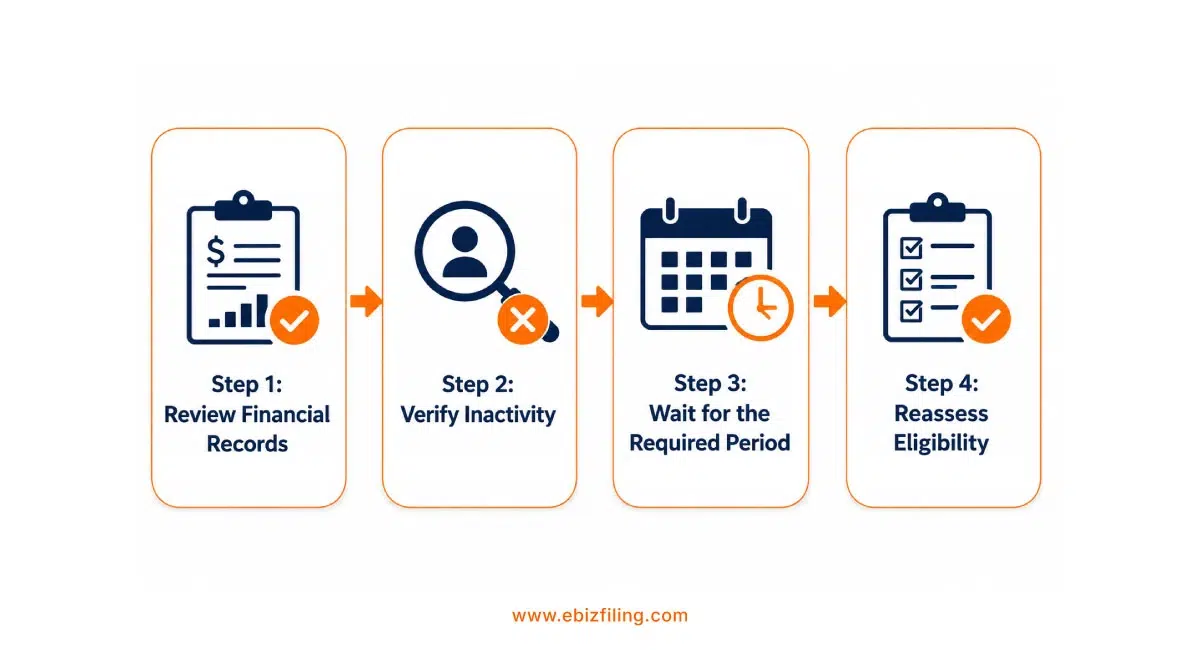
1. Review Financial and Operational Records: Examine the financial statements, bank records, GST records, contracts, invoices, expenses and operational activity for the last two financial years. Revenue is only one indicator; the key check is whether any business or operation was carried on during the required period.
2. Verify Inactivity: Ensure that no business operations were carried out during those two financial years. Strike-off Eligibility for companies depends on actual inactivity and not merely on the company’s present intention to close.
3. Wait for the Required Period: If revenue was recorded during the most recent financial year, the company should wait until two complete financial years of inactivity have passed.
4. Reassess Eligibility: Once the required period has been completed, review the company’s financial statements and operating history again. If both reflect inactivity for the two immediately preceding financial years, the necessary documents can be submitted for a fresh eligibility review.
Need Help With Company Strike-Off?
Ebizfiling helps businesses understand their Strike-off Eligibility for companies by reviewing relevant company details and financial records. Get professional support to assess eligibility and proceed with the strike-off process when the required conditions are met.
Choose Ebizfiling for clear, reliable, and professional compliance assistance. Contact Ebizfiling today to get started.
Conclusion
Understanding Strike-off Eligibility for companies requires identifying the applicable ground under Section 248 and reviewing the conditions relevant to the proposed strike-off.
The two immediately preceding financial years of inactivity are specifically relevant where the company relies on Section 248(1)(c), but this is not the only ground provided under Section 248.
Financial statements also play an important role in the eligibility review. Revenue from operations may provide evidence of business activity, but the statutory consideration under Section 248(1)(c) remains whether the company carried on any business or operation during the relevant period.
For voluntary strike-off, liabilities, member approval and the restrictions under Section 249 must also be considered before proceeding with the application.
Suggested Reads:
Strike-Off with Delayed INC-20A
Producer Company Strike Off: Complete Process & ROC Filing
Frequently Asked Questions
1. Is two-year inactivity mandatory for every company strike-off?
No. Two-year inactivity is specifically one of the grounds provided under Section 248(1)(c). Strike-off Eligibility for companies should be assessed according to the applicable ground under Section 248.
2. Can a company be struck off if revenue appears in the financial statements?
Revenue from operations may indicate business activity, but revenue itself is not the statutory test. The relevant question under Section 248(1)(c) is whether the company carried on any business or operation during the required period.
3. Is a company eligible for strike-off if its bank account has been closed?
Not automatically. Closing a bank account alone does not establish Strike-off Eligibility for companies. The company’s actual operations, financial records, and other applicable conditions must also be reviewed.
4. How does the two-year inactivity condition apply to strike-off?
Under Section 248(1)(c), the company should not have carried on any business or operation during the two immediately preceding financial years and should not have applied for dormant company status during that period.
5. Does revenue automatically make a company ineligible for strike-off?
No. Revenue should be considered as evidence while assessing whether business activity took place. The actual nature of the company’s operations during the relevant period should also be reviewed.
6. Does a company need to clear liabilities before voluntary strike-off?
Yes. Under Section 248(2), a company must extinguish all its liabilities before filing a voluntary application for removal of its name.
7. Is member approval required for voluntary company strike-off?
Yes. The company must obtain a special resolution or consent of seventy-five percent of members in terms of paid-up share capital before making the voluntary application.
8. Are there any restrictions before applying for voluntary strike-off?
Yes. Section 249 restricts an application where specified activities or circumstances have occurred during the previous three months. These conditions should be checked before filing.
9. Can Ebizfiling help check Strike-off Eligibility for companies?
Yes. Ebizfiling can review relevant company details and financial records to help assess the applicable conditions before proceeding with a company strike-off application.
10. How can Ebizfiling assist with a voluntary company strike-off?
Ebizfiling can help businesses understand the applicable strike-off conditions, review relevant records, and provide professional assistance with the company strike-off process.




Close Your Company With Expert Support
Get reliable support for Strike Off Company Online and complete your company closure process with confidence.
About Ebizfiling -



October 21, 2026 By Srishti M
Tax Planning for NRI Returning to India Before Becoming ROR Introduction Tax planning for NRI returning to India should start before the person becomes Resident and Ordinarily Resident, also known as ROR. Under the Income-tax Act, 2025, residential status decides […]
October 19, 2026 By Srishti M
October 21, 2026 By Srishti M
TDS and TCS Compliance Calendar November 2026: Compliance Guide Introduction The TDS and TCS Compliance Calendar November 2026 covers important tax deduction, collection, payment, certificate and reporting requirements applicable during the month. It helps businesses, government offices and other responsible […]