


-
July 21, 2026
-
BySteffy A
Section 201 of the Income Tax Act 2025: Tax Rate & Eligibility
Introduction
Section 201 of the Income Tax Act 2025 provides a concessional tax regime for eligible domestic manufacturing companies. It allows qualifying companies to pay income tax at a reduced rate of 15%, subject to prescribed eligibility conditions and restrictions. However, the benefit is available only when the company exercises the option within the prescribed time and complies with the conditions specified under the Act. The Income tax Act, 2025 came into force on 1 April 2026 and generally applies to tax years beginning on or after that date.
In this article, we explain Section 201 of the Income Tax Act 2025, including its tax rate, eligibility, conditions, option filing process, computation of total income, treatment of losses, and the difference between Section 201 and the earlier Section 115BAB.
What is Section 201 of the Income Tax Act 2025?
Section 201 of the Income Tax Act 2025 provides an optional concessional tax regime for an eligible domestic company engaged in the manufacture or production of an article or thing.
Under this section, an eligible company may pay tax at 15% on qualifying income, subject to the prescribed conditions. Separate tax rates apply to non-manufacturing income, specified short-term capital gains and income deemed under Section 205(4).
The provision is optional. A domestic company is not automatically taxed under Section 201. It must exercise the option in the prescribed manner on or before the due date specified under Section 263(1) for filing its first return of income.
Once the option is exercised, it applies to subsequent tax years and cannot be withdrawn.
Under the Income tax Act, 2025, Section 115BAB of the Income tax Act, 1961 has been renumbered as Section 201, with broadly similar tax rates and eligibility conditions for domestic manufacturing companies.
Who is Eligible to Opt for Section 201?
A company may opt for Section 201 of the Income Tax Act 2025 if it satisfies the following conditions:
- It is a domestic company.
- It is engaged in the business of manufacturing or producing an article or thing.
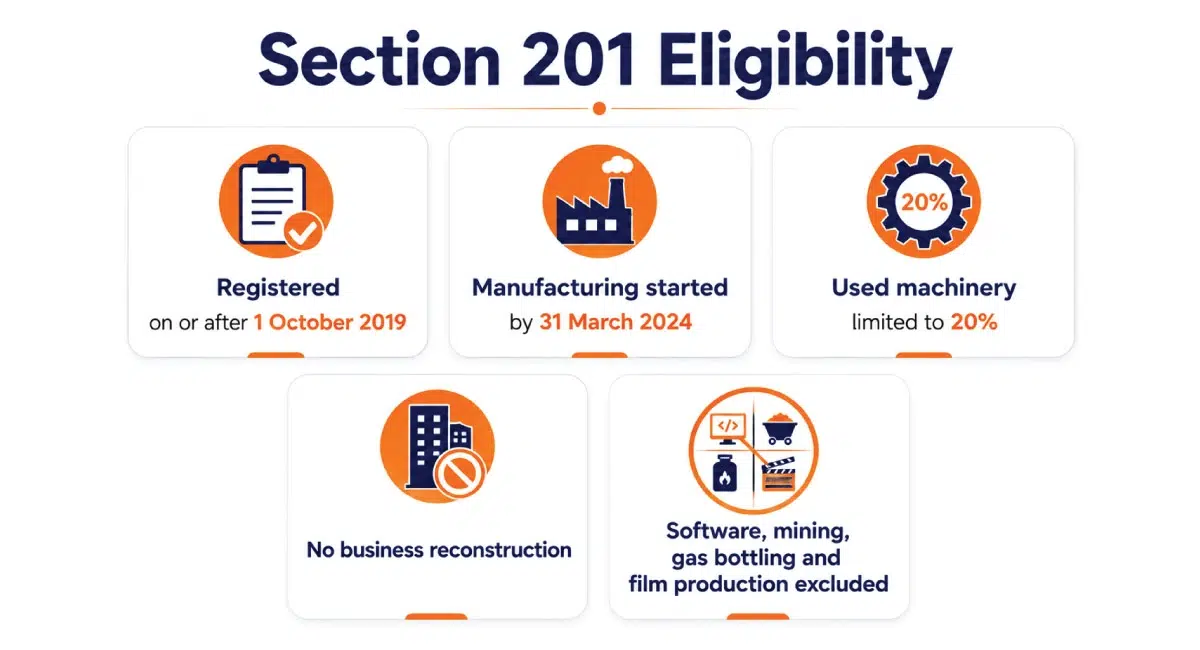
- It was set up and registered on or after 1 October 2019.
- It commenced manufacturing or production on or before 31 March 2024.
- It exercises the option in the manner prescribed under Section 201(2).
- It exercises the option on or before the due date specified under Section 263(1) for filing its first return of income.
- Its total income is computed in accordance with Section 201(3).
- It fulfils the conditions stated under Section 201(5) and Section 205(2).
Businesses planning to establish a production unit should also understand the registrations and approvals required to start a manufacturing business in India.
Tax Rates Under Section 201 of the Income Tax Act 2025
The applicable tax rate depends on the nature of income earned by the eligible domestic company.
|
Type of income |
Tax rate |
|
Total income other than income covered by the 22% and 30% categories below |
15% |
| Income that is neither derived from nor incidental to manufacturing or production and for which no separate tax rate is provided |
22% |
|
Short-term capital gains from the transfer of a capital asset on which depreciation is not allowable |
22% |
| Income deemed under Section 205(4) |
30% |
For non-manufacturing income taxable at 22%, no deduction or allowance is permitted in respect of any expenditure or allowance against such income.
Income Deemed Under Section 205(4)
Income deemed under Section 205(4) refers to excess profits arising where transactions between closely connected persons are arranged in a manner that produces more than ordinary profits. Where a specified domestic transaction is involved, the profits must be determined having regard to the arm’s length price. The excess profits are taxable at 30% under Section 201.
Note: The above rates are basic income-tax rates. Applicable surcharge and health and education cess must be added separately.
Conditions to Claim the Benefit Under Section 201
1. The company must be newly set up and registered
The domestic company must have been set up and registered on or after 1 October 2019. A company registered before this date does not satisfy the registration condition mentioned under Section 201 of the Income Tax Act 2025.
2. The company must be engaged in manufacturing or production
The company must carry on the business of manufacturing or producing an article or thing. The concessional rate under Section 201 is specifically provided for an eligible domestic manufacturing company.
3. Manufacturing must have commenced within the prescribed period
The company must have commenced the manufacture or production of an article or thing on or before 31 March 2024.
Merely registering the company within the prescribed period is not sufficient. The manufacturing or production activity must also have commenced by the specified date.
4. The option must be exercised within the due date
The company must exercise the option under Section 201 of the Income Tax Act 2025 in the prescribed manner on or before the due date specified under Section 263(1) for furnishing its first return of income for any tax year.
5. The company must continue to satisfy the prescribed conditions
The company must continue to fulfil the conditions specified under Section 201 and Section 205(2). Failure to satisfy the applicable conditions in any tax year makes the option invalid for that year and subsequent tax years.
Additional Conditions Under Section 205(2)
An eligible company must also satisfy the following conditions:
- The business must not be formed by splitting up or reconstructing an existing business, except in specified revival or reconstruction cases covered under Section 140(4).
- Previously used plant or machinery is generally not permitted.
- Machinery previously used outside India may be allowed subject to the prescribed conditions.
- Other previously used machinery may be allowed if its value does not exceed 20% of the total plant and machinery.
- The company must not use a building previously used as a hotel or convention centre where a deduction under Section 80-ID of the Income tax Act, 1961 was claimed and allowed.
- The company must not engage in any business other than manufacturing or production and related research or distribution activities.
Activities Not Treated as Manufacturing
For Section 201 of the Income Tax Act 2025, manufacturing or production includes the generation of electricity. However, the following activities are not treated as manufacturing or production:
- Development of computer software
- Mining
- Conversion of marble blocks or similar items into slabs
- Bottling of gas into cylinders
- Printing of books
- Production of cinematograph films
- Any other business notified by the Central Government
How to Exercise the Option Under Section 201?
The option under Section 201 of the Income Tax Act 2025 must be exercised in the prescribed manner.
The company must exercise the option on or before the due date specified under Section 263(1) for furnishing its first return of income for any tax year.
Once the option is exercised:
- It applies to subsequent tax years;
- Also, it cannot be withdrawn for the same tax year; and
- It cannot be withdrawn for any subsequent tax year.
Therefore, the company must examine the eligibility conditions, restricted deductions and treatment of losses before exercising the option.
When Does the Option Become Invalid?
The option under Section 201 of the Income Tax Act 2025 becomes invalid when the company fails to fulfil the prescribed conditions in any tax year.
In such a case:
- The option becomes invalid for the tax year in which the failure occurs;
- Option also becomes invalid for all subsequent tax years; and
- The other provisions of the Income Tax Act, 2025 apply as if the option under Section 201 had not been exercised.
Invalidity is therefore not limited only to the year of non-compliance. It continues for later tax years as well.
How is Total Income Computed Under Section 201?
The total income of a company opting for Section 201 of the Income Tax Act 2025 must be computed without certain deductions and without setting off specified losses or unabsorbed depreciation.
Deductions Not Allowed
While computing total income under Section 201, no deduction is allowed under:
- Section 45(2);
- Section 47(1)(b);
- Chapter VIII, except Section 146 or Section 148; and
- The sections specified under Section 205(1)(a) to (g).
The company must therefore compute its taxable income after excluding the deductions specifically restricted under Section 201(3).
Treatment of Losses and Unabsorbed Depreciation
A company opting for Section 201 of the Income Tax Act 2025 cannot set off any loss or unabsorbed depreciation deemed under Section 116 if such loss or depreciation is attributable to the deductions restricted under Section 201(3)(a).
Such loss or depreciation is treated as having been given full effect.
As a result:
- No set-off is allowed against the income computed under Section 201;
- No further deduction is allowed for such loss or depreciation; and
- The amount cannot be claimed in any subsequent tax year.
What Happens in Case of Amalgamation?
In the case of an amalgamation, the option under Section 201 of the Income Tax Act 2025 remains valid for the amalgamated company only if it continues to fulfil all the conditions prescribed under Section 201. If the amalgamated company fails to satisfy these conditions, the benefit cannot continue merely because the amalgamating company had exercised the option earlier.
Section 201 vs Section 115BAB of Income Tax Act
|
Basis |
Section 115BAB |
Section 201 |
|
Governing law |
Income tax Act, 1961 | Income Tax Act, 2025 |
| Applicable assessee | Eligible domestic manufacturing company |
Eligible domestic manufacturing company |
|
Main tax rate |
15% | 15% |
| Nature of provision | Earlier provision |
Corresponding provision under the Income Tax Act, 2025 |
|
Registration condition |
On or after 1 October 2019 | On or after 1 October 2019 |
| Manufacturing commencement condition | On or before 31 March 2024 |
On or before 31 March 2024 |
|
Nature of option |
Optional and irrevocable |
Optional and irrevocable |
Benefits of Opting for Section 201
The main benefits available under Section 201 of the Income Tax Act 2025 include:
- A 15% tax rate on qualifying income;
- Continuation of the option for subsequent tax years;
- Certainty regarding the applicable tax regime once the option is exercised; and
- Continuation of the option after amalgamation, subject to fulfilment of the prescribed conditions.
These benefits are available only when the company satisfies all eligibility and computation conditions under Section 201 and Section 205.
Situations Where Section 201 May Not Be Suitable
Section 201 of the Income Tax Act 2025 may not be suitable in the following situations:
- The company is not engaged in manufacturing or production;
- The company was registered before 1 October 2019;
- Manufacturing or production commenced after 31 March 2024;
- The company wishes to claim deductions restricted under Section 201(3);
- The company has losses or unabsorbed depreciation attributable to restricted deductions;
- A significant part of the company’s income is not derived from or incidental to manufacturing;
- The company is unable to fulfil the conditions under Section 205(2); or
- The company does not want to exercise an irrevocable tax option.
A company should compare its tax liability under the normal provisions and Section 201 before exercising the option because the option cannot be withdrawn after it is exercised.
Ebizfiling’s Company Income Tax Compliance Services
Ebizfiling helps domestic companies manage company income tax compliance with professional support.
Our Assistance Includes
- Company income tax return filing
- Tax computation and review
- Eligibility assessment under Section 201 of the Income Tax Act 2025
- Review of applicable deductions and losses
- Corporate tax compliance support
- Timely filing and documentation assistance
Contact Ebizfiling today for assistance with company income tax filing and ensure timely, accurate compliance.
Conclusion
Section 201 of the Income Tax Act 2025 provides an optional concessional tax regime for eligible domestic manufacturing companies. It allows a 15% tax rate on qualifying income, subject to the prescribed eligibility, computation, and compliance conditions. Since the option is irrevocable and restricts certain deductions, losses, and unabsorbed depreciation, companies should carefully evaluate its tax impact before opting for it. Proper assessment and timely compliance are essential to continue receiving the benefit under Section 201.
Frequently Asked Questions
1. Does the 15% Section 201 tax rate apply to every type of company income?
The Section 201 tax rate of 15% applies only to qualifying income of an eligible domestic manufacturing company. Non-manufacturing income covered by the provision is taxable at 22%, specified short-term capital gains are taxable at 22%, and income deemed under Section 205(4) is taxable at 30%.
2. Is a company incorporated before 1 October 2019 eligible under Section 201?
One of the main eligibility conditions under Section 201 is that the domestic company must have been set up and registered on or after 1 October 2019. A company incorporated before this date cannot claim the concessional tax regime under Section 201.
3. Can a company opt for Section 201 if manufacturing started after 31 March 2024?
No. The Section 201 manufacturing commencement date requires the company to have commenced manufacturing or production on or before 31 March 2024. A company starting production after this date does not satisfy the prescribed eligibility conditions.
4. Can the Section 201 option be withdrawn after it is exercised?
No. The Section 201 of the Income Tax Act 2025 option filing is irrevocable. Once the option is exercised in the prescribed manner, it applies to subsequent tax years and cannot be withdrawn for the same or any later tax year.
5. Which deductions are restricted under Section 201?
The Section 201 deductions restricted while computing total income include deductions under Section 45(2), Section 47(1)(b), Chapter VIII except Sections 146 and 148, and the deductions specified under Section 205(1)(a) to (g).
6. How does Section 201 treat losses and unabsorbed depreciation?
A loss or allowance for unabsorbed depreciation attributable to deductions restricted under Section 201(3)(a) cannot be set off. It is treated as having been given full effect, and no further deduction can be claimed in a subsequent tax year.
7. Does the Section 201 option remain valid after amalgamation?
The option under Section 201 remains valid for the amalgamated company only if it continues to satisfy all the prescribed conditions under Section 201 and Section 205.
8. What is the difference between Section 201 and Section 115BAB?
Section 115BAB was the earlier provision under the Income tax Act, 1961, while Section 201 is its corresponding provision under the Income tax Act, 2025. The main tax rates and eligibility conditions remain broadly similar.
9. How can Ebizfiling help determine Section 201 applicability?
Ebizfiling helps domestic manufacturing companies assess Section 201 applicability, review the prescribed eligibility conditions, evaluate restricted deductions, and prepare the company’s tax computation. Our experts also assist with Company Income Tax Return filing and corporate tax compliance.
10. Does Ebizfiling provide support for the concessional tax regime for domestic manufacturing companies?
Yes. Ebizfiling provides professional assistance with the concessional tax rate for domestic manufacturing companies, including eligibility assessment, tax computation, documentation review, and Company Income Tax Return filing for companies opting under Section 201.





Expert Tax Consultancy Services
Get expert tax consultancy to optimize tax planning and ensure seamless compliance with tax regulations.
About Ebizfiling -



October 15, 2026 By Srishti M
TDS and TCS Compliance Calendar November 2026: Compliance Guide Introduction The TDS and TCS Compliance Calendar November 2026 covers important tax deduction, collection, payment, certificate and reporting requirements applicable during the month. It helps businesses, government offices and other responsible […]
October 14, 2026 By Srishti M
GST Compliance Calendar November 2026: Key Due Dates & Filings Introduction The GST Compliance Calendar November 2026 highlights the major GST return filing, tax payment, invoice reporting and year-end adjustment deadlines applicable during the month. It covers regular taxpayers, QRMP […]
October 13, 2026 By Srishti M