


Everything You Should Know About RTI Application in India
Overview
An RTI Application allows Indian citizens to request official records and information from public authorities under the Right to Information Act, 2005. It promotes transparency and accountability by helping citizens access documents, file movement details, orders, reports, and updates related to government applications, refunds, approvals, or complaints.
In this blog, we explain the RTI filing process in India, applicable fees, response timelines, online filing procedure, appeals, and important RTI rules.
What Is RTI?
The full form of RTI is Right to Information. It is governed by the Right to Information Act, 2005. The main aim of the RTI Act is to promote transparency and accountability in the functioning of public authorities in India.
The Act gives Indian citizens the right to request information held by or under the control of public authorities. It empowers citizens to obtain government records, inspect documents, receive certified copies, take extracts, and access information available in electronic form.
RTI can be useful when a citizen wants information about the functioning of a government department, the recorded status of an application, the use of public funds, or an administrative decision. However, the applicant should normally request information that already exists in official records. A Public Information Officer is not required to create new information, provide legal advice, conduct research, or give an opinion.
The RTI Act has a wide reach. It applies to public authorities at the Central, State, and local levels. It may also apply to bodies that are owned, controlled, or substantially financed by the government and non-government organisations that receive substantial government funding.
How to File an RTI Application
The RTI filing process in India generally involves the following steps:
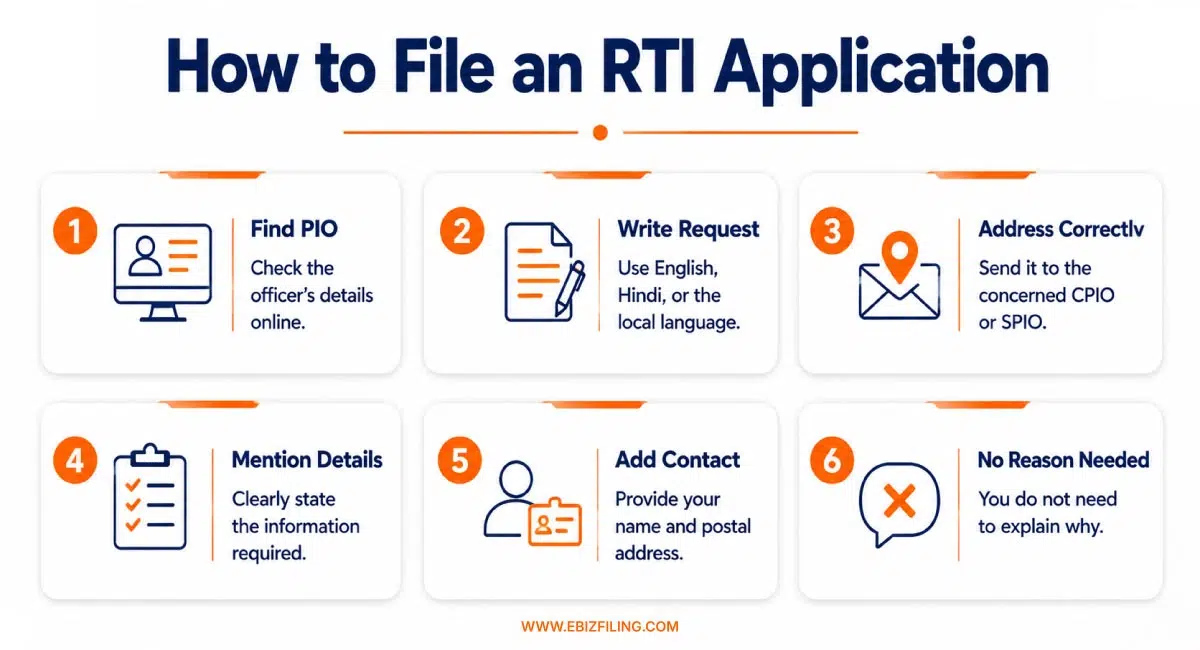
- Find the address and contact details of the concerned Public Information Officer from the official website of the organisation.
- Write an RTI Application in English, Hindi, or the official language of the area in which the application is being submitted.
- Address the application to the Central Public Information Officer or State Public Information Officer of the concerned public authority.
- Clearly mention the information or records you require. Wherever possible, include the relevant application number, file number, date, financial year, or period.
- Provide your full name, contact details, and postal address where the response should be sent.
There is no single mandatory format for seeking information under the Act. An offline application may generally be made on plain paper, subject to the rules applicable to the concerned authority.
The information seeker is not required to provide a reason for requesting the information. Only the personal details necessary for contacting the applicant and delivering the response may be required.
RTI Application Online
The Department of Personnel and Training operates the Central RTI Online Portal for Indian citizens who want to file RTI Applications and First Appeals with Central Government ministries, departments, and other listed Central public authorities.
The Central RTI Online Portal should not be used for authorities under State Governments, including the Government of NCT of Delhi. Applicants seeking information from a State authority should use the relevant State RTI portal or follow the offline procedure prescribed by that State.
Through the Central portal:
- RTI Applications can be submitted online.
- First Appeals can be filed online.
- No fee is charged for filing a First Appeal through the Central RTI Online Portal.
- The prescribed application fee can be paid electronically.
- Additional fees, when requested by the authority, may be paid online.
- Applicants can track the status using the registration number.
- Replies from the concerned Public Information Officer or First Appellate Authority can be viewed online.
The text field on the portal currently permits up to 3,000 characters. A longer application may be uploaded as a PDF supporting document. Applicants should not upload Aadhaar, PAN, or other identity documents unless a BPL certificate is required.
Before filing an RTI Application for a pending business matter, applicants should first check whether its status is available on the relevant government portal. For example, businesses can track a GST application using the ARN, check their trademark application status, or verify company records on the MCA portal.
Fees for an RTI Application
Under the Central RTI Rules, 2012, the application fee for seeking information from a Central public authority is ₹10.
For an offline application, the fee may generally be paid through:
- Cash against a proper receipt
- Demand draft
- Banker’s cheque
- Indian Postal Order
- Electronic payment, where accepted
A demand draft, banker’s cheque, or Indian Postal Order should generally be payable to the Accounts Officer of the concerned public authority.
Modes of Payment for Online Applications
The Central RTI Online Portal currently supports the following payment methods:
- Internet banking
- MasterCard or Visa debit and credit cards
- RuPay cards
- UPI
These payment methods may be updated by the portal from time to time.
The ₹10 application fee relates to Central public authorities. Fees and accepted payment methods for State Government authorities may differ according to the rules of the concerned State.
Note: A citizen belonging to the Below Poverty Line category is not required to pay the RTI application fee under the Central RTI Rules. However, the applicant must attach a valid BPL certificate issued by the appropriate government.
Time Period for Supply of Information
In the normal course, the requested information must be supplied within 30 days from the date on which the public authority receives the application.
If the information concerns the life or liberty of a person, it must be supplied within 48 hours.
Where an application is submitted through an Assistant Public Information Officer, an additional five days may be added to the response period. If third-party consultation is required, the decision may take up to 40 days.
If the public authority fails to provide the information within the prescribed period, the information must generally be supplied free of charge.
Government Organisations Covered Under the RTI Act
The RTI Act applies to public authorities established or constituted under the Constitution, a law passed by Parliament or a State Legislature, or a government notification or order.
Depending on their ownership, control, funding, and legal status, they following may fall within the scope of the Act:
- Central and State Government ministries
- Government departments
- Municipal corporations
- Gram panchayats and other local authorities
- Public sector undertakings
- Government-owned or controlled companies
- Government universities and schools
- Road and public works authorities
- Provident fund authorities
- Regulatory and statutory bodies
- Courts and judicial institutions, subject to applicable rules and exemptions
- Non-government organisations substantially financed by government funds
RTI may be used to seek the recorded status of your own government application, registration, refund, complaint, licence, or approval. It may also be used to obtain records relating to public expenditure or government decisions.
Private organisations are not automatically covered by the RTI Act. However, information relating to a private organisation may be requested when a public authority can legally access that information under another law.
Intelligence and Security Organisations Exempt Under the RTI Act
Certain intelligence and security organisations listed in the Second Schedule are exempt under Section 24 of the RTI Act. These include certain notified defence, intelligence, and security organisations.
However, this exemption is not absolute. Information relating to allegations of corruption or human-rights violations is not automatically excluded. In cases concerning alleged human-rights violations, approval from the appropriate Information Commission is required, and the information must be provided within 45 days.
Information That May Be Exempt from Disclosure
Information may be refused when its disclosure:
- Prejudicially affects the sovereignty, integrity, security, strategic, scientific, or economic interests of India
- Has been prohibited from publication by a court or tribunal
- Causes a breach of parliamentary or legislative privilege
- Contains commercial confidence, trade secrets, or intellectual property protected under the Act
- Relates to information held in a fiduciary relationship
- Involves confidential information received from a foreign government
- Endangers the life or physical safety of a person
- Reveals the identity of a confidential source
- Impedies an investigation, apprehension, or prosecution
- Relates to protected Cabinet papers
- Relates to personal information
- Infringes copyright held by someone other than the State
Under the current Section 8(1)(j) of the RTI Act, information that relates to personal information is exempt from disclosure. However, under Section 8(2), a public authority may allow access if the public interest in disclosure outweighs the harm to the protected interests. If only part of a record is exempt, the remaining separable portion may still be provided.
Appeals Under the RTI Act
A First Appeal may be filed when an applicant does not receive a response within the prescribed time, receives incomplete information, or is dissatisfied with the Public Information Officer’s decision.
The First Appeal should ordinarily be filed within 30 days from the expiry of the response period or from the date on which the Public Information Officer’s decision is received.
The First Appellate Authority should normally decide the appeal within 30 days. This period may be extended up to 45 days in exceptional cases, provided the reasons for the delay are recorded in writing.
If the applicant is dissatisfied with the First Appellate Authority’s decision, a Second Appeal may be filed before the Central Information Commission or the relevant State Information Commission within 90 days.
Ebizfiling Support for Compliance Issues Revealed Through RTI
An RTI Application can help a business understand why a government registration, refund, licence, approval, or complaint is pending. Once the official response identifies the issue or required action, Ebizfiling can assist with the related compliance process.
Ebizfiling can support businesses with:
- GST registration and GST refund matters
- Company and LLP registration
- Trademark registration and objection response
- ROC annual filing and company compliance
- Tax and regulatory filings
- Replies to departmental notices
- Document correction and filing support
Need help with a pending registration, refund, trademark, tax, or company compliance matter? Contact Ebizfiling today for professional support.
Conclusion
The Right to Information is an effective and affordable legal tool that enables Indian citizens to understand how public authorities function, how public money is used, and how government matters are processed.
It opens public authorities to greater scrutiny and promotes transparency and accountability. A properly drafted RTI Application should identify the correct public authority and request clear, specific, and existing records. When information is delayed, rejected, or supplied incompletely, the applicant may use the appeal process available under the RTI Act.
FAQs on RTI Application
1. What happens if an RTI Application is submitted to the wrong public authority?
Under Section 6(3) of the RTI Act, if the requested information is held by another public authority, the application or the relevant part should be transferred to that authority as soon as possible and no later than five days from receipt.
2. Can a company or LLP file an RTI Application in its own name?
The right under the RTI Act is available to Indian citizens. Therefore, a company, LLP, partnership firm, trust, or society does not independently exercise this right. An Indian citizen associated with the organisation may submit the RTI Application in their individual capacity.
3. Can online RTI filing be used for State Government departments?
The Central RTI Online Portal is meant for listed Central Government ministries, departments, and public authorities. It should not be used for State Government authorities. Applicants must use the relevant State RTI portal or follow the offline procedure prescribed by that State.
4. What should I do if my RTI Application exceeds the online character limit?
The Central RTI Online Portal permits a limited number of characters in the application field. If the request is longer, the applicant may write a brief summary in the field and upload the complete application as a PDF supporting document.
5. Can an RTI Application ask why an officer took a particular decision?
An applicant should request existing records, file notings, orders, reports, or documents connected with the decision. A Public Information Officer is not normally required to create a new explanation, provide an opinion, conduct research, or justify an action unless the explanation already exists in official records.
6. Can RTI be used to obtain the status of a pending GST refund or registration?
Yes. An Indian citizen may use an RTI Application to request the recorded status, file movement details, pending documents, notices, orders, or the name and designation of the officer handling the matter. RTI cannot guarantee approval or faster processing of the application.
7. Is Aadhaar or PAN required for the RTI filing process in India?
Applicants are generally not required to provide identity documents such as Aadhaar or PAN. Only the personal details required for communication and delivery of the response should be provided. A valid BPL certificate may be required when claiming exemption from the prescribed fee.
8. What can an applicant do if no RTI response is received within 30 days?
The applicant may file a First Appeal before the designated First Appellate Authority. The appeal should ordinarily be filed within 30 days from the date on which the response period expired. A Second Appeal may be filed before the appropriate Information Commission if the applicant remains dissatisfied.
9. Can Ebizfiling help after an RTI response identifies a GST or compliance issue?
Ebizfiling does not provide RTI Application filing services. However, if the RTI response identifies a pending GST registration, GST refund, company filing, trademark matter, or departmental notice, Ebizfiling can assist with the related registration, documentation, filing, or compliance process.
10. How can Ebizfiling support a business after receiving official records through RTI?
Ebizfiling can review the compliance issue revealed through the official records and assist with document correction, GST matters, company or LLP registration, ROC annual filing, trademark services, tax filings, and replies to departmental notices. The support is limited to the relevant compliance service and does not include filing the RTI Application itself.





Get Started Today
Your Trusted Business Advisory Service Provider
About Ebizfiling -


Follow Author
Leave a Reply
Reviews
-

Mamta Tanna
20 Dec 2017More power to the Ebizfiling team for being so generous and systematic in the whole process of ESIC registration.
-
Jinal Vora
27 Feb 2018They make GST returns easier and fuss-free.
-
Dr. Shilpa Jerurkar
16 Jul 2020I would give them a 10 star. The staff is really praiseworthy. I would like to mention specially for Ms Lata. She was available always whenever I required her. Very efficient and kept us updated about the proceedings. I strongly recommend the services of Ebizfiling India Pvt LTD for all types of Company related affairs



-
-
-
October 15, 2026 By Srishti M
TDS and TCS Compliance Calendar November 2026TDS and TCS Compliance Calendar November 2026: Compliance Guide Introduction The TDS and TCS Compliance Calendar November 2026 covers important tax deduction, collection, payment, certificate and reporting requirements applicable during the month. It helps businesses, government offices and other responsible […]
-
-
-
October 14, 2026 By Srishti M
GST compliance calendar November 2026GST Compliance Calendar November 2026: Key Due Dates & Filings Introduction The GST Compliance Calendar November 2026 highlights the major GST return filing, tax payment, invoice reporting and year-end adjustment deadlines applicable during the month. It covers regular taxpayers, QRMP […]
-




Hello sir,
We cannot extend our support for this service. Please contact us at +919643203209 / mail us at info@ebizfiling.com, if you need any additional information or assistance.
Thank you for the query.