


-
August 24, 2026
-
BySteffy A
Patent Search in India: Types, Process and Benefits
Introduction
Before spending on patent drafting, filing and product development, an inventor should know what similar technology already exists. A Patent Search in India helps identify published patent applications, granted patents and other public disclosures connected with an invention. It can show whether the proposed product or process appears new and where an application may face objections.
Under Section 2(1)(j) of the Patents Act, 1970, an invention must be a new product or process involving an inventive step and capable of industrial application. It must also avoid the exclusions under Sections 3 and 4. Therefore, Patent Search in India is an important pre-filing exercise, although the final decision on patentability rests with the Indian Patent Office.
What Is Patent Search in India?
Patent Search in India is a structured review of publicly available technical and patent information relating to a proposed invention. It may cover Indian and foreign patent documents, research papers, technical journals, manuals, conference materials and other disclosures available before the relevant filing or priority date.
The search is not limited to an identical invention. It also examines whether important technical features or their combination have already been disclosed. The Indian Patent Office searches patent and non-patent literature while examining novelty and inventive step.
Patent search and registration are different. A search provides information but creates no exclusive right and does not prevent another person from filing.
Legal Importance of a Patent Search
Under Patent law in India, an invention must meet requirements such as novelty, inventive step and industrial applicability before it can receive protection. Prior art may arise from patent documents and other public disclosures. A document can remain relevant even when the patent has expired, lapsed or was never granted because its technical disclosure may still form part of the prior art.
Patent Search in India can help an applicant determine whether:
- The invention appears to contain a new technical feature.
- Its difference from existing technology may involve an inventive step.
- The subject matter could fall within a statutory exclusion.
- The specification should explain technical advantages more clearly.
- Claims should be revised before filing.
A private search does not replace examination. The Patent Office may find additional documents, interpret the claims differently or raise other legal objections.
Applicants should also understand the requirements of patent eligibility before investing in drafting and filing an application.
Why Conduct Patent Search in India Before Filing?
Checks Novelty: Patent Search in India helps determine whether the same or a closely related product or process has already been disclosed. This reduces the risk of filing for clearly known subject matter.
Improves Patent Drafting: Relevant prior art allows the drafter to distinguish the invention from existing technology and focus the specification on the actual technical contribution. Applicants should also understand the key elements of writing a patent so that the specification clearly explains the invention, claims and technical advantages.
Saves Time and Cost: Patent filing involves government fees, drafting expenses and prosecution costs. An early search may show that further development is needed before those expenses are incurred.
Supports Business Planning: Search results can reveal competitors, filing trends and crowded technology areas. A business may then decide whether to file, redesign, license technology or change its market strategy. Once granted, a patent is an asset to owner and may support licensing, valuation, investment and commercial growth.
Reduces Avoidable Objections: No search prevents every objection. However, Patent Search in India can identify obvious novelty or inventive-step concerns before examination.
Types of Patent Search in India
Patentability Search: A patentability search evaluates whether an invention appears novel and non-obvious in view of earlier disclosures. It is commonly conducted before drafting or filing an application.
Prior Art Search: A prior art search looks for patents, applications, journal articles, theses, standards, manuals, websites and other material that may affect novelty or inventive step.
Freedom to Operate Search: A freedom to operate search checks whether commercial activities may fall within enforceable patent claims in a particular country. It is territory-specific and time-sensitive. A patentable product may still risk infringing another patent.
Patent Infringement Search: This search compares a product or process with patent claims. Proper analysis requires claim interpretation, legal-status checks and consideration of the exact commercial activity.
Patent Validity Search: A validity search seeks prior art that may affect an existing patent. It normally focuses on granted claims and disclosures available before the relevant priority date.
Patent Landscape Search: A landscape search studies patent activity across a technology sector. It can identify leading applicants, filing patterns, technical categories and emerging areas for research or licensing.
The appropriate search may also depend on the types of patent application in India that the applicant plans to file.
How to Conduct Patent Search in India
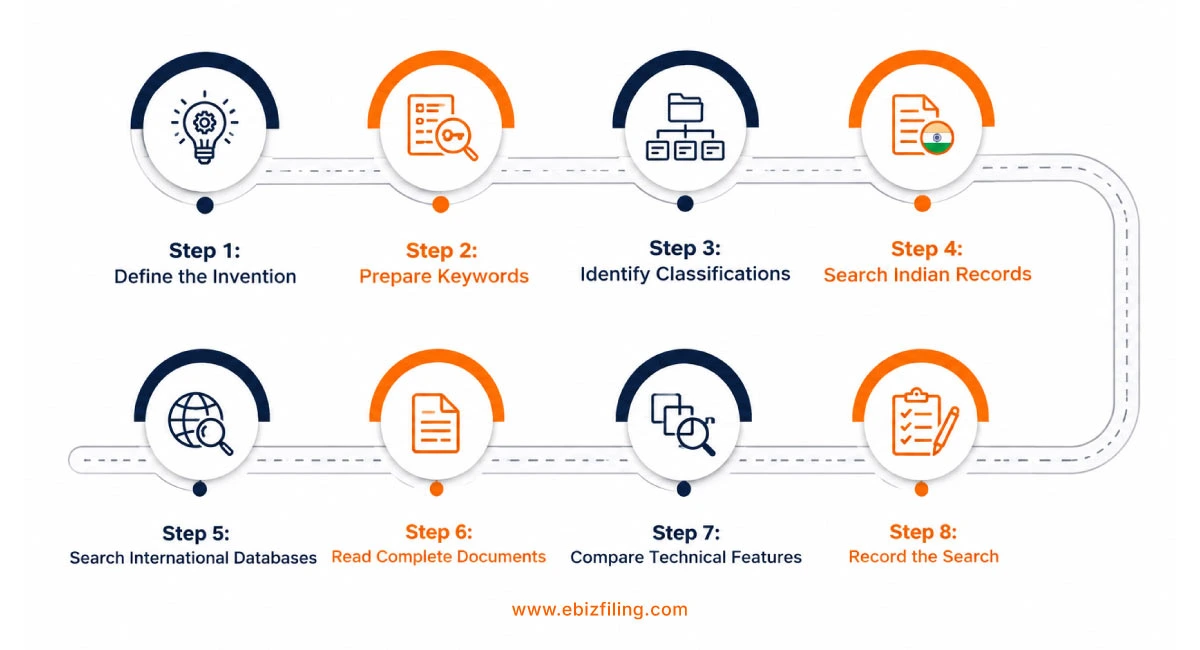
Step 1: Define the Invention
Prepare a clear technical description covering the problem, structure, process, function and result. Separate essential features from optional features.
Step 2: Prepare Keywords
List technical terms, synonyms, alternative spellings and industry language. Patent Search in India should not depend on only one product name.
Step 3: Identify Classifications
Patent classifications group inventions by technology. The International Patent Classification uses hierarchical symbols for different technical fields. IPC or CPC searches can reveal documents missed by keywords.
Step 4: Search Indian Records
Use the Intellectual Property India public search portal to review published and granted documents. Available fields include title, abstract, claims, description, application number, patent number, applicant, inventor and classification.
Step 5: Search International Databases
The absence of a similar Indian patent does not establish novelty. Patent Search in India should also consider foreign patent publications and non-patent literature.
Step 6: Read Complete Documents
Titles and abstracts give only an initial indication. Review the description, drawings and claims. Check priority details, patent families and legal status where relevant.
Step 7: Compare Technical Features
Prepare a feature chart showing where each essential part of the invention appears in the prior art. This is more reliable than a broad similarity assessment.
Step 8: Record the Search
Note the databases, search strings, classifications, dates and relevant documents. A clear record helps professionals review and update the Patent Search in India later.
Online Databases for Patent Search in India
|
Database |
Main Purpose |
|
Intellectual Property India Public Search |
Search published and granted Indian patent records |
| WIPO PATENTSCOPE |
Search PCT applications and participating national collections |
|
Espacenet |
Search worldwide patent information, families and classifications |
| Google Patents |
Conduct broad keyword and classification searches |
|
USPTO Patent Search |
Search United States applications and granted patents |
Applicants should normally use more than one source. Databases differ in coverage, search syntax, translations, update cycles and legal-status information. Findings from Patent Search in India should be checked against the relevant official register before a legal or commercial decision is made.
How to Use the Indian Patent Public Search Portal
Select published applications or granted patents. Search fields such as title, abstract, claims or description, then repeat with synonyms and logical operators. Use applicant or inventor names when relevant.
Use IPC classes to locate related documents. Open the complete specification and examine the claims, drawings and description. The portal also provides e-register and application-status functions.
Patent Search in India should cover published applications and granted records because a pending application may contain an earlier disclosure relevant to patentability. Record the search date because new applications continue to be published.
Information Required for Patent Search in India
Collect the following information before beginning:
- A clear title and technical description
- The problem being solved
- Essential components or process steps
- Technical advantages and expected results
- Drawings, flowcharts or working examples
- Keywords and alternative terminology
- Known competing products or patent owners
- Countries planned for protection or commercial launch
Confidential information should be shared under safeguards. Public disclosure before filing may affect patentability. Although Sections 29 to 34 of the Patents Act provide limited exceptions in certain cases, India does not provide a general grace period for every disclosure. Therefore, inventors should seek advice before publishing, selling or publicly discussing an invention.
What Does a Patent Search Report Include?
A professional report normally states the databases searched, search strategy, classifications and relevant documents. It may include publication numbers, applicants, priority dates, legal status and links to complete specifications.
The report may compare important invention features with prior references and group documents by relevance. However, Patent Search in India cannot certify novelty, guarantee grant or prove that no relevant document exists.
For freedom to operate or infringement work, the report should separately review enforceable claims, territorial scope, expiry, lapse, opposition, revocation and other legal-status issues.
Patent Search vs Patent Registration
|
Basis |
Patent Search |
Patent Registration |
|
Purpose |
Identifies prior technology and possible risks | Seeks statutory protection |
| Timing | Usually before drafting or launch |
Starts with filing an application |
|
Output |
Search results and analysis | Grant, refusal or another procedural result |
| Rights | Creates no exclusive right |
Rights arise after grant, subject to law |
|
Certainty |
Cannot guarantee patentability |
Grant depends on examination and compliance |
Patent Search in India is a preparatory risk-assessment exercise, while registration is a formal legal process before the Patent Office.
Mistakes Made During Patent Search in India
Common mistakes include using one keyword, reviewing only the first results and searching only Indian records. Searchers may also ignore classifications, patent families, non-patent literature or documents using different terminology. Applicants should also avoid common patent registration mistakes such as incomplete disclosures, weak claims, premature publication and incorrect filing strategies.
An expired patent should not be ignored automatically. Its claims may no longer block activity, but its published disclosure may remain relevant prior art. Also, the absence of an identical document does not prove inventive step.
Patent Search in India should not rely only on automated similarity tools. They help discovery, but technical interpretation and claim analysis still require professional judgement.
Cost and Time Required for Patent Search
The cost and time for Patent Search in India depend on the technology, number of inventive concepts, search objective, jurisdictions and volume of prior art. A basic patentability search for a mechanical device differs from an FTO review involving software, electronics or pharmaceuticals.
Clear drawings and feature lists can reduce unnecessary searching. The scope, databases, deliverables and limitations should be agreed before work begins.
How Can Ebizfiling Help with Patent Search in India?
Ebizfiling assists inventors, startups and businesses with patent search in India, prior art review, patent drafting and online patent filing. Depending on the filing strategy, applicants can get support for provisional and complete specifications, ordinary applications, convention applications, PCT applications, national-phase applications, divisional applications and patents of addition.
Ebizfiling also assists with publication, examination and procedural requirements before the Patent Office. However, patent search or filing does not guarantee patent grant, validity or freedom from infringement.
Planning to protect your invention? Get professional assistance with your patent application from Ebizfiling today.
Conclusion
A well-planned Patent Search in India helps an applicant understand existing technology before committing resources to filing or commercialisation. It supports better drafting, highlights possible legal concerns and informs decisions about development, licensing and market entry.
The search should cover suitable Indian and international databases, classifications, claims and non-patent literature. Because public records continue to change, Patent Search in India reflects the information available within its stated scope and search date, not an unlimited guarantee concerning every existing right or disclosure.
Suggested Reads:
Frequently Asked Questions
1. What is the difference between a patentability search and a freedom-to-operate search?
A patentability search checks whether an invention appears new and inventive compared with existing prior art. A freedom-to-operate search checks whether making, using, selling or importing a product may infringe active patent claims in a specific country. A patentable invention may still face infringement risk.
2. Can an expired patent affect a new patent application?
Yes. An expired or lapsed patent may no longer provide enforceable rights, but its published technical disclosure can still qualify as prior art. Therefore, expired patents should also be reviewed during a patent search in India.
3. Does filing a provisional specification provide patent protection?
A provisional specification establishes an initial priority date but does not itself create enforceable patent rights. The applicant must file a complete specification within 12 months from the provisional application date. Otherwise, the application is deemed abandoned. Patent rights become enforceable only after the patent is granted, subject to the provisions of the Patents Act.
4. Should a patent search cover only Indian patent databases?
No. Patentability may be affected by disclosures published anywhere in the world. Therefore, a patent search in India should also review foreign patent databases, PCT applications, technical journals, research papers, product manuals and other publicly available material.
5. Why are IPC and CPC codes important in patent searching?
IPC and CPC codes classify inventions according to their technical subject matter. They help identify relevant patent documents even when different applicants use different keywords, product names or technical descriptions for similar inventions.
6. Is reviewing the title and abstract of a patent sufficient?
No. Titles and abstracts provide only a brief summary. A proper patent search should examine the complete specification, drawings, claims, priority details and legal status. Patent claims are especially important because they define the scope of protection sought or granted.
7. When is an Indian patent application published?
An Indian patent application is generally published after 18 months from the filing date or priority date, whichever is earlier. An applicant may also request early publication by filing Form 9. Publication does not mean that the patent has been examined or granted.
8. What is the deadline for filing a request for patent examination?
For patent applications filed on or after 15 March 2024, Form 18 must generally be filed within 31 months from the filing date or priority date, whichever is earlier. Applications filed before 15 March 2024 generally continue to follow the earlier 48-month period. Eligible applicants may request expedited examination through Form 18A under Rule 24C. If the request is not filed within the applicable period, the application is treated as withdrawn.
9. How does Ebizfiling assist with patent search in India?
Ebizfiling assists inventors, startups and businesses with keyword identification, patent classification review, prior art research and analysis of relevant patent records. The findings can help applicants decide whether the invention requires further development, claim refinement or patent drafting.
10. Can Ebizfiling assist after completing the patent search?
Yes. Ebizfiling can assist with Patent Application in India, including provisional and complete specification filing, patent drafting and procedural support. However, patent search or filing assistance cannot guarantee patent grant, validity or freedom from infringement.





Apply For Your Patent
Wish to have an exclusive right over an invention? Apply for patent before someone else does.
About Ebizfiling -



Reviews
Avinash Shetty
19 Jul 2017Excellent support provided by Mr.Parin & Team. I got my IE Code within a week and this wouldn't have been possible without your help. Keep up the good work!
Dev Desai
19 Nov 2021Loves their services
Jobin Mathew
19 Nov 2021I reached ebizfiling for DSC renewal , Ms anitha KV assisted in renewal it was done on timely and hassle free.
October 19, 2026 By Srishti M
October 15, 2026 By Srishti M
TDS and TCS Compliance Calendar November 2026: Compliance Guide Introduction The TDS and TCS Compliance Calendar November 2026 covers important tax deduction, collection, payment, certificate and reporting requirements applicable during the month. It helps businesses, government offices and other responsible […]
October 14, 2026 By Srishti M
GST Compliance Calendar November 2026: Key Due Dates & Filings Introduction The GST Compliance Calendar November 2026 highlights the major GST return filing, tax payment, invoice reporting and year-end adjustment deadlines applicable during the month. It covers regular taxpayers, QRMP […]