

GST Migration in India: Process, Rules and Documents
Introduction
GST Migration was the process used to move taxpayers registered under earlier indirect tax laws, such as VAT, Service Tax, and Central Excise, into the Goods and Services Tax system when GST was introduced on 1 July 2017.
The process allowed eligible existing taxpayers to receive provisional GST registration and complete their enrolment on the GST portal. This guide explains the historical GST migration procedure, required documents, applicable provisions and what businesses seeking GST registration should do today.
Quick Insights
- GST Migration was primarily a transitional process connected with the introduction of GST on 1 July 2017.
- Existing taxpayers under earlier indirect tax laws were provided provisional registration credentials.
- Section 139 of the CGST Act, 2017 deals with migration of existing taxpayers.
- Rule 24 of the CGST Rules covers enrolment and finalisation of provisional registration.
- Businesses seeking GST registration today generally need to follow the current new-registration process instead of the original migration procedure.
Meaning of GST Migration
GST Migration refers to the transition of taxpayers registered under pre-GST indirect tax laws into the GST system.
According to CBIC, migration involved issuing a provisional GSTIN to eligible taxpayers registered under Central Excise or Service Tax before GST was implemented on 1 July 2017. These taxpayers could use provisional credentials to access the GST portal and complete the required enrolment formalities.
The purpose was to avoid requiring every existing taxpayer to start registration completely from the beginning when India moved to GST.
What Was the Legal Basis for GST Migration?
Section 139 of the Central Goods and Services Tax Act, 2017 contains the provision relating to migration of existing taxpayers.
It provided for provisional registration of persons registered under the earlier laws who had a valid PAN, subject to the prescribed conditions.
Rule 24 of the CGST Rules further provided the procedure for migration. Under the rule:
- Eligible taxpayers enrolled on the common portal by validating their email address and mobile number.
- Provisional registration was granted in FORM GST REG-25.
- Taxpayers holding provisional registration were required to submit the prescribed information and documents in FORM GST REG-26.
- Final registration could be granted after completion of the required process.
Who Was Covered Under the GST Migration Process?
The GST Migration mechanism was designed mainly for taxpayers already registered under the indirect tax laws that existed before GST.
This included taxpayers registered under systems such as:
- Central Excise
- Service Tax
- State VAT or sales tax
- Entry tax, where applicable
- Luxury tax
- Entertainment tax under the earlier state framework
The exact migration route depended on the taxpayer’s existing registration and the authority maintaining that registration.
CBIC specifically provided migration arrangements for Central Excise and Service Tax assessees with valid PAN details.
What is the Process of GST Migration?
The historical GST Migration process broadly involved the following steps.
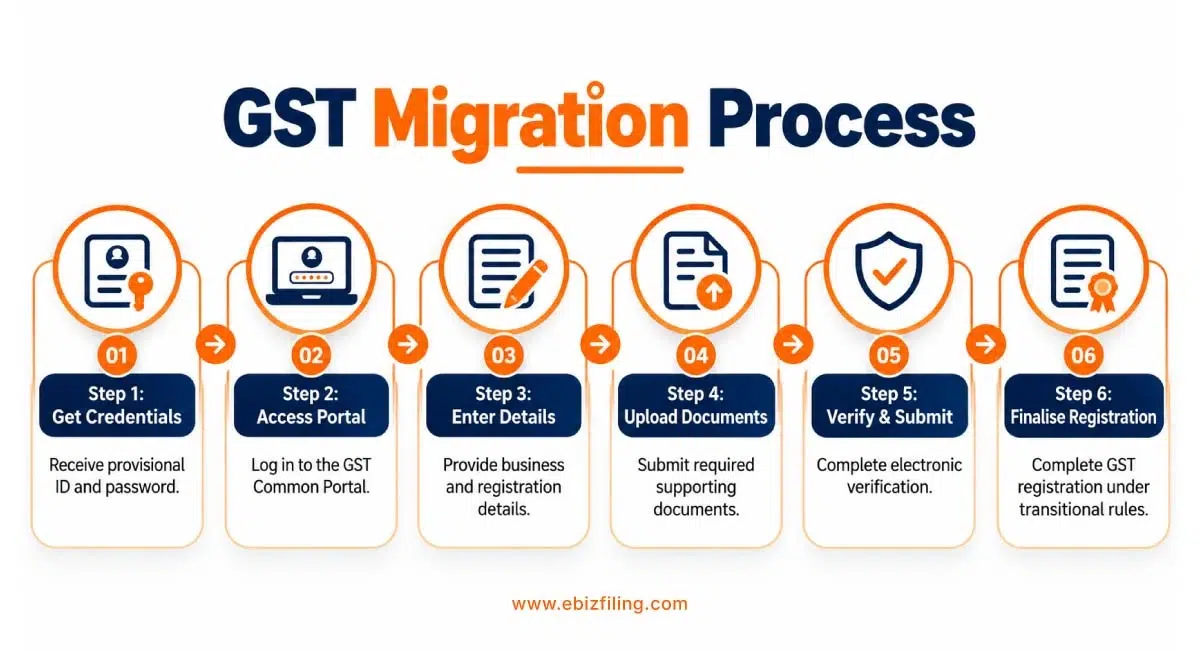
Step 1: Obtain Provisional Credentials
Existing eligible taxpayers were provided with a provisional ID and password through the relevant tax authority.
For Central Excise and Service Tax assessees, CBIC made the provisional credentials available through the ACES system.
Step 2: Access the GST Portal
The taxpayer used the provisional ID and password to access the GST Common Portal.
The taxpayer then verified the registered email address and mobile number and created login credentials for future access.
Step 3: Complete Enrolment Details
Business information had to be entered on the GST portal, including details relating to:
- Legal name of the business
- PAN
- Constitution of business
- Principal place of business
- Additional places of business
- Promoters, partners or directors
- Authorised signatory
- Existing indirect tax registrations
Step 4: Upload Supporting Documents
The taxpayer uploaded the required documents based on the constitution and nature of the business.
For current registrations, applicants can also refer to the detailed guide on documents required for GST registration to understand the commonly required PAN, identity, constitution and business-address documents.
Step 5: Verify and Submit the Application
The application had to be electronically verified through the permitted authentication method. Companies were required to authenticate prescribed submissions using a Digital Signature Certificate, as applicable under the GST Rules.
Businesses that need to understand electronic signing can refer to the guide on registering GST with a Digital Signature.
Step 6: Finalisation of Registration
If the information and documents submitted by the taxpayer were found to be correct and complete, the final certificate of registration was made available electronically in FORM GST REG-06 on the GST Common Portal.
This completed the migration from provisional registration to final GST registration.
Documents and Information Required for GST Migration
The documents depended on the type of taxpayer, but commonly included:
|
Document |
Purpose |
|
PAN |
Identification of taxpayer or business |
| Certificate of Incorporation |
Proof of constitution for a company |
|
Partnership or LLP documents |
Proof of constitution where applicable |
| Photograph |
Identification of proprietor, partners, directors or authorised persons |
|
Business address proof |
Evidence of principal place of business |
| Authorised signatory proof |
Confirmation of authority to act for the business |
|
Bank account details |
Business banking information, where required |
| Existing tax registration details |
Mapping VAT, Service Tax or Central Excise registration |
The information had to match the taxpayer’s existing registration and PAN records.
Is GST Migration Still Required for New Businesses in 2026?
No. A business starting operations today generally does not follow the original 2017 GST Migration procedure merely because it needs GST registration.
The GST Portal currently provides a separate new-registration process. An applicant can access Services > Registration > New Registration, enter the required PAN, business, email and mobile details, verify the OTPs, obtain a Temporary Reference Number (TRN), and complete Part B of the registration application. Under the current registration process, applicants may be required to complete Aadhaar-based authentication. Based on risk parameters, the GST Portal may require OTP-based Aadhaar authentication or biometric authentication and document verification at a GST Suvidha Kendra.
Therefore, businesses should distinguish between:
|
GST Migration |
New GST Registration |
|
Transitional process connected with GST rollout |
Current registration route for eligible applicants |
| Applied mainly to taxpayers under earlier indirect tax laws |
Applies to businesses seeking GST registration today |
|
Used provisional registration credentials |
Starts through New Registration on GST Portal |
| Connected with Section 139 and Rule 24 transitional provisions |
Governed by current GST registration provisions and portal procedures |
Businesses should also keep in mind that registration procedures and forms may change over time. Ebizfiling’s guide on GST Registration and Amendment Rules explains important developments relating to registration and amendments.
Ebizfiling Assistance for GST Migration
Ebizfiling can assist businesses with legacy GST migration issues, fresh GST registration, registration amendments, cancellation, revocation and related GST compliance requirements.
- Provide guidance on documents required for GST Migration.
- Assist with reviewing registration and authorised signatory details.
- Help identify discrepancies in existing registration information, where applicable.
- Provide support with GST-related registration and compliance queries.

Conclusion
GST Migration was an important transitional mechanism used when India moved from VAT, Service Tax, Central Excise and other earlier indirect taxes to GST in 2017.
Existing taxpayers were moved through a provisional registration process, while businesses seeking GST registration today should follow the current GST Portal registration procedure.
Businesses that already hold a GSTIN should use the applicable GST modification, cancellation or other current compliance procedure instead of relying on historical migration instructions.
Understanding this distinction helps businesses avoid following outdated migration instructions when applying for a new GSTIN or managing an existing GST registration.
Frequently Asked Questions
1. What happened if a taxpayer had multiple registrations under earlier tax laws using the same PAN?
Under Rule 24 of the CGST Rules, a taxpayer holding multiple registrations under the earlier laws based on a single PAN was generally granted only one provisional registration under GST. The final registration position depended on the applicable GST registration requirements and business locations.
2. Could a taxpayer cancel a provisional GST registration received during the transitional migration period?
Yes. During the transitional migration period, a person registered under the earlier laws who was not liable to register under GST could apply for cancellation of the migrated registration in FORM GST REG-29. This facility was available up to 31 March 2018 under Rule 24(4).
3. What happened if the information submitted during the GST migration process was incomplete or incorrect?
If the required information or documents were not submitted, or the details were found to be incorrect or incomplete, the proper officer could initiate cancellation of the provisional registration. Before cancellation, the taxpayer had to be given an opportunity to respond through a show-cause notice in FORM GST REG-27. If the issue was not resolved, the provisional registration could be cancelled through an order in FORM GST REG-28.
4. Could GST Migration be completed without a valid PAN?
No. A valid PAN issued under the Income-tax Act was required for migration under Rule 24 of the CGST Rules. Taxpayers registered under the earlier indirect tax laws had to have valid PAN details to enrol on the GST Common Portal. Therefore, any mismatch or issue with the PAN could prevent or delay completion of the migration process.
5. Were Input Service Distributors and persons deducting tax at source covered under the same GST migration procedure?
No. Rule 24 specifically excluded persons deducting tax at source and Input Service Distributors from the general migration mechanism provided under that rule. Their registration requirements were governed separately under the GST framework.
6. What should a taxpayer do if the legal name or PAN details did not match during GST registration migration?
During GST registration migration, taxpayer details needed to correspond with valid PAN and existing registration records. Where the PAN or legal-name details did not match the underlying records, the discrepancy had to be corrected in the relevant PAN or legacy tax-registration records before the migration process could be completed.
7. Was receiving a provisional GSTIN enough to complete GST Migration?
No. Receiving a provisional GSTIN did not by itself complete GST Migration. Taxpayers holding provisional registration were required to furnish the prescribed information and GST migration documents so that their registration could be finalised. Rule 24 prescribed FORM GST REG-26 for enrolment of an existing taxpayer.
8. How were provisional credentials used during the original GST migration process?
During the original GST migration process, eligible existing taxpayers were provided a provisional ID and password. These credentials were used to access the GST Common Portal, create login credentials and complete the enrolment process.
9. Is GST Migration required when a business changes its constitution today?
Not generally. GST Migration refers to the transitional process associated with the introduction of GST in 2017. If a present-day change in business constitution results in a change of PAN, such as conversion from a proprietorship to a company or LLP, a fresh GST registration may generally be required. Other changes should be handled under the applicable current GST registration or amendment provisions rather than the original migration procedure.
10. What should a business do if an old migrated GST registration is now cancelled or inactive?
The appropriate action depends on why the registration became inactive or was cancelled. Where a GST registration has been cancelled by the proper officer, an eligible taxpayer may be able to apply for revocation through the GST Portal, subject to the applicable conditions. Businesses should first check the GSTIN status and cancellation reason instead of attempting the original migration to GST process again.





GST Registration
Get GST Registration with ebizfiling at affordable prices.
About Ebizfiling -



Reviews
Akshat Mehta
12 Jan 2018They deliver things as promised but they are too slow.
Bharath
21 Apr 2020I’ve received great support even during these times of distress. Thank you so much, and a special shout to Nilesh who has been extremely supportive.
Christopher
07 Aug 2020EbizFiling helped us with our Indian subsidiary company formation from start to finish. The customer service, knowledge, technical know how and communication was amazing. The delivery of services were timely and as per schedule. Thanks team and congratulations on the job well done. I recommend EbizFiling to any local or international company that wants to start operations in Incredible India.
October 28, 2026 By Srishti M
October 27, 2026 By Srishti M
October 26, 2026 By Srishti M