


-
September 30, 2026
-
BySteffy A
ITR Form 7 Filing: Eligibility, Due Date and Filing Process
Introduction
ITR Form 7 Filing is prescribed for charitable and religious trusts, political parties, universities, educational institutions, research associations, medical institutions, and other specified persons required to furnish their income tax return under Sections 139(4A), 139(4B), 139(4C), or 139(4D) or 139(4F) of the Income-tax Act, 1961.
This article explains what ITR Form 7 Filing is, who is required to file it, its due date, applicable schedules, verification methods, and the ITR-7 online filing process.
What is ITR Form 7 Filing?
ITR Form 7 Filing is the prescribed income tax return for persons, including companies, required to furnish a return under Section 139(4A), 139(4B), 139(4C), or 139(4D) or 139(4F) of the Income-tax Act, 1961. It generally applies to charitable and religious trusts, political parties, specified institutions, universities, colleges, and certain research institutions.
ITR Form 7 for AY 2026-27 continues to be governed by the applicable provisions of the Income-tax Act, 1961, including Section 139. Under the Income-tax Act, 2025, return-filing provisions are contained in Section 263 and will apply to returns for Tax Year 2026-27 and subsequent tax years.
Who is Required to File ITR Form 7?
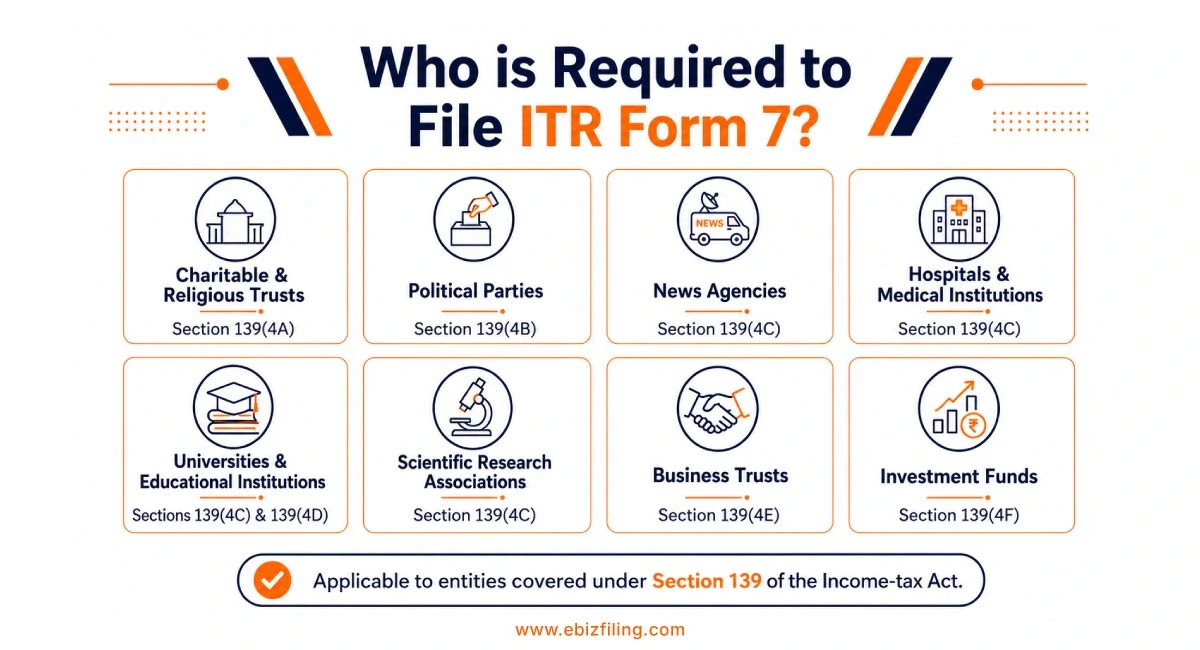
ITR Form 7 Filing is applicable to persons, including companies, required to furnish a return under Sections 139(4A), 139(4B), 139(4C), or 139(4D) of the Income-tax Act, 1961. For AY 2026-27, these returns continue to be governed by the Income-tax Act, 1961.
Charitable and Religious Trusts under Section 139(4A)
A person receiving income derived from property held wholly or partly under a trust or other legal obligation for charitable or religious purposes is required to file a return under Section 139(4A) where the total income, computed without giving effect to the exemptions available under Sections 11 and 12, exceeds the maximum amount not chargeable to income tax.
This provision also covers voluntary contributions received by eligible charitable or religious trusts and institutions.
Political Parties under Section 139(4B)
The Chief Executive Officer, Secretary, or another person holding an equivalent position in a political party must file a return under Section 139(4B) where the party’s total income, computed without giving effect to the exemption available under Section 13A, exceeds the maximum amount not chargeable to income tax.
Specified Institutions under Section 139(4C)
Subject to the conditions prescribed under the Income-tax Act, the following specified entities may be required to file ITR Form 7 under Section 139(4C):
- Scientific research associations referred to in Section 10(21)
- News agencies referred to in Section 10(22B)
- Associations or institutions referred to in Section 10(23A)
- Funds, trusts, institutions, universities, educational institutions, hospitals and other medical institutions covered under the relevant clauses of Section 10(23C)
- Investor Protection Funds and other specified funds or institutions covered under Section 10
- Trade unions and associations of trade unions covered under Section 10(24)
- Infrastructure Debt Funds, specified authorities, boards, trusts, commissions, and other notified bodies covered under the applicable provisions of Section 10
The filing requirement generally applies where the entity’s income, computed without giving effect to the relevant exemption provision, exceeds the maximum amount not chargeable to income tax.
Universities and Educational Institutions under Section 139(4D)
Every university, college or other institution referred to in Section 35(1)(ii) or Section 35(1)(iii), which is not otherwise required to furnish a return under another provision of Section 139, must file a return under Section 139(4D).
To understand which return form is applicable based on your taxpayer category, refer to our guide on Income Tax Return Forms.
What is the Structure of ITR Form 7?
The structure of ITR-7 may vary for each assessment year based on the form notified by the Central Board of Direct Taxes. For AY 2026-27, ITR-7 broadly contains general information, income and exemption-related schedules, computation of total income, tax liability and tax-payment details. The form for AY 2026-27 has been officially notified, and its filing utility was made available on 9 July 2026.
Part-A – General information
Part-B – Outline of the total income and tax computation with respect to income chargeable to tax.
- Schedule IA: “Details of accumulated income taxed in earlier assessment years as per section 11(3)”
- Schedule-D: Details of deemed application of income under clause (2) of Explanation 1 to sub-section (1) of section 11.
- Schedule-DA: Details of accumulated income taxed in earlier assessment years as per section 11(1B).
- Schedule-J: Statement showing the investment of all funds of the Trust or Institution as on the last day of the previous year.
- Part A-BS: Details of Application and Sources of Funds as on the last day of the previous year.
- Schedule R: Reconciliation of Corpus of Schedule J and Balance sheet
- Schedule-LA: Details in case of a political party.
- Schedule-ET: Details in case of an Electoral Trust
- Schedule-VC: Details of Voluntary Contributions received.
- Schedule AI: Aggregate of income derived during the year excluding voluntary contributions
- Schedule A: Amount applied to stated objects of the trust/institution during the previous year from all sources referred to in C1 to C7 of this table
- Schedule IE-1, IE-2, IE-3 and IE-4: Income and expenditure statements as applicable
- Schedule-HP: Computation of income under the head Income from House Property
- Schedule-CG: Computation of income under the head Capital gains.
- Schedule VDA: Income from transfer of virtual digital assets u/s 115BBH
- Schedule-OS: Computation of income under the head Income from other sources
- Schedule-OA: General information about business and profession
- Schedule-BP: Computation of income under the head profit and gains from business or profession
- Schedule-CYLA: Statement of income after set off of current year’s losses
- Schedule PTI: Pass through Income details from business trust or investment fund as per section 115UA, 115UB
- Schedule-SI: Statement of income which is chargeable to tax at special rates
- Schedule 115TD: Accreted income under section 115TD
- Schedule 115BBI: Specified income of certain Institutions covered u/s 115BBI
- Schedule FSI: Details of income accruing or arising outside India
- Schedule TR: Details of tax relief claimed for taxes paid outside India
- Schedule FA: Details of Foreign Assets and Income from any source outside India
- Schedule-SH: Details of shareholding in an unlisted company
- Part B-TI: Computation of total income
- Part B1: Applicable if exemption is being claimed u/s 11 and 12 or 10(23C)(iv)/10(23C)(v)/ 10(23C)(vi)/10(23C)(via) and where Part B3 is not applicable
- Part B2: Applicable if exemption is being claimed under section 13A/13B and under sections 10(21), 10(22B), 10(23A), 10(23AAA), 10(23B), 10(23EC), 10(23ED), 10(23EE), 10(29A), 10(23C)(iiiab), 10(23C)(iiiac), 10(23C)(iiiad), 10(23C)(iiiae), 10(23D), 10(23DA), 10(23FB), 10(24), 10(46), 10(47)
- Part B3 : Applicable if total income chargeable to tax u/s Twenty-second proviso to section 10(23C) or section 13(10)
- Part B-TTI: Computation of tax liability on total income Tax payments:
- Details of payments of Advance Tax and Self-Assessment Tax
- Details of Tax Deducted at Source (TDS) on Income (As per Form 16A/16B/16C/16D/16E).
- Details of Tax Collected at Source (TCS)
To understand the latest TDS and TCS changes effective from 1 April 2026 and their impact on taxpayers and businesses, read our detailed guide on the new TDS and TCS provisions.
ITR 7 Due Date
The due date for filing ITR Form 7 depends on whether the taxpayer is subject to audit or transfer-pricing requirements. For AY 2026-27, the applicable due dates are:
- 31 July 2026: Where audit under the Income-tax Act is not applicable.
- 21 November 2026: Where the taxpayer is required to obtain an audit report (extended from 31 October 2026 as per CBDT Circular No. 07/2026).
- 30 November 2026: Where a report under Section 92E relating to international transactions or specified domestic transactions is required.
The applicable audit report must generally be furnished one month before the due date for filing the return of income. Taxpayers should refer to the latest CBDT notifications/circulars for any further updates.
Note: ITR-7 applies to entities such as trusts, political parties, institutions and other persons covered under Section 139(4A) to Section 139(4D). The transfer-pricing due date should only be mentioned where Section 92E is applicable.
How to file ITR Form 7?
ITR Form 7 must be filed electronically through the Income Tax e-Filing portal. The taxpayer may prepare the return using the applicable online facility, offline utility, or authorised return-preparation software available for the relevant assessment year.
The general ITR-7 filing process includes:
- Log in to the Income Tax e-Filing portal.
- Select the applicable assessment year and ITR-7.
- Enter general, registration, exemption, audit, income, expenditure, tax and other required details.
- Complete all applicable schedules.
- Validate the return and resolve any errors.
- Submit the return electronically.
- Verify the return using DSC, EVC, Aadhaar OTP, or ITR-V, as applicable.
Verification of ITR Form 7 Filing
Political parties filing ITR-7 must verify the return using a Digital Signature Certificate through the authorised person, such as the Chief Executive Officer or Secretary.
Other eligible taxpayers may verify the return through:
- Digital Signature Certificate
- Electronic Verification Code
- Aadhaar OTP, wherever available
- A duly signed ITR-V sent to the Centralised Processing Centre, Income Tax Department, Bengaluru – 560500
Verification or submission of ITR-V should ordinarily be completed within 30 days from the date of filing the return. A return that is not verified within the prescribed period may be treated as invalid or may attract late-filing consequences.
Simplify Your Income Tax Return Filing with Ebizfiling
ITR Form 7 Filing involves multiple compliance requirements, including exemption claims, audit details, and tax reporting. Ebizfiling helps eligible taxpayers file their returns accurately while ensuring compliance with the applicable provisions of the Income-tax Act.
Ebizfiling can help you with:
- Accurate preparation and filing of ITR Form 7
- Review of Form 26AS, AIS, and TDS details
- Verification of exemption claims and audit information
- Assistance with return verification and compliance support
- Timely filing to avoid penalties and notices
Let Ebizfiling simplify your Income Tax Return Filing with expert guidance, accurate return preparation, timely filing, and end-to-end compliance support. Contact our professionals today for an accurate and timely filing experience.
Conclusion
ITR Form 7 Filing is mandatory for eligible charitable and religious trusts, political parties, universities, educational institutions, research associations, medical institutions, and other specified persons covered under Sections 139(4A), 139(4B), 139(4C), or 139(4D) of the Income-tax Act, 1961. The Income Tax Department provides the prescribed filing utility for each assessment year through the Income Tax e-Filing portal. Taxpayers should use the applicable JSON utility or other filing facility released for the relevant assessment year. Before filing, they should verify their income details, exemption claims, registration or approval particulars, audit information, and tax credit statements.
Suggested Reads:
FAQs on ITR Form 7 Filing
1. Can a charitable trust file ITR Form 7 if it has no taxable income?
A charitable or religious trust may still need ITR Form 7 Filing if it is covered under Section 139(4A), even when its income is claimed as exempt under the Income-tax Act. Filing may be required to report income, claim exemption, disclose application of income, and comply with return filing provisions.
2. Is ITR Form 7 for trust applicable when property is partly held for charitable purposes?
ITR Form 7 Filing for trust applies when income is received from property held wholly or partly under trust or legal obligation for charitable or religious purposes. The return helps report income, expenditure, accumulation, and exemption-related details of the trust.
3. Can a political party file ITR 7 without a Digital Signature Certificate?
A political party ITR Form 7 Filing under Section 139(4B) is required to verify the return using a Digital Signature Certificate through the authorised person. This is usually done by the Chief Executive Officer or Secretary of the political party.
4. What should be checked before ITR 7 online filing?
Before ITR 7 online filing, taxpayers should check Form 26AS, AIS, TIS, TDS details, exemption details, audit report details, registration or approval details, and income schedules. This helps reduce mismatch issues and ensures that the return is filed with correct income and tax credit details.
5. Is ITR Form 7 Filing applicable to universities and colleges?
Yes. Universities, colleges and other institutions covered under Section 139(4D) may be required to file ITR-7 where they are not otherwise required to furnish a return under another provision of Section 139.
6. Is ITR Form 7 Filing applicable to all charitable institutions?
ITR Form 7 Filing is generally applicable to charitable or religious trusts and specified institutions covered under Sections 139(4A) or 139(4C). The correct return form depends on the entity’s legal status, income, registration, exemption claim, and applicable return-filing provision.
7. Is audit information required in the ITR 7 filing process?
Yes, if the taxpayer is liable for audit, the ITR 7 filing process requires details of the audit report, date of furnishing the audit report, and other relevant audit information. These details should match the audit report filed on the Income Tax e-Filing portal.
8. What happens if ITR-V is not sent after filing ITR 7?
If the return is not electronically verified and the signed ITR-V does not reach CPC within the prescribed period, the return may be treated as invalid. Verification should generally be completed within 30 days from the date of filing through DSC, EVC, Aadhaar OTP, net banking, or ITR-V, as applicable.
9. Can Ebizfiling help if a trust has a mismatch in Form 26AS and AIS before ITR Form 7 Filing?
Yes, Ebizfiling can help review Form 26AS, AIS, TIS, TDS credits, exemption details, and return data before ITR Form 7 Filing. This review can help identify mismatch issues, missing tax credits, or incorrect reporting before the return is submitted.
10. Why should institutions take professional help for ITR 7 online filing?
Institutions may need professional help because ITR 7 online filing involves multiple schedules, exemption sections, registration details, audit reporting, and verification rules. Ebizfiling can assist eligible taxpayers with return preparation, compliance checks, online filing, and verification support.





File Income Tax Returns
File your ITR with EbizFiling at INR 1199/- only
About Ebizfiling -



Reviews
Chilakala Krishna
19 Apr 2022I took gst registration from Ebizfiling india private limited.. The service was excellent and am looking for more colloboration
Hemang Malhotra
08 Oct 2018I was new as an Entrepreneur when I had seen their post on social media. I contacted them regarding proprietorship and realized they their pricing is incomparable in the market also their services are really prompt. Thank you, Ebizfiling.
Amit Tripathi
01 Jun 2018Easy and Fast Thanks for the Help, Very Nice Services will contact for other services too.
October 14, 2026 By Srishti M
September 29, 2026 By Srishti M
Income Tax Compliance Calendar October 2026: Filing Guide Introduction The Income Tax Compliance Calendar October 2026 highlights important income tax obligations applicable to taxpayers, businesses and entities covered under audit and transfer pricing provisions. October 2026 includes key compliance […]
September 25, 2026 By Steffy A