


Investing in a Startup Business in India: Guide for Investors
Introduction
Investing in a Startup Business in India provides investors an opportunity to participate in innovative companies, emerging technologies and high-growth sectors.
However, startup investments require more than evaluating business potential. Investors must also understand the legal structure, ownership pattern, financial position, regulatory compliance and investment terms before committing capital.
Unlike traditional investment options, startups may have limited operating history, evolving revenue models and uncertain growth paths. Therefore, Investing in a Startup Business requires a structured evaluation process covering legal, financial and operational aspects.
In India, startup investments are governed by multiple regulations depending on the investor profile and investment structure, including:
- Companies Act, 2013
- Foreign Exchange Management Act, 1999 (FEMA)
- RBI regulations applicable to foreign investment
- DPIIT Startup India framework
- Applicable provisions of the Income-tax Act, 2025 for Tax Year 2026-27 onwards
Before investing, investors should conduct proper due diligence to understand ownership rights, compliance status, potential risks and investment protections.
Quick Insights
- Investing in a startup business requires evaluating legal, financial and regulatory factors.
- Investors should review the cap table, ROC filings, shareholder agreements and intellectual property ownership.
- Foreign investors must comply with FEMA and FDI regulations before investing in Indian startups.
- DPIIT Startup India recognition provides benefits to eligible startups but is not mandatory for every startup.
- Proper investment documentation helps define investor rights, ownership and exit terms.
What Does Investing in a Startup Business Mean?
Investing in a Startup Business means providing capital to an early-stage or growing company in exchange for equity ownership, financial rights or other agreed investment benefits.
Startup investments are generally different from traditional investments because investors often evaluate future growth potential rather than only historical performance.
Common startup investment routes in India include:
- Equity shares
- Preference shares
- Convertible instruments
- Angel investments
- Venture capital investments
- Strategic investments
The investment structure depends on factors such as:
- Startup stage
- Business valuation
- Funding requirement
- Investor rights
- Exit expectations
How to Invest in a Startup Business in India?
The process of Investing in a Startup Business involves identifying the startup opportunity, evaluating the business, conducting due diligence and completing legal documentation.
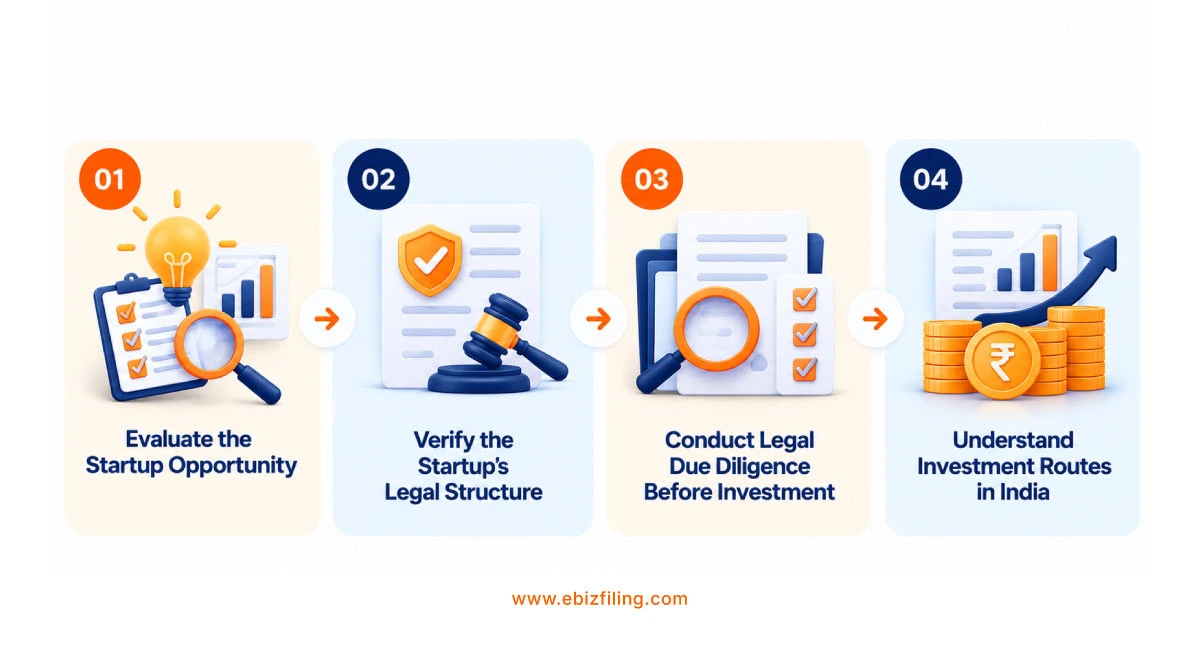
Step 1: Evaluate the Startup Opportunity
Before investing, investors should understand:
- Business model
- Product or service offering
- Target customers
- Market opportunity
- Revenue model
- Growth strategy
Investors should evaluate whether the startup has a scalable business model and whether the opportunity aligns with their investment objectives.
Step 2: Verify the Startup’s Legal Structure
The legal structure of a startup determines its ownership framework, compliance obligations and fundraising options.
Investors should review:
- Certificate of Incorporation
- Entity type
- Directors and shareholders
- Registered office details
- MCA records
- Statutory compliance status
Many startups seeking external funding operate as Private Limited Companies because this structure allows equity fundraising and structured ownership management.
Investors can understand the incorporation framework through Private Limited Company Registration.
Step 3: Conduct Legal Due Diligence Before Investment
Legal due diligence is one of the most important steps before Investing in a Startup Business. It helps investors verify whether the startup has proper ownership records, compliance documents and legal protections.
Corporate and ROC Due Diligence
Investors should review:
- Incorporation documents
- Memorandum of Association (MOA)
- Articles of Association (AOA)
- Annual filings with MCA
- Director details
- Registered charges
- Share allotment records
Reviewing ROC filings helps investors understand whether the startup has maintained proper corporate compliance.
Shareholding and Cap Table Review
A cap table provides details of the startup’s ownership structure.
Before investing, investors should review:
- Founder shareholding
- Existing investors
- Equity distribution
- ESOP pool
- Previous funding rounds
- Potential dilution after investment
A clear cap table helps investors understand their expected ownership percentage and rights after investment.
Intellectual Property Due Diligence
Intellectual property can be one of the most valuable assets of a startup.
Investors should verify ownership of:
- Brand names
- Trademarks
- Software
- Copyrights
- Patents
- Proprietary technology
Before Investing in a Startup Business, investors should ensure that important intellectual property assets are owned by the startup and not by founders, employees or third parties.
Startups can explore Trademark Registration for protecting brand identity and intellectual property rights.
Agreement and Contract Review
Investors should review important agreements, including:
- Founder agreements
- Share Subscription Agreement (SSA)
- Shareholders Agreement (SHA)
- Customer contracts
- Vendor agreements
- Employment agreements
- Confidentiality agreements
These agreements define investor rights, obligations, ownership conditions and exit mechanisms.
Step 4: Understand Investment Routes in India
Equity Investment
Equity investment involves acquiring ownership shares in the startup.
Under this structure:
- Investor receives shares.
- Ownership percentage depends on investment amount and valuation.
- Investor rights are defined through company documents and agreements.
Equity issuance by companies must comply with applicable provisions of the Companies Act, 2013.
Preference Share Investment
Preference shares provide specific rights attached to the investment.
These rights may include:
- Preference in dividend payments
- Liquidation preference
- Specific investor protections
The rights depend on the terms of issue approved by the company.
Convertible Instruments
Convertible instruments allow investment amounts to convert into equity based on predefined terms.
Investors should review:
- Conversion conditions
- Valuation mechanism
- Rights after conversion
- Dilution impact
Angel and Venture Capital Investment
Angel investors and venture capital funds generally evaluate startups based on:
- Market opportunity
- Founder capability
- Scalability
- Financial projections
- Exit opportunities
Institutional investors usually conduct detailed legal and financial due diligence before Investing in a Startup Business.








Reviews
Akshay shinde
23 Apr 2019Excellent service…
Ashrith Akkana
19 Apr 2022I took import export certificate from the ebizfiling. They have done the work on time.. Thank you for making my import export certificate in time 😊
Karna
08 Mar 2018Mr Parin and Mr Jay can say whole story about my Experience with registering the LLP. I had to shift to another vendor to complete LLP registration. My email : sonejikarna@gmail.com. You will find all detail about me in your database.
November 23, 2026 By Siddhi R
November 20, 2026 By Srishti M
November 18, 2026 By Srishti M