
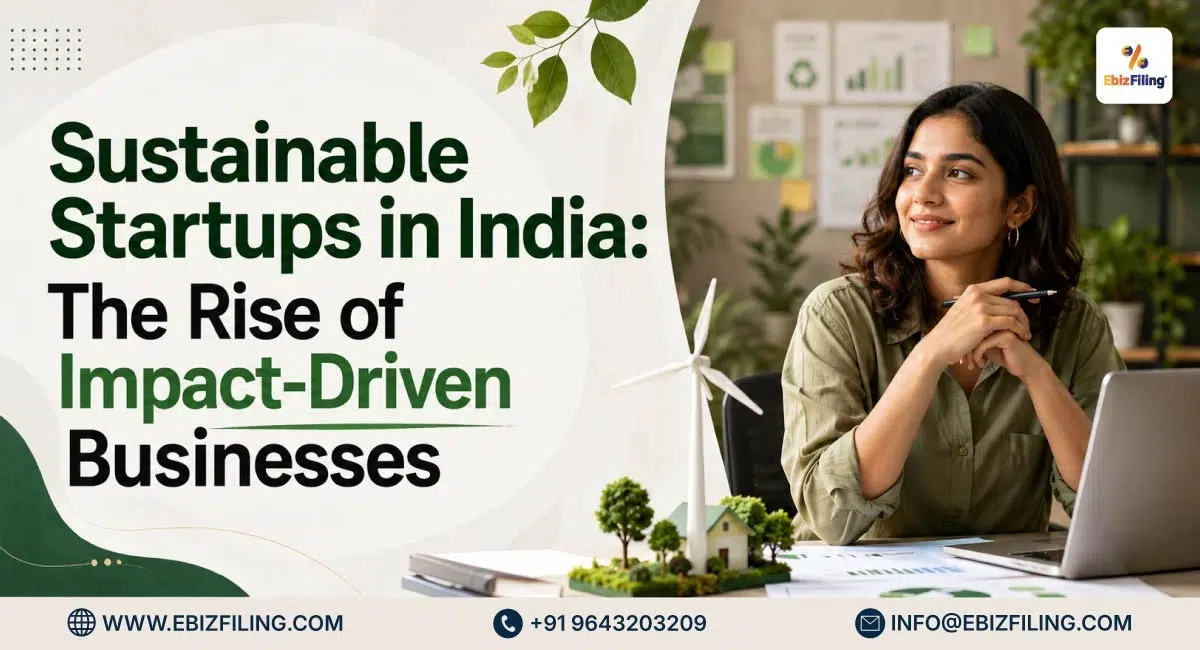
Sustainable Startups in India: Building Businesses That Create Impact
Introduction
Sustainable startups in India are turning environmental problems into practical business ideas. Founders are building solutions for waste, pollution, clean energy and water conservation while earning revenue.
A sustainable startup must connect sustainability to its main product, service or way of working. For example, a company may recycle industrial waste, reduce emissions, save water or replace harmful materials with safer alternatives.
However, these ventures need more than a strong purpose. They also need paying customers, suitable funding, proper registrations and a business model that can survive in the long run. This blog explains their sectors, examples, challenges and tax support.
What Are Sustainable Startups in India?
Sustainable startups in India are young businesses that solve environmental or social problems through products or services that can generate income. Their aim is to create a positive impact without ignoring commercial growth.
A startup may be sustainability-focused when it reduces waste, improves energy efficiency or makes better use of natural resources. It may serve consumers or other businesses. Sustainability usually has three connected parts.
Environmental Sustainability
Environmental sustainability means reducing pollution, waste and the unnecessary use of resources. Sustainable startups in India may work on renewable energy, recycling, water treatment, low-emission technology or responsible packaging.
Social Sustainability
A business also has responsibilities towards workers, suppliers and communities. Fair employment, safe working conditions and responsible sourcing form part of social sustainability.
Economic Sustainability
A useful green idea cannot create long-term impact if the business keeps losing money. Therefore, sustainable startups in India must earn revenue, control costs and build reliable operations. This balance between purpose and profit is important. The startup must solve a real problem at a practical price.
Why Are These Startups Growing?
Environmental concerns are becoming more visible. Consumers are paying attention to plastic use, waste generation and energy consumption. At the same time, companies are looking for better ways to manage packaging, recycling, emissions and resource use.
Technology is also opening new possibilities. Sensors can track water and power consumption. Software can calculate emissions. New materials can replace conventional plastic. As a result, sustainable startups in India can now develop solutions that were difficult or expensive to build earlier.
Investors and incubators are also exploring climate technology, clean mobility and circular-economy ideas. Government recognition may offer selected benefits, but it does not guarantee funding or tax relief.
Sectors and Examples of Sustainable Startups in India
Sustainable startups in India operate across several industries and serve consumers, farmers, manufacturers and large companies.
Renewable Energy
Renewable-energy startups work on solar power, energy storage, smart electricity management and decentralised energy systems. Their solutions may help homes and businesses reduce dependence on conventional power sources.
Electric Mobility
This sector includes electric vehicles, charging stations, fleet-management systems, battery technology and battery recycling. Sustainable startups in India working in mobility aim to make transport cleaner and more efficient.
Waste Management and Circular Economy
Waste-focused businesses collect, separate, recycle or reuse materials that might otherwise reach landfills. These materials may include plastic, flowers, textiles, food waste, electronic waste and industrial by-products.
A circular-economy model keeps materials in use for longer. Therefore, sustainable startups in India may turn discarded materials into new products.
Sustainable Agriculture
Agricultural startups may offer soil-monitoring tools, smart irrigation, crop-management technology, biological inputs and solutions for agricultural residue. Such ideas can help farmers use water, land and inputs more efficiently.
Water and Climate Technology
Water-focused businesses work on purification, wastewater treatment, leakage detection and efficient irrigation. Climate-tech startups may provide carbon accounting, emission monitoring and environmental data tools.
Sustainable Materials and Packaging
Businesses in this area create reusable containers, compostable packaging, recycled construction products and lower-impact alternatives to traditional materials.
Sustainable startups in India can use material innovation to solve both environmental and commercial problems.
Phool
Phool turns discarded flowers from places of worship into products such as incense. The model gives floral waste a new use and shows how a local environmental concern can become a consumer business. Its official website describes the collection and upcycling of temple flowers into handcrafted incense products.
The company is an example of how sustainable startups in India can connect waste management with product development and branding.
Chakr Innovation
Chakr Innovation develops emission-control and environmental-monitoring solutions. Its work includes retrofit technology for diesel-generator emissions and monitoring systems for commercial and industrial users.
It shows how sustainable startups in India can provide technical business-to-business solutions rather than only selling green consumer products.
Sea6 Energy
Sea6 Energy works on seaweed farming and seaweed-based applications. Its business areas include agricultural inputs, food, materials, bioplastics and biofuels.
The company shows how marine biotechnology can support new materials and products.
Banyan Nation
Banyan Nation works in plastic recycling and recycled-material supply. It processes plastic waste so that the material can be used again in new products. Its official website highlights recycled polyethylene, plastic credits and traceable circular supply chains.
This model supports a circular economy by keeping useful plastic in the supply chain.
How Sustainable Startups in India Can Register, Grow and Claim Tax Benefits
A clear environmental idea is only the starting point. Sustainable startups in India must choose the right legal structure, complete applicable registrations, find customers and measure their impact.
Benefits of Building a Sustainable Business
Sustainable businesses solve problems that affect daily life. They may reduce waste, improve energy use, conserve water or replace harmful materials.
A clear sustainability focus can also help a startup stand out. For sustainable startups in India, measurable results are more convincing than broad promises.
However, businesses should support environmental claims with reliable information. Statements such as “completely green” or “100% eco-friendly” may create doubt when there is no data behind them.
Large companies need support with recycling, responsible sourcing and energy management. This creates opportunities for sustainable startups in India.
Climate funds, impact investors and lenders may consider businesses with measurable impact. Funding still depends on the team, product, market and financial plan.
Common Growth Challenges
Developing a sustainable product can be expensive. Research, testing, machinery and specialised materials may increase the initial cost. Customers may like an eco-friendly idea but still choose a cheaper conventional option.
Supply chains may create further problems. Recycled or responsibly sourced materials may not be available in the required quantity or quality. Testing facilities, collection networks and charging infrastructure are also not equally available everywhere.
Another challenge is measuring results. Sustainable startups in India should track clear indicators, such as waste recycled, water saved, power reduced or emissions avoided. This helps sustainable startups in India show whether their solution is creating real value. This information can help founders speak more honestly with customers and investors.
DPIIT Recognition
There is no separate legal registration called sustainable startup registration. However, an eligible business may apply for DPIIT recognition under the Startup India framework.
An eligible private limited company, registered partnership firm, LLP or cooperative society may apply for normal DPIIT recognition. The entity should not be more than 10 years old, its annual turnover should not have exceeded ₹200 crore in any financial year since incorporation, and it should be working on innovation, improvement or a scalable business model. It must also not have been formed by splitting or reconstructing an existing business. The portal currently shows a ten-year age limit and a ₹200 crore turnover ceiling for normal recognition.
DPIIT recognition may provide access to selected benefits related to self-certification, intellectual-property support, procurement and tax applications. However, sustainable startups in India should not assume that every recognised business automatically receives every benefit.
The Gazette Notification G.S.R. 127(E), dated 19 February 2019, is an important historical notification for startup recognition. It originally referred to private limited companies, registered partnership firms and LLPs and used a ₹100 crore recognition limit.
Tax Deduction Under Section 140
The Income-tax Act, 2025 applies from 1 April 2026. Under the new law, the profit deduction for an eligible startup is covered by Section 140. This provision corresponds to Section 80-IAC under the earlier Income-tax Act, 1961.
Section 140 provides a deduction equal to 100% of profits and gains from an eligible business for three consecutive tax years. The eligible startup may choose these three years from the first ten tax years beginning with its year of incorporation.
For this benefit, the startup must be an eligible company or LLP incorporated on or after 1 April 2016 but before 1 April 2030. Its turnover must not exceed ₹100 crore in the tax year linked to the deduction. It must also hold the prescribed certificate from the Inter-Ministerial Board of Certification.
The business should involve innovation, development or improvement of products, processes or services, or have a scalable model with strong potential for employment or wealth creation.
Therefore, sustainable startups in India should not describe themselves as automatically tax-free after obtaining DPIIT recognition.
Normal recognition and Section 140 follow separate conditions. The current Startup India portal uses a ₹200 crore turnover ceiling for normal recognition, while Section 140 uses ₹100 crore for the startup profit deduction.
Steps to Start the Business
First, identify one clear problem involving waste, pollution, water, energy, transport or agricultural residue.
Next, speak with potential customers. Test whether they need the solution and are willing to pay before making a large investment.
The founders should then choose a suitable structure. A private limited company or LLP may be useful where the business expects investment, multiple owners or formal contracts. Those planning to claim Section 140 should note that the provision applies only to eligible companies and LLPs.
Depending on the activity, sustainable startups in India may require:
- Private limited company registration
- LLP registration
- GST registration
- Udyam or MSME registration
- Trademark registration
- Import Export Code registration
- Environmental or industry-specific approvals
Finally, measure impact from the beginning. Reliable data can help sustainable startups in India improve marketing, investor discussions and planning.
How Ebizfiling Can Help
Ebizfiling can assist sustainable startups in India with private limited company registration, LLP registration, DPIIT recognition assistance, Udyam registration, GST registration, trademark registration, patent application support and recurring compliance.
The exact requirements depend on the business activity, location, legal structure and products involved. Therefore, founders should identify the applicable approvals before beginning commercial operations.
Conclusion
Sustainable startups in India are creating useful solutions for waste, energy, water, mobility and responsible production. Their success, however, depends on more than a green idea.
A strong startup must understand its customer, generate revenue, follow the law and measure its impact with reliable data. DPIIT recognition and Section 140 may support eligible businesses, but both have separate conditions.
With proper planning, practical pricing and clear compliance, sustainable startups in India can create long-term value for customers, investors and the environment.
Frequently Asked Questions
1. What conditions must a sustainable startup meet for DPIIT recognition?
An eligible entity should generally be within 10 years of incorporation and registered as a private limited company, LLP, partnership firm or cooperative society. Its annual turnover should not have exceeded ₹200 crore in any financial year. It must also meet the innovation, scalability and original-entity conditions prescribed by the Department for Promotion of Industry and Internal Trade (DPIIT).
2. Is there a separate registration for sustainable startups in India?
No, there is no separate legal registration called sustainable startup registration. The business must first register under a suitable legal structure. Depending on its activities, it may also require DPIIT recognition, GST registration, Udyam registration, environmental approvals and industry-specific licences.
3. Is DPIIT recognition the same as eligibility for the Section 140 deduction?
No. DPIIT recognition and eligibility for the profit deduction under Section 140 of the Income-tax Act, 2025 are separate. A startup may receive DPIIT recognition but still fail to qualify for the tax deduction if it does not satisfy the prescribed incorporation, turnover, business and certification conditions.
4. Which startups can claim the deduction under Section 140?
The deduction is available only to eligible companies and LLPs incorporated during the prescribed period. The startup must satisfy the ₹100 crore turnover limit, eligible-business conditions and certification requirements. A partnership firm or cooperative society may qualify for normal DPIIT recognition but cannot claim the deduction merely on that basis.
5. For how long can an eligible startup claim the Section 140 deduction?
An eligible startup can claim a deduction equal to 100% of the profits and gains derived from its eligible business for three consecutive tax years. It may select these three years from the first 10 tax years beginning with the tax year in which the startup was incorporated.
6. What environmental approvals may a sustainable startup require?
The required approvals depend on the startup’s activity, location, production process, emissions and type of waste handled. A manufacturing, recycling or waste-processing business may require consent to establish, consent to operate or waste-specific authorisation from the relevant State Pollution Control Board or another sector regulator.
7. Can a DPIIT-recognised startup self-certify environmental compliance?
Eligible DPIIT-recognised startups falling within the prescribed white category may self-certify compliance under specified environmental laws, subject to applicable conditions and random checks. However, self-certification does not remove the need to obtain licences, consents or approvals required under other environmental or industry-specific laws.
8. How should a sustainable startup measure its environmental impact?
The startup should establish a baseline and track measurable results such as waste recycled, water saved, emissions reduced, renewable energy generated or recycled material used. Impact claims should be supported by records, calculation methods, reports or recognised measurement standards to reduce the risk of misleading environmental claims.
9. How can Ebizfiling help register a sustainable startup?
Ebizfiling can assist with private limited company registration, LLP registration, DPIIT recognition assistance, GST registration and Udyam registration. The most suitable structure and registrations depend on the founders, funding plan, turnover, location and nature of the business activity.
10. Can Ebizfiling assist with intellectual property and ongoing compliance?
Yes. Ebizfiling can assist with trademark registration, patent application support and recurring company, LLP, GST and income-tax compliance. Sustainable startups may use trademark protection for their brand and consider patent protection for eligible inventions, technical processes or innovative products.



Startup Recognition
Get recognition Under Government’s startup India Schemes, and get the benefits available to startups. Get Startup India recognition with ebizfiling
About Ebizfiling -



Reviews
Prachi Pandya
02 Aug 2018I wanted to start my E-commerce business and couldn’t find a way out until I came across Ebizfiling website. They helped me get through the whole process hassle-free. Thank you.
Lakshman Rajpurohit
28 May 2017We are looking for company who provides registration and process for SSI certificate. We contact ebizfiling and they have done job for us in a smooth way. we really appreciate their service and quick turn around time. Special Thanks to team of ebizfiling India pvt. ltd.
Ratnesh Mishra
19 Nov 2021Awesome work done by this team especially Ms Aishwarya and Mr Deepak....They followed everything on time and service cost was very competitive... Looking forward working with these awesome guys👏👏👏😍
October 19, 2026 By Srishti M
October 15, 2026 By Srishti M
TDS and TCS Compliance Calendar November 2026: Compliance Guide Introduction The TDS and TCS Compliance Calendar November 2026 covers important tax deduction, collection, payment, certificate and reporting requirements applicable during the month. It helps businesses, government offices and other responsible […]
October 14, 2026 By Srishti M
GST Compliance Calendar November 2026: Key Due Dates & Filings Introduction The GST Compliance Calendar November 2026 highlights the major GST return filing, tax payment, invoice reporting and year-end adjustment deadlines applicable during the month. It covers regular taxpayers, QRMP […]