


-
July 7, 2026
-
BySteffy A
How to File Form 61A Online? Applicability, Due Date & Process
Introduction
To file Form 61A online, specified reporting entities must report the Statement of Financial Transactions (SFT) under the Income Tax Act, 1961. It helps the Income Tax Department track high-value financial transactions recorded during a financial year.
With the implementation of the Income Tax Act, 2025 from 1 April 2026, Form 61A has been renumbered as Form No. 165 under the new framework. The reporting requirement continues, but the form number has changed under the new law.
In this blog, we will discuss what Form 61A is, who needs to file it, the due date for filing Form 61A, the online filing process, and the consequences of non-filing.
What is Form 61A of the Income Tax Act, 1961?
The Income Tax Department requires certain reporting entities to furnish details of high-value financial transactions through the Statement of Financial Transactions (SFT). This reporting requirement is prescribed under Section 285BA of the Income Tax Act, 1961 and is filed using Form 61A.
According to Rule 114E of the Income Tax Rules, 1962, specified reporting persons notified under Rule 114E are required to furnish Form 61A. The statement must be furnished in Form 61A under the Income Tax Act, 1961 and filed by the notified reporting person for the relevant financial year on an annual basis. Rule 114E also governs the type of transactions and their value that must be reported in the Statement of Financial Transactions.
Under the Income Tax Act, 2025, Form 61A has been renumbered as Form No. 165. While the reporting requirement continues, the prescribed form number has changed under the new law.
What are the Specified Financial Transactions?
The Specified Financial Transactions (SFTs) may include the following transactions, subject to the prescribed limits under Rule 114E:
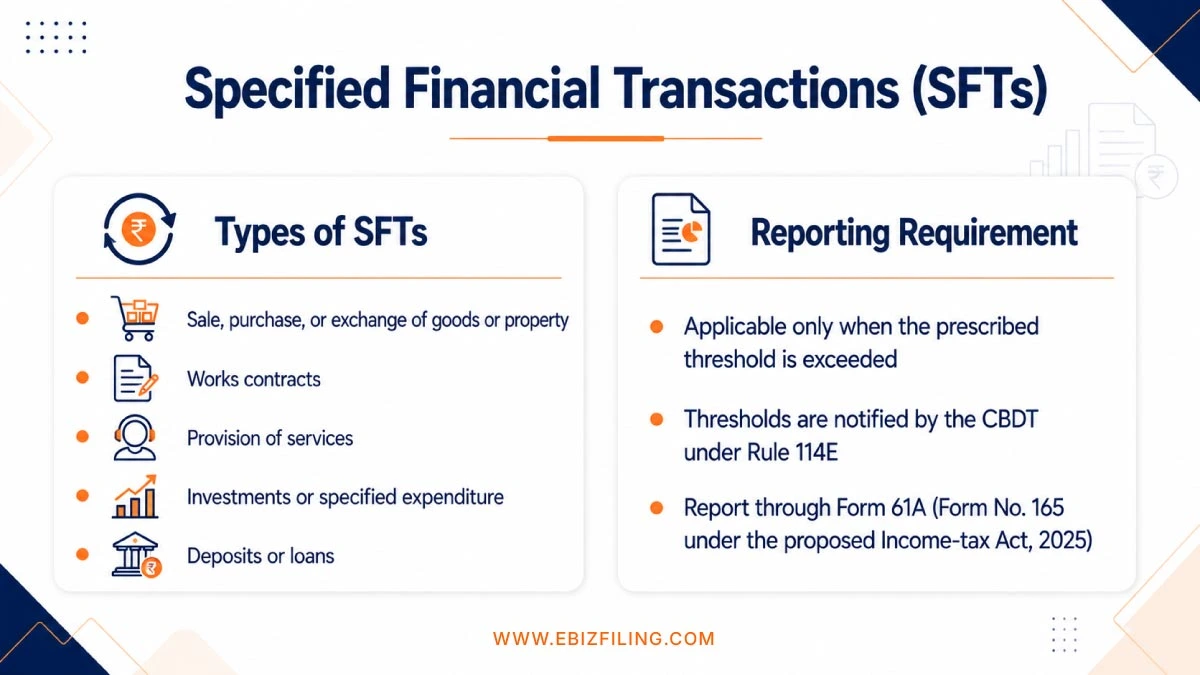
- Cash deposits or withdrawals in bank accounts above the prescribed threshold.
- Credit card payments above the specified limit.
- Purchase or sale of immovable property.
- Investment in shares, bonds, debentures, or mutual fund units.
- Receipt of cash for sale of goods or services by persons liable for tax audit.
- Purchase or sale of foreign currency.
- Acceptance of deposits or repayment of loans above the prescribed limit.
The CBDT may prescribe different reporting thresholds for different classes of persons and transactions through notifications issued from time to time.
Who is Required to File Form 61A?
- A banking company or a cooperative bank
- A non-banking financial company (NBFC)
- Any institution issuing credit card
- Any person who is liable for audit under Section 44AB of the Income Tax Act, 1961.
- Post offices
- A Nidhi referred to in section 406 of the Companies Act, 2013
- A company issuing bonds or debentures
- A company issuing shares
- A mutual fund institution
- A company listed on a recognized stock exchange
- A trustee of a mutual fund or such other person as authorized by the trustee
- Authorized dealer, offshore banking unit, money changer or any other person defined in FEMA
- Inspector General or sub-registrar appointed under Registration Act, 1908.
Due Date to File Form 61A
The Statement of Financial Transactions (SFT) must generally be furnished on or before 31 May immediately following the financial year in which the transaction is registered or recorded.
A penalty under Section 271FA of ₹500 per day is levied for failure to furnish Form 61A within the prescribed due date. The Income Tax Department may issue a notice requiring the reporting entity to furnish the statement within 30 days. If the reporting entity still fails to comply within the specified period, the penalty increases to ₹1,000 per day from the expiry of the notice period.
If you receive a notice from the Income Tax Department for non-filing or delayed filing of Form 61A, you can refer to our guide on Income Tax Notice Response to understand the response process and compliance requirements.
However, certain SFT reporting requirements, such as transactions in listed securities or units of mutual funds, may be subject to different reporting timelines as prescribed.
Consequences of Non-filing Form 61A
Non-filing or delayed filing of Form 61A attracts a penalty under Section 271FA of the Income Tax Act. The penalty is ₹500 per day of default until a notice is issued by the Income Tax Department. If the reporting entity still fails to file the statement within the time specified in the notice, the penalty increases to ₹1,000 per day from the expiry of that period.
In case of inaccurate information or failure to correct reported information within the prescribed time, a penalty under Section 271FAA may also apply.
File Form 61A Online with Ebizfiling
Filing Form 61A requires accurate reporting of Specified Financial Transactions (SFT) and compliance with the prescribed Income Tax provisions. At Ebizfiling, our experts help reporting entities complete the filing process correctly and on time.
Our Form 61A Online Filing Services Include:
- Eligibility Assessment to determine whether your entity is required to file Form 61A.
- End-to-End Form Preparation based on your financial transaction details.
- Accurate SFT Reporting in accordance with Section 285BA and Rule 114E.
- Timely Online Filing to help you meet the statutory due date.
- Compliance Support for notices, corrections, and filing-related queries.
Along with Form 61A filing, Ebizfiling assists with TDS Return Filing, Tax Audit, PAN/TAN services, and Income Tax compliance to keep your business fully compliant.
Conclusion
When you file Form 61A, the Income Tax Department can track specified financial transactions reported by notified entities. Businesses that fall under the reporting requirements should ensure timely and accurate filing to avoid penalties and regulatory notices. Although Form 61A has been renumbered as Form No. 165 under the Income Tax Act 2025, the overall reporting requirement remains substantially the same. Timely compliance supports better record management, helps maintain tax compliance, and reduces the possibility of notices arising from non-reporting.
Frequently Asked Questions on Form 61A Filing
1. Which transactions are reported in Form 61A?
File Form 61A under the Income Tax Act to report Specified Financial Transactions (SFT) above the prescribed threshold. These may include high-value cash deposits, purchase or sale of immovable property, investments in shares, bonds, debentures, mutual funds, foreign exchange transactions, credit card payments, and other notified transactions under Rule 114E.
2. Can Form 61A be revised after it has been filed?
Yes. If any information reported in Form 61A filing is found to be incorrect, incomplete, or omitted, the reporting entity can submit a correction statement through the Income Tax Reporting Portal as per the prescribed procedure.
3. What is the difference between Form 61, Form 61A and Form 61B under the Income Tax Act?
Income tax form 61 is a statement related to declarations received from persons who do not have PAN for specified transactions. Form 61A is used by notified reporting entities to report Specified Financial Transactions (SFT) under Section 285BA, whereas Form 61B is used by reporting financial institutions for FATCA and Common Reporting Standard (CRS) compliance.
4. Can Form 61A be filed after the due date?
Yes. Form 61A can be filed after the due date, but delayed filing may attract penalties under Section 271FA of the Income Tax Act. To avoid additional penalties and notices, reporting entities should complete Form 61A filing within the prescribed timeline.
5. What is the procedure for Form 61A online filing?
Form 61A online filing is carried out through the Income Tax Department’s Reporting Portal. The reporting entity must register on the portal, prepare the Statement of Financial Transactions (SFT) in the prescribed format, validate the information, and submit the statement electronically.
6. What details are required for Form 61A filing?
Form 61A filing requires details of the reporting entity, particulars of reportable transactions, information relating to the persons involved in those transactions, and other details prescribed under Rule 114E. The information should be accurate and supported by the entity’s records.
7. Can Form 61A be filed without reportable transactions?
If there are no reportable transactions, the reporting entity should check the applicable portal instructions or prescribed reporting requirements before deciding whether any nil reporting is needed.
8. Who verifies the information furnished in Form 61A?
The information furnished in Form 61A is verified by the authorized person of the reporting entity before submission. The Income Tax Department may also verify the information reported and seek clarification or additional details, wherever required.
9. Where can Form 61A be filed online?
Form 61A should be furnished electronically through the Income Tax Reporting Portal in the manner prescribed by the Income Tax Department. Reporting entities must complete the required registration before proceeding with Form 61A online filing, and they may also seek assistance from Ebizfiling for a smoother filing process.
10. Which tax compliance services are available along with Form 61A filing?
Along with Form 61A filing, Ebizfiling assists businesses with TDS Return Filing, Tax Audit, Income Tax Return Filing, PAN/TAN services, and other Income Tax compliance requirements. Our experts help ensure timely filings and compliance with the applicable tax provisions.





File Income Tax Returns
Filing of Income Tax return is necessary if you have earned any income. File your ITR with EbizFiling at INR 1199/- only.
About Ebizfiling -



Reviews
Kunal Undirwade
04 Apr 2022I registered my company from Ebizfilling. I have had a great experience with them. Their services and work are very beautiful and understandable to everyone. At first I thought that these people would work or not and I was skeptical about how they would work properly. But here I was very much assisted by Divya Gehlot and Madam Sejal. I am very happy with the service / help provided by them and I wish them success in their endeavors. Also my best wishes to the entire Ebizfilling team
Rohit Chaudhary
23 Sep 2017Very good service and good support thank you ebizfiling.
Shailendra Ahire
10 Feb 2019The services are excellent. The staff was very helpful and professional. They explained the procedure and guided through every process and kept us informed of what was happening.
September 30, 2026 By Srishti M
October 14, 2026 By Srishti M
September 29, 2026 By Srishti M
Income Tax Compliance Calendar October 2026: Filing Guide Introduction The Income Tax Compliance Calendar October 2026 highlights important income tax obligations applicable to taxpayers, businesses and entities covered under audit and transfer pricing provisions. October 2026 includes key compliance […]