


-
July 7, 2026
-
BySteffy A
Form 165 under the Income Tax Act: Applicability and Filing Guide
Overview
Form 165 under the Income Tax Act is a statement used for reporting Specified Financial Transactions (SFTs) to the Income Tax Department. It has been introduced under the Income Tax Act, 2025 as the renumbered version of the earlier Form 61A. Although the form number has changed, its primary objective remains the same: to help the Income Tax Department monitor specified high-value financial transactions and strengthen tax compliance.
In this article, we explain what Form 165 under the Income Tax Act is, its applicability, reportable transactions, filing process, due date, penalties, and how it differs from Form 61A.
What is Form 165 under the Income Tax Act?
Form 165 under the Income Tax Act is the new form prescribed for reporting Specified Financial Transactions (SFTs) under the Income Tax Act, 2025. It is the corresponding renumbered Form 61A after the renumbering of income tax forms. Form No. 165 is prescribed under Section 508(1) of the Income Tax Act, 2025, which requires specified persons to furnish a statement of specified financial transactions in the prescribed form and manner.
The purpose of Form 165 remains the same. It enables the Income Tax Department to receive details of specified high-value financial transactions from notified reporting entities, helping improve transparency and tax compliance.
In simple words, if your organization is required to report specified financial transactions, you will now file Form 165 instead of Form 61A under the new Income Tax Act.
To understand the form number changes in detail, read our guide on Major Renumbering of Income Tax Forms Explained.
Form 165 vs Form 61A: Key Differences
|
Particulars |
Form 61A |
Form 165 |
|
Applicable Law |
Income Tax Act, 1961 | Income Tax Act, 2025 |
| Governing Section | Section 285BA |
Section 508(1) |
|
Purpose |
Statement of Specified Financial Transactions (SFT) | Statement of Specified Financial Transactions (SFT) |
| Current Status | Applicable for filings governed by the Income Tax Act, 1961 |
Applicable for filings governed by the Income tax Act, 2025 from 1st April 2026 |
|
Reporting Entities |
Specified reporting persons | Specified reporting persons under the new Act |
| Filing Portal | Income Tax Department’s INSIGHT Reporting Portal |
Income Tax Department’s INSIGHT Reporting Portal |
|
Due Date |
Generally 31 May after the relevant financial year, unless otherwise prescribed | Generally 31st May after the relevant financial year, unless otherwise prescribed |
| Main Change | Existing form under the 1961 Act |
Renumbered form under the 2025 Act |
For a complete comparison, refer to our blog on Income Tax Act 2025 vs old income tax law.
Transactions Reportable in Form 165 under the Income Tax Act
The specific transactions to be reported in Form 165 are governed by Section 508(1) of the Income Tax Act, 2025 and the prescribed rules. Some reportable transactions and applicable thresholds include:
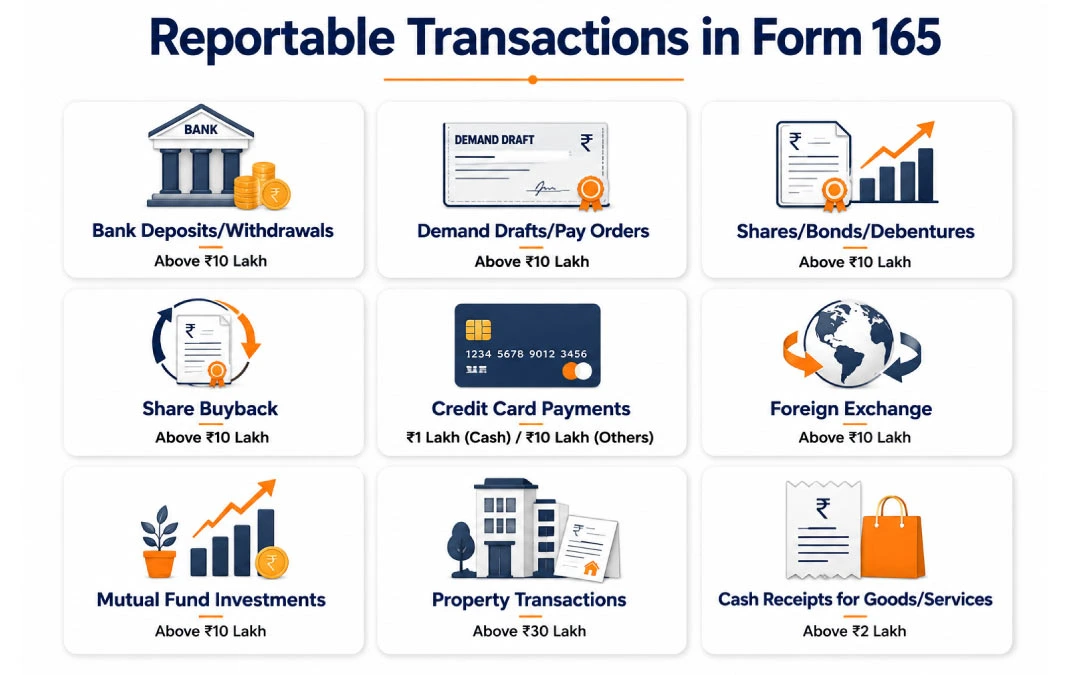
- Cash deposits of ₹10 lakh or more in one or more accounts, other than current accounts and time deposits, are reportable. Cash deposits or withdrawals of ₹50 lakh or more in one or more current accounts are also reportable by prescribed banking or post office entities.
- Cash payments exceeding ₹10 lakh in a financial year for demand drafts, pay orders, or prepaid instruments issued by the RBI.
- Share application money or receipts exceeding ₹10 lakh in a financial year from any person for acquiring shares issued by a company.
- Receipts exceeding ₹10 lakh in a financial year from any person for acquiring bonds or debentures issued by a company or institution.
- Share buy-backs exceeding ₹10 lakh in a financial year by listed companies.
- Credit card bill payments exceeding ₹10 lakh through non-cash modes, or exceeding ₹1 lakh in cash, in a financial year.
- Receipts from the sale of foreign currency, or expenses incurred in foreign currency, exceeding ₹10 lakh through credit cards, debit cards, traveller’s cheques, drafts, or other financial instruments.
- Receipts exceeding ₹10 lakh in a financial year from any person for acquiring units of a mutual fund.
- Sale or purchase of immovable property exceeding ₹30 lakh, reported by the Inspector General or Sub-Registrar appointed under the Registration Act, 1908.
- Cash receipts exceeding ₹2 lakh for the sale of goods or services by persons liable for audit under the corresponding provisions of the Income tax Act, 2025.
Information Required for Form 165 under the Income Tax Act
Before filing Form 165, the reporting entity should keep the following information ready:
- Name and details of the reporting entity
- PAN or TAN of the reporting entity
- PAN of the person involved in the transaction, wherever applicable
- Details of the specified financial transaction
- Date and value of each reportable transaction
- Customer or account holder details
- Any other information prescribed under the Income tax Rules
Ensuring complete and accurate information helps avoid validation errors and reduces the chances of receiving notices from the Income Tax Department.
How to File Form 165 Online?
Form 165 can be filed in the following simple steps. The basic filing process is as follows:
- Visit the Income Tax Department’s INSIGHT Reporting Portal.
- First-time reporting entities must register on the Reporting Portal and generate an Income-tax Department Reporting Entity Identification Number, wherever applicable.
- Existing reporting entities can log in using their registered credentials.
- Prepare the Form 165 statement in the prescribed format with the required reporting entity details and transaction information.
- Generate and validate the XML file using the applicable reporting utility.
- Sign and encrypt the prepared file with the required digital signature or validation file, as applicable.
- Upload the prepared statement package on the Reporting Portal / INSIGHT Portal.
- After successful validation, an upload confirmation message will appear on the screen confirming the upload status of Form 165.
Due Date for Filing Form 165
Form 165 is generally required to be filed on or before 31 May immediately following the financial year in which the transaction is recorded, unless another due date is prescribed. Certain SFT reporting categories, such as listed securities and mutuaal fund units may follow half-yearly filing requirements.
Reporting entities should complete the filing within the prescribed time to avoid penalties and ensure timely compliance. However, certain SFT reporting categories, such as listed securities and mutual fund units, may have different periodic filing requirements as prescribed.
Penalty for Non-Filing or Incorrect Filing of Form 165
Failure to furnish Form 165 within the prescribed time may attract a penalty of ₹500 per day under Section 454 of the Income-tax Act, 2025. If the default continues after notice, a higher penalty may apply as prescribed.
Some common situations that may result in penalties include:
- Failure to furnish the statement within the prescribed due date or after receiving notice.
- Furnishing inaccurate or incomplete information.
- Failure to rectify defects or incorrect information after receiving a notice from the Income Tax Department.
- Non-compliance with the reporting requirements prescribed under the Act and the Income-tax Rules.
Reporting entities should maintain proper records and ensure timely and accurate filing to avoid unnecessary penalties and compliance issues.
Get Professional Assistance from Ebizfiling
Filing Form 165 under the Income Tax Act requires accurate reporting of specified financial transactions and timely submission to the Income Tax Department. Any errors, omissions, or delays may result in notices or penalties. Ebizfiling simplifies the entire filing process by offering end-to-end compliance support.
Our experts help you:
- Determine whether your organization is required to file Form 165.
- Verify reportable transactions and applicable reporting thresholds.
- Assist with online filing on the Income Tax Reporting Portal.
- Ensure timely filing and compliance with the Income Tax Act, 2025.
- Provide professional support for notices, corrections, or filing-related queries.
For expert assistance, explore our business income tax return filing service.
Conclusion
Form 165 under the Income Tax Act is the prescribed form for reporting Specified Financial Transactions (SFTs) under the Income Tax Act, 2025. It corresponds the earlier Form 61A while continuing the same objective of reporting specified high-value financial transactions to the Income Tax Department. Reporting entities must understand the applicability, reportable transactions, filing process, due date, and penalty provisions to ensure compliance with the law. If your organization is required to file Form 165, timely and accurate reporting is essential to avoid penalties and maintain regulatory compliance.
Frequently Asked Questions
1. Who is required to file Form 165 under the Income Tax Act?
Form 165 under the Income Tax Act must be filed only by specified reporting entities notified under Section 508 of the Income Tax Act, 2025, and the applicable Income-tax Rules. These generally include banks, co-operative banks, post offices, registrars, mutual funds, companies issuing shares or debentures, authorized foreign exchange dealers, and other prescribed institutions.
2. What transactions need to be reported in Form 165?
Form 165 filing is required for reporting specified high-value financial transactions, such as large cash deposits or withdrawals, high-value credit card payments, purchase or sale of immovable property, investments in mutual funds, foreign exchange transactions, and other transactions prescribed under the Income-tax Rules.
3. How do I know whether Form 165 applies to my organization?
Form 165 applicability depends on two factors: whether your organization is a notified reporting entity and whether it has recorded transactions that exceed the prescribed reporting thresholds during the financial year. If both conditions are met, filing Form 165 becomes mandatory.
4. Who is responsible for reporting high-value property transactions in Form 165?
For reportable immovable property transactions, the responsibility usually lies with the Inspector General or Sub-Registrar appointed under the Registration Act, 1908. Buyers and sellers are generally not required to submit Form 165 under the Income Tax Act for these transactions.
5. Can mistakes be corrected after submitting Form 165?
Yes. If incorrect or incomplete information is reported, the reporting entity can file a correction statement through the Income Tax Department’s INSIGHT Reporting Portal. Correcting errors promptly helps reduce the chances of receiving notices from the department..
6. Is Form 165 filed through the regular Income Tax e-Filing portal?
No. The Statement of Specified Financial Transactions in Form 165 is filed through the Income Tax Department’s INSIGHT Reporting Portal, which is different from the regular e-Filing portal used for filing Income Tax Returns.
7. What is the penalty for late filing of Form 165?
Late filing may attract a penalty of ₹500 per day under Section 454 of the Income-tax Act, 2025. If the default continues after notice, a higher penalty may apply as prescribed.
8. What happens if incorrect information is reported in Form 165?
If incorrect or incomplete information is furnished in the Statement of Specified Financial Transactions, the Income Tax Department may ask the reporting entity to rectify the defects by filing a correction statement. Failure to do so within the prescribed time may result in penalties under the Income Tax Act, 2025.
9. What should reporting entities check before filing Form 165?
Before Form 165 filing, reporting entities should confirm their Form 165 applicability, verify transaction values, PAN details, customer information, and reporting thresholds. Ebizfiling helps organizations review reportable transactions, prepare accurate statements, and complete the filing process smoothly and on time.
10. Is Form 165 applicable to every taxpayer?
No. Form 165 is not applicable to every taxpayer. It applies only to specified reporting entities that record prescribed financial transactions above the applicable thresholds. Ebizfiling can assist with reviewing the reported information, preparing correction statements, and ensuring your compliance is updated accurately in accordance with the applicable provisions.





Simplify Your Income Tax Return Filing
Complete your Income Tax Return quickly with professional support and ensure timely tax compliance.
About Ebizfiling -



October 15, 2026 By Srishti M
TDS and TCS Compliance Calendar November 2026: Compliance Guide Introduction The TDS and TCS Compliance Calendar November 2026 covers important tax deduction, collection, payment, certificate and reporting requirements applicable during the month. It helps businesses, government offices and other responsible […]
October 14, 2026 By Srishti M
GST Compliance Calendar November 2026: Key Due Dates & Filings Introduction The GST Compliance Calendar November 2026 highlights the major GST return filing, tax payment, invoice reporting and year-end adjustment deadlines applicable during the month. It covers regular taxpayers, QRMP […]
October 13, 2026 By Srishti M