

Company registration in India for UAE-based businesses and investors

Company Registration in India from UAE: Process and Business Strategy

Introduction

For a UAE business, entering India is not just about incorporating a company. The investor must decide how the Indian operations will be owned, which legal structure fits the business model, whether foreign investment is permitted under the automatic route, and what FEMA reporting will follow after investment.


Company Registration in India from UAE can involve setting up a wholly owned subsidiary, forming a joint venture, or choosing another permitted presence such as a branch office, liaison office or project office. Each structure serves a different commercial purpose and carries different regulatory requirements.


For businesses planning long-term operations in India, these decisions should be made before capital is remitted or incorporation documents are signed. This guide explains the legal framework, registration process, benefits and practical India-entry strategy for UAE investors.


Summary

  • UAE individuals and companies can invest in Indian businesses subject to the Companies Act, FEMA and applicable FDI rules.
  • A private limited company generally requires at least two members and two directors.
  • Every Indian company must have at least one director satisfying the statutory resident-director requirement.
  • A UAE parent can own 100% of an Indian company where the relevant sector permits 100% foreign investment.
  • FDI eligibility, ownership structure and FEMA reporting should be reviewed before funds are invested.


What Does Company Registration in India from UAE Mean?

Company Registration in India from UAE generally means a UAE resident, entrepreneur or corporate entity establishing or investing in a company incorporated under Indian law.


Where a UAE company establishes a subsidiary in India, the Indian company becomes a separate legal entity from its UAE parent. It can enter contracts, hire employees, own permitted assets and carry on its approved commercial activities in India.


Foreign ownership is governed separately by India’s foreign investment framework. Depending on the sector, foreign investment may be permitted under the automatic route or may require prior government approval.


Businesses can also read Ebizfiling’s guide on a foreign company subsidiary in India for a broader understanding of the structure.


Can a UAE Company Own 100% of an Indian Company?

Yes, where the relevant sector permits 100% foreign investment, a UAE company may establish a wholly owned subsidiary in India.


However, this is not a universal rule. Certain sectors have foreign investment caps, conditions or approval requirements. The business activity should therefore be checked against the current FDI framework before the ownership structure is finalised.

Ready to Register Your Company
in India from the UAE?

Simplify your India entry with expert assistance for incorporation, MCA filings, DSC, DIN, PAN, and TAN.

Get Registration Support

Which Business Structure Can a UAE Company Choose in India?

Choosing the correct structure is an important part of Company Registration in India from UAE.


Structure

Separate Indian Entity

Typical Purpose

Wholly Owned Subsidiary

Yes Long-term operations with 100% foreign ownership where permitted
Joint Venture Company Yes

Operations with an Indian or other eligible partner

Branch Office

No Specified activities of the UAE parent
Liaison Office No

Representation and communication

Project Office

No

Execution of an eligible project in India


Wholly Owned Subsidiary

A wholly owned subsidiary is an Indian company whose equity is fully owned by the foreign parent, subject to applicable FDI rules.


This structure may suit a UAE company that wants greater control over its Indian operations and intends to conduct long-term commercial activities.


For documentation requirements, businesses can refer to Ebizfiling’s guide on the documents required for Indian subsidiary registration.


Joint Venture Company

A UAE investor may establish an Indian company with another eligible investor.


A joint venture can be useful where the UAE company requires a local partner for distribution, technical expertise, licences, market access or operational support.


The final shareholding must comply with the applicable FDI rules.


Branch Office

A branch office remains part of the UAE parent company rather than becoming a separate Indian legal entity.


Under the RBI framework, branch offices can undertake only permitted activities, such as specified import/export, consultancy, research, technical collaboration, representation, IT/software services and technical-support activities.


Liaison Office

A liaison office is mainly used to represent the foreign parent in India and maintain communication with Indian customers, suppliers or business partners.


It cannot ordinarily undertake commercial income-generating business in India.


Project Office

A project office may be appropriate where a UAE company has secured a specific eligible project in India. Its activities must remain connected to that project and comply with the applicable FEMA framework.


What Are the Legal Requirements for Company Registration in India from UAE?

The exact requirements depend on the structure selected. For a UAE-owned private limited company, the following points are particularly important.


Directors and Shareholders

A private company generally requires at least two members and two directors.


Section 149(3) of the Companies Act, 2013 requires every company to have at least one director who has stayed in India for a total period of at least 182 days during the previous calendar year.


The provision is based on stay in India. It does not require the resident director to be an Indian citizen merely for satisfying Section 149(3).


Registered Office in India

The company must maintain a registered office in India in accordance with the Companies Act.


The registered office is used for statutory notices, MCA records and other official communications.


DSC and DIN

Proposed directors involved in electronic incorporation filings require a Digital Signature Certificate.


Director Identification Number requirements are completed through the applicable MCA incorporation process.


How Should UAE Documents Be Authenticated?

This is an important requirement in Company Registration in India from UAE.


MCA requirements distinguish between documents executed in countries covered by the Hague Apostille Convention and those executed in countries outside that framework.


The UAE is not currently a Contracting Party to the Hague Apostille Convention. Therefore, UAE documents should not simply be treated as apostille documents.


For applicable foreign incorporation documents executed in the UAE, the MCA framework generally requires notarisation followed by authentication through the appropriate Indian diplomatic or consular channel, subject to the exact document and incorporation circumstances.


Documents may include:

  • Passport and address proof of foreign subscribers or directors
  • UAE company’s certificate of incorporation
  • Constitutional documents
  • Board resolution or corporate authorisation
  • Subscription and incorporation documents

The exact authentication requirement should be confirmed for each document before submission.

Planning to Set Up a UAE-Owned
Subsidiary in India?

Get professional support with subsidiary incorporation, statutory documentation, and applicable foreign-investment compliance.

Click Here

How Do FDI Rules Affect Company Registration in India from UAE?

Foreign ownership is a major compliance consideration in Company Registration in India from UAE.


Automatic Route

Under the automatic route, prior government approval for foreign investment is not required where the sector, ownership level and conditions fall within the permitted framework.


Sectors not specifically restricted may generally permit up to 100% foreign investment under the automatic route, subject to applicable laws, sectoral regulations and security conditions.


Government Route

Where a sector or proposed level of investment falls under the government route, prior approval must be obtained through the prescribed process.


The UAE investor should therefore classify the proposed business activity correctly before finalising ownership or transferring funds.


Sector-Specific Restrictions

Foreign investors should verify:

  • Whether FDI is permitted in the proposed activity
  • Maximum foreign ownership allowed
  • Whether the automatic or government route applies
  • Sector-specific licensing conditions
  • Any security or beneficial ownership restrictions that may apply


What FEMA Reporting May Apply After Foreign Investment?

Company Registration in India from UAE does not end when the certificate of incorporation is issued.


Where an Indian company issues equity instruments to a person resident outside India and the issue qualifies as FDI, Form FC-GPR must generally be filed within 30 days from the date of issue of the equity instruments.


A foreign-owned Indian company may also have an annual Foreign Liabilities and Assets reporting obligation where the RBI criteria are met.


Entities with outstanding inward FDI or applicable overseas investment generally file the FLA return by 15 July each year.


Businesses can also read Ebizfiling’s guide on FEMA compliance in India for further context.

Need Assistance with Foreign
Investment or FC-GPR Filing?

Manage applicable investment documentation and FC-GPR filing requirements with Ebizfiling's expert assistance.

Call Us Today

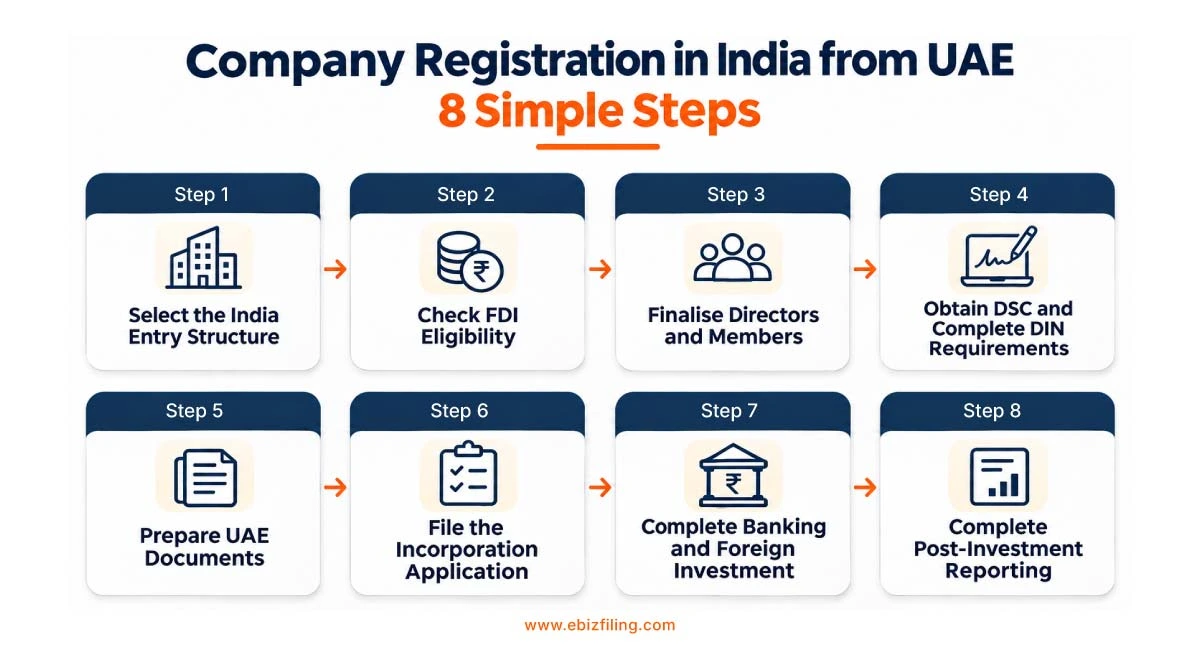
How to Complete Company Registration in India from UAE

The practical process generally involves the following stages.


Choosing the right business structure for entering the Indian market


Step 1: Select the India Entry Structure

Decide whether the proposed business should operate through a wholly owned subsidiary, joint venture or another permitted foreign-company structure.


Step 2: Check FDI Eligibility

Identify the business activity, applicable foreign ownership cap and whether the investment falls under the automatic or government route.


Step 3: Finalise Directors and Members

Ensure the proposed company satisfies the required number of members and directors, including the resident-director requirement.


Step 4: Obtain DSC and Complete DIN Requirements

Arrange the digital signatures and director identification requirements needed for MCA filings.


Step 5: Prepare UAE Documents

Collect the foreign individual and corporate documents and complete the applicable notarisation and consular authentication requirements.


Step 6: File the Incorporation Application

Company incorporation is completed through MCA’s integrated SPICe+ framework along with the required constitutional and linked incorporation documents.


Step 7: Complete Banking and Foreign Investment

After incorporation and banking arrangements, foreign capital can be remitted through permitted banking channels in accordance with FEMA and the approved investment structure.


Step 8: Complete Post-Investment Reporting

Applicable RBI reporting, including FC-GPR where required, should be completed within the prescribed period.


What Are the Benefits of Company Registration in India from UAE?

Separate Legal Presence: An Indian subsidiary is legally separate from its UAE parent. It can enter into Indian contracts and maintain local commercial relationships in its own name.


Local Business Operations: An incorporated Indian company can establish local customer, supplier, employee and banking relationships, subject to applicable laws.


Long-Term Market Presence: A subsidiary is generally more appropriate than a liaison office where the objective is sustained revenue-generating activity in India.


Future Expansion: A company structure can support future expansion, additional investment and new business activities, subject to corporate, FDI and sector-specific requirements.


Greater Operational Control: Where 100% foreign ownership is permitted, the UAE parent may retain full equity ownership of its Indian subsidiary. This can provide greater control over management, commercial strategy, branding and operations.


What Business Strategy Should UAE Companies Follow Before Entering India?

A successful Company Registration in India from UAE strategy should begin before the incorporation documents are filed.


Match the Structure With the Business Objective

A company planning full commercial operations should not select a liaison office if its objective is to generate regular Indian revenue.


Similarly, a branch or project office should only be used where the intended activities fit within the applicable regulatory framework.


Check FDI Rules Before Deciding Ownership

The UAE investor should confirm the sectoral cap and entry route before fixing its shareholding.


This is especially important where the parent intends to hold 100% of the Indian company.


Plan Capital Before Transferring Funds

The amount, ownership percentage, valuation and form of foreign investment should be reviewed before money is remitted to India.


Consider Cross-Border Tax and Transfer Pricing

Transactions between the UAE parent and Indian company may involve management services, technology fees, royalties, reimbursements, loans or sale of goods and services.


Such related-party transactions may have Indian tax, withholding and transfer-pricing implications.


Protect Intellectual Property

Trademarks, technology, software and other intellectual property intended for use in India should be reviewed before commercial launch.


Plan Post-Incorporation Compliance

An Indian company with UAE ownership may have ongoing obligations relating to MCA filings, statutory audit, taxation, FEMA reporting and sector-specific regulations.


Businesses can also review Ebizfiling’s guide on RBI rules for foreign subsidiary companies in India.

Unsure About the Right
UAE-to-India Business Structure?

Make informed entry decisions with a professional review of corporate, FEMA, tax, and commercial requirements.

Get Expert Help

What Mistakes Should UAE Businesses Avoid?

Businesses planning Company Registration in India from UAE should avoid assuming that all sectors allow 100% FDI or that incorporation automatically completes foreign-investment compliance.


Other common mistakes include transferring funds before confirming the investment structure, using improperly authenticated UAE documents, choosing a liaison office for commercial activities, overlooking the resident-director requirement, missing FEMA reporting and ignoring related-party tax implications.


How Ebizfiling Can Support UAE Businesses Entering India

Entering India from the UAE requires company incorporation, foreign-investment planning and post-incorporation compliance to work together. Ebizfiling can assist UAE entrepreneurs and corporate groups with company registration in India, foreign subsidiary setup, MCA documentation, DSC, DIN, PAN and TAN, and applicable foreign-investment filings.


Support can also include FC-GPR-related assistance and professional review of the proposed corporate or FEMA structure, depending on the transaction and service selected.


For a free consultation, contact Ebizfiling at +91 9643203209 or email info@ebizfiling.com for professional assistance with establishing a UAE-owned business presence in India.


Conclusion

Company Registration in India from UAE is both a corporate registration process and a cross-border investment decision. UAE investors should evaluate the proposed activity, foreign ownership limits, FDI route, legal structure and capital plan before incorporating or remitting funds.


A wholly owned subsidiary can provide a separate Indian presence and greater control where 100% foreign investment is permitted. A joint venture, branch office, liaison office or project office may suit different commercial objectives.


Planning the structure, UAE document authentication, foreign investment, FEMA reporting, taxation and post-incorporation compliance together can reduce avoidable regulatory issues and create a stronger foundation for long-term business operations in India.


Frequently Asked Questions


1. Can a UAE company start sending money to India before the Indian company is incorporated?

The safer approach is to first finalise the Indian entity, FDI route, shareholding and banking structure. Equity investment should be remitted through permitted banking channels after the Indian company is set up and the investment structure is clear. Premature remittance can create banking and FEMA-reporting complications.


2. What if a UAE company wants 100% ownership but the Indian sector has an FDI cap?

The UAE investor cannot simply hold 100% equity if the applicable sectoral rules permit a lower foreign ownership limit. The shareholding must stay within the prescribed cap unless a different route or approval is legally available. DPIIT’s FDI policy applies sector-specific caps and entry conditions.


3. Can a UAE founder appoint only UAE-based directors in the Indian company?

An Indian company must satisfy the resident-director requirement under Section 149(3) of the Companies Act, 2013. At least one director must fulfil the prescribed 182-day stay requirement during the financial year. For newly incorporated companies, the requirement applies proportionately. UAE nationality does not automatically disqualify a person from being the resident director.


4. Can a UAE company open a liaison office in India and start billing customers?

No. A liaison office cannot ordinarily carry on business activity or earn income in India. Its role is limited mainly to representation, communication, promoting collaborations and related liaison activities.


5. Can a UAE company use a branch office for any type of business activity in India?

No. A branch office can undertake only permitted activities under the RBI framework. These may include specified import/export, consultancy, research, IT/software and technical-support activities. Retail trading and direct manufacturing or processing are not generally permitted through a branch office.


6. What should a UAE company do if its business activity changes after incorporation?

The company should review whether the new activity is covered by its constitutional documents, sector-specific licences and applicable FDI rules before commencing it. A change in activity can affect the permitted foreign ownership level, entry route or regulatory approvals.


7. What if the UAE parent issues capital but the Indian company misses the FC-GPR filing timeline?

The company should not ignore the delay. It should review the applicable FEMA reporting position and complete the required regularisation or delayed-reporting process, where available. FC-GPR compliance should be monitored immediately after equity instruments are issued to the UAE investor.


8. Can UAE corporate documents be used in MCA incorporation filings after simple notarisation?

Not always. The UAE is not currently listed as a Contracting Party to the Hague Apostille Convention, so UAE documents should not automatically be treated as apostilled documents. The applicable notarisation and Indian diplomatic or consular authentication requirements should be checked before MCA filing.


9. Can Ebizfiling help if a UAE company is unsure whether a subsidiary or branch office is more suitable?

Yes. Ebizfiling can assist with the selected India-entry structure and help businesses review incorporation requirements, foreign ownership, MCA documentation and applicable FEMA considerations. The final structure should be chosen after considering the intended activities and regulatory framework.


10. Can Ebizfiling support a UAE parent after the Indian company is incorporated?

Yes. Ebizfiling can assist with foreign subsidiary incorporation and applicable post-investment compliance support, including relevant MCA and foreign-investment filings depending on the structure and transaction.

About Ebizfiling -

EbizFiling is a concept that emerged with the progressive and intellectual mindset of like-minded people. It aims at delivering the end-to-end corporate legal services 0f incorporation, compliance, advisory, and management consultancy services to clients in India and abroad in all the best possible ways.
 
To know more about our services and for a free consultation, get in touch with our team on  info@ebizfiling.com or call 9643203209.
 
Ebizfiling

Author: srishti

Srishti Mukherjee is an Advocate, Legal Researcher, and Legal Content Writer at Ebizfiling, with practical courtroom experience in civil, criminal, and revenue matters before Trial Courts and High Courts. She holds an LL.M. in Constitutional Law and Criminal Law, combining her academic background with hands-on litigation experience, legal drafting, and statutory interpretation. At Ebizfiling, Srishti researches and writes on corporate law, Income Tax, GST, Intellectual Property Rights (IPR), business registration, and regulatory compliance. Her professional interests extend to company law, taxation, and emerging legal developments, where she applies her legal research skills to understand statutory provisions, compliance procedures, and their practical implications for businesses and individuals. Her writing reflects a research-oriented approach supported by practical legal experience. She focuses on simplifying complex legislation, regulatory requirements, filing procedures, and legal documentation into clear, structured, and accessible content. Through her articles, she aims to help startups, businesses, professionals, and taxpayers better understand legal obligations and make informed compliance decisions.

Follow Author

Leave a Reply

Your email address will not be published. Required fields are marked *

  • Rating

Reviews

  • Client Review, Ebizfiling

    Hemanshu Mahajan

    01 Apr 2018

    I registered my LLP company, from eBizfilling. Great team and very competitive pricing. Will definitely use their services again.Thanks for work well done.

  • Client review, Ebizfiling

    madhu mita

    24 Aug 2021

    It's an awesome experience with Ebizfiling India Pvt Ltd. My special thank you to LATA Mam and i really appreciate her for the services she provide. LATA Mam is so cooperative always and always ready to help and solve any query related to their services.The way they communicate as per the time schedule is really awesome and satisfying, This is second financial year we are connected with Ebizfiling for Annual Returns filing as I really like their work culture, every employees are so cooperatives and available to respond any query whenever needed.Thank you so much to Ebizfiling Team!

  • Padmnabh Thomre

    23 Apr 2022

    We filed our DIR-3 KYC forms with Ebizfiling India and it was a wonderful experience. Ms. Aishwarya, Ms. Snehal, and their team members were professional, prompt, and courteous. They guided us at each step and helped us complete the process within 2 days!

Hi, Welcome to EbizFiling!

Hello there!!! Let us know if you have any Questions.

Thank you for your message.

☎
whatsapp