


-
August 27, 2026
-
BySteffy A
Company Audit Ceiling Limit Under Companies Act, 2013
Overview
Companies registered under the Companies Act, 2013 must comply with the legal requirements prescribed under the Act. These compliances depend on the nature, size and applicable provisions of the company. If a company falls within the prescribed criteria of a particular provision, it must follow the related compliance requirements.
One such requirement relates to the appointment of auditors and the maximum number of company audits that an auditor can undertake. The Company Audit Ceiling Limit ensures that auditors do not accept an excessive number of assignments and can properly perform their statutory responsibilities.
What is a Company Audit?
A company audit refers to the detailed examination and verification of books of accounts, financial records and other relevant documents by an auditor. The objective of an audit is to verify the accuracy of financial statements and provide an independent opinion on the financial position of the company.
An audit may include checking accounting records, reviewing transactions, verifying assets and liabilities, and examining whether the company has followed applicable legal and accounting requirements.
Every company registered under the Companies Act, 2013 is required to have its financial statements audited by a statutory auditor unless specifically exempted under applicable provisions of the Act.
Who Can Be Appointed as an Auditor of a Company?
A Chartered Accountant holding a valid Certificate of Practice can be appointed as an auditor of a company, subject to the eligibility and disqualification conditions prescribed under Section 141 of the Companies Act, 2013.
Companies must follow the prescribed procedure while selecting and appointing an auditor. Understanding the process of auditor appointment helps companies comply with the requirements under the Companies Act, 2013.
An audit firm can also be appointed as a company auditor if it fulfils the eligibility conditions prescribed under the Companies Act, 2013. However, only partners who are Chartered Accountants holding a valid Certificate of Practice can sign the audit report or certificates on behalf of such firm.
Before accepting an audit assignment, the auditor must ensure that the appointment does not violate the restrictions prescribed under the Act.
Company Audit Ceiling Limit Under the Companies Act, 2013
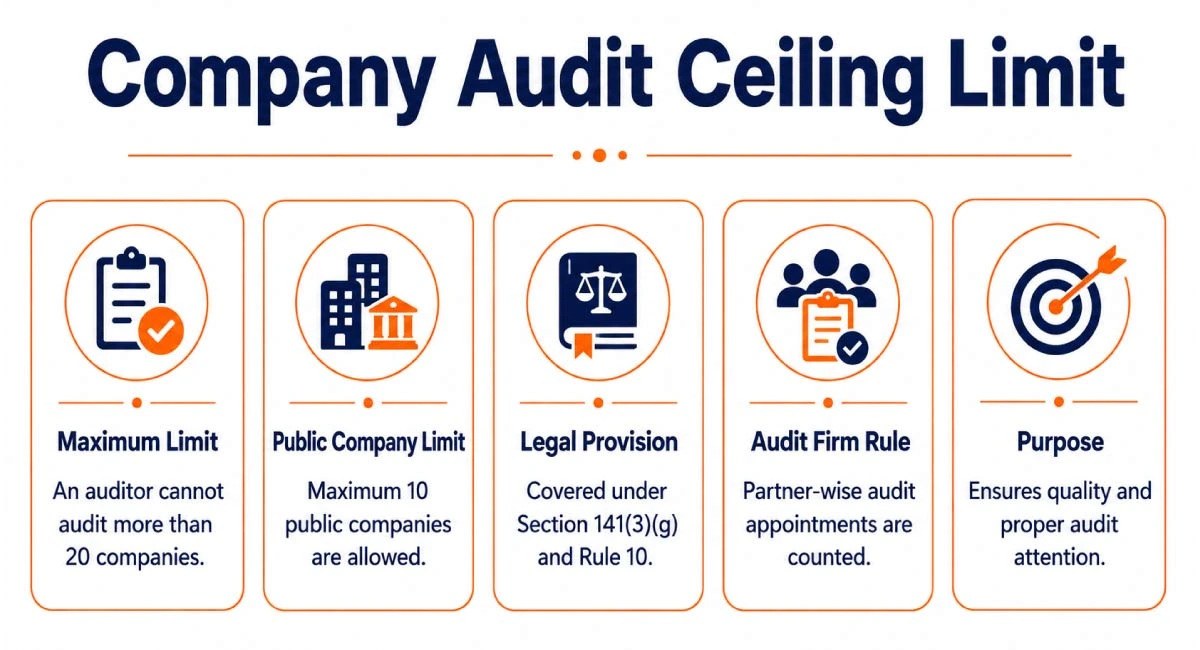
The Company Audit Ceiling Limit refers to the restriction on the maximum number of company audit assignments that an auditor can hold. This limit is prescribed under Section 141(3)(g) of the Companies Act, 2013.
According to Section 141(3)(g), a person or a partner of an audit firm is not eligible for appointment or reappointment as a company auditor if they are already appointed as auditor of more than 20 companies.
However, Rule 10 of the Companies (Audit and Auditors) Rules, 2014 provides an additional restriction. Out of the overall limit of 20 companies, an auditor cannot be appointed as auditor of more than 10 public companies. The same restriction applies to specified private companies having paid-up share capital of ₹10 crore or more, or private companies having paid-up share capital below ₹10 crore but having public borrowings from financial institutions, banks or public deposits of ₹50 crore or more.
The purpose of this restriction is to ensure that auditors have sufficient time and resources to conduct audits properly and maintain the required level of audit quality.
Important points relating to Company Audit Ceiling Limit:
- An auditor cannot hold appointment as auditor of more than 20 companies covered under the prescribed limit.
- The limit applies to individual auditors and partners of audit firms based on their eligible company audit appointments.
- In case of an audit firm, the number of audits accepted by partners is considered while calculating the overall limit.
- Before accepting a new audit assignment, the auditor must consider existing company audit appointments.
Which Companies Are Considered for Calculating the Auditor Limit?
The calculation of the Company Audit Ceiling Limit is governed by Section 141(3)(g) of the Companies Act, 2013 along with the Companies (Audit and Auditors) Rules, 2014.
Certain companies are excluded while calculating the Company Audit Ceiling Limit as prescribed under Rule 10 of the Companies (Audit and Auditors) Rules, 2014, including:
- One Person Companies (OPCs)
- Dormant companies
- Small companies
- Private companies having paid-up share capital less than ₹100 crore and which do not have public borrowings from financial institutions, banks or public deposits of ₹50 crore or more.
Difference Between Company Audit Limit and Tax Audit Limit
The Company Audit Ceiling Limit should not be confused with the tax audit limit applicable under Section 44AB of the Income-tax Act, 1961.
|
Particulars |
Company Audit Ceiling Limit |
Tax Audit Limit |
|
Applicable Law |
Companies Act, 2013 | Income-tax Act, 1961 |
| Relevant Provision | Section 141(3)(g) read with Rule 10 of Companies (Audit and Auditors) Rules, 2014 |
Section 44AB |
|
Purpose |
Restricts the number of statutory company audit appointments | Regulates tax audit assignments |
| Authority | Ministry of Corporate Affairs |
Income Tax Department and ICAI |
The company audit limit applies to statutory audits of companies, whereas tax audit limits apply separately to tax audit assignments.
Get Professional Assistance for Company Compliance with Ebizfiling
Managing statutory compliance under the Companies Act, 2013 requires proper understanding of applicable provisions and filing requirements. Ebizfiling helps companies with corporate compliance services, including company audit-related compliance support and regulatory requirements.
Ebizfiling can assist with:
- Company Annual Compliance Services including preparation and filing of required MCA forms.
- Company Incorporation and Compliance Support for businesses at different stages of growth.
- Statutory Compliance Advisory to understand applicable Companies Act requirements.
- ROC Compliance Services to help companies complete mandatory filings with the Ministry of Corporate Affairs.
Need assistance with auditor appointment, ROC compliance, or statutory audit requirements? Connect with Ebizfiling’s corporate compliance experts for professional guidance.
Conclusion
The Company Audit Ceiling Limit under the Companies Act, 2013 restricts auditors from accepting more than the prescribed number of company audit assignments.
Section 141(3)(g) provides the framework for determining auditor eligibility and maintaining audit quality. Companies should verify the eligibility of auditors before appointment, and auditors should review their existing assignments to ensure compliance with the applicable provisions. The company audit limit and tax audit limit are separate requirements governed by different laws and should not be considered the same.
Frequently Asked Questions
1. Does the audit of a subsidiary company count towards the auditor limit?
Yes, a subsidiary company audit may be counted while calculating the Company Audit Ceiling Limit if the subsidiary falls within the categories considered for the purpose of Rule 10. Companies excluded under Rule 10 are not counted.
2. Are joint audits counted separately for calculating the auditor limit?
Yes, a joint auditor appointment is counted as one company audit assignment while calculating the applicable Company Audit Ceiling Limit.
3. Can an auditor accept a new audit assignment after reaching the maximum limit?
No, an auditor cannot accept additional company audit appointments if accepting such assignment would exceed the limit prescribed under Section 141(3)(g) of the Companies Act, 2013.
4. Does an audit appointment continue to be counted after resignation?
An auditor who has resigned should consider the effective date of resignation and completion of applicable statutory formalities while determining the number of existing audit appointments.
5. Are foreign companies included while calculating the company audit limit?
The Company Audit Ceiling Limit under Section 141(3)(g) applies to companies covered under the Companies Act, 2013. Foreign company audits conducted outside this framework are not considered under this limit.
6. Can the same Chartered Accountant sign audit reports for multiple companies?
Yes, a Chartered Accountant can sign audit reports for multiple companies, provided the appointments comply with eligibility conditions and the Maximum number of company audits by auditor does not exceed the prescribed limit.
7. What happens if an auditor becomes disqualified after appointment?
If an auditor becomes disqualified under the Companies Act, 2013, the company must take appropriate steps for compliance with auditor appointment provisions.
8. Is auditor rotation the same as the Company Audit Ceiling Limit?
No, auditor rotation relates to the tenure of auditors in specified companies, whereas the Company Audit Ceiling Limit relates to the number of audit assignments an auditor can hold.
9. Does Section 141(3)(g) apply to every audit performed by a CA?
No, Section 141(3)(g) specifically relates to appointment as a company auditor and does not apply to every type of audit assignment undertaken by a Chartered Accountant.
10. How can Ebizfiling assist with company compliance requirements?
Ebizfiling provides assistance with ROC compliance, company annual filings and other corporate compliance services to help businesses manage their statutory obligations under the Companies Act, 2013.





Appointment of Auditors
Appoint an auditor for your company with Ebizfiling at affordable prices.
About Ebizfiling -



Reviews
Neha Mody
27 Nov 2017“Quite impressed with the professionalism and efficiency that ebiz- filing have demonstrated throughout! Everything runs like clockwork. This means that I can concentrate on building my profession and not be worrying about compliance requirements, the team takes care of it all. Excellent work!!"
Sneh Ajmera
04 Jan 2018"Quite simply put, ebizfiling is a pleasure to do business with and providing top-notch versatile services. I do not have to run here and there , as I am getting all the services at one place. We appreciate the ability to maintain their efficiency, transparent pricing,competitive fees and timeliness."
Ahmed Shaikh
23 Sep 2018Ms. Ishani and other team members are very helpful in the entire process of GST filing.
I really appreciate their support superb team.
Cheers!!!!*****
September 7, 2026 By Steffy A
Health Insurance Deduction Under Section 126: Rules & Limits Introduction Health insurance protects families from rising medical costs and can also provide a tax benefit when the legal conditions are satisfied. Section 126 of the Income Tax Act, 2025 provides […]
August 29, 2026 By Steffy A
OPC Compliance Calendar September 2026: Key Due Dates Introduction The OPC Compliance Calendar September 2026 lists the major tax, GST, labour law, and ROC obligations that One Person Companies may need to complete during the month. September includes important compliances […]
August 29, 2026 By Steffy A
TDS and TCS Compliance Calendar September 2026: Key Deadlines Introduction The TDS and TCS Compliance Calendar September 2026 helps deductors, collectors, government offices, property buyers and eligible individuals or HUFs identify the forms applicable to them. Reviewing these requirements in […]