

-
September 16, 2026
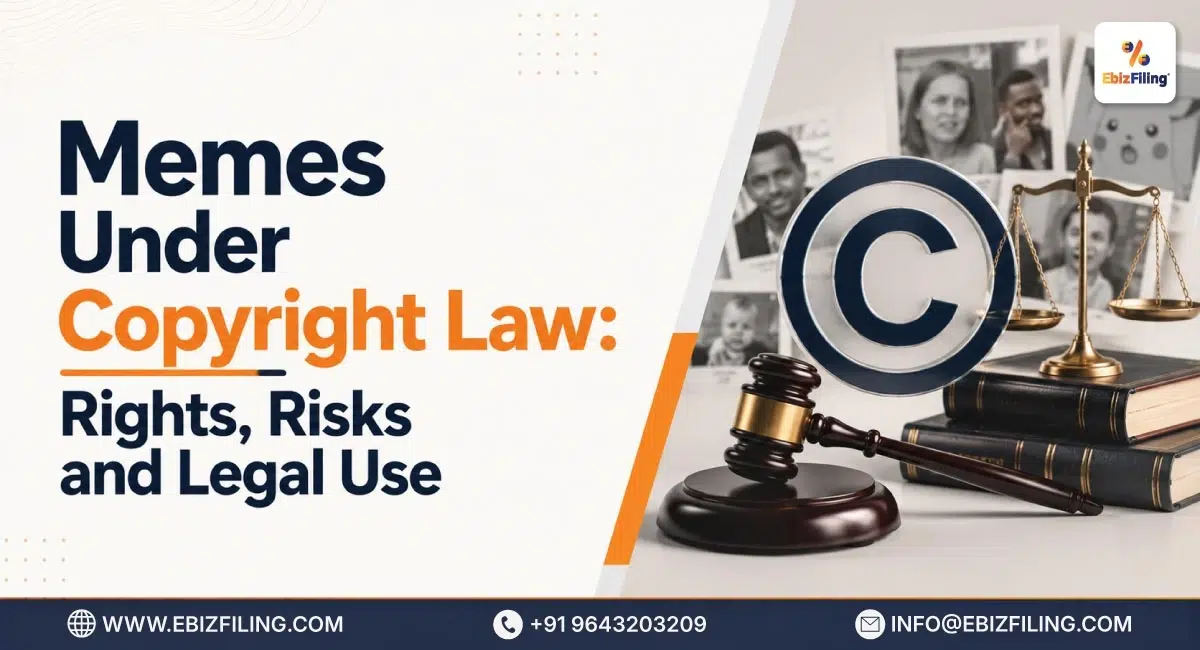
Memes Under Copyright Law: A Guide for Creators and Brands
Introduction
Memes are widely used for humour, criticism, social commentary and brand marketing. However, the Copyright Act, 1957 does not recognise a meme as a separate category of protected work. A meme may combine a photograph, film scene, illustration, dialogue, music clip, caption and graphic arrangement.
Therefore, the legal position of Memes Under Copyright Law depends on the copyright attached to each element. A meme may contain one original contribution and several works owned by other persons.
Something being viral does not place a work in the public domain. Similarly, adding text, cropping an image or applying a filter does not automatically make its use lawful. A legal analysis of Memes Under Copyright Law must examine copyright subsistence, originality, ownership, substantial copying, fair dealing and moral rights.
Key Highlights
- Memes may contain separately protected photographs, captions, film scenes, music and artwork.
- Adding text, cropping or editing does not automatically prevent copyright infringement.
- Indian law permits fair dealing only for limited purposes such as criticism, review and reporting current events.
- Giving credit does not replace permission or a valid copyright licence.
- Brands face greater legal risk when memes are used for advertising, promotions or commercial gain.
How Copyright Applies to Memes?
Section 13 of the Copyright Act provides that copyright may subsist in original literary, dramatic, musical and artistic works, cinematograph films and sound recordings. The definition of an artistic work includes photographs, drawings, paintings and other specified artistic creations, whether or not they possess artistic quality.
Accordingly, Memes Under Copyright Law may involve separate rights in:
- The photograph or illustration used as the template;
- The film or television scene shown in the meme;
- The written caption or dialogue;
- The music or sound recording used in a video meme; and
- The final visual arrangement created by the meme maker.
Section 13(4) further clarifies that copyright in a cinematograph film or sound recording does not affect the separate copyright in the works incorporated in it. Thus, using a film clip may potentially involve rights in the film, screenplay, music and sound recording.
Section 14 gives copyright owners exclusive rights in relation to the whole or a substantial part of a work. Depending on the category, these rights may include reproduction, adaptation, issuing copies and communication of the work to the public. Posting protected content on a public social-media account may therefore involve reproduction as well as communication to the public.
Originality of Memes Under Copyright Law
Copyright does not protect every caption, reaction or minor edit. For a literary or artistic contribution to receive protection, it must satisfy the requirement of originality.
In Eastern Book Company v. D.B. Modak, (2008) 1 SCC 1, the Supreme Court rejected a test based solely on labour or effort. The work must involve skill and judgment and possess at least a minimal degree of creativity.
Applied to Memes Under Copyright Law, an independently created photograph, original caption, distinctive composition and creative visual arrangement may qualify for protection. However, adding a common expression such as “Monday mood” to an existing photograph may provide little independent protection.
The meme creator may own the original expression contributed by them. That ownership does not automatically extend to the photograph, film frame or illustration on which the meme is based.
Copyright Protects Expression, Not Meme Ideas
Copyright protects the expression of an idea rather than the idea itself.
In R.G. Anand v. Delux Films, AIR 1978 SC 1613, the Supreme Court held that there can be no copyright in an idea, theme, plot or subject matter. Protection extends to the form, arrangement and manner in which the idea is expressed. The Court also stated that infringement requires substantial and material copying.
This principle is important for Memes Under Copyright Law. No person can ordinarily claim exclusive rights over general formats such as:
- Expectation versus reality;
- Before and after;
- How it started versus how it is going; or
- Nobody versus absolutely nobody.
Another creator or brand may use the same general concept through original photographs, captions and visual design. However, copying the same photograph, wording, composition and distinctive arrangement may amount to infringement.
In R.G. Anand, the Court also applied an ordinary-viewer test. The question is whether a person who has seen both works receives an unmistakable impression that the later work is a copy of the earlier work. Minor colour changes, filters or cropping may not prevent infringement where the substantial expression remains copied.
Who Owns Copyright in a Meme?
Section 17 provides the general rule that the author of a work is its first copyright owner, subject to several statutory exceptions. For example, the person taking a photograph is its author, while the producer is treated as the author of a cinematograph film or sound recording.
Ownership of Memes Under Copyright Law may therefore be divided between:
- The photographer who captured the original image;
- The producer who owns the film or video;
- The artist who created the illustration;
- The writer who created an original caption; and
- The designer who arranged the final content.
Commissioned works
Section 17(b) contains a specific rule for a photograph, painting, portrait, engraving or cinematograph film made for valuable consideration at another person’s instance. Unless an agreement states otherwise, the person who commissioned such a work may be the first copyright owner.
This exception does not automatically apply to every work created by a freelancer. For works outside the categories listed in Section 17(b), ownership must be determined from the general rule, the nature of the relationship and the contract between the parties.
Employee-created works
Under Section 17(c), where a work is made in the course of employment under a contract of service or apprenticeship, the employer may be the first owner unless an agreement provides otherwise. An independent contractor or freelancer is not necessarily the same as an employee working under a contract of service.
Assignment and licensing
Sections 18 and 19 allow copyright to be assigned. A valid assignment must be in writing and signed by the assignor or an authorised agent. It should identify the work and specify the rights assigned, duration and territorial extent.
Section 30 also permits the copyright owner to grant a licence in writing. Therefore, brands dealing with Memes Under Copyright Law should obtain a written assignment or licence covering social-media publication, modification, paid promotion, territory, duration and future reuse.
When Does Meme Use Become Copyright Infringement?
Section 51 applies when a person, without authority or in breach of a licence, performs an act that is exclusively reserved for the copyright owner. It also covers specified commercial dealings involving infringing copies.
Infringement under Memes Under Copyright Law may arise when someone:
- Reposts a protected photograph after adding a caption;
- Converts a movie clip into a branded GIF;
- Uses copyrighted music in a monetised meme video;
- Reproduces an artist’s illustration;
- Removes a creator’s name and republishes the work;
- Sells merchandise containing a protected meme; or
- Uses a film frame in a commercial advertisement.
Not every similarity amounts to infringement. The copied material must form a substantial part of protected expression. Substantiality is not determined only by length or quantity. A short extract may still be substantial when it captures the most distinctive or important part of the original.
Giving credit does not replace permission. Statements such as “credits to the owner,” “taken from the internet” or “no copyright intended” do not create a licence or provide an independent legal defence.
Fair Dealing and Memes Under Copyright Law
India follows the statutory concept of fair dealing rather than the broader American doctrine of fair use.
Section 52(1)(a) permits fair dealing with a work, other than a computer programme, for:
- Private or personal use, including research;
- Criticism or review, whether of that work or another work; and
- Reporting current events and current affairs, including reporting a lecture delivered in public.
Humour, entertainment, parody and virality are not separately listed as exceptions. Therefore, Memes Under Copyright Law require consideration of two questions:
- Does the use fall within a purpose recognised by Section 52?
- Is the dealing with the work fair in the circumstances?
A meme using part of an advertisement to criticise a misleading claim may have a stronger defence than a meme using the same advertisement only to sell another product.
Courts may consider the purpose of the use, the quantity and value of the material taken and whether the later work competes with or substitutes the original.
Commercial use does not automatically amount to infringement or automatically exclude fair dealing. However, a fair-dealing argument may be weaker where protected content is primarily being used to attract customers or promote sales.
Parody and Memes Under Copyright Law
The Copyright Act does not provide a separate exception for parody or satire. Such use must generally fall within criticism, review or another permitted purpose under Section 52.
In Civic Chandran v. C. Ammini Amma, the Kerala High Court considered the purpose, quantity and value of the copied material and whether the new work competed with the original. At the interim stage, the Court found a strong prima facie fair-dealing defence because the portions were used to make criticism effective.
Therefore, a meme that genuinely criticises a film, advertisement or statement may have a stronger defence. However, humour or transformation alone does not automatically make copied content lawful.
Landmark Cases on Meme Copyright
The following decisions provide the principal legal tests for Memes Under Copyright Law:
R.G. Anand v. Delux Films (1978) 4 SCC 118; AIR 1978 SC 1613.
This Supreme Court decision established the idea-expression distinction, the requirement of substantial copying and the ordinary-viewer test. It permits creators to use a general idea while protecting the particular expression of that idea.
Eastern Book Company v. D.B. Modak (2008) 1 SCC 1
This case established that originality requires more than labour alone. A work should involve skill and judgment with at least minimal creativity. The principle helps determine whether a meme’s caption, design or arrangement independently qualifies for protection.
Civic Chandran v. C. Ammini Amma 1996 PTC (16) 329 (Ker)
At the interlocutory stage, the Kerala High Court recognised a strong prima facie fair-dealing defence where portions of a play were used to make criticism effective. The decision is relevant to critical parody but does not create a general exemption for memes.
Mannu Bhandari v. Kala Vikas Pictures Pvt. Ltd.
In Mannu Bhandari v. Kala Vikas Pictures Pvt. Ltd., AIR 1987 Del 13, the Delhi High Court discussed the scope of an author’s special rights under Section 57 after the assignment of filming rights.
However, the parties settled before pronouncement. The appeal and suit were withdrawn, and the Court expressly stated that its factual findings and directions had become “otiose.” The judgment should therefore be treated as containing influential observations on moral rights rather than an uncomplicated final determination on the merits.
Moral Rights and Altered Memes
Section 57 gives an author the right to claim authorship and to restrain or claim damages for distortion, mutilation, modification or another act relating to the work where it would prejudice the author’s honour or reputation. These rights may continue even after the copyright has been wholly or partially assigned.
Therefore, Memes Under Copyright Law may raise moral-right concerns when an artwork, photograph or written work is manipulated and associated with an offensive or reputation-damaging message.
However, not every alteration or negative portrayal automatically violates Section 57. The author must establish the statutory requirements, including prejudice to honour or reputation.
Watermarks and Rights-Management Information
Removing every visible watermark does not automatically constitute an offence under Section 65B.
Section 2(xa) defines rights-management information to include information identifying the work, author, performer or rights owner, as well as terms of use and related identifying codes. Section 65B applies where a person knowingly and without authority removes or alters such information or distributes or communicates copies knowing that the information was removed or altered without authority.
Therefore, removing a watermark, creator’s name or embedded metadata may attract Section 65B where the information falls within the statutory definition and the removal is knowing and unauthorised.
Commercial Use by Creators and Brands
Commercial use is particularly important when reviewing Memes Under Copyright Law. Brands often use popular images to increase engagement, advertise offers or sell products.
Before publishing a commercial meme, a business should verify the rights in:
- Film and television scenes;
- Celebrity photographs;
- Sports footage;
- Cartoon characters;
- Music and sound recordings;
- Artwork and illustrations; and
- User-generated content.
A licence must cover the proposed use. Permission to repost an image may not include permission for sponsored advertising, merchandise, packaging, editing or sublicensing.
The safer approach is to use the unprotected idea behind a trend while creating original photographs, captions and designs. This allows a brand to participate in a popular format without copying another person’s protected expression.
Remedies for Copyright Infringement
Section 55 provides civil remedies that may include injunctions, damages and accounts of profits. Section 57 provides separate protection for an author’s special rights.
Section 63 applies where a person knowingly infringes or abets the infringement of copyright or specified rights under the Act. Criminal liability is therefore not established merely because infringement is alleged. The statutory knowledge requirement and other elements must be proved through the appropriate legal process.
A person enforcing rights in a meme may need to establish:
- That copyright subsists in the relevant work;
- That they own or may enforce the right;
- That protected expression was copied;
- That the copied portion was substantial;
- That the use was not properly licensed; and
- That no exception under Section 52 applies.
Source files, drafts, metadata, contracts, licences, emails and publication records may assist in proving authorship, ownership and copying.
A social-media platform’s decision to remove content is not the same as a final judicial ruling that copyright infringement has occurred.
Protect Your Creative Content with Ebizfiling
Using memes for marketing can expose creators and brands to copyright disputes if ownership, permission or licensing is unclear. Ebizfiling can assist with copyright registration and intellectual property documentation to help protect original content and strengthen ownership records.
Get expert support from Ebizfiling to safeguard your creative work and use digital content with greater legal confidence.
Conclusion
The Copyright Act does not provide a special exemption for memes. The legality of Memes Under Copyright Law depends on the type of material used, originality, ownership, substantial copying, purpose and applicable statutory exceptions.
A person may own an original caption or visual arrangement without owning the underlying photograph, film scene or illustration. Similarly, attribution does not replace permission, and minor editing does not automatically prevent infringement.
For safer use of Memes Under Copyright Law, creators and brands should produce original content, obtain written permission where required and rely on fair dealing only where both the statutory purpose and fairness of the use can be established.
Frequently Asked Questions
1. Can a short meme caption receive copyright protection?
Generally, short captions, titles, slogans and common phrases do not receive copyright protection because they may lack sufficient originality. However, a longer and creatively written caption may qualify as an original literary work under Section 13 of the Copyright Act, 1957. Therefore, the protection of memes under copyright law depends on whether the caption contains original and creative expression.
2. When is a meme considered a work of joint authorship?
Under Section 2(z), joint authorship arises when two or more people collaborate and their contributions cannot be separated. If the image and caption have distinct creators, each may own separate rights.
3. Can someone claim copyright in a meme based on public-domain content?
Yes, but only over the new original elements. A creator may own an original caption, layout or illustration, while the underlying public-domain work remains free to use.
4. Are foreign memes and photographs protected in India?
Yes. Under Section 40 and the International Copyright Order, eligible foreign works may receive protection in India. Therefore, Memes Under Copyright Law may also involve content created outside India.
5. Can a creator voluntarily surrender copyright in a meme?
Yes. Section 21 permits an author to relinquish all or part of their copyright by giving notice to the Registrar of Copyrights. Simply uploading a meme online does not amount to formal surrender.
6. Can meme rights be assigned for a limited campaign?
Yes. Sections 18 and 19 allow partial or limited assignments. The written agreement should specify the work, rights, duration, territory, royalty and other consideration. This is important when brands use Memes Under Copyright Law for advertising campaigns.
7. Should the meme image and caption be registered separately?
It depends on their authorship and classification. Separate applications may be appropriate where the photograph, caption, illustration and design are distinct works created by different persons.
8. Does posting a meme on social media waive copyright?
No. Public posting does not place a meme in the public domain. However, the platform may receive a licence under its terms of service.
9. Can an unregistered meme still receive copyright protection?
Yes. Registration is not mandatory for copyright to arise. However, under Section 48, entries in the Register of Copyrights may serve as prima facie evidence of the recorded particulars.
10. How can Ebizfiling assist creators and brands?
Ebizfiling can assist with copyright registration applications, classification of eligible works and ownership documentation. Proper records can strengthen the legal position of creators dealing with Memes Under Copyright Law.

Apply For Your Copyright
Copyright your literary, artistic work with ebizfiling.com. Prices starting at INR 11,999/- only.
About Ebizfiling -



Reviews
arti ittannavr
18 Apr 2022Took trademark registration from Ebizfiling india private limited service was excellent thank you 😊
Gunjan Kapoor
19 Jan 2018I was amused when I saw the pro activeness in the staff as they made sure everything was on track and in time.
Kiara Singh
19 Jan 2018They are very quick when it comes to processing things. Within no time I was given a solution to my problems. Would definitely recommend them.
September 19, 2026 By Steffy A
September 18, 2026 By Srishti M
Professional Tax Registration Cancellation Process Explained Introduction Professional Tax is a state-level tax applicable to individuals and businesses engaged in professions, trades, callings, or employment, subject to the provisions prescribed under respective state laws. Businesses liable under applicable Professional Tax […]
September 18, 2026 By Siddhi R
EPFO Wage Ceiling Increased to ₹25,000: Key Impact Explained Introduction The EPFO wage ceiling increased proposal has been approved by the Union Cabinet based on the recommendation of the Ministry of Labour & Employment to enhance the mandatory EPFO coverage […]