


-
September 7, 2026
-
BySteffy A
Online Business Set Up in India: How to Start and Register
Introduction
Starting an online business can be an exciting way to turn an idea into a source of income. With digital platforms making it easier to reach customers across different locations, entrepreneurs can start and manage businesses without necessarily investing in a traditional physical store or office.
However, a successful online business set up requires more than just a good idea. You need to understand your target customers, identify the right product or service, choose suitable digital platforms, and comply with applicable business and tax requirements.
If you are wondering how to start an online business, this article explains the key steps, registration requirements, and some profitable online business ideas you can consider in India.
Key Highlights
- An online business set up starts with selecting a practical business idea and understanding your target customers.
- Entrepreneurs can choose from structures such as Sole Proprietorship, Partnership, LLP, OPC, or Private Limited Company depending on their requirements.
- GST registration is not automatically mandatory for every online seller and depends on applicable GST provisions.
- Businesses importing or exporting goods generally require an Importer Exporter Code (IEC), subject to applicable exemptions.
- A professional website, digital marketing strategy, customer communication, and regulatory compliance are important for building an online business.
How to Set Up an Online Business in India?
If you want to start an online business in India, planning each stage carefully can help you establish a stronger foundation. A structured online business set up can also reduce avoidable expenses and help you identify compliance requirements at an early stage.
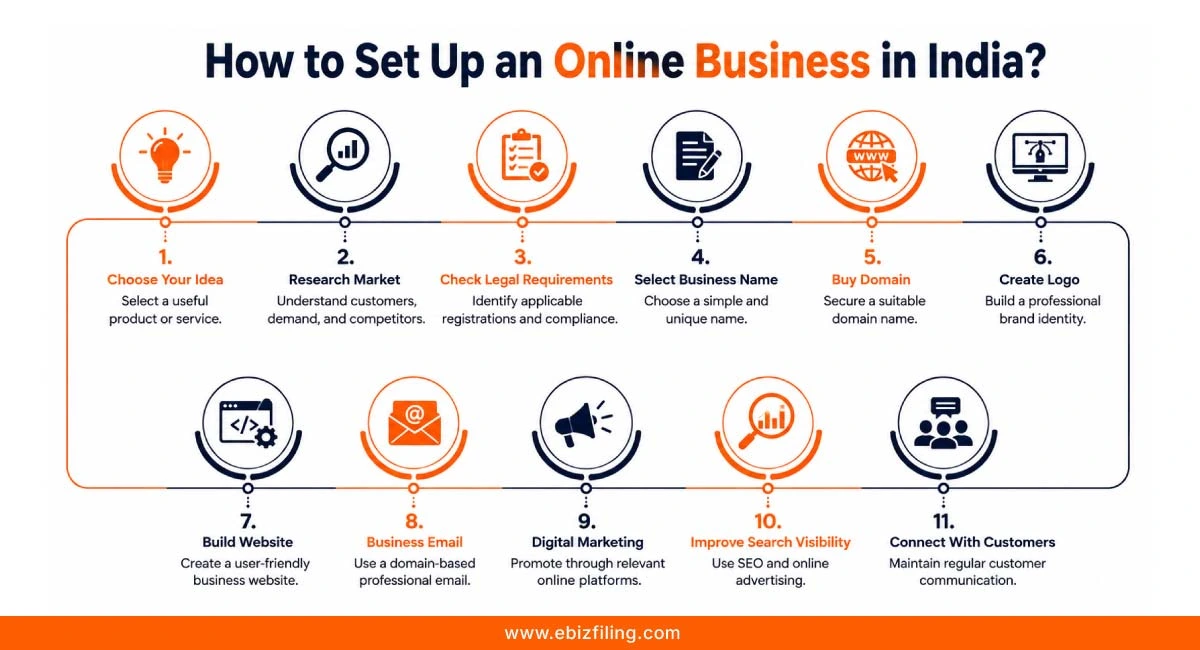
1. Choose Your Business Idea
Start by identifying a product or service that solves a real customer problem or fulfils a specific market need. Your idea does not necessarily have to be completely new. What matters is how effectively you can differentiate your offering through quality, pricing, convenience, customer service, or expertise.
2. Conduct Market Research
Before investing in the business, understand your target market.
Research:
- Your potential customers
- Existing competitors
- Product or service demand
- Pricing expectations
- Customer buying behaviour
- Suitable online sales channels
Market research can help you determine whether your idea has practical business potential.
3. Understand Applicable Business Laws
Different online businesses may have different legal, tax, licensing, consumer protection, and compliance requirements. The requirements can depend on factors such as the business structure, products or services offered, turnover, location, sales model, and whether the business operates domestically or internationally.
4. Select a Business Name
Choose a name that is simple, memorable, and relevant to your business. Before finalising the name, it is advisable to check whether the desired domain name, company name, and trademark are available.
5. Purchase a Domain Name
A domain gives your business a dedicated online identity. Choose a domain name that closely matches your business or brand name and is easy for customers to remember and type.
A suitable domain also makes it easier to create a professional website and business email address as part of your online business set up.
6. Create a Professional Logo
A good logo can help customers recognise and remember your brand. Your logo should reflect the nature and identity of your business. If required, you can use professional Logo Design Services to develop a suitable brand identity.
7. Build Your Business Website
Create an easy-to-use website where customers can understand your products or services, contact your business, or make purchases where applicable. The website should clearly communicate what your business offers and provide customers with essential information.
8. Create a Professional Business Email
Using an email address connected to your business domain can make your communication look more professional and consistent. It can be used for customer enquiries, order communication, marketing, and business correspondence.
9. Build a Digital Marketing Strategy
Simply creating a website is not enough. Customers need to discover your business. Businesses can use platforms such as Google, Instagram, Facebook, LinkedIn, YouTube, and other relevant channels depending on their audience. Professional Digital Marketing Services can also help businesses develop strategies for search visibility, content, advertising, and social media.
10. Use Search Engines to Attract Customers
Search engine optimisation, useful website content, local search visibility, and paid advertising can help potential customers discover your online business. Your strategy should focus on attracting relevant users rather than simply generating large amounts of website traffic.
11. Stay Connected With Customers
Customer communication should continue even after a purchase or enquiry. Businesses can use email, customer support systems, newsletters, and other communication channels to provide updates and build long-term relationships.
Online Business Registration in India
An online business does not automatically have to be incorporated as a company simply because it operates digitally.
The appropriate business structure depends on factors such as ownership, liability, funding requirements, scale, and plans. Choosing the appropriate structure is therefore an important part of an online business set up.
Depending on the business, an entrepreneur may consider structures such as:
- Sole Proprietorship
- Partnership Firm
- Limited Liability Partnership
- One Person Company
- Private Limited Company
For example, the Ministry of Corporate Affairs provides for incorporation of a One Person Company through the SPICe+ incorporation process.
Entrepreneurs planning to operate through a company can explore Private Limited Company Registration and determine which structure best suits their business requirements.
Does an Online Business Need GST Registration?
GST registration requirements depend on factors such as turnover, nature of supply, business model, and applicable provisions under GST law.
It is not correct to say that every online seller must obtain GST registration simply because products are sold through an online platform.
Under Notification No. 34/2023 – Central Tax, certain persons supplying goods through an e-commerce operator that is required to collect TCS under Section 52 can be exempt from GST registration if they satisfy the prescribed conditions. These include remaining within the applicable registration threshold, not making interstate supplies of goods, operating through an e-commerce operator in only one State or Union Territory, having a PAN, and obtaining the required enrolment number. The notification became effective from 1 October 2023.
GST requirements should therefore be reviewed carefully during the online business set up process instead of assuming that registration is automatically required.
Businesses should therefore assess their individual circumstances before applying for GST Registration.
Does an Online Business Need IEC Registration?
If your online business imports or exports goods, an IEC is generally mandatory unless the business or transaction falls under a specific exemption.
DGFT identifies IEC as a key business identification number for undertaking import and export activities. For the import or export of services or technology, IEC is generally required when the service or technology provider is availing of benefits under the Foreign Trade Policy or dealing with specified services or technologies.
Businesses involved in international trade can apply for IEC Registration after determining whether it applies to their activities.
Profitable Online Business Ideas in India
If you are planning an online business set up in India, choosing the right idea should depend on your skills, budget, target customers, and market demand. Here are some profitable online business ideas that entrepreneurs can consider:
1. E-commerce Store : You can sell products such as clothing, accessories, home decor, beauty products, or specialised goods through your own website or online marketplaces.
2. Digital Marketing Services : Businesses increasingly require support with SEO, social media management, paid advertising, content marketing, and online branding. Professionals with digital marketing skills can offer these services remotely.
3. Freelance Content Writing : Writers can provide blog writing, website content, social media content, product descriptions, and other writing services to businesses in India and abroad.
4. Online Consulting : Professionals with experience in areas such as business, finance, marketing, technology, or career development can offer consultation through video calls and digital platforms.
5. Online Coaching and Courses : If you have expertise in a particular subject or skill, you can create online courses, conduct live classes, or provide individual coaching sessions.
6. Graphic Design Services : Businesses regularly require logos, social media creatives, brochures, website graphics, and branding materials. Graphic designers can build an online service business with relatively low initial investment.
7. Web Development Services : Website design and development can be a suitable online business for individuals with technical skills. Services may include website creation, maintenance, redesign, and e-commerce development.
8. Print-on-Demand Business : A print-on-demand model allows entrepreneurs to sell customised products such as T-shirts, mugs, notebooks, or merchandise without maintaining large quantities of inventory. The profitability of these online business ideas in India depends on factors such as demand, competition, pricing, marketing, operating costs, and execution. Before investing significantly, it is advisable to test the idea, understand customer demand, and identify the registrations or licences that may apply to the chosen business.
Build Your Online Business with Ebizfiling Support
Ebizfiling can help simplify your online business set up by assisting with:
- Business Registration: Private Limited Company, LLP, OPC, and Partnership registration.
- GST Support: Assistance with GST registration and related compliance.
- IEC Registration: Support for businesses involved in import or export.
- Trademark Services: Help with protecting your business name and brand.
- Compliance Support: Assistance with annual filings and other applicable business requirements.
Star Your Online Business with Ebizfiling Today.
Conclusion
An online business set up can provide entrepreneurs with an opportunity to reach customers, build a brand, and operate with greater flexibility. However, success depends on selecting the right idea, understanding the market, creating a strong digital presence, and complying with applicable business requirements.
If you are planning to start an online business in India, first determine your business model and target customers. You can then choose the appropriate business structure, build your website, develop a marketing strategy, and complete registrations such as GST or IEC wherever they are applicable. Starting small, testing your idea, and expanding based on actual customer demand can help you build a more sustainable online business.
Frequently Ask Questions
1. Do I need to register a Private Limited Company before starting an online business?
No. An online business set up does not automatically require Private Limited Company registration. Depending on ownership, liability, funding plans, and business size, you may operate through a Sole Proprietorship, Partnership, LLP, OPC, or Private Limited Company. If you decide to incorporate a company, MCA provides the SPICe+ process for incorporation. Ebizfiling can assist you in selecting and registering a suitable business structure based on your requirements.
2. If I sell products only through my own website, do I have to collect TCS under GST?
Not merely because you own the website. CBIC explains that when a business sells its own products through its own website, TCS under Section 52 is not required because the platform is not collecting consideration for supplies made by other sellers. Normal GST provisions may still apply to the transactions.
3. Is GST registration compulsory for every seller using Amazon, Flipkart, or another marketplace?
Not in every situation. Certain persons supplying goods through e-commerce operators can operate without GST registration if they meet the prescribed exemption conditions, including applicable turnover and supply restrictions. Therefore, GST applicability should be checked individually when planning an online business set up in India rather than assuming registration is always compulsory.
4. Do I need an IEC if my online business sells services to foreign clients?
IEC is generally not required merely because a business exports services. However, it is required where the service or technology provider is availing benefits under the Foreign Trade Policy or dealing with specified services or technologies.
5. Can one person complete online business registration in India as an OPC?
Yes, an eligible individual can incorporate a One Person Company. MCA allows OPC incorporation through SPICe+ Part B, which integrates several incorporation-related services. An OPC may be suitable when a single founder wants a company structure instead of operating individually.
6. Should I check trademark availability before buying a domain for my online business?
Yes. A domain being available does not necessarily mean the same name is available as a trademark. Before finalising your brand for an online business set up, it is advisable to search existing trademarks and identify the appropriate trademark class. IP India provides a Trademark Public Search facility that can be used to check existing trademarks before filing an application.
7. Can I start an online business in India using only Instagram or WhatsApp?
Yes, your initial sales channel can be social media instead of a dedicated website. However, the platform you use does not remove applicable requirements relating to business registration, GST, licences, invoicing, or other compliances. If you want to start an online business in India, these requirements should be assessed according to what you sell and how the business operates.
8. Should I register the business before testing profitable online business ideas?
Not necessarily in every case. You can first research demand, competitors, pricing, and customer interest before making major investments. Once a business model begins accepting orders or operating commercially, applicable registrations and compliance requirements should be identified. This approach can help you evaluate profitable online business ideas before committing significant resources.
9. Can an online business sell to both Indian and international customers?
Yes. An online business set up can serve domestic as well as international customers, but cross-border transactions may introduce additional tax, payment, export, and documentation requirements. Businesses dealing in imports or exports should specifically review IEC applicability and other relevant trade requirements.
10. Who can help if I am unsure how to start an online business and which registrations I need?
The registrations required depend on your business structure, products or services, sales channels, turnover, and whether you operate only in India or internationally. Ebizfiling can assist with online business registration in India, including company or LLP registration, GST registration, IEC registration, trademark services, and applicable compliance support. This can help entrepreneurs focus on building their business while managing relevant registration requirements.




E-Commerce Business in India
Start your own online Business Set-up / E-Commerce Business in India with Ebizfiling at affordable prices
About Ebizfiling -



Reviews
Akshay shinde
23 Apr 2019Excellent service…
Anaya Patel
16 Sep 2018I was so satisfied with the services they provided to me. I had a great time working with them.
October 19, 2026 By Srishti M
October 15, 2026 By Srishti M
TDS and TCS Compliance Calendar November 2026: Compliance Guide Introduction The TDS and TCS Compliance Calendar November 2026 covers important tax deduction, collection, payment, certificate and reporting requirements applicable during the month. It helps businesses, government offices and other responsible […]
October 14, 2026 By Srishti M
GST Compliance Calendar November 2026: Key Due Dates & Filings Introduction The GST Compliance Calendar November 2026 highlights the major GST return filing, tax payment, invoice reporting and year-end adjustment deadlines applicable during the month. It covers regular taxpayers, QRMP […]