


-
October 12, 2026
Increasing Authorized Capital: Procedure and Compliance
Introduction
Companies often require additional funds to support business expansion, attract investors, or increase their shareholding capacity. However, before issuing shares beyond the existing limit, a company must complete the process of increasing its authorized share capital as per the provisions of the Companies Act, 2013.
Increasing Authorized Capital allows a company to increase the maximum share capital it is authorised to issue. It does not mean that the company has immediately received additional funds. The actual funds are received only when shares are issued and subscribed by shareholders.
The process involves checking the Articles of Association (AOA), obtaining shareholder approval, altering the capital clause of the Memorandum of Association (MOA), and completing the required filings with the Ministry of Corporate Affairs (MCA).
Key Highlights
- Authorized capital defines the maximum share capital a company can issue as per its MOA.
- Increasing authorized capital requires compliance with Section 61 and Section 64 of the Companies Act, 2013.
- Companies must obtain shareholder approval and update the MOA before increasing capital.
- Form SH-7 filing is required to intimate the ROC about the alteration of share capital.
- Increasing authorized capital helps companies raise funds and support future business expansion.
What Is Authorized Capital?
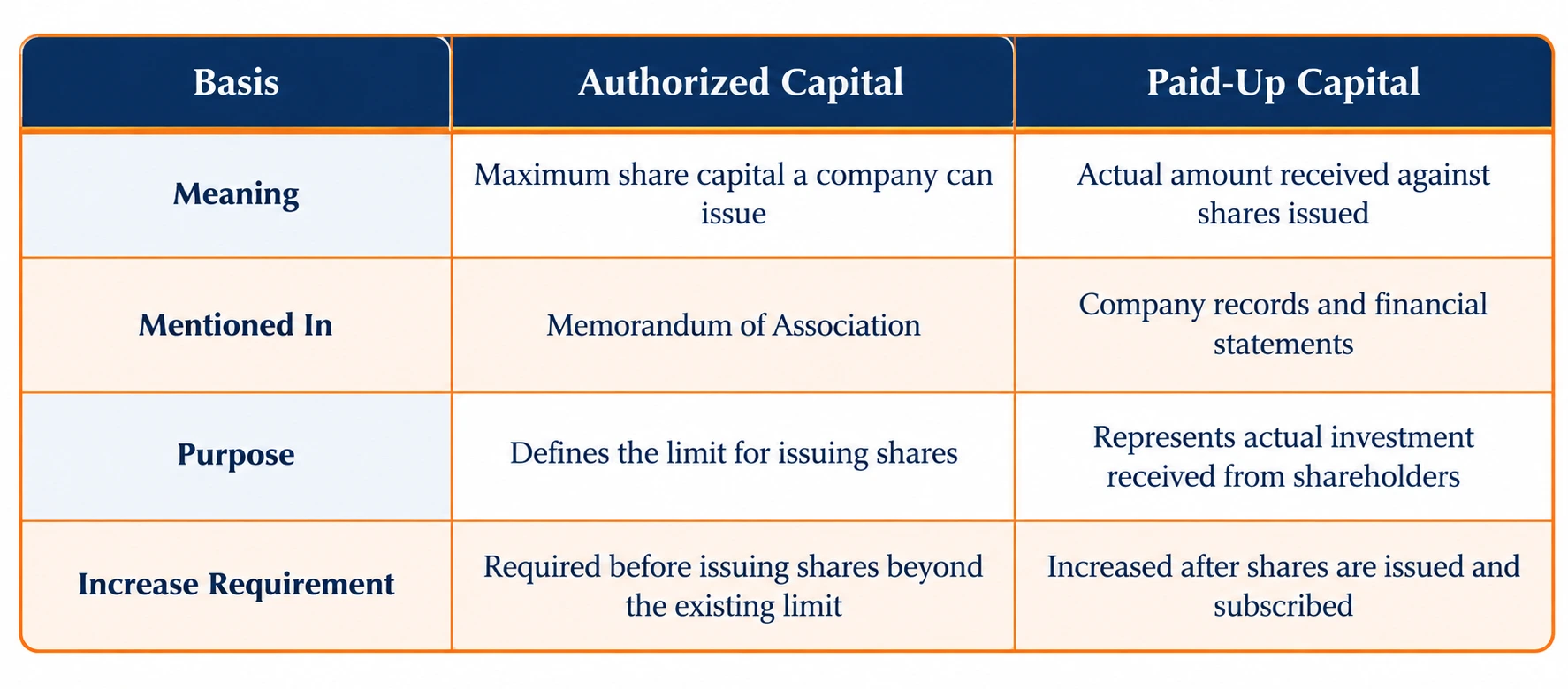
Authorized capital refers to the maximum share capital that a company is authorised to issue as mentioned in its Memorandum of Association. For a detailed understanding of the concept, structure and significance of authorized share capital of a company, businesses can refer to the relevant guide.
A company cannot issue shares beyond its existing authorized capital limit. Therefore, if a company plans to issue additional shares exceeding the available limit, it must first complete the process of Increasing Authorized Capital. For example, if a company has an authorized capital of ₹10 lakh and wants to issue shares worth ₹20 lakh, it must increase its authorized capital before proceeding with the share issue.
Difference Between Authorized Capital and Paid-Up Capital
Why Do Companies Need to Increase Authorized Capital?
Companies may require an increase in authorized share capital due to various business requirements, such as:
- Raising funds through issue of additional shares.
- Bringing new investors or shareholders into the company.
- Increasing paid-up capital through further share allotment.
- Supporting business expansion plans.
- Issuing shares through permitted methods such as private placement or rights issue.
Companies planning fundraising through ownership restructuring may also require proper documentation such as a shareholders agreement to define rights, responsibilities, and ownership terms.
When Is Increasing Authorized Capital Required?
A company needs an authorized capital increase procedure when it plans to issue shares beyond its existing authorized capital limit.
For example, if the authorized capital of a private limited company is ₹5 lakh but the company wants to issue additional shares exceeding this limit, it must first increase its authorized capital.
The process of increasing authorized capital is different from increasing paid-up capital. Increasing authorized capital only increases the company’s capacity to issue shares, whereas paid-up capital increases when shareholders subscribe to and pay for shares.
The authorized capital structure is generally decided during private limited company registration and can be increased later based on business requirements.
Legal Provisions for Increasing Authorized Capital
The process of Increasing Authorized Capital is governed by the Companies Act, 2013.
Section 61 of the Companies Act, 2013
Section 61 deals with alteration of share capital. A company limited by shares can increase its authorized share capital if:
- The Articles of Association authorise such increase.
- Shareholders approve the alteration through the required resolution.
If the Articles of Association do not permit the increase, the company must first complete the required alteration of AOA. Section 61 broadly deals with alteration of share capital, and companies should understand the applicable alteration of share capital provisions before proceeding with the proposed change.
Section 64 of the Companies Act, 2013
Section 64 requires a company to file notice with the Registrar of Companies (ROC) regarding alteration of share capital.
The company must file the required details with ROC within the prescribed period after the alteration of share capital.
Conditions Before Increasing Authorized Capital
Before proceeding with an increase authorized capital of company process, the company should ensure:
- The Articles of Association allow the increase in authorized capital.
- Necessary alteration of AOA is completed if required.
- Shareholders’ approval is obtained.
- The capital clause of MOA is updated.
- Required MCA filings are completed.
Maintaining updated capital records is also an important part of post-incorporation compliances after Pvt Ltd registration.
Procedure for Increasing Authorized Capital
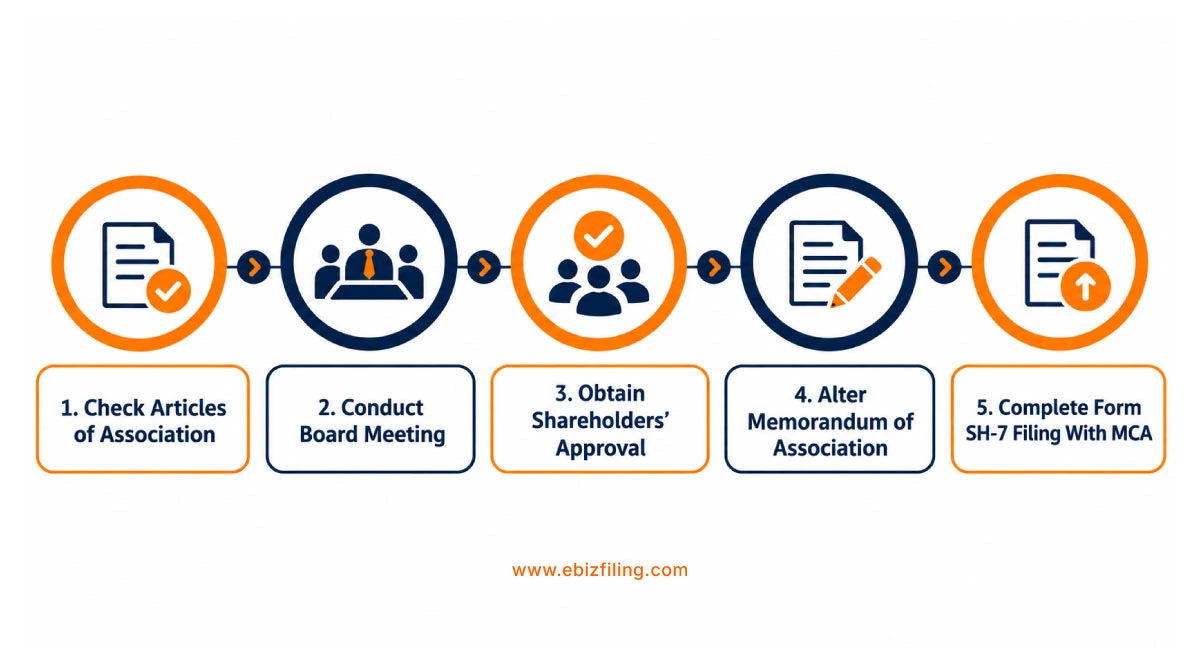
1. Check Articles of Association
The company must first verify whether the Articles of Association contain provisions allowing an increase in authorized capital.
If such provisions are not available, the company must alter the AOA before proceeding further.
2. Conduct Board Meeting
The company conducts a Board Meeting to:
- Approve the proposal for increasing authorized capital.
- Decide the proposed increase amount.
- Approve the notice for obtaining shareholders’ approval.
The company should also ensure that the proposed capital alteration follows the applicable corporate approval and filing process. A detailed process for increasing authorized share capital can help companies understand the procedural sequence.
3. Obtain Shareholders’ Approval
The company must obtain shareholders’ approval through an ordinary resolution passed at a general meeting, provided that the AOA already authorises such increase.
If alteration of AOA is required, the company must complete additional compliance requirements applicable for alteration of Articles.
4. Alter Memorandum of Association
Since authorized capital is mentioned in the capital clause of the MOA, the company must alter the MOA to reflect the revised authorized capital structure.
The updated MOA forms part of the required MCA filing process.
5. Complete Form SH-7 Filing With MCA
A company must complete Form SH-7 filing with the Registrar of Companies after passing the required resolution.
Form SH-7 is filed for notifying ROC about alteration of share capital under Section 64 of the Companies Act, 2013.
The form includes details such as:
- Existing authorized capital.
- Increased authorized capital.
- Details of shareholder approval.
- Revised share capital structure.
The company must file Form SH-7 with ROC within 30 days from the date of alteration of share capital along with applicable fees and attachments.
Documents Required for Increasing Authorized Capital
The documents generally required include:
- Board resolution.
- Shareholders’ resolution.
- Notice of general meeting.
- Altered Memorandum of Association.
- Altered Articles of Association, if applicable.
- Revised capital structure details.
- Digital Signature Certificate (DSC) of authorised signatory.
Fees for Increasing Authorized Capital
The fees for Increasing Authorized Capital depend on the amount by which the authorized capital is increased and the applicable MCA fee structure.
Additional stamp duty may also apply depending on the state where the company is registered.
The overall cost may include:
- MCA filing fees.
- Stamp duty charges.
- Professional service charges.
Increasing Authorized Capital vs Increasing Paid-Up Capital
|
Basis |
Increasing Authorized Capital |
Increasing Paid-Up Capital |
|
Meaning |
Increase in maximum limit of shares a company can issue | Increase in actual subscribed share capital |
| Requirement | Required before issuing shares beyond existing limit |
Happens after issue and allotment of shares |
|
Approval |
Shareholders’ approval required | Share allotment approval required |
| MCA Filing | Form SH-7 |
Form PAS-3 after allotment |
Mistakes While Increasing Authorized Capital
Companies should avoid the following mistakes:
- Issuing shares beyond existing authorized capital.
- Not checking AOA provisions before starting the process.
- Failing to obtain proper shareholder approval.
- Filing incorrect details in Form SH-7.
- Not updating MOA after approval.
- Ignoring applicable stamp duty requirements.
Benefits of Increasing Authorized Capital
Increasing authorized capital helps companies:
- Raise additional funds through future share issues.
- Bring new investors into the company.
- Support business expansion plans.
- Maintain flexibility for future fundraising.
- Manage capital restructuring efficiently.
Companies planning to issue additional shares may also consider compliance requirements related to a rights issue of shares depending on the fundraising method selected.
How Ebizfiling Helps With Increasing Authorized Capital?
Increasing authorized capital involves multiple compliance steps, including drafting resolutions, updating company documents, and completing MCA filings.
Ebizfiling assists companies with the complete process of Increasing Authorized Capital, including documentation preparation, MOA alteration support, resolution drafting, and MCA filing assistance.
Our experts help businesses complete the compliance process efficiently while ensuring that required legal requirements are properly followed. Companies planning to issue additional shares may also consider compliance requirements related to a rights issue of shares for private companies depending on the fundraising method selected.

For free consultation call us on 09643203209 or email info@ebizfiling.com
Conclusion
Increasing Authorized Capital is an important compliance process that allows companies to increase their capacity to issue shares beyond their existing authorized capital limit.
The process requires compliance with the Companies Act, 2013, including checking AOA provisions, obtaining shareholder approval, altering the MOA, and completing Form SH-7 filing with the Registrar of Companies.
Companies planning expansion, fundraising, or future share issuance should complete the authorized capital increase process properly to ensure regulatory compliance and smooth capital management.
Frequently Asked Questions
1. Can a company increase its authorized capital if the Articles of Association do not contain a provision for such increase?
No. A company can increase its authorized capital only if its Articles of Association authorise such alteration. If the AOA does not contain the required enabling provision, the company must first alter its Articles by following the applicable provisions of the Companies Act, 2013 before proceeding with the authorized capital increase.
2. Is Form SH-7 required before issuing additional shares beyond the existing authorized capital?
Yes. If the proposed share issue exceeds the existing authorized capital limit, the company must first increase its authorized capital and file Form SH-7 with the Registrar of Companies. Shares cannot be allotted beyond the authorized capital limit unless the required alteration is completed.
3. Does increasing authorized capital require alteration of the Memorandum of Association?
Yes. Since authorized capital is mentioned in the capital clause of the Memorandum of Association, the company must alter the MOA to reflect the revised authorized capital structure after obtaining the required approval.
4. Is MGT-14 required for increasing authorized capital under Section 61?
The requirement of MGT-14 depends on the type of resolution and compliance involved. Increasing authorized capital under Section 61 generally requires an ordinary resolution if the Articles already authorise such increase. However, if alteration of Articles of Association is required, additional filing requirements may apply.
5. Can authorized capital be increased without increasing paid-up capital?
Yes. Increasing authorized capital only increases the maximum limit within which a company can issue shares. It does not automatically increase paid-up capital. Paid-up capital increases only after shares are issued, subscribed, and allotted to shareholders.
6. Can a private limited company increase authorized capital after incorporation?
Yes. A private limited company can increase its authorized capital after incorporation by following the procedure prescribed under the Companies Act, 2013, including shareholder approval, MOA alteration, and ROC filing through Form SH-7.
7. What details are required while filing Form SH-7 for authorized capital increase?
While filing Form SH-7, the company needs to provide details such as existing authorized capital, revised authorized capital, details of shareholder approval, and revised share capital structure along with applicable attachments.
8. Can a company issue shares immediately after passing the resolution for increasing authorized capital?
No. Passing the resolution alone does not complete the process. The company must complete the required ROC filing and update its statutory records before proceeding with share allotment beyond the earlier authorized capital limit.
9. How does Ebizfiling assist companies with increasing authorized capital?
Ebizfiling assists companies with the complete Increasing Authorized Capital compliance process, including reviewing AOA provisions, preparing required corporate documents, assisting with MOA alteration, and completing MCA filing requirements.
10. Does Ebizfiling provide assistance with Form SH-7 filing for authorized capital increase?
Yes. Ebizfiling provides support for Form SH-7 filing, including document preparation, compliance review, and MCA submission assistance to help companies complete the authorized capital increase process smoothly.





Increase Your Share Capital
Get in touch with EbizFiling for seamlessly complying regarding Increase in Authorised Share Capital. Prices start at INR 3499/- only.
About Ebizfiling -



Reviews
Hemang Malhotra
08 Oct 2018I was new as an Entrepreneur when I had seen their post on social media. I contacted them regarding proprietorship and realized they their pricing is incomparable in the market also their services are really prompt. Thank you, Ebizfiling.
Manank Turakhia
14 Jun 2019Ebizfilling.com is one of its kind of organization, believe me guys their working process is very smooth. I had an awesome experience regarding MSME certification. Thank you Kushani & Mansi for your wonderful efforts. Kudos to Ebizfiling, you are doing great keep doing it.
Pavani Reddy
18 Apr 2022I took trade mark registration from Ebizfiling india private limited thank you for registration and completing the process on time.
October 21, 2026 By Srishti M
Tax Planning for NRI Returning to India Before Becoming ROR Introduction Tax planning for NRI returning to India should start before the person becomes Resident and Ordinarily Resident, also known as ROR. Under the Income-tax Act, 2025, residential status decides […]
October 19, 2026 By Srishti M
October 21, 2026 By Srishti M
TDS and TCS Compliance Calendar November 2026: Compliance Guide Introduction The TDS and TCS Compliance Calendar November 2026 covers important tax deduction, collection, payment, certificate and reporting requirements applicable during the month. It helps businesses, government offices and other responsible […]