


-
September 5, 2026
-
BySteffy A
A Guide to Authorized Share Capital of a Company
Introduction
When a company is incorporated, one of the important decisions its promoters need to make is how much share capital the company should be permitted to issue. This upper limit is known as the authorized share capital of a company.
Authorized capital does not mean that the entire amount has already been invested in the business. It only represents the maximum amount of share capital that the company is authorized to issue according to its Memorandum of Association.
The authorized share capital of a company becomes particularly relevant when a business plans to issue additional shares, introduce new investors, raise equity funding, or restructure its capital. If the proposed share issue exceeds the existing authorized limit, the company must first increase that limit by following the applicable provisions of the Companies Act, 2013.
Quick Insights
- Authorized Limit: It sets the maximum share capital a company can issue under its Memorandum of Association.
- Legal Provision: Section 61 of the Companies Act, 2013 governs the increase in authorized share capital.
- Member Approval: The company must obtain the required members’ approval before altering its capital clause.
- SH-7 Filing: Form SH-7 must generally be filed with the ROC within 30 days of the alteration.
- No Automatic Issue: Increasing authorized capital does not automatically issue shares or change existing ownership.
What is Authorized Share Capital of a Company?
According to Section 2(8) of the Companies Act, 2013, “authorised capital” or “nominal capital” means the capital authorized by the memorandum of a company to be the maximum amount of share capital of the company.
In simple words, the authorized share capital of a company determines the maximum value of share capital that the company is permitted to issue under its existing Memorandum of Association.
For example, suppose a company has an authorized capital of ₹10,00,000 divided into 1,00,000 equity shares of ₹10 each. It does not have to issue all 1,00,000 shares immediately. It may initially issue only 20,000 shares worth ₹2,00,000.
In this case:
- Authorized share capital: ₹10,00,000
- Face value per share: ₹10
- Maximum authorized shares: 1,00,000
- Shares initially issued: 20,000
- Issued share capital: ₹2,00,000
The remaining authorized amount provides room for future share issuance, subject to compliance with the Companies Act, 2013. Businesses preparing for incorporation should therefore consider their expected capital requirements while completing their Private Limited Company Registration.
Types of Share Capital in a Company
Understanding the different forms of share capital makes the authorized share capital of a company easier to distinguish from the amount actually raised.
1. Authorized Capital: Authorized or nominal capital is the maximum amount of share capital that the company’s Memorandum permits.
2. Issued Capital: Issued capital is the portion of the authorized capital that the company actually issues for subscription.
3. Subscribed Capital: Subscribed capital is the portion of issued capital that shareholders have agreed to subscribe to.
4. Called-Up Capital: Called-up capital refers to the amount that the company has called upon shareholders to pay on their shares.
5. Paid-Up Capital: Paid-up share capital is the amount credited as paid-up in respect of shares issued by the company.
Authorized Share Capital vs Paid-Up Share Capital
The authorized share capital of a company and paid-up share capital serve different purposes.
|
Basis |
Authorized Share Capital |
Paid-Up Share Capital |
|
Meaning |
Maximum capital permitted by the MOA | Amount credited as paid-up on issued shares |
| Nature | Maximum permitted ceiling |
Actual paid-up amount |
|
Share issuance |
Provides capacity for issuing shares | Results from shares actually issued and paid for |
| Funds received | Does not itself represent funds received |
Represents the amount paid on shares |
|
Increase |
Requires alteration if the authorized ceiling is raised |
Changes as shares are issued and amounts become paid-up |
Therefore, authorized capital should never be treated as the actual investment received by the company. For a more detailed comparison, you can also read our guide on Authorized Capital vs Paid-Up Share Capital.
Why is Authorized Share Capital Important?
The authorized share capital of a company plays an important role in capital planning and future fundraising.
- Capital Limit: It determines the maximum amount of share capital the company can issue under its existing capital clause.
- Funding Flexibility: Having adequate authorized capital can give the company room to issue additional shares when it raises capital in the future.
- Ownership Planning: Promoters can consider future investor participation and planned share allotments while determining an appropriate capital structure.
- Compliance Planning: If the proposed share issue exceeds the authorized limit, the company must first increase the limit before proceeding with the excess issuance.
Companies considering a future increase can also review the factors to consider while deciding authorized share capital before changing their capital structure.
How is Authorized Share Capital Calculated?
The authorized share capital of a company can generally be understood using a simple calculation:
Authorized Share Capital = Number of Authorized Shares × Face Value Per Share
For example: 1,00,000 equity shares × ₹10 = ₹10,00,000
Here, ₹10 lakh is the authorized share capital.
The face value of a share should not be confused with its market value. Similarly, authorized share capital does not represent the commercial valuation or net worth of the company.
How Much Authorized Share Capital Should a Company Have?
There is no single amount that is suitable for every company. While deciding the authorized share capital of a company, promoters should consider factors such as:
- Initial investment requirements
- Proposed number of shareholders
- Number and face value of shares
- Expected future share allotments
- Fundraising plans
- Entry of potential investors
- Applicable registration and capital-related fees
A company expecting an investment round soon may choose to maintain sufficient authorized headroom. At the same time, an unnecessarily high capital limit may result in higher applicable government fees.
The amount should therefore be selected according to the company’s genuine and foreseeable capital requirements.
Is There a Minimum Authorized Share Capital Requirement?
It is important to distinguish authorized capital from the historical minimum paid-up capital requirements.
The Companies (Amendment) Act, 2015 removed the earlier statutory minimum paid-up capital requirements of ₹1 lakh for a private company and ₹5 lakh for a public company from the respective definitions under the Companies Act, 2013.
Therefore, older content stating that every private limited company must maintain ₹1 lakh as minimum paid-up capital should not be relied upon without considering the amendments.
The authorized share capital of a company should instead be determined according to its proposed capital structure and applicable incorporation requirements.
Can a Company Issue Shares Beyond Its Authorized Capital?
A company should not issue share capital beyond the ceiling permitted by its Memorandum of Association.
Suppose the authorized share capital of a company is ₹10 lakh and the company has already issued shares worth ₹8 lakh. If it plans to issue additional shares worth ₹5 lakh, the total issued capital would become ₹13 lakh.
Since this exceeds the existing ₹10 lakh authorized ceiling, the company must first increase its authorized share capital sufficiently before completing the proposed issue.
However, increasing authorized capital does not automatically issue new shares. The subsequent share issuance must separately comply with the applicable provisions of the Companies Act, 2013.
When Should a Company Increase Authorized Share Capital?
An increase in the authorized share capital of a company may become necessary when its existing limit is insufficient for a proposed capital transaction.
Common situations include:
- Bringing new investors into the company
- Making a rights issue
- Undertaking a private placement
- Issuing additional shares to promoters
- Converting eligible securities into shares
- Making employee-related share issuances where fresh shares are required
- Raising additional equity capital for expansion
Legal Provisions for Increasing Authorized Share Capital
The increase in the authorized share capital of a company is primarily governed by the Companies Act, 2013 and the Companies (Share Capital and Debentures) Rules, 2014.
1. Section 61 of the Companies Act, 2013
Under Section 61(1)(a) of the Companies Act, 2013, a limited company having share capital may, if authorized by its Articles of Association, alter its Memorandum in general meeting to increase its authorized share capital by such amount as it considers expedient.
Section 61 also deals with other forms of alteration of share capital, including consolidation, subdivision and cancellation of certain shares that have not been taken or agreed to be taken.
2. Section 13 of the Companies Act, 2013
Section 13 of the Companies Act, 2013 generally deals with alteration of the Memorandum of Association. However, Section 13 begins with the words “save as provided in section 61.”
Therefore, an increase made specifically under Section 61 of the Companies Act, 2013 should not automatically be described as requiring a special resolution merely because the capital clause of the MOA is altered.
If the company’s Articles do not contain the necessary authority, alteration of the Articles may separately be required in accordance with Section 14 of the Companies Act, 2013.
3. Section 64 of the Companies Act, 2013
After alteration under Section 61, Section 64(1) of the Companies Act, 2013 requires the company to give notice of the alteration to the Registrar within the prescribed period along with an altered Memorandum.
4. Rule 15 of the Companies (Share Capital and Debentures) Rules, 2014
Under Rule 15 of the Companies (Share Capital and Debentures) Rules, 2014, notice of the alteration covered by Section 64 is filed with the Registrar in Form SH-7, along with the prescribed fee.
Process to Increase Authorized Share Capital of a Company
The process for increasing the authorized share capital of a company generally involves the following steps.
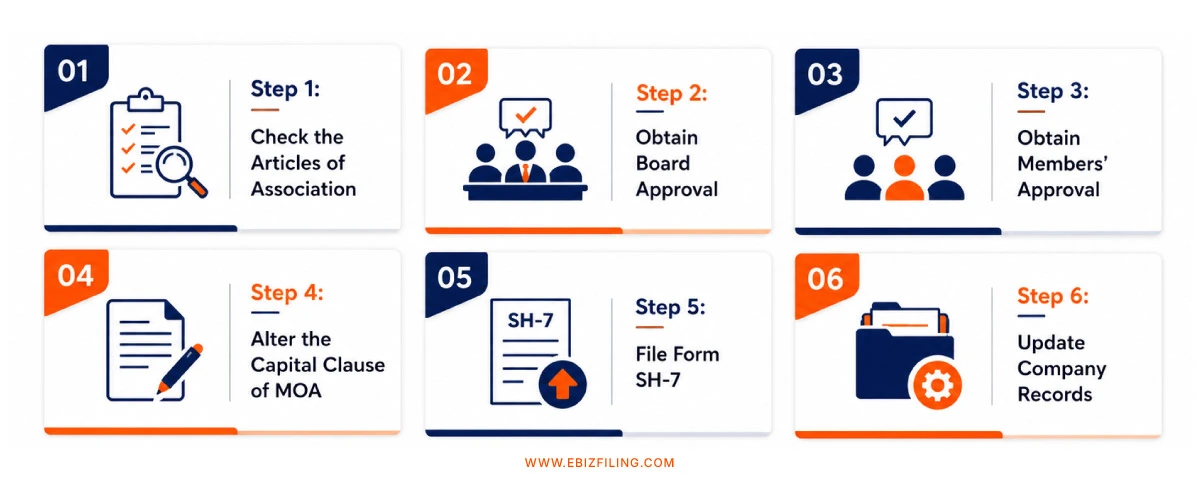
Step 1: Check the Articles of Association
The company should first verify whether its Articles authorize alteration of share capital as contemplated by Section 61 of the Companies Act, 2013. If the necessary authority is absent, the Articles may need to be altered separately under Section 14 of the Companies Act, 2013.
Step 2: Obtain Board Approval
The Board considers the proposed increase, approves the necessary proposal and takes steps to convene a general meeting of members.
Step 3: Obtain Members’ Approval
The proposed alteration is placed before the members in a general meeting in accordance with Section 61 of the Companies Act, 2013 and the company’s Articles.
A special resolution should not automatically be assumed for every increase under Section 61. The nature of the approval also depends on whether any separate alteration, such as an amendment to the Articles, is required.
Step 4: Alter the Capital Clause of MOA
After obtaining the necessary approval, the capital clause in the Memorandum of Association should be amended to reflect the revised authorized share capital of a company.
Step 5: File Form SH-7
The company must file Form SH-7 pursuant to Section 64(1) of the Companies Act, 2013 read with Rule 15 of the Companies (Share Capital and Debentures) Rules, 2014.
Step 6: Update Company Records
The company should ensure that its applicable statutory and internal records reflect the revised authorized capital.
To learn more, read our guide on the process to increase authorized share capital provides further practical information on the process.
Form SH-7 and Filing Time Limit
Once the authorized share capital of a company is altered under Section 61, notice of the alteration must be given to the Registrar. Under Section 64(1) of the Companies Act, 2013, read with Rule 15 of the Companies (Share Capital and Debentures) Rules, 2014, the prescribed notice is filed through Form SH-7.
According to the MCA Form SH-7 instruction kit, the return must be filed with the Registrar within 30 days of the alteration. The filing is accompanied by the altered Memorandum and applicable supporting documents and fees. Companies that require assistance with regular corporate filings can also explore our ROC Filing Services.
Documents Required for Increasing Authorized Share Capital
The documents needed to increase the authorized share capital of a company depend on the particular circumstances and the applicable MCA filing requirements.
Documents may include:
- Altered Memorandum of Association
- Members’ resolution
- Board resolution and meeting documents, where applicable
- Altered Articles of Association, if the Articles also need amendment
- Supporting documents required with Form SH-7
- Valid Digital Signature Certificate of the authorized signatory
The latest MCA webform and instruction kit should always be checked at the time of filing because attachment and filing requirements may be updated.
Fees for Increasing Authorized Share Capital
There is no single government fee applicable to every increase in the authorized share capital of a company.
The amount payable may depend on:
- Existing authorized capital
- Revised authorized capital
- Applicable capital slab
- Type of company
- Filing fee
- Additional fee in case of delay
- Applicable stamp duty
The relevant fee framework is prescribed under the Companies (Registration Offices and Fees) Rules, 2014, together with the applicable MCA fee structure. For this reason, companies should calculate the applicable government fee based on their actual proposed increase rather than relying on a standard figure.
What Happens if Form SH-7 is Not Filed on Time?
Compliance with Section 64 of the Companies Act, 2013 is important after increasing the authorized share capital of a company. Under Section 64(2) of the Companies Act, 2013, failure to comply with the requirements of Section 64 can result in a penalty for the company and every officer who is in default.
Apart from statutory consequences, delayed filing can also create inconsistencies between the company’s internal capital records and the information recorded with the Registrar. Companies should therefore complete Form SH-7 and related ROC compliance within the prescribed timeline.
Why Connect with Ebizfiling for Increase in Authorized Share Capital?
Increasing the authorized share capital of a company is not limited to changing a figure in the Memorandum of Association. The process may involve reviewing whether the Articles of Association permit the alteration, preparing the required board and member approvals, updating the capital clause of the MOA, and completing the prescribed ROC filing through Form SH-7 within the applicable timeline.
Ebizfiling assists companies with the increase in authorized capital by helping with document preparation, resolution drafting, MOA alteration, Form SH-7 filing, and related ROC compliance. This support can be especially useful when the capital increase is linked with a proposed investment round, further issue of shares, private placement, or broader restructuring of the company’s capital.
If your company is planning to increase its authorized capital, connect with Ebizfiling today to complete the process with the required documentation and ROC compliance in place.
Conclusion
The authorized share capital of a company establishes the maximum amount of share capital that its Memorandum permits. It should not be confused with issued capital, paid-up capital, funds actually received, ownership percentage or company valuation.
When the existing limit becomes insufficient, a limited company may increase it under Section 61 of the Companies Act, 2013, provided its Articles authorize the alteration. The company must then comply with Section 64 of the Companies Act, 2013 and Rule 15 of the Companies (Share Capital and Debentures) Rules, 2014, including the applicable Form SH-7 filing.
Maintaining an appropriate authorized share capital of a company helps businesses plan future share issues and investment requirements while keeping their corporate records compliant.
Frequently Asked Questions
1. Can authorized share capital include both equity shares and preference shares?
Yes. A company may structure its authorized share capital into different classes of shares, such as equity shares and preference shares, subject to the provisions of the Companies Act, 2013, its Memorandum of Association, and Articles of Association.
2. Does an increase in authorized share capital change the voting rights of existing shareholders?
No. Merely increasing the authorized share capital does not change existing shareholders’ voting rights. Voting rights are linked to shares actually issued and held, not to the unissued portion of authorized capital.
3. Can a company increase authorized share capital before receiving an investment?
Yes. A company may increase its authorized share capital in advance if it expects a proposed investment or share issuance to exceed the existing authorized limit. The subsequent allotment must separately comply with the applicable provisions of the Companies Act, 2013.
4. Can authorized share capital be reduced after it has been increased?
A company may alter or reduce its capital structure, but reducing share capital is not simply the reverse of increasing authorized capital. A reduction of share capital may attract the separate procedure prescribed under Section 66 of the Companies Act, 2013, depending on the nature of the proposed reduction.
5. Does unused authorized share capital create any annual tax liability?
No. The unused portion of authorized share capital does not, by itself, create an annual income-tax liability merely because the company has the capacity to issue additional shares. Tax implications generally arise from actual transactions rather than unused authorized capital.
6. Can the face value of shares be changed while altering authorized share capital?
Yes, but changing the face value may involve a separate alteration of the share capital structure. For example, subdivision or consolidation of shares is covered under Section 61 of the Companies Act, 2013, subject to the company’s Articles and applicable compliance requirements.
7. Does increasing authorized share capital affect the company's existing shareholding pattern?
No. The existing shareholding pattern remains unchanged merely because the authorized capital is increased. The shareholding percentage changes only when additional shares are actually issued or existing shares are transferred.
8. Can a subsidiary company increase its authorized share capital independently?
Yes, a subsidiary company can increase its authorized share capital by following the applicable provisions of the Companies Act, 2013 and its own Memorandum and Articles. However, internal approvals or shareholder rights under its corporate structure may also need to be considered.
9. Is stamp duty payable every time authorized share capital is increased?
Stamp duty may apply depending on the applicable state or union territory laws and the nature of the alteration. Since stamp duty is jurisdiction-specific, the exact liability should be checked at the time of filing rather than assuming a uniform amount across India.
10. Does a company need to increase authorized capital for a transfer of existing shares?
No. A transfer of already issued shares generally does not require an increase in authorized share capital because no new shares are being created. An increase becomes relevant when a fresh issue would cause the company’s issued capital to exceed its existing authorized limit.





Increase in Authorized Capital
Get in touch with EbizFiling for seamlessly complying regarding Increase in Authorised Share Capital.
About Ebizfiling -



Reviews
Harshit Gamit
19 Apr 2018My GST process was made easier with Ebizfiling. I really appreciate the hard work by your team. Keep up the same in the future. Good Luck!
Misha Kapoor
04 Oct 2017I am a satisfied customer of Ebizfiling. I would surely recommend it to others.
Rohan Mehra
09 Mar 2018I never thought registering a company would be this easier.
August 18, 2026 By Steffy A
Independent Director in India: Eligibility and Registration Process Overview Becoming an independent director in India is increasingly recognized as a professional opportunity in corporate governance. Experienced professionals can use their knowledge to contribute to Board-level discussions, business strategy, risk management, […]
July 9, 2026 By Steffy A
AML obligations for Practicing CS under FIU-IND Framework Introduction AML obligations for Practicing CS are becoming increasingly important in today’s evolving regulatory environment, where the role of Practicing Company Secretaries has expanded beyond traditional compliance functions into areas involving corporate […]
June 25, 2026 By Steffy A
The Independent Director Data Bank : Zero to Board Member Introduction Dreaming of sitting on a company’s board? The Independent Director Data Bank is your easiest first step to becoming a board member in India. If you’re wondering how to […]