

-
September 7, 2026
-
BySteffy A
Trademark Objection Reply under Section 9: Process & Documents
Introduction
A Trademark Objection Reply becomes necessary when the Trade Marks Registry raises objections during examination of a trademark application. An objection under Section 9 of the Trade Marks Act, 1999 generally relates to the inherent registrability or distinctiveness of the proposed mark. The applicant gets an opportunity to explain why the mark should be accepted and may submit supporting evidence with the reply.
What Is a Section 9 Trademark Objection?
Section 9 of the Trade Marks Act, 1999 contains the absolute grounds for refusal of registration. It covers several grounds relating to what cannot be registered as a trademark, including lack of distinctiveness, descriptiveness and certain prohibited marks.
A Section 9 Trademark Objection may arise where the mark:
- Has no distinctive character and cannot distinguish one person’s goods or services from another’s.
- Consists exclusively of words or indications describing the kind, quality, quantity, purpose, value, geographical origin or other characteristics of the goods or services.
- Consists exclusively of expressions that have become customary in common language or established trade practices.
- Is likely to deceive the public or cause confusion.
- Contains material that may hurt the religious susceptibilities of a section of Indian citizens.
- Contains scandalous or obscene matter.
- Contains matter prohibited under the Emblems and Names (Prevention of Improper Use) Act, 1950.
- Consists exclusively of a shape resulting from the nature of the goods, a shape necessary to obtain a technical result, or a shape that gives substantial value to the goods.
However, Section 9(1) also provides an important exception. A trademark should not be refused on the grounds mentioned in Section 9(1) if, before the application date, it acquired distinctive character through use or qualified as a well-known trademark.
Section 9 vs Section 11 Trademark Objection
These two objections should not be confused.
- A Section 9 objection relates to the inherent characteristics of the applied trademark.
- A Section 11 objection deals with relative grounds for refusal, including conflicts with earlier trademarks, likelihood of confusion, well-known trademarks and certain earlier rights protected through passing off or copyright.
How to File a Trademark Objection Reply under Section 9?
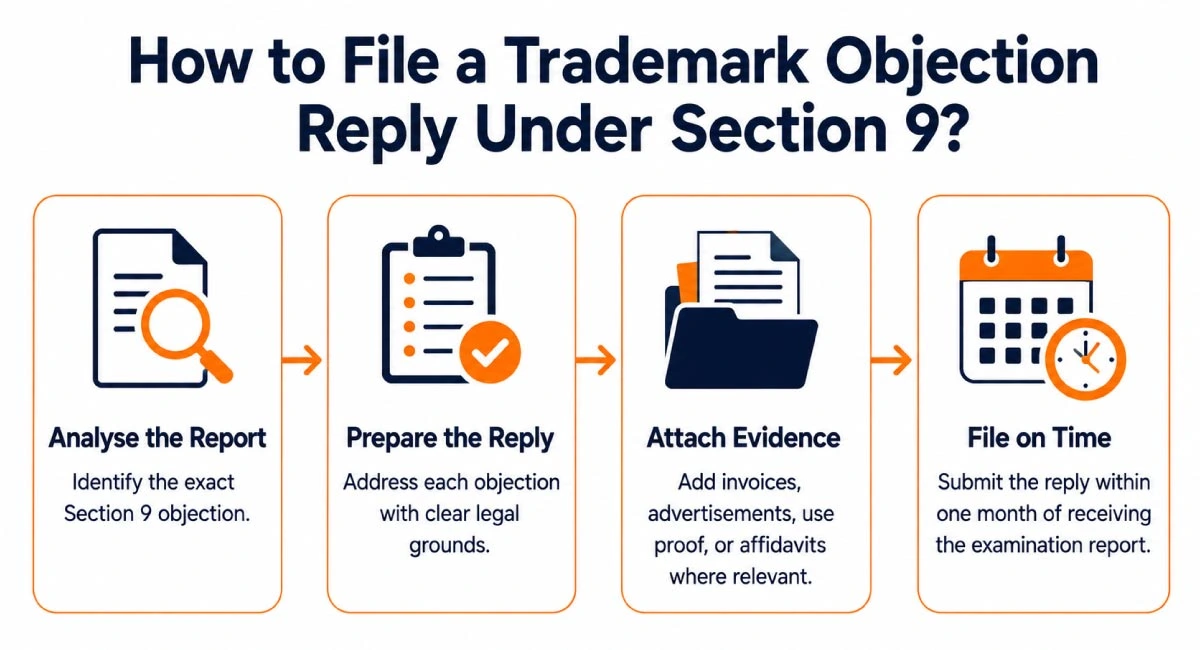
Analyse the Examination Report
Read the examination report carefully and identify the exact clause of Section 9 cited by the Examiner.
For example, the objection may relate to:
- Section 9(1)(a): lack of distinctiveness
- Section 9(1)(b): descriptive character
- Section 9(1)(c): customary expressions
- Section 9(2): deceptive, prohibited, religiously sensitive, scandalous or obscene matter
- Section 9(3): Consists exclusively of a shape resulting from the nature of the goods, a shape necessary to obtain a technical result, or a shape that gives substantial value to the goods.
The Trademark Objection Reply should address the specific objection rather than relying on a standard explanation.
Prepare a Point-by-Point Reply
The reply should explain why the trademark is capable of registration.
Depending on the objection, the applicant may argue that:
- The mark is inherently distinctive.
- The mark is suggestive rather than directly descriptive.
- The trademark must be considered as a whole.
- The words or device used are not customary in the relevant trade.
- The mark has acquired distinctiveness through continuous commercial use before the application date.
- The objection does not apply to the particular goods or services covered by the application.
The applicant may also rely on relevant statutory provisions and verified judicial precedents where appropriate.
Attach Supporting Evidence
Evidence becomes particularly important when the applicant relies on prior use or acquired distinctiveness.
Depending on the facts of the application, supporting documents may include:
- Earlier invoices showing use of the trademark
- Product packaging or labels
- Brochures and catalogues
- Advertising and promotional material
- Website screenshots
- Social media or digital marketing material
- Business correspondence
- Sales or turnover information relating to the mark
- Evidence showing the duration and geographical extent of use
- Affidavit supporting the claimed use, where appropriate
The documents should support the actual claims made in the Trademark Objection Reply.
File the Reply Within the Prescribed Time
Rule 33(4) provides that the applicant should respond within one month from the date of receipt of the examination report. If the applicant fails to respond within this period, the Registrar may treat the application as abandoned. Applicants who miss the prescribed period can also read about the position relating to a trademark objection after missing the deadline.
Can the Time for Filing the Reply Be Extended?
An applicant may seek an extension through Form TM-M under Section 131 read with Rule 109 of the Trade Marks Rules, 2017.
The Registrar may, if satisfied with the circumstances, grant an extension not exceeding one month. The extension is discretionary and should not be treated as automatic.
The current government fee for a general TM-M extension request is:
|
Filing Mode |
Government Fee |
|
E-filing |
₹900 |
| Physical filing |
₹1,000 |
Documents Required for Trademark Objection Reply
The exact documents depend on the objection and facts of the application. Common documents include:
- Copy/details of the examination report
- Detailed reply addressing the Section 9 objection
- Evidence of prior commercial use, where relied upon
- Invoices, advertisements, brochures and website evidence
- Supporting affidavit, where appropriate
- Authorisation of agent, where the applicant is represented through an authorised agent
Under Rule 19, authorisation of an agent is executed through Form TM-M under the current Trade Marks Rules, 2017.
Trademark Objection Reply Format
A Trademark Objection Reply Format may generally contain the following:
To:
The Registrar of Trade Marks
Trade Marks Registry
Subject: Reply to Examination Report for Trademark Application No. [Application Number]
Trademark: [Mark Name]
Class: [Class Number]
Applicant: [Applicant Name]
Examination Report Date: [Date]
- Background: Briefly identify the trademark application and goods or services covered.
- Objection Raised: Mention the exact Section 9 clause cited in the examination report.
- Applicant’s Submission: Provide a point-by-point legal and factual response explaining why the objection should not prevent registration.
- Evidence Relied Upon: List the invoices, advertisements, brochures, sales records, affidavits or other supporting documents, where applicable.
- Prayer: Request the Registrar to consider the submissions, accept the trademark application and allow it to proceed to advertisement in accordance with the Trade Marks Act, 1999 and applicable Rules.
The actual reply should be customised to the trademark and the objection mentioned in the examination report. A generic template should not be used without checking the facts of the application.
What Happens After Filing the Trademark Objection Reply?
If the Registrar finds the response satisfactory, the application may proceed towards acceptance and advertisement in the Trade Marks Journal.
If the Trademark Objection Reply is not satisfactory, Rule 33(6) provides for an opportunity of hearing. Applicants can understand the next stage through the trademark hearing process. The Registry conducts the hearing in accordance with Rule 115 of the Trade Marks Rules, 2017.
A pending objection therefore does not by itself mean that the trademark application has been finally refused.
Professional Support for Trademark Objection Reply
Ebizfiling can assist applicants with:
- Reviewing the trademark examination report
- Identifying the Section 9 objection raised by the Registry
- Preparing a structured Trademark Objection Reply
- Organising supporting evidence of trademark use
- Assisting with applicable filing requirements
- Providing support for subsequent trademark hearing requirements, where applicable
Need help responding to a Section 9 objection? Ebizfiling can assist with reviewing the examination report, preparing a customised Trademark Objection Reply, organising supporting evidence and handling applicable filing requirements.
Conclusion
A Trademark Objection Reply under Section 9 should directly address the absolute grounds raised by the Trade Marks Registry. Applicants should carefully review the examination report, prepare appropriate legal submissions and provide supporting evidence where required. Filing the reply within the prescribed period can help the application continue to the next stage of the trademark registration process.
Frequently Asked Questions
1. Can a descriptive trademark be accepted if it has been used for several years?
Yes, depending on the facts. Section 9(1) allows a mark that would otherwise face an objection under Section 9(1)(a), (b), or (c) to be considered if it had acquired distinctive character through use before the date of the trademark application. A Trademark Objection Reply relying on acquired distinctiveness should therefore provide credible evidence showing how consumers came to associate the mark with the applicant.
2. What if the examination report raises objections under both Section 9 and Section 11?
The applicant should address each objection separately in the Trademark Examination Report Reply. Section 9 examines inherent issues such as distinctiveness or descriptiveness, while Section 11 primarily concerns conflicts with earlier trademarks. A response dealing only with one objection may leave the other objection unresolved. Applicants can also understand the broader grounds for refusal of trademark registration.
3. Can adding a logo overcome a Section 9 objection against descriptive words?
Not automatically. A combination of words and visual elements may be examined as a whole, and a distinctive overall representation may affect the assessment. However, registration of a composite mark does not necessarily give exclusive rights over a descriptive or non-distinctive element appearing within it. Section 17 limits exclusive rights over such individual elements in certain cases.
4. Can a No Objection Certificate from another trademark owner remove a Section 9 objection?
Not necessarily. A No Objection Certificate may be relevant where an objection involves an earlier trademark, but a Section 9 Trademark Objection concerns the inherent registrability of the applicant’s own mark. Therefore, consent from another proprietor does not by itself establish that a descriptive or non-distinctive mark satisfies Section 9.
5. Can a trademark filed on a proposed to be used basis claim acquired distinctiveness?
Acquired distinctiveness under the proviso to Section 9(1) depends on distinctiveness acquired through use before the application date. Therefore, an application filed on a “proposed to be used” basis would ordinarily not rely on prior use to establish acquired distinctiveness. Any claim of prior use should remain consistent with the use details recorded in the trademark application.
6. Is a slightly altered spelling of a descriptive word automatically distinctive?
No. Merely changing the spelling of a descriptive expression does not automatically make it registrable. The Registry may still examine whether consumers would understand the expression as descriptive of the goods or services. IP India’s Trade Marks Manual guidance also explains that a misspelling may remain objectionable where it does not remove the descriptive character of the expression.
7. Can geographical words receive a Section 9 objection?
Yes. Section 9(1)(b) covers marks consisting exclusively of indications that may designate characteristics of goods or services, including their geographical origin. However, whether a particular geographical term is objectionable depends on the mark, the relevant goods or services and the overall facts of the application.
8. Does acceptance of the Trademark Objection Reply mean the trademark is registered?
No. Acceptance of a Trademark Objection Reply only allows the application to move further in the registration process. If accepted, the application is generally advertised in the Trade Marks Journal. After advertisement, any person may file an opposition in Form TM-O within four months from the date of publication of the Trade Marks Journal.
9. Can Ebizfiling review Trademark Objection Documents before the reply is filed?
Yes. Ebizfiling can assist in reviewing the examination report and relevant Trademark Objection Documents, such as evidence of use, invoices, advertisements, website material and supporting records. The documents can then be organised according to the grounds relied upon in the Trademark Objection Reply. Final acceptance remains subject to the decision of the Trade Marks Registry.
10. Can Ebizfiling help prepare a Trademark Objection Reply Format for a Section 9 objection?
Yes. Ebizfiling can assist in preparing a Trademark Objection Reply Format based on the specific clause of Section 9 mentioned in the examination report. Assistance may include structuring the response, organising supporting evidence and helping with applicable filing requirements. Ebizfiling cannot guarantee waiver of the objection or registration because the final decision rests with the Trade Marks Registry.





Trademark Objection
File Reply for the Trademark Objection with Ebizfiling at affordable prices
About Ebizfiling -



Reviews
Ahmed Shaikh
23 Sep 2018Ms. Ishani and other team members are very helpful in the entire process of GST filing.
I really appreciate their support superb team.
Cheers!!!!*****
Gautam Chhabria
01 Oct 2019These guys deliver on their promise..
Karthik
05 Apr 2019Awesome Service! I am very happy with the way the process is being handled. Snehal also followed up constantly to ensure that the items are completed on time successfully. Thanks for your service.
May 13, 2026 By Ishita Ramani
May 13, 2026 By Ishita Ramani
Trademark Renewal vs Trademark Restoration: Which is the right option for you? What Is a Trademark? A trademark is a unique sign, symbol, word, or combination of these elements that serves to identify and distinguish the products or services of one […]
May 14, 2026 By Ishita Ramani
Legal Guidelines for Naming a Company in India When establishing a business, one of the first and most critical decisions is choosing the right name. The name of your company is not just a label; it represents your brand identity, […]