


-
August 24, 2026
-
BySteffy A
Udyam Registration Conflict Between Proprietorship & Private Limited Company
Overview
A Udyam Registration Conflict can arise when a business operating as a Proprietorship is incorrectly shown as a unit under the Udyam Registration of a Private Limited Company. Although both businesses may be connected with the same individual, they do not necessarily form one enterprise for Udyam purposes.
A Private Limited Company is a separate legal entity with its own PAN. A Proprietorship, however, does not have a separate legal personality from its proprietor and generally operates using the proprietor’s PAN. This distinction becomes important because the Udyam framework relies heavily on PAN, organisation type and enterprise-level information.
Where two businesses operating under different PAN structures are combined incorrectly, the Udyam Registration Conflict should be reviewed and corrected before a separate registration is attempted.
What Causes a Udyam Registration Conflict?
The Udyam Registration framework provides that an enterprise should have only one Udyam Registration. At the same time, multiple manufacturing or service activities may be included under that registration.
A Udyam Registration Conflict can occur when this facility is incorrectly used to add another independently operated business as a plant or unit.
For example, a business may have entered the name of a Proprietorship under the plant or unit details of a company’s Udyam Registration. If the proprietorship operates under the proprietor’s PAN while the company operates under a different corporate PAN, the two should not automatically be treated as ordinary units of the same PAN-based enterprise.
The Udyam framework also provides that GSTINs linked to the same PAN are considered collectively for determining the status of an enterprise. This makes PAN an important factor when examining such conflicts.
Businesses that want to understand the general registration framework, required details and application process can also refer to our MSME Udyam Registration process and documents guide.
Why the Two Business Structures Need Separate Examination
Understanding the legal structure is essential before trying to resolve a Udyam Registration Conflict.
A Private Limited Company comes into existence as a separate body corporate and has an identity independent of its shareholders or directors. Businesses considering this structure can learn more through Ebizfiling’s Private Limited Company Registration service.
A Proprietorship works differently. The business and proprietor are not separate legal persons. For Udyam Registration, the Aadhaar used for a proprietorship is the Aadhaar of the proprietor, and the business generally operates under the proprietor’s PAN.
For more information on the legal nature and basic setup of this business structure, read our guide to registering a Proprietorship in India.
Therefore, common ownership or management alone does not mean that two businesses can automatically be combined into one Udyam record.
The registration should reflect the actual organisation type, PAN and enterprise structure.
Can a Proprietorship Obtain Its Own Udyam Registration?
Yes, a Proprietorship can obtain Udyam Registration where it satisfies the applicable MSME requirements and the registration is made using the correct proprietor and enterprise details.
The Udyam Registration Conflict becomes relevant when that business has already been incorrectly entered as a unit under another entity’s registration.
Before filing a fresh application, the existing registration should be reviewed to determine:
- Which PAN appears on the registration
- Which organisation type has been selected
- Which business is listed as the enterprise
- Whether another business has been added under plant or unit details
- Which Aadhaar was used for authentication
A new application should not be used merely to bypass inaccurate information in an existing registration.
How to Correct a Udyam Registration Conflict?
The first step is to identify exactly where the incorrect linkage appears.
If a Proprietorship has been entered as a plant or unit under a Private Limited Company’s Udyam Registration, the available update or modification facility should first be checked to determine whether the incorrect unit information can be corrected.
The Udyam framework permits registered enterprises to update relevant information through the portal. However, the availability of a general update facility does not mean that every structural, PAN or identity-related error can necessarily be corrected directly online.
When resolving a Udyam Registration Conflict, businesses should avoid changing unrelated details merely to make the portal accept another registration.
The information on the portal should remain consistent with the actual constitution and PAN of the business.
What If Aadhaar Details Are Creating the Problem?
Aadhaar is used as an authentication element in the Udyam Registration process.
For a proprietorship, the Aadhaar number is that of the proprietor. In the case of a company, the prescribed company details and Aadhaar of the relevant authorised person are used during registration.
An important distinction should be kept in mind: the Udyam rules do not state that one Aadhaar number can be connected with only one enterprise.
Therefore, a Udyam Registration Conflict should not automatically be described as an “Aadhaar already used” legal restriction.
However, incorrect Aadhaar, PAN, organisation type or enterprise details may create a portal-level validation issue. If the normal correction facility does not allow the inaccurate information to be rectified, the applicant should use the official support, facilitation or grievance mechanism instead of repeatedly submitting inconsistent applications.
When Should a Udyam Grievance Be Raised?
A grievance becomes relevant when the required correction cannot be completed through the normal portal functionality.
The official Udyam framework provides facilitation through the Single Window System and District Industries Centres. In cases involving discrepancies or complaints, the competent authorities can examine the registration information and take appropriate steps for amendment or other corrective action.
Therefore, if a Udyam Registration Conflict involves a wrongly linked unit, organisation type, PAN or identity information that cannot be corrected online, the applicant should clearly explain the discrepancy and provide the relevant supporting information through the prescribed channel.
The objective should be correction of the existing record rather than creation of another conflicting record.
Step-by-Step Process to Resolve the Conflict
A practical sequence for resolving a Udyam Registration Conflict is:
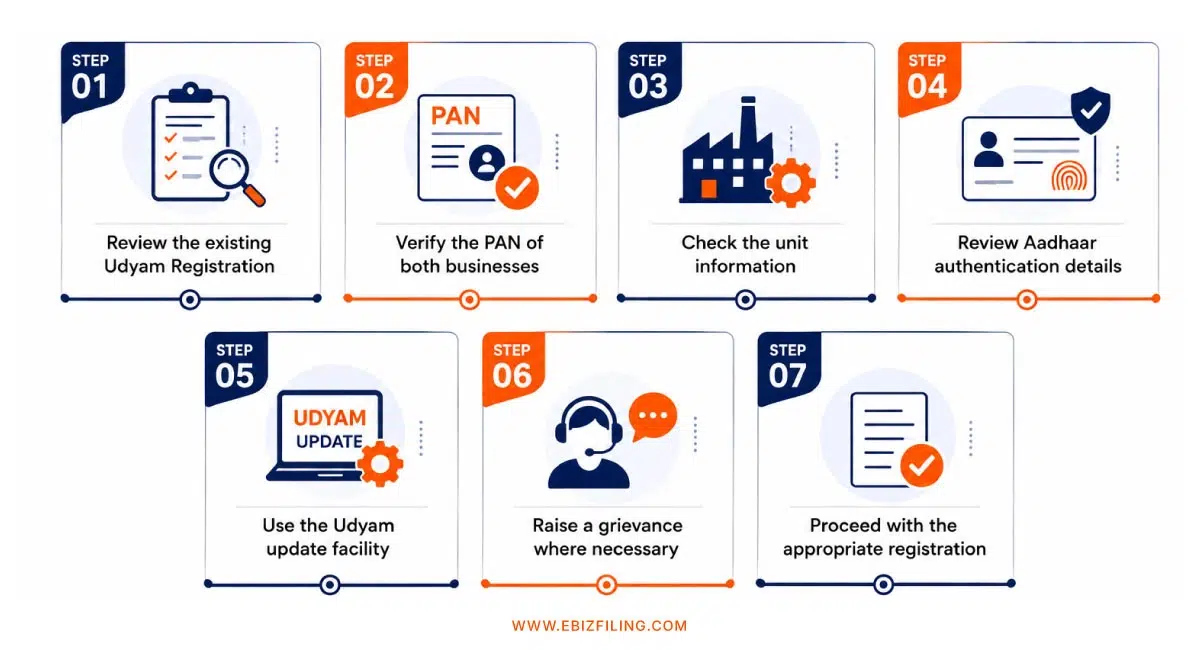
Review the existing Udyam Registration
Check the enterprise name, organisation type, PAN and registered unit details.
Verify the PAN of both businesses
Confirm whether the two businesses actually operate under different PANs.
Check the unit information
Identify whether an independently operated business has been incorrectly added as a plant or unit.
Review Aadhaar authentication details
Determine whose Aadhaar was used when the registration was completed.
Use the Udyam update facility
Correct information that the portal permits to be modified.
Raise a grievance where necessary
If the required change is restricted, approach the official Udyam/MSME facilitation mechanism.
Proceed with the appropriate registration
Once the incorrect linkage has been resolved, the independently operated business can proceed using the correct PAN, organisation type and proprietor details.
Following the correct order can prevent another Udyam Registration Conflict from being created.
Important Points Before Filing a Separate Registration
Before filing separately, businesses should check whether the existing registration accurately represents the enterprise to which it belongs.
A Udyam Registration Conflict should not be resolved merely by changing the trade name while leaving incorrect PAN or organisation details unchanged.
Multiple units can be included in one Udyam Registration, but they must form part of the enterprise covered by that registration. Where businesses operate through different PAN structures, their Udyam treatment should reflect the actual enterprise arrangement.
Businesses can also review our guide to the MSME Registration Certificate to understand how enterprise information is reflected in the MSME registration framework.
Need Help Resolving Udyam Registration Issues?
An incorrect unit, PAN or organisation linkage can make a straightforward registration difficult. Before submitting another application, the existing Udyam record should be reviewed to identify where the Udyam Registration Conflict originated and whether the issue can be corrected through the portal or requires official facilitation.
Ebizfiling can assist businesses with reviewing registration details and completing MSME and Udyam Registration using the appropriate enterprise information.
Need assistance with Udyam Registration or MSME compliance? Connect with Ebizfiling for professional support.
Conclusion
A Udyam Registration Conflict between a Proprietorship and a Private Limited Company usually requires the underlying registration details to be examined before another application is filed.
The key distinction is that a company has its own legal identity and PAN, whereas a proprietorship operates through its proprietor. The Udyam portal’s facility for adding multiple units should not be interpreted as permission to combine independently operated businesses under different PAN structures into one registration.
Where the information can be corrected online, the available update facility should be used. Where PAN, organisation or identity-related information cannot be appropriately corrected through normal portal options, the official grievance or DIC facilitation mechanism should be approached.
Resolving the Udyam Registration Conflict through the correct process helps ensure that the Udyam record reflects the actual business structure and avoids further registration inconsistencies.
Frequently Asked Questions
1. What are the current MSME classification limits for Udyam Registration?
From 1 April 2025, an enterprise is classified as Micro where investment does not exceed ₹2.5 crore and turnover does not exceed ₹10 crore. For Small enterprises, the limits are ₹25 crore investment and ₹100 crore turnover. For Medium enterprises, the limits are ₹125 crore investment and ₹500 crore turnover. Both investment and turnover form part of the classification criteria.
2. What happens if an enterprise crosses only the turnover limit but remains within the investment limit?
Udyam classification follows a composite criterion. If an enterprise exceeds the ceiling for its existing category in either investment or turnover, it can move to the next higher category. However, an enterprise cannot move to a lower category unless it falls below the prescribed limits under both investment and turnover.
3. Is export turnover included while determining the MSME category?
No. Export turnover from goods, services or both is excluded when turnover is calculated for Micro, Small or Medium classification. The turnover and export information is linked with the applicable Income Tax and GST data maintained by government systems.
4. How is investment in plant and machinery calculated for Udyam classification?
For an existing enterprise, investment in plant and machinery or equipment is generally linked with the information reported through the applicable Income Tax Return. Land and building, furniture and fittings are not included within the specified meaning of plant and machinery or equipment for this purpose.
5. How is investment calculated for a newly established enterprise that has not filed an ITR?
Where a new enterprise does not have a prior ITR, investment can initially be determined on the promoter’s self-declaration. For plant and machinery or equipment purchased by such an enterprise, the invoice value is considered excluding GST. This self-declaration relaxation ends after 31 March of the financial year in which the enterprise files its first ITR.
6. Does an Udyam Registration Certificate expire or require annual renewal?
No. The official Udyam framework provides a permanent Udyam Registration Number, and there is no requirement for periodic renewal of the registration. The online certificate also contains a dynamic QR code through which the enterprise details available on the Udyam portal can be accessed.
7. Is an enterprise required to update its ITR and GST information after obtaining Udyam Registration?
Yes. An enterprise holding a Udyam Registration Number is required to update relevant information, including previous financial year’s ITR and GST return details, as required on the portal. Failure to update the required information within the specified period can make the enterprise liable for suspension of its Udyam status.
8. Can incorrect or intentionally suppressed information in an Udyam application lead to a penalty?
Yes. The Udyam framework provides that a person who intentionally misrepresents or attempts to suppress self-declared facts and figures during registration or updation may become liable to the penalty prescribed under Section 27 of the MSMED Act, 2006. Therefore, investment, turnover and enterprise information should be reported accurately.
9. Can Ebizfiling help determine whether a business should be classified as Micro, Small or Medium after expansion?
Yes. Ebizfiling can assist in reviewing the enterprise’s investment and turnover figures against the current MSME limits and help identify the appropriate Udyam classification. This can be useful where business expansion, additional machinery or significant turnover growth may affect the enterprise’s existing MSME category.
10. Can Ebizfiling help review Udyam details against ITR and GST records before using the certificate for business purposes?
Yes. Ebizfiling can assist businesses in reviewing Udyam-related information against available PAN, ITR, GST and enterprise records. Such a review can help identify inconsistencies before the Udyam Registration Certificate is relied upon for MSME benefits, financing, tenders or other business requirements.





Get Expert Support for Udyam Registration
Access reliable support for MSME and Udyam Registration and keep your business registration accurate and compliant.
About Ebizfiling -



October 21, 2026 By Srishti M
Tax Planning for NRI Returning to India Before Becoming ROR Introduction Tax planning for NRI returning to India should start before the person becomes Resident and Ordinarily Resident, also known as ROR. Under the Income-tax Act, 2025, residential status decides […]
October 19, 2026 By Srishti M
October 21, 2026 By Srishti M
TDS and TCS Compliance Calendar November 2026: Compliance Guide Introduction The TDS and TCS Compliance Calendar November 2026 covers important tax deduction, collection, payment, certificate and reporting requirements applicable during the month. It helps businesses, government offices and other responsible […]