


-
August 22, 2026
-
BySteffy A
Form 105 Filing for NPO Registration Under Income Tax Act 2025
Introduction
Form 105 filing under the Income Tax Act 2025 is used by specified non-profit organizations seeking regular registration or approval. Form No. 105 is a common application form relevant for organizations that want to claim benefits available to registered NPOs or obtain approval so that eligible donations can qualify for deduction under the applicable provisions of the Act.
Understanding Form 105 filing is important because the form covers eligibility, registration status, financial information, office bearer details, supporting documents, and other information relating to the organization. Filing the correct information within the prescribed period can help an NPO avoid unnecessary delays in its registration or approval process.
What is Form 105 Under the Income Tax Act 2025?
Form No. 105 is a common application form prescribed for registration or approval of eligible non-profit organizations under the Income Tax Act 2025.
It can be used by an eligible NPO seeking regular registration under section 332 and by eligible registered NPOs or specified funds seeking approval under section 354. For organizations seeking approval, the purpose is to enable qualifying donations received by them to become eligible for deduction for donors under the applicable provisions.
Therefore, Form 105 filing is not limited to first-time registration. It may also become relevant when provisional registration is expiring, an existing registration is nearing expiry, registration has become inoperative, or the objects of an organization have been modified.
Form No. 105 is the common application form prescribed under Rule 181 of the Income-tax Rules, 2026 for regular registration under section 332 or approval under section 354 of the Income Tax Act 2025.
Who Should File Form 105?
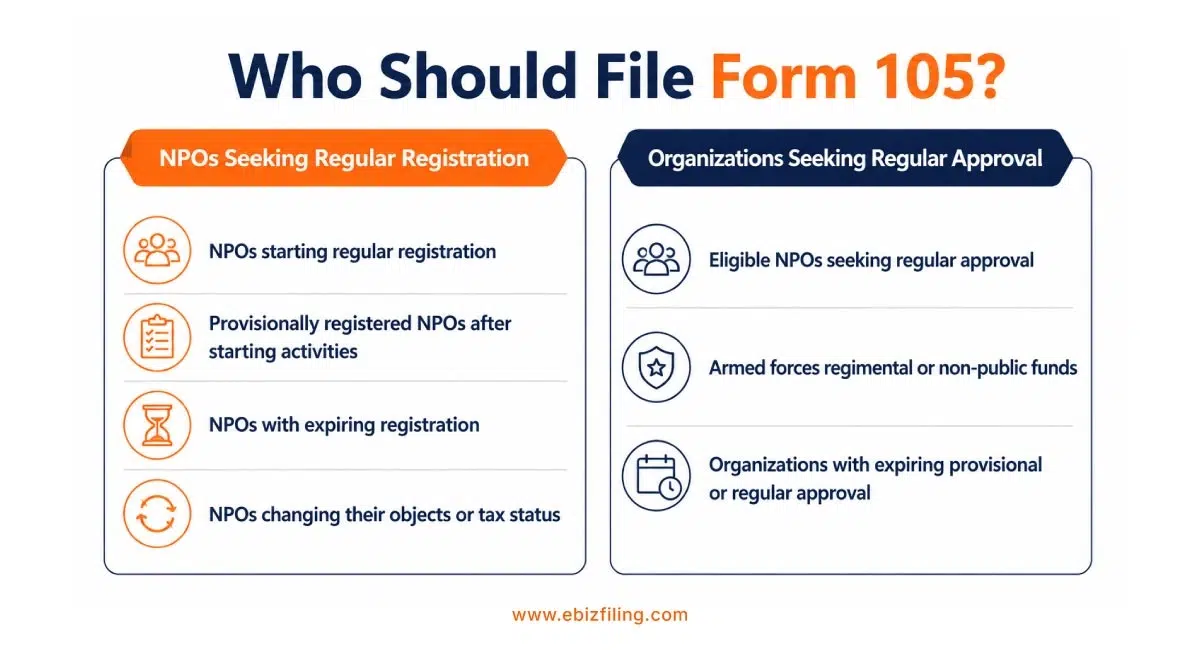
NPOs Seeking Regular Registration
An eligible non-profit organization may need to complete Form 105 filing in several circumstances.
An NPO whose activities have already commenced but which has never been registered under the specified provisions may apply for regular registration. An organization that has received provisional registration and has subsequently commenced activities may also have to apply.
The form is also applicable where provisional registration is due to expire but activities have not commenced, or where an existing registration is approaching expiry.
Further, an NPO may need to apply when its registration becomes inoperative because of a change in the applicable tax regime. A registered NPO that modifies its objects in a way that does not conform to the conditions of registration is also covered.
Organizations Seeking Regular Approval
Registered non-profit organizations and eligible regimental or non-public funds established by the armed forces may also apply for regular approval.
The relevant circumstances include commencement of activities, provisional approval followed by commencement of activities, approaching expiry of provisional approval, or approaching expiry of the existing approval period.
Form 105 Filing Due Date
The deadline depends on the applicant’s circumstances. The source provides different timelines for different categories.
|
Situation |
Time Limit |
|
Activities commenced without earlier registration or approval |
At any time during the tax year from which registration or approval is sought |
| Provisional registration or approval followed by commencement |
Within six months from commencement |
|
Provisional registration or approval due to expire; activities not commenced |
At least six months before expiry |
| Existing registration or approval is due to expire |
At least six months before expiry |
|
Registration becomes inoperative |
At any time during the relevant tax year |
| Objects modified contrary to registration conditions |
Within 30 days from modification |
Because the deadlines vary significantly, timely Form 105 filing is important for organizations approaching expiry or changing their objects.
Note: The timelines relating to registration becoming inoperative and modification of objects specifically relate to registration applications under section 332.
Validity of Registration or Approval Through Form 105
Regular registration or approval is generally valid for five tax years starting from the tax year in which the application is made.
In certain expiry-related situations, the five-year period begins from the tax year following the year in which the application is submitted.
A special 10-year validity rule applies to certain applications under section 332(3), Table Sl. Nos. 3 to 7. Where the applicant’s total income, without giving effect to the provisions of Part B of Chapter XVII, does not exceed ₹5 crore in each of the two tax years preceding the tax year in which the application is made, registration may be valid for ten tax years.
Organizations approaching the end of their registration period should also understand the requirements relating to renewal of 12A and 80G registration.
Details Required in Form No. 105
A Form 105 filing requires extensive organizational and financial information.
The form includes personal information such as the applicant’s name, PAN, and address. It also asks whether the application is a fresh application, delayed application, or re-application.
Applicants may need to disclose formation details, the nature of activities, governing instruments, objects of the organization, and existing registrations or approvals.
Information relating to office bearers, beneficial ownership, institutions managed by the applicant, bank accounts, land and buildings, assets, liabilities, investments, and different sources of income may also be required.
Where applicable, details of commercial activities, grants, corpus donations, and religious expenditure must also be disclosed.
Documents Required for Form 105 Filing
Depending on the nature and history of the applicant, documents required may include:
- Self-certified trust deed
- Formation or incorporation document
- Registration certificate from the relevant registrar
- FCRA registration certificate, if applicable
- Existing registration or approval order
- Previous rejection or cancellation order, where applicable
- Annual accounts for up to the relevant preceding three years
- Audit reports where applicable
- Documents supporting the modification of objects
- Order condoning delay, if applicable
- Withdrawal document where a previous appeal has been withdrawn
- Explanation for delayed filing or re-application
- Detailed note on the activities of the organization
The precise documents for Form 105 filing depend on the applicant’s category and circumstances.
How to File Form 105 Online?
Prepare Required Information
Identify the applicable registration or approval category and collect information about the organization, its activities, office bearers, finances and existing registrations.
Collect Supporting Documents
Prepare the required self-certified documents, financial statements, registration orders and other attachments relevant to the application.
Complete Form No. 105 Electronically
Enter all prescribed information accurately in Form No. 105 and attach the applicable documents and undertakings.
e-File > Income-tax Forms > File Income-tax Forms > Forms as per Income-tax Act 2025 > search Form 105 > File Now.
Verify Using DSC or EVC
Form No. 105 must be furnished electronically under a digital signature where the applicant’s return of income is required to be filed under digital signature. In other cases, the form must be verified through an electronic verification code (EVC). The form must be verified by the person authorised to verify the applicant’s return of income.
Submit the Application to the Jurisdictional Authority
Complete the Form 105 online filing by submitting it electronically to the jurisdictional Principal Commissioner or Commissioner.
What Happens After Form 105 Filing?
After Form 105 filing, the Principal Commissioner or Commissioner examines the application and passes an order in Form No. 107.
The authority may grant registration or approval and issue a 16-digit alphanumeric Unique Registration Number. The application may also be rejected or, in relevant circumstances, rejected along with cancellation of an existing registration or approval.
Where multiple section codes are involved, registration or approval may be granted under one section code while being rejected under another.
Form 105 Filing Support with Ebizfiling
Form 105 filing can involve checking the correct application category, reviewing filing timelines, preparing supporting documents, and ensuring that the information submitted is complete and consistent. Ebizfiling helps NPOs handle these requirements with professional support at each stage.
- Eligibility Review: We help identify whether the organization is applying for regular registration, approval, re-application, or another applicable category.
- Document Support: Our team helps organize the relevant trust deed, registration records, financial statements, approval orders, and other required documents.
- Application Review: We review the information before submission to reduce the chances of avoidable errors, incomplete details, or mismatched documents.
- Filing Assistance: Ebizfiling supports the electronic filing process and helps ensure that the application is prepared in line with the applicable requirements.
Need assistance with your NPO registration or approval application?
Conclusion
Form 105 filing plays an important role in the registration and approval framework for eligible non-profit organizations under the Income Tax Act 2025. The application involves several eligibility conditions, timelines, disclosures, and supporting documents. Timely and accurate Form 105 filing can help NPOs complete their registration or approval process properly and reduce the risk of avoidable delays or rejection.
Frequently Asked Questions
1. Is Form 105 filing required when an NPO has already received provisional registration?
Yes. Where an NPO has provisional registration and its activities have commenced, it may be required to submit Form No. 105 within six months from commencement of activities, subject to the applicable provisions.
2. What is the deadline for Form 105 filing when provisional registration is about to expire?
Where provisional registration or provisional approval is due to expire and activities have not commenced, the application should generally be furnished at least six months before expiry.
3. Can Form 105 of the Income-tax be filed after an NPO changes its objects?
Yes. Where a registered NPO modifies its objects in a manner that does not conform to its registration conditions, the application is required within 30 days from the date of adoption or modification.
4. Does Form No. 105 require disclosure of office bearers and beneficial owners?
Yes. Form No. 105 seeks information about office bearers, and, where an office bearer is not an individual, details of the natural person who is the ultimate beneficial owner may also be required.
5. Is Form 105 online filing verified through DSC or EVC?
Yes. Form No. 105 must be filed electronically. DSC is required where the applicant’s return of income is required to be furnished under digital signature. In other cases, the application can be verified through EVC.
6. Can Form 105 Income-tax Act 2025 registration be valid for 10 tax years?
Yes, in specified registration cases. Where an NPO applies under section 332(3), Table Sl. Nos. 3 to 7, and its total income, without giving effect to the provisions of Part B of Chapter XVII, does not exceed ₹5 crore in each of the two tax years preceding the tax year of application, the registration period may extend from five tax years to ten tax years.
7. What happens if documents are missing from a Form 105 filing?
Failure to provide information or documents requested by the Principal Commissioner or Commissioner may result in rejection of the application. In specified cases covered by Rule 181(12), the applicant may get a one-time opportunity to re-apply in Form No. 105 within one month from the end of the month in which the earlier Form No. 107 order was passed, subject to the prescribed conditions.
8. Can an applicant withdraw Form 105 for NPO registration after submitting it?
Yes. A request for withdrawal can be made within seven days from filing the application.
9. Can an incorrect activity type be corrected after Form 105 for non-profit organization filing?
Yes. A request may be made to correct an erroneous nature of activity or section code before the authority passes its order in Form No. 107.
10. How can Ebizfiling help an NPO prepare Form No. 105?
Ebizfiling can assist with understanding eligibility, reviewing filing timelines, organizing required information and documents, and supporting the application process. This can be useful for NPOs dealing with first-time registration, expiry, re-application or modification of objects.





Expert Support for Non-Profit Organizations
Start your Non Profit Organization with reliable guidance on registration, compliance, and essential legal requirements.
About Ebizfiling -



October 21, 2026 By Srishti M
Tax Planning for NRI Returning to India Before Becoming ROR Introduction Tax planning for NRI returning to India should start before the person becomes Resident and Ordinarily Resident, also known as ROR. Under the Income-tax Act, 2025, residential status decides […]
October 19, 2026 By Srishti M
October 21, 2026 By Srishti M
TDS and TCS Compliance Calendar November 2026: Compliance Guide Introduction The TDS and TCS Compliance Calendar November 2026 covers important tax deduction, collection, payment, certificate and reporting requirements applicable during the month. It helps businesses, government offices and other responsible […]