


-
August 12, 2026
-
BySteffy A
Form 144 Filing: Complete Guide for Non-Resident Payments
Introduction
Form 144 filing is required for reporting tax deducted at source from non-salary payments made to non-residents. It is a quarterly TDS statement introduced under the Income-tax Act, 2025 and the Income-tax Rules, 2026. Form 144 is the corresponding form for Form 27Q under the Income-tax Act, 2025. It applies to TDS reporting for transactions governed by the new Act from 1 April 2026. Statements and corrections relating to earlier periods continue under the Income-tax Act, 1961 framework.
What Is Form 144 Filing?
Form 144 is a quarterly statement filed by a person who deducts TDS from payments, other than salary, made to a non-resident.
It applies when a company, firm, government body, individual or another person makes a payment to a non-resident and tax is deductible from that payment.
Examples may include interest, professional fees, technical service fees, royalty and other taxable income.
The statement generally contains:
- Name and TAN of the deductor
- PAN and details of the non-resident deductee
- Nature and amount of payment
- Applicable TDS rate
- Amount of tax deducted
- Date of deduction and deposit
- Challan and payment details
The Income Tax Department confirms that Form 144 must be filed every quarter by persons deducting TDS from non-salary payments made to non-residents.
Form 144 vs Form 27Q Filing
Form 144 is the corresponding form to the earlier Form 27Q under the Income-tax Act, 2025. It applies to reportable transactions governed by the new Act from 1 April 2026. Statements and corrections relating to earlier periods continue under the previous framework.
|
Particulars |
Earlier provision |
New provision |
|
Form number |
Form 27Q | Form 144 |
| Governing Act | Income-tax Act, 1961 |
Income-tax Act, 2025 |
|
Relevant section |
Section 200(3) | Section 397(3)(b) |
| Relevant rule | Rule 31A |
Rule 219 |
|
Filing frequency |
Quarterly | Quarterly |
| Purpose | TDS reporting for non-resident payments |
Same reporting purpose |
The Income-tax Act, 2025, came into effect from 1 April 2026, and several forms were renumbered under the new legislative framework. The Income Tax Department also lists Form 27Q and Form 144 together on its form page.
Who Is Required to File Form 144?
Form 144 filing applies to every deductor who is required to deduct tax from a non-salary payment made or credited to a non-resident.
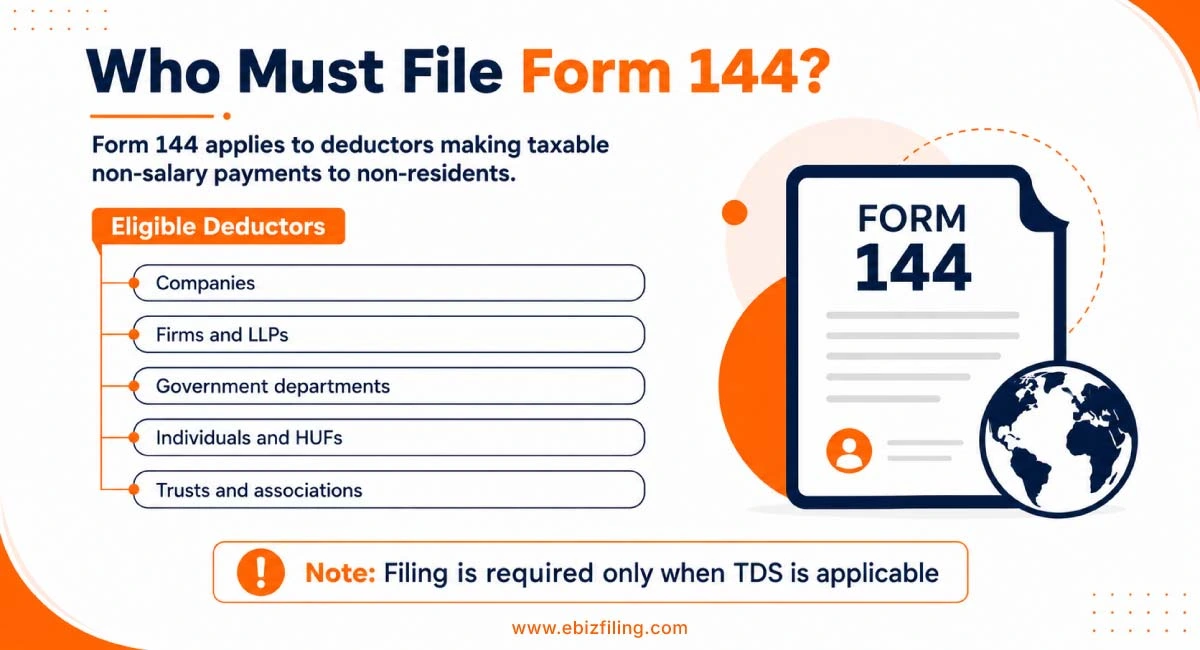
The deductor may be:
- A domestic or foreign company
- A partnership firm or LLP
- A government department
- An individual or HUF
- A trust, association, or other entity
The filing requirement depends on whether TDS is deductible from the payment. Merely making a payment to a non-resident does not automatically determine the reporting obligation. The nature of payment, tax provisions, applicable treaty and available documents may also need to be reviewed.
Form 144 Filing Due Date
The Form 144 due date depends on the quarter in which TDS was deducted.
|
Quarter |
Reporting period |
Due date |
|
Q1 |
April to June | 31 July of the financial year |
| Q2 | July to September |
31 October of the financial year |
|
Q3 |
October to December | 31 January of the financial year |
| Q4 | January to March |
31 May of the following financial year |
These quarterly deadlines are confirmed in the official Form 144 user manual.
Before completing the Form 144 filing, the deductor should verify that the TDS payment has been deposited and that the challan, PAN, payment and deductee details match the underlying records.
Documents and Details Required For Form 144 Filing
The following information should normally be kept ready:
- Valid TAN of the deductor
- PAN of the non-resident deductee, where available
- Deductee’s name and address
- Country of residence
- Payment date and amount
- Nature of income
- TDS rate and amount deducted
- Challan identification details
- Tax Residency Certificate and supporting treaty documents, where DTAA benefits or a lower treaty rate are claimed
- Supporting invoice, agreement, or remittance records
The official filing requirements include a valid TAN registered on the e-Filing portal, the latest Return Preparation Utility and a valid FVU file. A registered DSC is also required where the deductor chooses DSC-based verification.
How to Complete Form 144 Filing Online
The following process can be followed for Form 144 filing online:
- Visit the Protean portal and download the latest Return Preparation Utility.
- Enter the deductor, deductee, payment, challan and TDS details.
- Validate the statement and resolve any errors.
- Generate the FVU file using the applicable utility.
- Convert the validated FVU file into a ZIP file.
- Log in to the Income Tax e-Filing portal using the deductor’s TAN.
- Go to e-File > Income Tax Forms > File Income Tax Forms.
- Select the category for TDS and TCS forms under the Income-tax Act, 2025.
- Select Form 144, the applicable tax year, quarter, and upload type.
- Upload the ZIP file and complete e-verification.
The FVU version used for preparing the return must match the version displayed on the e-Filing portal. A version mismatch can result in rejection.
Time Limit for Filing a Correction Statement
A Form 144 correction statement must be filed within two years from the end of the tax year in which the original statement was required to be delivered.
For example, a correction statement relating to Q1 of Tax Year 2026-27 may be filed up to 31 March 2029.
Deductors should not wait until the end of this period. Errors should be corrected as soon as they are identified so that the deductee receives the correct TDS credit.
How to Check the Status of Form 144?
After submission, the deductor can check whether the statement has been accepted or rejected through the e-Filing portal.
Go to:
e-File > Income Tax Forms > View Filed Forms
The portal displays the status after validating the uploaded FVU file. If validation is successful, the form is accepted and forwarded to TRACES for further processing. If validation fails, the statement is rejected, and the reason is communicated to the registered email address.
Common reasons for rejection include:
- Wrong tax year selection
- Duplicate filing for the same quarter
- Incorrect FVU version
- TAN mismatch
- Uploading a correction file as a regular statement
- Incorrect reference number in a correction statement
The View Filed Forms service also allows registered users to access acknowledgements, submitted forms, attachments and filing status.
Penalties for Delayed or Incorrect Filing
Delayed or inaccurate Form 144 filing may result in:
- Late filing fee under Section 427: A fee of ₹200 for every day of delay may apply. However, the total fee cannot exceed the amount of tax deductible or collectible.
- Penalty under Section 461: The Assessing Officer may impose a penalty ranging from ₹10,000 to ₹1,00,000 for delayed filing or furnishing incorrect information in the statement.
- Penalty under Section 465(2)(k): A penalty of ₹500 for every day during which the failure to submit the statement continues, subject to the applicable statutory limit.
- Delay or mismatch in the TDS credit available to the non-resident deductee.
- Complaints or reconciliation issues raised by the deductee.
- Additional compliance work for filing correction statements.
A penalty under Section 461 for delayed or non-filing may not apply if the deducted tax, applicable fee and interest have been paid and the statement is filed within one month from the prescribed due date, subject to the conditions of the section.
The deductor should carefully verify the PAN, payment amount, TDS rate, tax deposited and challan details before submitting Form 144.
Complete Form 144 Filing Support by Ebizfiling
Applicability Review: Our team checks whether TDS provisions apply to non-salary payments made to non-residents.
Data Verification: PAN, TAN, challan, payment and deductee details are reviewed before preparing the return.
Return Preparation: We assist with preparing the quarterly statement in the prescribed electronic format.
FVU Validation: The return file is validated to identify errors, mismatches or missing information before submission.
Need help with Form 144 filing? Ebizfiling can assist with applicability review, return preparation, FVU validation, filing, and correction support.
Conclusion
Form 144 filing is required for quarterly reporting of TDS deducted from non-salary payments made to non-residents. Deductors must verify the applicable tax provision, PAN, challan, payment and TDS details before submitting the statement. Following the prescribed quarterly deadlines and checking the filing status can help prevent rejection, tax-credit mismatch, and non-compliance.
Frequently Asked Questions
1. Is Form 144 required when no tax is deductible from a payment to a non-resident?
Form 144 filing is generally required only when tax is deductible from a non-salary payment made or credited to a non-resident. If no TDS obligation arises, the deductor should review the applicable tax provision and supporting documents before deciding that no statement is required.
2. Does Form 144 apply to payments made to foreign companies?
Yes. Form 144 for non-residents may cover reportable payments made to foreign companies, NRIs and other non-resident persons. The filing requirement depends on whether tax is deductible from the nature of the payment involved.
3. Can one Form 144 include payments made to multiple non-residents?
Yes. A quarterly TDS statement can contain details of multiple non-resident deductees for the same quarter. Each deductee’s PAN, payment, TDS and challan details must be reported accurately.
4. Is Form 144 required separately for every quarter?
Yes. Non-resident TDS filing is completed quarter-wise. A separate Form 144 may be required for each quarter in which reportable TDS transactions are made.
5. Can Form 144 be filed if the non-resident does not have a PAN?
The payment may still need to be reported, but the applicable TDS rate and reporting requirements should be checked carefully. The deductor should verify whether any alternative information, prescribed documentation or higher deduction rate applies.
6. What happens if the wrong challan is linked to Form 144?
An incorrect challan can result in a tax-payment mismatch, rejection, or short-deduction demand. The deductor may need to submit a Form 144 correction statement after the original return has been processed.
7. Is Form 144 the complete replacement for Form 27Q?
Form 144 is the corresponding Form 27Q replacement under the Income-tax Act, 2025. It applies to transactions governed by the new Act from 1 April 2026, while statements and corrections relating to earlier periods continue under the previous framework.
8. Can Form 144 be revised after receiving the acknowledgement?
A filed statement cannot be edited directly. Errors in PAN, challan, payment, TDS amount or deductee details must be corrected through a correction statement after the original filing is processed.
9. Can Ebizfiling assist with both regular and correction Form 144 returns?
Yes. Ebizfiling can assist with data verification, statement preparation, FVU validation, online submission and correction filing. Businesses may also explore our Online TDS Return Filing service for support with quarterly TDS compliance.
10. Does Form 144 filing remove the need for Form 145 and Form 146?
No. Form 144 is used to report TDS deducted from non-salary payments made to non-residents. Form 145, which corresponds to the earlier Form 15CA, may apply separately when specified payments are remitted to a non-resident or foreign company. Form 146, earlier known as Form 15CB, is a certificate issued by a Chartered Accountant in specified cases. The requirement to file these forms depends on the nature, amount, and taxability of the foreign remittance.





File Income Tax Return
Get professional assistance with accurate Income Tax Return filing and stay compliant with applicable tax requirements.
About Ebizfiling -



October 13, 2026 By Srishti M
October 12, 2026 By Srishti M
October 12, 2026 By Srishti M
Company Compliance Calendar November 2026: Key Due Dates & Filings Introduction The Company Compliance Calendar November 2026 highlights important annual return, dematerialisation and income tax compliances that companies may need to complete during the month. November 2026 is particularly […]