


-
August 10, 2026
-
BySteffy A
Form 140 Filing: Due Dates, Documents and Process
Introduction
Form 140 filing is a quarterly TDS compliance requirement for persons who deduct tax from specified non-salary payments made to resident deductees. Form No. 140 replaces Form No. 26Q under the Income tax Rules, 2026 and applies to quarterly TDS statements under the Income tax Act, 2025 framework for Tax Year 2026-27 onwards. It reports TDS deducted from payments such as interest, commission, brokerage, rent, professional fees, contractual payments and other specified payments. Accurate and timely filing helps deductors report TDS correctly and enables deductees to receive the corresponding tax credit.
What Is Form 140?
Form No. 140 is a quarterly statement of tax deducted at source on payments made to resident deductees other than salary. It is filed under Section 397(3)(b) of the Income tax Act, 2025 and Rule 219(1) [Table: Sl. No. 3] of the Income tax Rules, 2026.
The form records the details of the deductor, the person responsible for deducting tax, the tax deposited with the Central Government and the deductee-wise breakup of payments and TDS. Form 140 filing is therefore an important part of quarterly TDS compliance for businesses and other deductors.
Under the earlier law, Form 26Q was filed under Section 200(3) of the Income tax Act, 1961 and Rule 31A of the Income tax Rules, 1962. The reporting purpose is broadly similar, but the form number, legal references, and terminology have changed.
|
Particular |
Earlier provision |
New provision |
|
TDS return form |
Form 26Q | Form 140 |
| Applicable payments | Resident non-salary payments |
Resident non-salary payments |
|
Governing Act |
Income tax Act, 1961 | Income tax Act, 2025 |
| Governing section | Section 200(3) |
Section 397(3)(b) |
|
Governing rule |
Rule 31A | Rule 219(1), Table Sl. No. 3 |
| Filing period terminology | Financial Year/Assessment Year |
Tax Year |
|
Correction reference |
Token/acknowledgement number |
Return Receipt Number |
Who Should File Form 140?
Every person responsible for deducting TDS from a specified non-salary payment made to a resident may be required to file Form No. 140. This can include:
- Companies and limited liability partnerships
- Partnership firms
- Government departments
- Trusts and institutions
- Individuals and Hindu Undivided Families where TDS provisions apply
- Other persons making specified payments to residents
Form No. 140 is not used for salary TDS. It may cover interest, commission, brokerage, rent, contractor payments, professional or technical fees, director remuneration, dividends and other payments covered by the applicable TDS provisions.
The obligation depends on the payment, threshold, and status of the parties. Transactions specifically reportable through Form 141 are excluded from Form 140.
Form 140 Filing Due Dates
Form No. 140 must be filed for every applicable quarter.
|
Quarter |
Period Covered |
Filing Due Date |
|
Q1 |
April to June | 31 July |
| Q2 | July to September |
31 October |
|
Q3 |
October to December | 31 January |
| Q4 | January to March |
31 May of the following year |
Deductors should verify whether the Income Tax Department has granted an extension for a particular quarter. Delay in filing may attract a fee of ₹200 per day under Section 427, limited to the amount of tax deductible or collectible. A separate penalty may also apply under the applicable provisions of the Income tax Act, 2025, subject to the conditions and relief provided under that section. Interest applies separately where TDS is deducted or deposited late.
Structure of Form No. 140
Form No. 140 contains Part A, Part B and a deductee-wise annexure.
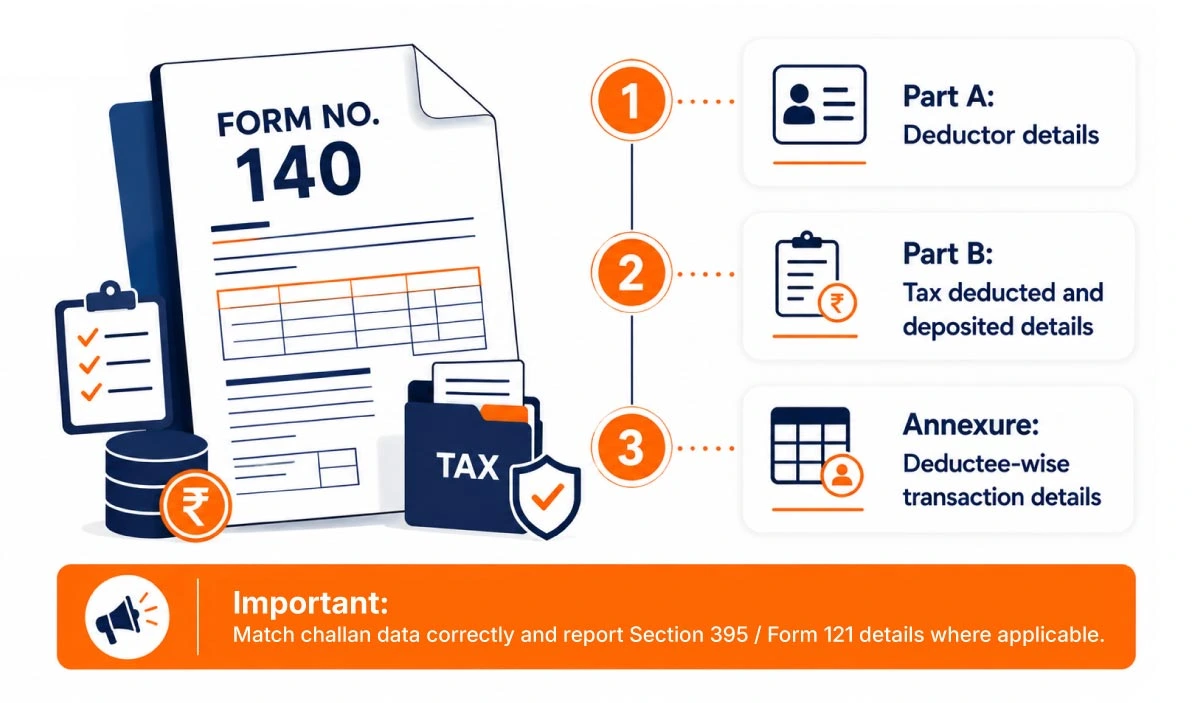
Part A: Deductor Details
Part A records basic information about the deductor, including:
- Type of deductor
- Name and address
- PAN and TAN
- Email address and contact number
- Applicable Tax Year
It also captures the details of the person responsible for deducting tax. In the case of a correction statement, the Return Receipt Number (RRR) of the original statement may be required.
Part B: Tax Deducted and Deposited
Part B contains details of the tax deducted and paid to the Central Government. These details may include:
- Total tax deposited
- Interest and fee paid
- Mode of payment
- BSR code
- Date of deposit
- Challan serial number
- Minor head
- Book adjustment details, where applicable
The challan information should match the amounts reported in the deductee records. A mismatch can result in a processing default or rejection.
Annexure: Deductee-Wise Details
The annexure contains transaction-level information for each deductee, including:
- PAN and name of the deductee
- Applicable section code
- Amount paid or credited
- Date of payment or credit
- Date of TDS deduction
- Applicable TDS rate
- Tax deducted and deposited
- Reason for nil, lower or higher deduction
Where applicable, the deductor may also need to provide the certificate number under Section 395 or the UIN of Form No. 121. The form uses a single annexure for deductee-level reporting across applicable sections.
Documents Required for Form 140 Filing
The deductor should keep the following documents and information ready:
- Valid TAN and PAN of the deductor
- PAN and name of every deductee
- Copies of TDS payment challans
- BSR code and challan serial number
- Date of payment or credit
- Date of TDS deduction and deposit
- Nature and amount of each payment
- Applicable TDS section code and rate
- Lower or nil deduction certificate details
- Interest, fee or default payment details
- Return Receipt Number (RRR) for a correction statement
The deductor’s TAN must be registered on the income tax e-Filing portal. A registered Digital Signature Certificate is also required when DSC is selected as the verification method. The latest RPU and a valid FVU file are also required for online submission.
Form 140 Filing Process
1. Deduct and Deposit TDS: Deduct tax at the time prescribed under the applicable TDS provision. Deposit the deducted amount with the Central Government within the timeline prescribed under Rule 218 of the Income tax Rules, 2026.
2. Download the Latest RPU: Visit the Protean portal and download the latest Return Preparation Utility for quarterly TDS statements. An outdated utility may cause validation or upload errors.
3. Prepare the TDS Statement: Enter the deductor, challan and deductee details in the RPU. Verify the PAN, section code, payment amount, deduction date, TDS rate and tax deposited for every transaction.
4. Validate the Statement: Validate the prepared statement through the File Validation Utility. After successful validation, generate the FVU file and place it in the prescribed ZIP format for uploading.
5. Upload Form No. 140: Log in to the income tax e-Filing portal using the deductor’s TAN.
Go to:
e-File – Income Tax Forms – File Income Tax Forms – Forms as per Income Tax Act, 2025 – Deduction and Collection at Source (Form TDS/TCS) – File Now
Select the category for deduction and collection at source. Choose Form No. 140, the applicable Tax Year, quarter, and upload type, such as regular or correction.
Upload the ZIP file containing the validated FVU file. The FVU version should match the version displayed on the e-Filing portal.
6. Verify and Submit: Select the applicable verification method and complete e-verification. The submitted statement can be checked under the “View Filed Forms” section.
When validation is successful, the statement is accepted and sent to TRACES for further processing. If it is rejected, the portal displays the rejection reason. The deductor must correct the error, generate a fresh FVU file and complete Form 140 filing again.
Reasons for Form 140 Rejection
A statement may be rejected because of:
- Selection of the wrong Tax Year
- Filing more than one regular statement for the same quarter
- Mismatch in the FVU version
- Uploading a correction file as a regular statement
- Uploading a regular file as a correction statement
- TAN in the FVU file not matching the logged-in TAN
- Incorrect Return Receipt Number (RRR)
- Invalid deductee or transaction details
The deductor should correct the reported error before generating and uploading a fresh validated file.
Get Professional Support for Form 140 Filing
Ebizfiling helps deductors prepare and file quarterly TDS statements accurately and on time. Our team reviews deductee details, PAN information, section codes and challan records before submission.
We can assist with:
- TDS calculation and reconciliation
- RPU preparation and FVU validation
- Online Form 140 filing
- Correction statement filing
Need help with Form 140 filing? Get expert assistance from Ebizfiling for TDS reconciliation, FVU validation, online submission and correction filing.
Explore our online TDS return filing service and file your return accurately and on time.
Conclusion
Form 140 filing is the quarterly reporting requirement for TDS deducted from specified non-salary payments made to resident deductees. It replaces Form 26Q under the Income tax Act, 2025 framework. Deductors should reconcile challans, verify PAN and TAN details, select the correct section codes and use the latest RPU and FVU versions. They should also distinguish between delays in depositing TDS and delays in filing the quarterly statement, as separate consequences may apply. Accurate and timely filing reduces the risk of rejection, correction statements, processing defaults and delayed TDS credit for deductees.
Frequently Asked Questions
1. Can salary and non-salary TDS be reported together in Form No. 140?
No. Form No. 140 is a non-salary TDS return used for specified payments made to resident deductees. Salary-related TDS must be reported through the form prescribed separately for salary payments.
2. Is Form No. 140 applicable to payments made to non-residents?
No. Form No. 140 applies to specified non-salary payments made to resident deductees. TDS deducted from payments made to non-residents must be reported through the applicable TDS statement prescribed for non-resident payments.
3. Is a separate annexure required for every TDS section in Form No. 140?
No. Form No. 140 contains a single deductee-wise annexure that can report transactions covered under different applicable TDS sections. The correct section code must be entered against every deductee transaction.
4. What is the Return Receipt Number (RRR) in the Form 140 filing process?
The Return Receipt Number (RRR) is the acknowledgement reference generated for the original TDS statement. It replaces the earlier Token Number and may be required when a deductor submits a correction statement.
5. Can Form 140 filing be completed with an older RPU or FVU version?
Using an outdated Return Preparation Utility or File Validation Utility may cause validation or upload errors. Deductors should use the latest RPU and FVU version prescribed for the relevant Tax Year and quarter.
6. What happens when the challan amount does not match the deductee details?
A challan mismatch can result in rejection, processing defaults, or incorrect allocation of the tax deposited. The deductor should reconcile the BSR code, challan serial number, deposit date and TDS amount before submitting the quarterly TDS return.
7. When should certificate details under Section 395 be reported?
Certificate details under Section 395 should be reported where tax has been deducted at a lower rate or not deducted based on a valid certificate. The relevant certificate number must be entered in the deductee-wise annexure.
8. When is the UIN of Form No. 121 required in Form No. 140?
The UIN of Form 121 must be reported where the deductee has submitted a valid Form 121 declaration and TDS has not been deducted on the relevant payment. The deductor should verify the PAN, UIN and declaration details before filing Form No. 140.
9. Can Ebizfiling help if a filed Form 140 contains an error?
Yes. Ebizfiling can review the filed statement, rejection reason, deductee details, challan records, PAN information and Return Receipt Number. If a regular Form 140 filing is rejected, the error can be corrected and the statement can be filed again. Ebizfiling can assist with correction filing once the facility becomes available.
10. Does Ebizfiling provide complete support for Form 140 filing?
Yes. Ebizfiling can assist with TDS reconciliation, Form 140 documents required, RPU preparation, FVU validation, online submission and correction filing. This helps deductors complete the Form 140 filing process accurately and within the applicable due date.





Stay Compliant with TDS Returns
Simplify TDS Return filing with professional assistance for accurate reporting and timely tax compliance.
About Ebizfiling -



October 12, 2026 By Srishti M
October 12, 2026 By Srishti M
Company Compliance Calendar November 2026: Key Due Dates & Filings Introduction The Company Compliance Calendar November 2026 highlights important annual return, dematerialisation and income tax compliances that companies may need to complete during the month. November 2026 is particularly […]
October 10, 2026 By Srishti M