
-
September 22, 2026
-
BySteffy A
Form 104 under the Income Tax Act: Registration and Filing Guide
Introduction
Form 104 under the Income Tax Act helps newly established non-profit organizations apply for provisional registration or approval before commencing their charitable or religious activities. Introduced under the Income Tax Act, 2025, it replaces Form 10A under the Income Tax Act, 1961 and provides a streamlined online application process. In this blog, you’ll learn what Form 104 under the Income Tax Act, 2025 is, who can apply, its purpose, eligibility, required documents, the online filing process, key timelines, the differences between Form 104 and Form 10A, and how Ebizfiling can assist with the registration process.
Purpose of Form 104 under the Income Tax Act, 2025
Form 104 helps newly established non-profit organizations obtain provisional registration or approval before they begin their activities. This allows eligible organizations to meet legal requirements and access the applicable tax benefits under the Income Tax Act, 2025. Form 104 replaces Form 10A under the Income Tax Act, 1961 and serves as a single electronic application for newly formed charitable trusts, societies, Section 8 companies, and certain specified funds.
Form 104 is filed for the following purposes:
- To obtain provisional registration under Section 332(3) and claim tax benefits available to registered non-profit organizations.
- To obtain provisional approval under Section 354(2) so that donations received by eligible organizations qualify for tax deduction in the hands of donors under Section 133(1)(b)(ii).
- To simplify the registration process through a single online application with fewer documentation requirements and faster processing.
This form is specifically intended for organizations whose charitable or religious activities have not yet commenced. Once approved, the Income Tax Department issues Form 106 along with a Unique Registration Number (URN) confirming the provisional registration or approval.
Form 104 under the Income Tax Act vs Form 10A: Key Differences
|
Particulars |
Form 10A under the Income Tax Act, 1961 |
Form 104 under the Income Tax Act, 2025 |
|
Applicable Law |
Income Tax Act, 1961 |
Income Tax Act, 2025 |
|
Purpose |
Application for registration, re-registration, or provisional registration of charitable or religious institutions and approval under Section 80G |
Application for provisional registration or provisional approval for eligible non-profit organizations under the new Act |
|
Applicable Sections |
Sections 12A, 12AB, and 80G |
Sections 332 and 354 |
|
Who Can Apply? |
Charitable trusts, societies, Section 8 companies, religious institutions, and other eligible entities |
Newly formed charitable trusts, societies, Section 8 companies, specified funds, and other eligible non-profit organizations whose activities have not commenced |
|
Mode of Filing |
Online through the Income Tax e-Filing portal |
Online through the Income Tax e-Filing portal |
|
Registration Certificate Issued |
Registration/approval certificate under the Income Tax Act, 1961 |
Form 106 along with a 16-digit Unique Registration Number (URN) |
|
Current Status |
Applicable under the Income Tax Act, 1961 |
Replaces Form 10A under the Income Tax Act, 2025 for provisional registration and provisional approval |
Learn more about Society Registration in India, including its eligibility, registration process, required documents, and legal compliance.
Who Should File Form 104 under the Income Tax Act, 2025?
Form 104 is meant for non-profit organizations (NPOs) seeking provisional registration or provisional approval before commencing their charitable or religious activities. It can be filed by:
- Non-profit organizations seeking provisional registration under Section 332(3), provided they have not commenced activities and have not been registered under the specified provisions of the Income Tax Act, 1961 or the Income Tax Act, 2025.
- Registered non-profit organizations, regimental funds, or non-public funds established by the Armed Forces seeking provisional approval under Section 354(2), so that donations received become eligible for tax deduction for donors.
Read our detailed guide on Trust Registration to understand the registration process, eligibility, required documents, and legal requirements in India.
Documents Required for Form 104 Registration
Before starting the Form 104 registration process, it is advisable to keep the following documents ready to avoid delays during online filing:
- PAN of the organisation.
- Trust Deed, Memorandum of Association (MOA), Articles of Association (AOA), or other governing documents.
- Registration or incorporation certificate.
- FCRA registration certificate, if applicable.
- Self-certified financial statements for up to the previous three tax years, if applicable.
- A brief note on the proposed charitable or religious activities.
- Copies of any previous rejection or cancellation orders, if applicable.
Key Timelines and Validity of Form 104
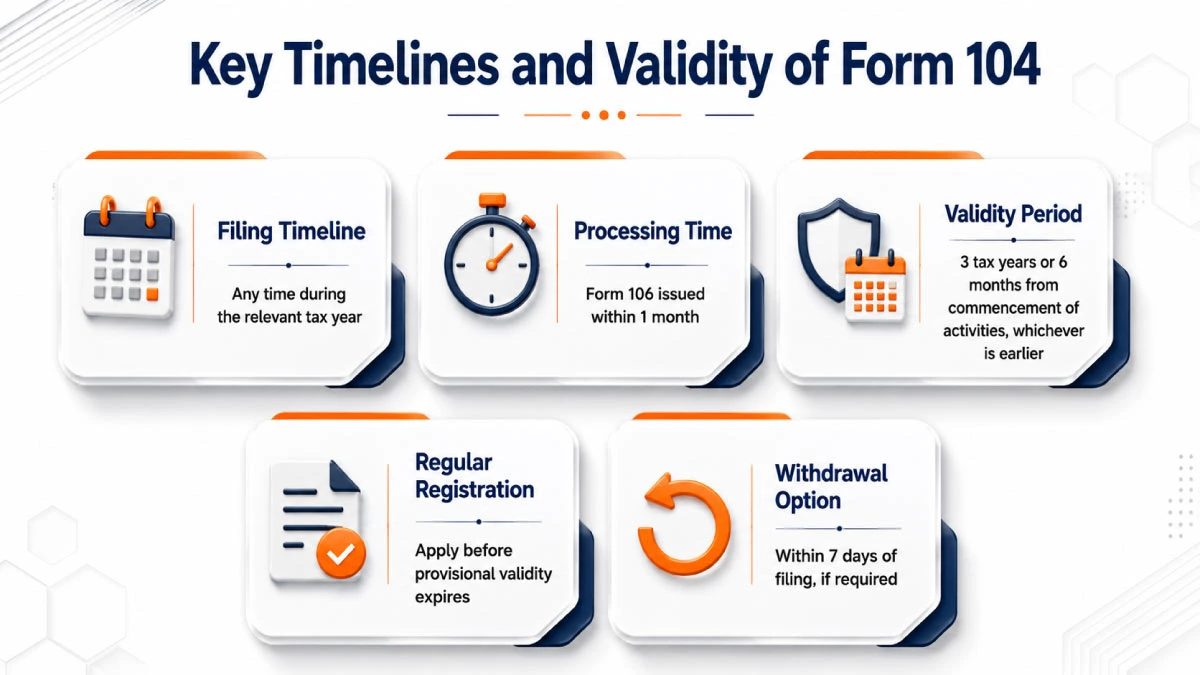
- Filing Timeline: Form 104 can be filed at any time during the tax year from which provisional registration or approval is sought.
- Processing Time: The Commissioner of Income Tax (CPC) is required to pass an order in Form 106 within one month from the end of the month in which Form 104 is filed.
- Validity: The provisional registration or approval remains valid for three tax years or up to six months from the commencement of activities, whichever is earlier.
- Re-registration: Organizations must apply for regular registration or approval before the provisional validity expires to continue enjoying tax benefits.
- Withdrawal: If an error is identified after submission, Form 104 can be withdrawn within seven days from the date of filing.
How to Complete Form 104 Online Filing?
- Log in to the Income Tax e-Filing Portal using your registered credentials.
- Navigate to e-File > Income Tax Forms > File Income Tax Forms.
- Select Form 104 and choose the relevant assessment year from the drop-down menu.
- Select Prepare and Submit Online as the filing mode.
- Complete the form by providing all the required details and uploading the prescribed supporting documents.
- Verify and submit the application using a Digital Signature Certificate (DSC) or Electronic Verification Code (EVC), as applicable.
Ebizfiling Assistance for Form 104 Filing
Preparing and filing Form 104 requires selecting the correct registration category, arranging supporting documents, and complying with the applicable provisions of the Income Tax Act, 2025.
Ebizfiling supports organizations by:
- Evaluating eligibility for provisional registration or approval.
- Reviewing trust deeds, MOA, AOA, registration certificates, and other necessary documents.
- Preparing and submitting Form 104 through the Income Tax e-Filing Portal.
- Reviewing all details before submission to reduce errors and avoid delays.
- Assisting with responses to notices or clarification requests from the Income Tax Department.
- Providing complete support until Form 106 and the Unique Registration Number (URN) are issued.
After obtaining provisional registration, organizations must continue to meet annual compliance requirements. Ebizfiling also assists with Annual Filing for Trust to help ensure ongoing compliance.
Conclusion
Form 104 under the Income Tax Act provides a simpler way for newly established non-profit organizations to obtain provisional registration before beginning their activities. Submitting Form 104 accurately along with the required documents helps avoid unnecessary delays and facilitates the timely issuance of Form 106 and the Unique Registration Number (URN).
Suggested Reads:
Changes in Section 12A and 80G
Documents Required for Sectionn 12A and 80G registration
All About Section 12AB and 80G Registration
Frequently Asked Questions
1. Can Form 104 under the Income Tax Act, 2025 be filed more than once by the same organization?
No. Form 104 is intended for obtaining provisional registration or provisional approval before commencing charitable or religious activities. Once provisional registration has been granted, the organization must apply for regular registration within the prescribed time instead of filing a fresh Form 104.
2. What happens if incorrect information is provided during Form 104 filing?
Providing incorrect or misleading information during Form 104 filing may result in rejection of the application or cancellation of the provisional registration or approval. Applicants should ensure that all supporting documents and declarations are complete and accurate before submission.
3. Is a Permanent Account Number (PAN) mandatory for Form 104 registration?
Yes. A valid PAN of the applicant organization is required for Form 104 registration. The Income Tax e-Filing portal does not process the application without the PAN details of the applicant entity.
4. Can foreign-funded NGOs apply through Form 104?
Yes, provided they satisfy the eligibility conditions under the Income Tax Act, 2025. If the organization is registered under the Foreign Contribution (Regulation) Act (FCRA), the relevant registration details should also be furnished while completing the Form 104 registration process.
5. Does Form 104 automatically provide tax exemption to an organization?
Form 104 helps eligible organizations obtain provisional registration or approval. To continue claiming tax-related benefits, the organization must comply with the applicable provisions of the Income Tax Act, 2025.
6. Can an application be edited after Form 104 online filing is completed?
Once Form 104 online filing has been successfully submitted, the application cannot be edited. If an error is identified, the applicant may withdraw the application within the prescribed time limit and file a fresh application, if eligible.
7. Is there any government fee payable for Form 104 filing?
The Income Tax Department does not prescribe a separate government filing fee specifically for Form 104 filing. However, organizations may incur professional service charges if they engage consultants for preparing and submitting the application.
8. Is Form 106 issued immediately after approval of Form 104 under the Income Tax Act?
No. After verification of the application, the Income Tax Department issues Form 106 Income Tax along with a 16-digit Unique Registration Number (URN). Form 106 is issued only after the competent authority approves the application.
9. Can Ebizfiling help organizations avoid common errors in Form 104 registration?
Yes. Ebizfiling assists organizations by reviewing eligibility, verifying supporting documents, and preparing the application before submission. This helps minimise errors that could otherwise delay or affect the Form 104 registration process.
10. Why should organizations seek professional assistance for Form 104 under the Income Tax Act, 2025?
Professional assistance from Ebizfiling helps applicants select the correct registration category, prepare accurate documentation, and complete the Form 104 registration process while reducing filing errors and unnecessary delays.




Build Your Non-Profit with Confidence
Whether you're forming a trust, society, or Section 8 company, our experts make the registration process simple, fast, and compliant.
About Ebizfiling -



October 21, 2026 By Srishti M
Tax Planning for NRI Returning to India Before Becoming ROR Introduction Tax planning for NRI returning to India should start before the person becomes Resident and Ordinarily Resident, also known as ROR. Under the Income-tax Act, 2025, residential status decides […]
October 19, 2026 By Srishti M
October 21, 2026 By Srishti M
TDS and TCS Compliance Calendar November 2026: Compliance Guide Introduction The TDS and TCS Compliance Calendar November 2026 covers important tax deduction, collection, payment, certificate and reporting requirements applicable during the month. It helps businesses, government offices and other responsible […]