

-
August 13, 2026
-
BySteffy A
Section 80GGC Deduction: Eligibility, Limit and ITR Filing
Introduction
Section 80GGC deduction allows eligible taxpayers to claim a tax deduction on donations made to registered political parties or electoral trusts through non-cash modes. Until FY 2025-26, this benefit was governed by Section 80GGC of the Income-tax Act, 1961. From April 1, 2026, the corresponding provision is Section 137 of the Income-tax Act, 2025. The deduction is subject to prescribed conditions, including the taxpayer’s applicable tax regime.
What is Section 80GGC deduction?
Section 80GGC of the Income-tax Act, 1961 allows eligible taxpayers to claim a deduction for contributions made to:
- A political party registered under Section 29A of the Representation of the People Act, 1951
- An eligible electoral trust
The section applies to eligible persons other than local authorities and artificial juridical persons that are wholly or partly funded by the government. Indian companies generally claim a deduction for eligible political contributions under Section 80GGB. From Tax Year 2026-27 onwards, the corresponding provision for Indian companies is Section 136 of the Income-tax Act, 2025.
The deduction applies to the amount contributed through a non-cash payment method. Taxpayers should note that donations to charitable institutions are governed separately under Section 80G of the Income Tax Act.
Important Update Under the Income-tax Act, 2025
The Income-tax Act, 2025, came into force on April 1, 2026 and replaced the Income-tax Act, 1961 for income earned from Tax Year 2026-27 onwards. Matters relating to FY 2025-26, including returns filed for AY 2026-27, continue to be governed by the Income-tax Act, 1961.
Under the new law:
Section 80GGC has been replaced by Section 137.
Section 80GGB for company contributions has been replaced by Section 136.
The essential conditions remain similar, including the requirement that the contribution must not be made in cash.
Section 137 permits eligible taxpayers, other than excluded entities, to claim a deduction for non-cash contributions made to registered political parties or electoral trusts.
Therefore, an updated article should refer to both provisions:
- Section 80GGC: Applicable to FY 2025-26 and earlier periods
- Section 137: Applicable from Tax Year 2026-27 onwards
Eligibility Criteria for Section 80GGC Tax Deduction
Section 80GGC deduction is not restricted only to individual taxpayers. Subject to the applicable provisions, it allows eligible assessees to claim a deduction for qualifying contributions made to a registered political party or an electoral trust.
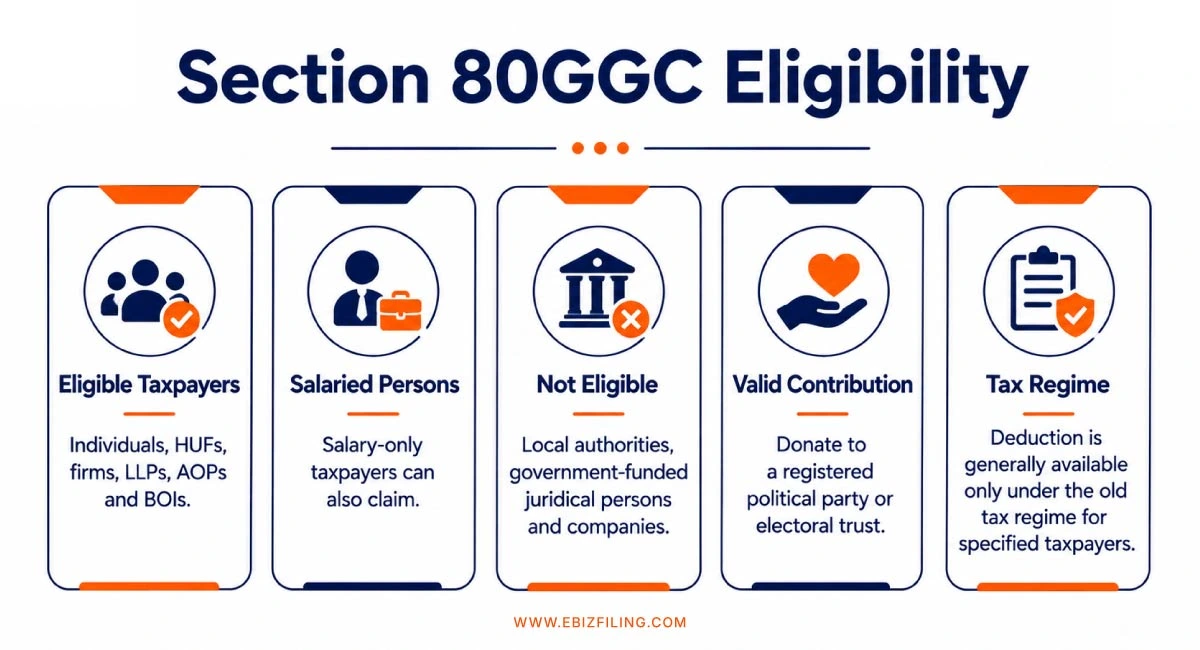
The following taxpayers may claim the deduction:
- Individuals, including salaried and self-employed individuals
- Hindu Undivided Families
- Partnership firms
- Limited Liability Partnerships
- Associations of Persons
- Bodies of Individuals
- Other eligible non-company taxpayers
Partnership firms, LLPs, AOPs and BOIs should also review the applicable requirements for Form ITR-5 filing.
A salaried employee can claim the deduction even when salary is the only source of income. Having business or professional income is not a requirement.
However, the following taxpayers cannot claim the Section 80GGC deduction:
- A local authority
- An artificial juridical person wholly or partly funded by the government
- An Indian company claiming a deduction for an eligible political contribution, as Indian companies are specifically covered under Section 80GGB. From Tax Year 2026-27 onwards, the corresponding provision is Section 136 of the Income-tax Act, 2025.
The contribution must be made to a political party registered under Section 29A of the Representation of the People Act, 1951, or to an eligible electoral trust.
For FY 2025-26 and earlier, individuals, HUFs, AOPs, BOIs and specified artificial juridical persons covered by Section 115BAC generally cannot claim the Section 80GGC deduction under the default new tax regime. They must opt for the old tax regime to claim it. From Tax Year 2026-27 onwards, the corresponding new tax regime is governed by Section 202 of the Income-tax Act, 2025, under which the Section 137 deduction is generally not available. This restriction does not apply in the same manner to partnership firms and LLPs.
Important Points About Political Party Donations Under Section 80GGC
Section 80GGC allows eligible taxpayers to claim a deduction for contributions made to registered political parties or electoral trusts. The following points must be considered:
Eligible Donations
The contribution must be made to:
- A political party registered under Section 29A of the Representation of the People Act, 1951
- An eligible electoral trust
A direct donation to an individual election candidate or an unregistered political organization does not qualify under this section.
Payment Methods
The donation must be made through a traceable non-cash method, such as:
- Account payee cheque
- Demand draft
- NEFT
- RTGS
- IMPS
- UPI
- Debit card
- Credit card
- Internet banking
No deduction is available for a contribution made in cash, irrespective of whether the amount is below or above ₹2,000. The ₹2,000 cash limit applicable to certain charitable donations under Section 80G does not apply to Section 80GGC. Under Section 80GGC, every cash contribution is ineligible.
Deduction Limit
Section 80GGC does not prescribe a separate maximum deduction limit of ₹20,000.
An eligible taxpayer may generally claim the full amount of the qualifying contribution. However, deductions under Chapter VI-A cannot create a loss or exceed the taxpayer’s gross total income.
For example, if an eligible taxpayer contributes ₹50,000 through a bank transfer to a registered political party, the taxpayer may claim the full ₹50,000, subject to the applicable tax regime and other provisions of the Income-tax Act.
Documents Required
Form 10BB is not required for claiming a deduction under Section 80GGC. Form 10BB is an audit report applicable to certain trusts, institutions, universities, educational institutions, and hospitals. It is not a declaration form for political donations made by taxpayers.
The taxpayer should obtain and retain:
- A donation receipt issued by the political party or electoral trust
- The name and PAN of the political party or electoral trust
- The contribution amount and payment date
- The payment method
- The cheque number, UTR number or transaction reference
- A bank statement showing the payment
- Registration details of the political party, where available
The receipt should ideally include the donor’s name, the amount contributed, the payment date, the payment method, the recipient’s details and the signature of an authorised person.
Disclosure in the Income Tax Return
The contribution must be reported in the relevant Section 80GGC schedule of the applicable ITR form.
The Income Tax Department requires taxpayers claiming the deduction to provide additional information, including the name and PAN of the political party.
How to Claim the Section 80GGC Deduction
Verify the Recipient: Confirm that the donation is made to a registered political party or eligible electoral trust.
Choose the Tax Regime: For FY 2025-26 and earlier, taxpayers covered by Section 115BAC should opt for the old tax regime to claim Section 80GGC deduction. From Tax Year 2026-27 onwards, taxpayers covered by Section 202 should opt out of the default new tax regime to claim the corresponding deduction under Section 137. Taxpayers should check the provisions applicable to them.
Make a Non-Cash Payment: Pay through cheque, demand draft, bank transfer, UPI, card, or another electronic method. Cash donations are not eligible.
Obtain a Receipt: Collect a receipt containing the donor’s name, recipient’s name and PAN, amount, date, payment mode, and transaction reference.
Claim in the ITR: Enter the contribution details in Schedule 80GGC or the relevant deduction section of the applicable ITR form.
Keep Supporting Proof: Retain the receipt and payment evidence. These documents are not normally attached to the ITR but may be required for verification.
Professional ITR Filing Assistance
Claiming the Section 80GGC deduction requires accurate reporting of the donation, recipient details, payment method, and applicable tax regime.
How Ebizfiling Helps
- Selects the appropriate ITR form
- Checks eligibility for the deduction
- Reports political donation details correctly
- Calculates taxable income accurately
- Assists with return filing and e-verification
- Provides post-filing support when required
Ebizfiling’s Income Tax Return Filing service helps taxpayers claim eligible deductions correctly and avoid errors while reporting political donations in the ITR.
Conclusion
Section 80GGC allows eligible taxpayers to claim a deduction for genuine, non-cash contributions made to registered political parties or electoral trusts. There is no separate ₹20,000 deduction limit, and every cash contribution is ineligible. Taxpayers should select the correct tax regime, verify the political party’s registration, obtain a complete receipt, and retain banking evidence. For income earned from April 1, 2026 onwards, taxpayers should refer to Section 137 of the Income-tax Act, 2025 instead of Section 80GGC.
Frequently Asked Questions
1. Can a taxpayer claim a Section 80GGC deduction for donations made to multiple political parties?
Yes. A taxpayer may claim the deduction for eligible non-cash contributions made to more than one registered political party or electoral trust. Separate receipts and payment records should be retained for each donation.
2. Does a donation made directly to an election candidate qualify?
No. A direct donation to an individual candidate does not qualify for a political party donation tax deduction. The contribution must be made to a registered political party or an eligible electoral trust.
3. Is a UPI payment eligible for the deduction?
Yes. A UPI payment may qualify because it is a traceable non-cash method. The taxpayer should retain the payment reference, donation receipt, contribution amount, and recipient details.
4. Can the deduction be claimed if the donation receipt is lost?
The claim may be difficult to support without a valid receipt. The taxpayer should request a duplicate receipt or written acknowledgment from the political party or electoral trust before filing the return.
5. Is there a fixed Section 80GGC deduction limit?
No. There is no separate ₹20,000 limit. Eligible non-cash contributions may generally qualify for a 100% deduction, subject to the taxpayer’s gross total income and other applicable provisions.
6. Can a cash donation below ₹2,000 be claimed?
No. Every cash contribution is ineligible, regardless of the amount. The ₹2,000 cash limit applicable to certain charitable donations under Section 80G does not apply here.
7. Can an Indian company claim a Section 80GGC deduction?
Eligible Indian companies generally claim a deduction for qualifying political contributions under Section 80GGB rather than Section 80GGC. From Tax Year 2026-27 onwards, the corresponding provision is Section 136 of the Income-tax Act, 2025.
8. What changes under Section 137 of the Income-tax Act?
Section 137 of the Income-tax Act, 2025 is the corresponding provision applicable from Tax Year 2026-27 onwards. It covers eligible non-cash contributions made to registered political parties or electoral trusts.
9. How can Ebizfiling help report a political donation in the ITR?
Ebizfiling can help taxpayers select the correct ITR form, verify eligibility, report the recipient’s PAN and donation details, and claim the Section 80GGC deduction accurately.
10. Can the Section 80GGC deduction be claimed under the new tax regime?
No. Taxpayers under the default new tax regime generally cannot claim this deduction. From Tax Year 2026-27, the corresponding deduction is available under Section 137, subject to the applicable tax regime. Ebizfiling can help taxpayers check eligibility and choose the correct tax regime.





File Income Tax Returns
Filing of Income Tax return is necessary if you have earned any income. File your ITR with EbizFiling at INR 1199/- only.
About Ebizfiling -



Reviews
Devang Panchal
09 Sep 2018They helped me with my company’s name change and I was quite satisfied with the way they served me. I am surely coming back to you in case of any compliance problem.
Hemang Malhotra
08 Oct 2018I was new as an Entrepreneur when I had seen their post on social media. I contacted them regarding proprietorship and realized they their pricing is incomparable in the market also their services are really prompt. Thank you, Ebizfiling.
Nayanshree Barsaiyan
08 Jul 2019My requirement was fulfilled on time. the customer care response is very prompt.
October 14, 2026 By Srishti M
September 29, 2026 By Srishti M
Income Tax Compliance Calendar October 2026: Filing Guide Introduction The Income Tax Compliance Calendar October 2026 highlights important income tax obligations applicable to taxpayers, businesses and entities covered under audit and transfer pricing provisions. October 2026 includes key compliance […]
September 25, 2026 By Steffy A