


-
July 6, 2026
-
BySteffy A
GST LUT for Export of Goods: A Complete Compliance Guide
Introduction
GST LUT for Export of Goods is an important compliance mechanism that allows eligible exporters to undertake exports without paying Integrated Goods and Services Tax (IGST). For many exporters, paying IGST on exports and then waiting for a refund can result in blockage of working capital and affect business cash flow.
To address this issue, the Goods and Services Tax (GST) law permits eligible exporters to furnish a Letter of Undertaking (LUT) and export goods without payment of IGST. Understanding the eligibility criteria, filing process, validity, and compliance requirements of GST LUT for Export of Goods is essential for businesses engaged in international trade.
What is GST LUT for Export of Goods?
A Letter of Undertaking (LUT) is a declaration furnished by an eligible registered person under Rule 96A of the CGST Rules, 2017. It enables exporters to export goods or services, or make supplies to Special Economic Zone (SEZ) units or developers, without payment of IGST.
Exports and supplies to SEZ units or developers are treated as zero-rated supplies under Section 16 of the IGST Act, 2017. Instead of paying tax at the time of export and subsequently claiming a refund, eligible businesses can furnish an LUT and undertake exports without upfront tax payment.
GST LUT for Export of Goods helps businesses simplify export transactions, improve liquidity, and reduce the financial burden associated with the refund process. If you are new to LUT compliance, you may also read our detailed guide on LUT under GST to understand its purpose, eligibility, and legal framework before proceeding with export transactions.
Why is GST LUT for Export of Goods Important?
GST LUT for Export of Goods provides exporters with a practical way to undertake exports without paying IGST. By avoiding upfront tax payment, businesses can preserve liquidity and reduce working capital blockage.
Some key advantages include:
- Export goods without payment of IGST.
- Avoid waiting for GST refund processing.
- Improve cash flow management.
- Reduce working capital requirements.
- Simplify export-related GST compliance.
- Minimize administrative efforts associated with refund claims.
For businesses that regularly export goods, the LUT route is often considered more convenient than paying IGST and claiming a refund later. Businesses evaluating different export tax options should also understand the differences between GST LUT vs Bond and determine which mechanism is more suitable for their export operations.
One of the major advantages of filing LUT is improved cash flow management and simplified GST reporting. Explore the complete benefits of using GST LUT for filing GST returns to understand its practical advantages for exporters.
Who is Eligible to Furnish GST LUT?
Any registered person intending to export goods or services or make supplies to an SEZ unit or developer without payment of IGST may furnish an LUT, subject to GST provisions.
The facility is commonly used by:
- Exporters of goods.
- Exporters of services.
- Suppliers to SEZ units.
- Suppliers to SEZ developers.
GST LUT for Export of Goods enables eligible exporters to undertake zero-rated supplies without the burden of upfront tax payment.
Conditions for Using GST LUT for Export of Goods
Businesses opting to export under LUT must comply with certain prescribed conditions under GST law.
Export of Goods
Goods should generally be exported within three months from the date of issue of the export invoice or within such extended period as may be permitted by the Commissioner under Rule 96A of the CGST Rules, 2017.
Export of Services
In the case of export of services, payment for the services should generally be received in convertible foreign exchange or in Indian Rupees wherever permitted by the Reserve Bank of India, within the prescribed period under applicable regulations.
Compliance Requirements
Exporters must:
- Maintain proper export documentation.
- Comply with applicable GST provisions.
- File GST returns within prescribed timelines.
- Retain records supporting export transactions.
Failure to comply with prescribed conditions may require payment of the applicable tax along with interest in accordance with GST provisions. Exporters should also understand how GST LUT affects invoicing and accounting to ensure accurate record keeping and seamless GST compliance.
Documents Required for GST LUT for Export of Goods
While filing an LUT, exporters should keep the following information readily available:
- GST Identification Number (GSTIN).
- Legal name and business details.
- Authorized signatory details.
- Details of two witnesses.
- Digital Signature Certificate (DSC) or Electronic Verification Code (EVC), as applicable.
In addition, exporters should maintain supporting export-related records such as export invoices, shipping bills, and other documentation required under GST and customs laws.
Providing accurate information helps ensure smooth processing of GST LUT for Export of Goods. Before filing an LUT application, exporters can review a detailed GST LUT exporters checklist to ensure all required information and supporting documents are readily available.
Step-by-Step GST LUT Filing Process
GST LUT filing is completed online through the GST portal.
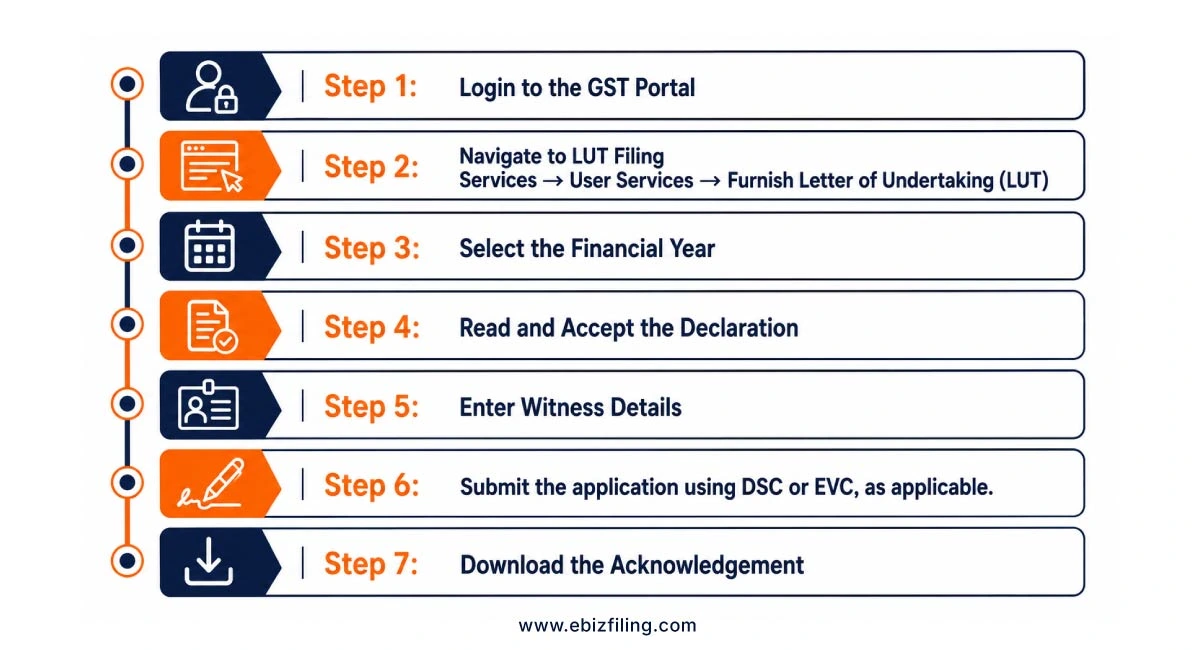
After successful submission, an Application Reference Number (ARN) and acknowledgement are generated. Exporters should download and retain the acknowledgement for future reference. The filing process for GST LUT for Export of Goods is simple and can generally be completed online within a short period.
Exporters should also verify that their GST registration details are accurate before filing. Learn how to use GST LUT to verify GSTIN and avoid filing errors during the application process.
GST LUT Validity and Renewal
A GST LUT is valid for one financial year. Therefore, exporters who wish to continue exporting without payment of IGST must furnish a fresh LUT at the beginning of each financial year.
Timely renewal is important to avoid disruptions in export activities and ensure uninterrupted compliance with GST requirements. Businesses using GST LUT for Export of Goods should monitor renewal timelines to avoid compliance-related issues.
Timely filing and renewal of LUT can significantly reduce compliance burdens for exporters. Learn more about how LUT simplifies GST compliance for businesses engaged in regular export activities.
GST LUT for Export of Goods vs IGST Refund Route
Exporters generally have two options for undertaking exports under GST.
|
Particulars |
LUT Route |
IGST Refund Route |
|
Payment of IGST at the Time of Export |
Not required | Required |
| Requirement to Claim Refund | No refund of IGST required |
Refund application/process required |
|
Working Capital Blockage |
Minimal | Higher until refund is received |
| Cash Flow Impact | Better liquidity management |
Funds remain blocked until refund is processed |
|
Export Process |
Export can be undertaken without paying IGST | Export can be undertaken after payment of IGST |
| Compliance Requirement | Furnishing and annual renewal of LUT |
Payment of IGST and compliance with refund procedures |
|
Refund Dependency |
Not dependent on refund of IGST | Dependent on successful refund processing |
| Documentation Requirement | LUT acknowledgement and export documents |
Export documents and refund-related records |
|
Suitability |
Businesses seeking better cash flow and lower working capital blockage | Businesses comfortable paying IGST and claiming refunds later |
| Administrative Effort | Comparatively lower |
Comparatively higher due to refund procedures |
|
Popularity Among Exporters |
Commonly preferred by regular exporters | Generally chosen based on specific business requirements |
| Impact on Export Operations | Faster access to working capital |
Potential delay in fund availability due to refund processing |
Businesses engaged in GST LUT for Export of Goods should assess their cash flow requirements, administrative capacity, and operational needs before selecting the most suitable export route.
Exporters often compare the LUT route with the refund mechanism to identify the most efficient option for their business. Read our detailed comparison of LUT vs IGST Refund– Which is Better? for a deeper understanding of both approaches.
Mistakes to Avoid While Using GST LUT for Export of Goods
Many exporters face compliance issues due to avoidable errors. Some common mistakes include:
- Failure to renew LUT for the relevant financial year.
- Incorrect witness details in the application.
- Failure to maintain export documentation.
- Non-compliance with prescribed export timelines.
- Errors in GST return reporting.
- Failure to retain LUT acknowledgement and supporting records.
Avoiding these mistakes can help ensure smooth export operations and reduce the risk of compliance-related issues.
Simplify GST LUT for Export of Goods Compliance with Ebizfiling
Managing GST LUT for Export of Goods involves more than simply furnishing an application. Exporters must also ensure timely renewal, accurate GST reporting, proper documentation, and ongoing compliance with export-related provisions.
Ebizfiling assists businesses with:
- GST Registration
- GST LUT Filing
- GST LUT Renewal
- Import Export Code (IEC) Registration
- GST Return Filing
- GST Refund Assistance
- End-to-End GST Compliance Support
Whether you are a first-time exporter or an established business looking to streamline export operations, our experts can help simplify compliance and reduce administrative burden.
Connect with Ebizfiling today and export with confidence while we take care of your GST compliance requirements.
Conclusion
GST LUT for Export of Goods is a valuable facility that allows eligible exporters to undertake exports without payment of IGST. By eliminating the requirement for upfront tax payment, it helps businesses improve cash flow and avoid delays associated with the refund process.
Understanding the eligibility requirements, filing procedure, validity, and compliance obligations associated with GST LUT for Export of Goods is essential for exporters seeking seamless and compliant export operations. By furnishing LUT on time and adhering to GST provisions, businesses can focus on expanding their presence in global markets while ensuring regulatory compliance.
Frequently Asked Questions
1. Is LUT required for exporting goods without payment of IGST?
Yes. If exports are to be made without payment of IGST, a valid LUT must be filed on the GST portal for the relevant financial year. Without LUT, IGST will need to be paid first and later claimed as a refund.
2. What happens if LUT is not renewed before starting exports in a new financial year?
An expired LUT cannot be used for exports. In such cases, exports may need to be carried out on payment of IGST until a fresh LUT is furnished and accepted on the GST portal.
3. What if goods are not exported within the prescribed time under LUT?
If goods are not exported within the prescribed time limit (generally 3 months from the date of invoice), GST law may require payment of IGST along with applicable interest, unless an extension is granted by the authorities.
4. Can Input Tax Credit (ITC) still be claimed while exporting under LUT?
Yes. Export under LUT is treated as zero-rated supply, and eligible Input Tax Credit on inputs and input services can still be claimed, subject to GST provisions.
5. Is LUT required for every export shipment?
No. LUT is not shipment-specific. A single LUT filed for a financial year can be used for multiple export transactions during that period.
6. Can LUT be used for supplies to SEZ units or developers?
Yes. LUT is applicable not only for export of goods or services but also for supplies made to SEZ units or SEZ developers without payment of IGST.
7. What are the common errors exporters make while using LUT?
Common issues include failure to renew LUT, mismatch between GST returns and shipping bills, incorrect invoice details, and non-compliance with export timelines, which can lead to delays in refunds or compliance notices.
8. Why is matching GST and shipping bill data important under LUT?
Consistency between GST returns and customs records is essential. Any mismatch in invoice details, value, or GSTIN may result in delays in refund processing or additional scrutiny.
9. How does Ebizfiling assist with GST LUT compliance?
Ebizfiling provides end-to-end support for LUT filing, renewal, and GST compliance. Assistance is provided to ensure accurate filing and smooth export operations without compliance-related delays.
10. Does Ebizfiling also support other export-related GST compliance work?
Yes. Support is also provided for GST registration, Import Export Code (IEC) registration, GST return filing, and GST refund-related assistance for exporters.





Letter of Undertaking under GST
All registered tax payers who export the goods or services have to furnish Letter of Undertaking (LUT) in GST RFD-11. File with Ebizfiling.
About Ebizfiling -



Reviews
Aditya Dufare
24 Aug 2021Prompt service.They value your time. Professional and experienced staff to guide you. offer services at very competitive price. I would like to continue with them in future. must try.
Ashrith Akkana
19 Apr 2022I took import export certificate from the ebizfiling. They have done the work on time.. Thank you for making my import export certificate in time 😊
Ishwar Prasad
18 Apr 2022I took trade mark registration from Ebizfiling india private limited thank you for registration and service was excellent and received the certificate from Anitha KV.
August 29, 2026 By Steffy A
GST Compliance Calendar September 2026: Key Due Dates & Filings Introduction The GST Compliance Calendar for September 2026 provides a clear overview of the applicable deadlines, filing requirements and taxpayer categories. September 2026 includes several important GST return filing and […]
August 26, 2026 By Steffy A
GST Compliance Calendar August 2026: Key Due Dates & Filings Introduction The GST Compliance Calendar August 2026 provides a comprehensive overview of the important GST due dates that taxpayers should keep track of during the month. In this blog, you […]
June 22, 2026 By Steffy A
GST Compliance Calendar July 2026: Key Due Dates & Filings Introduction The GST Compliance Calendar July 2026 provides a complete list of important GST due dates that taxpayers should keep track of during the month. In this blog, you will […]