

-
July 25, 2026
-
BySteffy A
Section 206C of the Income tax Act, 1961: TCS Rules and Updates
Introduction
Section 206C of the Income-tax Act, 1961 governed Tax Collected at Source, commonly known as TCS, for transactions covered under the earlier income-tax law. It required specified sellers and other persons to collect tax from buyers on transactions involving scrap, timber, tendu leaves, minerals, motor vehicles, notified luxury goods, foreign remittances and overseas tour packages.
This blog explains the earlier applicability of Section 206C, its transaction-specific provisions, the omission of Section 206C(1H) and the compliance requirements applicable to periods up to 31 March 2026.
What Is Section 206C of the Income Tax Act?
Section 206C of the Income tax Act required tax to be collected from the buyer at a prescribed rate on specified transactions. The seller or collector had to:
- Collect TCS from the buyer;
- Deposit the amount with the Central Government;
- File the prescribed TCS statement;
- Issue a TCS certificate to the buyer; and
- Quote the correct PAN and TAN in the relevant records.
Businesses responsible for collecting TCS must obtain and quote a valid TAN. Eligible applicants can use Ebizfiling’s TAN Application Online service.
The applicable rate, threshold, and time of collection depended on the nature of the transaction.
Section 206C governed TCS under the earlier law. For the current rates, exemptions, and compliance rules applicable from 1 April 2026, read our detailed guide on Section 394 of the Income Tax Act, 2025.
Important Update on Section 206C(1H)
Section 206C(1H) earlier required eligible sellers to collect TCS at 0.1% on sale consideration exceeding ₹50 lakh received from a buyer during a financial year. It generally applied where the seller’s business turnover exceeded ₹10 crore in the immediately preceding financial year.
However, the Finance Act, 2025 inserted a proviso stating that Section 206C(1H) would not apply from 1 April 2025. Therefore, sellers were no longer required to collect TCS under this sub-section for sales made on or after that date. TDS under Section 194Q continued to apply to eligible buyers, subject to its prescribed conditions.
To understand how these provisions interacted before the omission, read our comparison of Section 194Q and Section 206C(1H).
Transactions Covered Under Section 206C
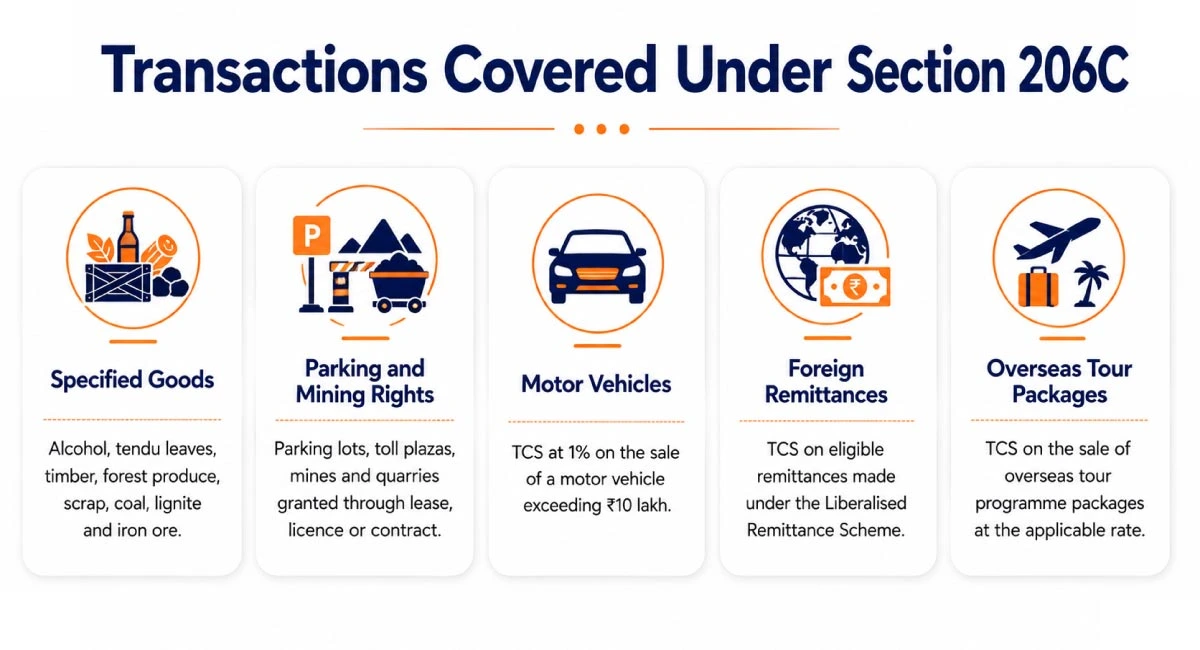
Section 206C of the Income tax Act, 1961 covered several transactions through its different sub-sections.
Sale of Specified Goods
TCS applied to the sale of goods such as:
- Alcoholic liquor for human consumption;
- Tendu leaves;
- Timber;
- Eligible forest produce;
- Scrap; and
- Minerals such as coal, lignite, and iron ore.
Parking Lots, Toll Plazas and Mining
A person granting a lease, licence or contract relating to a parking lot, toll plaza, mine or quarry was generally required to collect TCS at the prescribed rate.
Sale of Motor Vehicles and Notified Luxury Goods
TCS at 1% applied where the sale value of a motor vehicle exceeded ₹10 lakh. The tax was generally collected when the seller received the consideration from the buyer.
Foreign Remittances
Authorised dealers were required to collect TCS on qualifying remittances made under the Liberalised Remittance Scheme.
The applicable rate depended on the purpose of the remittance, the amount remitted, and whether the payment related to education, medical treatment, or another purpose.
For purpose-wise thresholds and rates under the earlier framework, read our guide on TCS on foreign remittances under LRS.
Overseas Tour Programme Packages
A seller of an overseas tour programme package was also required to collect TCS. The prescribed rate depended on the transaction value and the law applicable during the relevant financial year.
Sale of Motor Vehicles and Notified Luxury Goods
TCS at 1% applied where the value of an individual motor vehicle or notified luxury item exceeded ₹10 lakh. From 22 April 2025, the notified goods included wristwatches, art pieces, collectibles, yachts, boats, helicopters, sunglasses, handbags, shoes, specified sportswear and equipment, home theatre systems, and horses used for racing or polo. TCS was generally collected when the seller received the consideration.
Exemption for Manufacturing or Processing
A resident buyer could obtain specified goods without TCS where the goods were purchased for:
- Manufacturing;
- Processing;
- Producing articles or things; or
- Generating power.
This exemption was not available when the goods were purchased for trading.
The buyer had to provide the prescribed declaration to the seller stating that the goods would be used for an eligible purpose. The seller was then required to submit the declaration to the prescribed income tax authority within the applicable time.
Merely operating a manufacturing business did not automatically provide an exemption. The declaration and other statutory conditions had to be satisfied.
Lower TCS Certificate
A buyer, licensee or lessee could apply in Form 13 for a lower TCS certificate in eligible cases covered under Section 206C(1) or Section 206C(1C). A lower-rate certificate was not available for motor vehicles or notified goods under Section 206C(1F), or for foreign remittances and overseas tour packages under Section 206C(1G).
Time of TCS Collection
For specified goods, TCS was generally collected at the earlier of:
- Debiting the amount payable by the buyer; or
- Receiving the payment from the buyer.
Different collection rules applied to transactions such as motor vehicles, overseas tour packages and foreign remittances.
TCS Deposit and Return Filing
After collecting TCS, a non-government collector was generally required to deposit the amount with the Central Government within seven days from the end of the month in which the tax was collected.
The quarterly TCS statement was filed in Form 27EQ under the Income-tax Rules applicable to the Income tax Act, 1961.
|
Quarter |
Period |
Due date |
|
Quarter 1 |
1 April to 30 June | 15 July |
| Quarter 2 | 1 July to 30 September |
15 October |
|
Quarter 3 |
1 October to 31 December | 15 January |
| Quarter 4 | 1 January to 31 March |
15 May |
The collector was also required to issue the prescribed TCS certificate to the buyer. The buyer should verify whether the TCS credit appears correctly in the tax records.
The collector was required to issue the TCS certificate in Form 27D within 15 days from the due date for filing Form 27EQ. Accordingly, the general certificate due dates were 30 July, 30 October, 30 January and 30 May.
For deadlines applicable from FY 2026-27, refer to our TDS and TCS Compliance Calendar FY 2026-27.
Consequences of Non-Compliance
Failure to comply with Section 206C of the Income tax Act could result in the following consequences:
Failure to Collect TCS
A person who failed to collect TCS could be treated as an assessee in default. A penalty equal to the amount that should have been collected could also apply.
Interest
Interest could generally apply at:
- 1% per month or part of a month from the date TCS was collectible until the date it was actually collected; and
- 1.5% per month or part of a month from the date TCS was collected until the date it was deposited with the Central Government.
Late Filing Fee
A late filing fee of ₹200 per day could apply under Section 234E for delay in filing the TCS statement. The total fee could not exceed the amount of TCS required to be reported.
Penalty for TCS Statement Default
A penalty ranging from ₹10,000 to ₹1 lakh could apply for failure to file the prescribed statement or for furnishing an incorrect statement, subject to statutory conditions.
Serious failure to deposit tax already collected could also lead to prosecution.
Professional Support for TCS Compliance
Ebizfiling helps businesses manage their TCS requirements accurately and on time. Our experts can assist with:
- Checking TCS applicability, thresholds and rates;
- Calculating and depositing TCS within the due date;
- Filing quarterly TCS statements and issuing certificates; and
- Correcting previously filed returns and resolving TCS mismatches.
Conclusion
Section 206C of the Income Tax Act contained separate TCS requirements for specified goods, motor vehicles, notified luxury goods, leases, foreign remittances and overseas tour packages. Businesses should identify the exact transaction before determining the applicable threshold, rate, exemption, and reporting requirement.
Section 206C(1H), which earlier covered sale consideration exceeding ₹50 lakh, ceased to apply from 1 April 2025 after the Finance Act, 2025 inserted a specific proviso making the sub-section inapplicable from that date.
Frequently Asked Questions
1. Does Section 206C of the Income Tax Act apply to every sale of goods?
No. Section 206C of the Income Tax Act applied only to specified transactions, including the sale of scrap, timber, tendu leaves, certain minerals, motor vehicles, notified luxury goods above the prescribed value, foreign remittances and overseas tour packages.
2. Is the ₹10 crore turnover limit applicable to the entire Section 206C of the Income Tax Act?
No. The ₹10 crore seller-turnover condition was specifically connected with the former Section 206C(1H). It was not a general eligibility condition for TCS on scrap, timber, motor vehicles, foreign remittances or other specified transactions.
3. Is TCS applicable when sales to a buyer exceed ₹50 lakh?
Section 206C(1H) earlier required eligible sellers to collect TCS at 0.1% on sale consideration exceeding ₹50 lakh. However, the Finance Act, 2025 inserted a proviso making Section 206C(1H) inapplicable from 1 April 2025. Therefore, TCS is no longer collected under this sub-section for sales made on or after that date. Eligible buyers may still be required to deduct TDS under Section 194Q.
4. When is TCS collected on the sale of a motor vehicle?
TCS at 1% applied when the sale consideration of an individual motor vehicle exceeded ₹10 lakh. It was generally collected when the seller received the payment from the buyer.
5. Can a manufacturer purchase scrap or timber without TCS?
A resident buyer could claim exemption where specified goods were purchased for manufacturing, processing, production or power generation and not for trading. The buyer had to provide the prescribed declaration to the seller.
6. What TCS rate applied to timber and forest produce from 1 April 2025?
From 1 April 2025, TCS at 2% applied to timber or any other forest produce, other than tendu leaves, obtained under a forest lease. TCS at 2% also applied to timber obtained through any mode other than a forest lease. Tendu leaves continued to be covered separately at the applicable prescribed rate.
7. When was TCS collected under Section 206C of the Income Tax Act?
For specified goods, TCS was generally collected at the earlier of debiting the amount payable by the buyer or receiving payment. Different collection timings applied to motor vehicles, foreign remittances, and overseas tour packages.
8. Can a buyer apply for a lower TCS rate?
Yes. A buyer could apply to the Assessing Officer for a lower-rate certificate where the prescribed conditions were satisfied. Ebizfiling can help review the transaction and guide businesses on the documentation required for lower TCS compliance.
9. Which form was used for filing quarterly TCS statements?
Quarterly TCS statements under the Income-tax Act, 1961 were filed in Form 27EQ. Ebizfiling can assist businesses with TCS return filing, statement correction and related compliance within the applicable due dates.
10. Why was Section 206C(1H) omitted?
Section 206C(1H) ceased to apply from 1 April 2025 after the Finance Act, 2025 inserted a proviso making the sub-section inapplicable from that date. This removed the parallel TCS requirement on general sale of goods, while eligible buyers continued to deduct TDS under Section 194Q.





File Your GST Return
File error-free GST Return and in-time. Get your GST return filings done through experts ebizfiling.com. Prices start at INR 499/- only.
About Ebizfiling -



Reviews
Akshay Sharma
18 Apr 2022I took a TM service for my Tea Brand, wonderful service with humble staff, and provided solutions on time. Recommended for all
Animesh Garg
19 Nov 2021Highly professional team. Execution Manager Jayesh handled incorporation and post compliance of our foreign subsidiary to perfection in spite of lockdown hurdles. Anuja was our SPOC and they also provided full tax and accounting compliance retainer ship at reasonable charges. Highly recommend!
Devang Panchal
09 Sep 2018They helped me with my company’s name change and I was quite satisfied with the way they served me. I am surely coming back to you in case of any compliance problem.
September 18, 2026 By Srishti M
Professional Tax Registration Cancellation Process Explained Introduction Professional Tax is a state-level tax applicable to individuals and businesses engaged in professions, trades, callings, or employment, subject to the provisions prescribed under respective state laws. Businesses liable under applicable Professional Tax […]
September 19, 2026 By Srishti M
Defective Return Notice: Resolve Schedule BS & PL Errors Introduction Receiving a Defective Return Notice from the Income Tax Department means that the filed Income Tax Return (ITR) contains incomplete, inconsistent, or incorrect information that requires correction. Such notices are […]
September 19, 2026 By Srishti M
Section 87A Capital Gains in 2026: The Rs. 12 Lakh Trap Explained Introduction “No tax up to Rs. 12 lakh” is useful shorthand for the new tax regime, but it is not a blanket exemption. For AY 2026-27, an eligible […]