


-
July 23, 2026
-
BySteffy A
Section 196B of the Income Tax Act, 1961: TDS on Offshore Funds
Introduction
Section 196B of the Income Tax Act governed TDS on specified income paid to a qualifying Offshore Fund. It covered income from eligible units purchased in foreign currency and long-term capital gains arising from the transfer of those units. This provision did not apply to every non-resident or mutual fund investor. The recipient, investment arrangement, and units had to satisfy specific legal conditions.
From 1 April 2026, the taxation of such income is covered under Section 208 of the Income-tax Act, 2025. The corresponding TDS provisions are contained in Section 393(2), Table Serial Numbers 11 and 12.
This article explains the applicability, rates, deduction timing, compliance requirements and new-law mapping of Section 196B.
What is Section 196B of the Income Tax Act?
Section 196B of the Income Tax Act, 1961 required a person responsible for paying specified income to an Offshore Fund to deduct tax at source.
It covered:
- Income received in respect of eligible units purchased in foreign currency; and
- Long-term capital gains arising from the transfer of those units.
The eligible units included units of a mutual fund specified under Section 10(23D) of the old Act and units of the Unit Trust of India. The corresponding taxation provision was contained in Section 115AB.
From 1 April 2026:
- Section 208 governs the taxation of such income;
- Section 393(2), Table Serial Number 11 prescribes TDS at 10% on income from eligible units; and
- Section 393(2), Table Serial Number 12 prescribes TDS at 12.5% on long-term capital gains from the transfer of eligible units.
Applicability of Section 196B of the Income Tax Act
Section 196B applied only when all the prescribed conditions were satisfied.
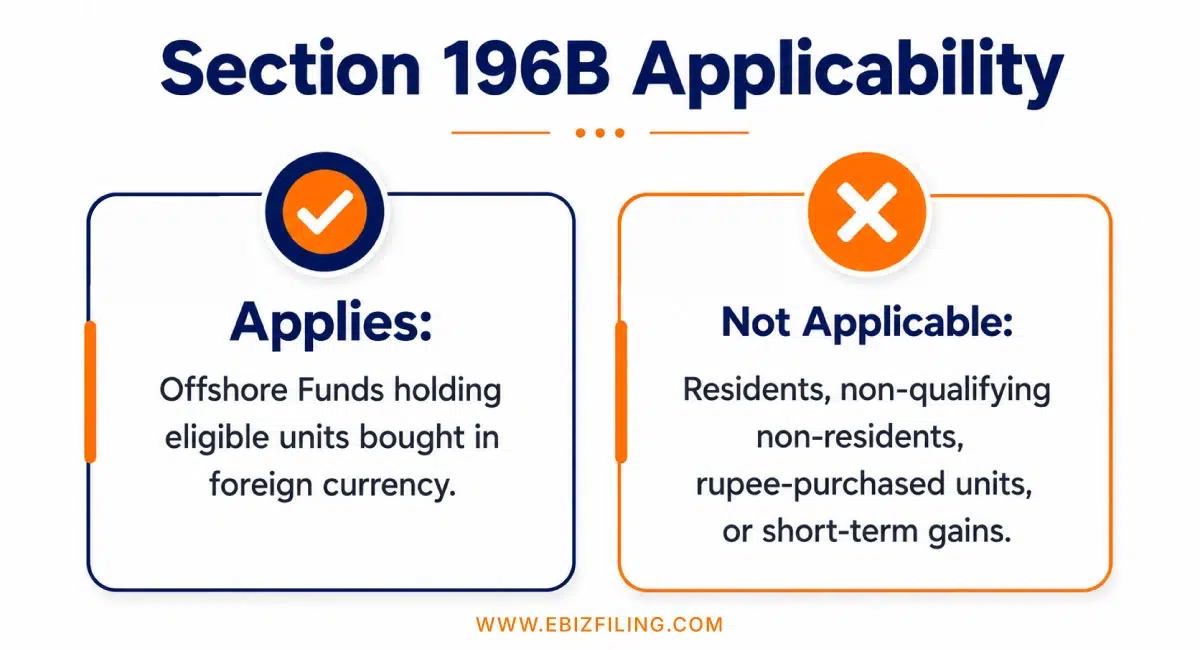
It applied where:
- The recipient qualified as an Offshore Fund;
- The relevant units were purchased in foreign currency;
- The payment represented income from eligible units; or
- The payment represented long-term capital gains from the transfer of those units.
Section 196B of the Income Tax Act did not apply to:
- Ordinary resident investors receiving mutual fund income;
- A non-resident who did not qualify as an Offshore Fund;
- Units purchased in Indian rupees;
- Short-term capital gains under this specific provision; or
- Payments that did not satisfy the conditions prescribed under Sections 115AB and 196B.
Merely being a non-resident, foreign company or overseas investor was not sufficient. An Offshore Fund was required to be a fund, institution, association or body established under the laws of a country outside India. It must also have entered into an arrangement for investment in India with a public sector bank, public financial institution or eligible mutual fund, and the arrangement must have been approved by SEBI.
Payments to non-residents may also attract other provisions depending on the nature of income. Read our guide on TDS on payments to non-residents for a broader understanding.
TDS Rates under Section 196B of the Income Tax Act
The applicable base rates are as follows:
|
Nature of income |
Applicable provision |
Applicable rate |
|
Income from eligible units purchased in foreign currency |
Section 196B read with Section 115AB | 10% |
| LTCG where the transfer occurred before 23 July 2024 | Section 196B read with Section 115AB |
10% |
|
LTCG where the transfer occurred on or after 23 July 2024 |
Section 196B read with Section 115AB | 12.5% |
| Income from eligible units from 1 April 2026 | Section 393(2), Table Serial Number 11, read with Section 208 |
10% |
|
LTCG from eligible units from 1 April 2026 |
Section 393(2), Table Serial Number 12, read with Section 208 |
12.5% |
Note: These are the statutory base rates. The deductor should also examine whether surcharge and Health and Education Cess apply based on the recipient’s legal status and the relevant rate provisions.
Before applying the domestic TDS rate, the payer should examine whether a more beneficial rate is available under an applicable Double Taxation Avoidance Agreement. The payer should also review the availability of a lower or nil deduction certificate under Section 395 and the higher TDS provisions under Section 397(2) for failure to furnish a valid PAN, subject to the applicable exceptions.
You can also refer to the TDS rates chart for FY 2026-27 for section-wise rates applicable to resident and non-resident payments.
Is there a threshold limit?
No specific monetary threshold is prescribed under Section 196B of the Income Tax Act or the corresponding entries under Section 393(2). Therefore, TDS may apply even when the payment amount is relatively small, provided all the conditions of the provision are satisfied.
Time of TDS Deduction
TDS must be deducted at the earlier of:
- The date on which the income is credited to the account of the Offshore Fund; or
- The date on which the payment is made through cash, cheque, draft, or any other mode.
Therefore, postponing the actual payment does not defer the TDS obligation when the income has already been credited to the Offshore Fund’s account.
Procedure for TDS Compliance
1. Verify the recipient’s status
The payer should verify whether the recipient satisfies the conditions of an Offshore Fund. Section 196B should not be applied merely because the recipient is a non-resident or foreign entity.
2. Verify the units
The payer should confirm that the payment relates to eligible units purchased in foreign currency.
3. Classify the income
The payment should be classified as:
- Income received in respect of eligible units; or
- Long-term capital gains arising from the transfer of those units.
This classification determines the applicable TDS rate.
4. Deduct tax at the correct rate
Tax should generally be deducted at:
- 10% on income from eligible units; or
- The applicable 10% or 12.5% rate on LTCG, depending on the date and law governing the transfer.
From 1 April 2026, the applicable LTCG TDS rate under Section 393(2), Table Serial Number 12 is 12.5%.
5. Deposit the deducted tax
For a deductor other than a government office, TDS must generally be deposited:
- On or before 30 April for tax deducted during March; and
- Within seven days from the end of the month in which tax was deducted for other months.
These timelines are prescribed under Rule 218 of the Income-tax Rules, 2026.
6. File the quarterly TDS statement
TDS deducted on payments to an Offshore Fund must generally be reported in Form 144. Form 144 replaces the earlier Form 27Q for non-salary payments made to non-residents.
7. Issue the TDS certificate
The deductor must issue the non-salary TDS certificate in Form 131.
Under Rule 215, Form 131 must generally be issued within 15 days from the due date for furnishing the applicable quarterly TDS statement under Rule 219.
8. Examine Form 145 and Form 146 requirements
The payer should separately examine whether information regarding the foreign remittance must be furnished in Form 145 under Rule 220.
Depending on the amount, taxability, and circumstances of the payment:
- Part A of Form 145 may apply where the remittance is taxable under the Act and the remittance or aggregate remittances during the tax year do not exceed ₹5 lakh;
- Part B may apply where the remittance is taxable, exceeds ₹5 lakh and an Assessing Officer’s certificate or order has been obtained;
- Part C may apply where the remittance is taxable, exceeds ₹5 lakh and an accountant’s certificate in Form 146 has been obtained; or
- Part D may apply where the remittance is not taxable under the Act, subject to the prescribed exclusions and conditions.
The applicable part should be selected after examining the taxability of the payment, the status of the Offshore Fund and the nature of the foreign remittance.
9. Maintain supporting records
The deductor should retain:
- Documents proving the recipient’s Offshore Fund status;
- Evidence that the units were purchased in foreign currency;
- The relevant SEBI-approved arrangement;
- Income or capital-gain calculations;
- Payment records and TDS challans;
- Form 144 acknowledgements;
- Form 131; and
- Form 145 and Form 146, where applicable.
Penalty for Non-Compliance
Failure to deduct or deposit TDS can result in interest, penalty and other legal consequences.
Under Section 398 of the Income-tax Act, 2025:
- Interest at 1% per month or part of a month may apply where tax was not deducted on time.
- Interest at 1.5% per month or part of a month may apply where tax was deducted but not deposited with the government on time.
- The deductor may also be treated as an assessee in default.
Under Section 448, the Assessing Officer may impose a penalty equal to the amount of tax that the person failed to deduct or pay, subject to the applicable provisions and circumstances of the case.
Defaults relating to periods before 1 April 2026 will continue to be examined under the relevant provisions of the Income-tax Act, 1961, including the applicable interest and penalty provisions.
Professional Support for Offshore Fund TDS Compliance
Correctly determining the applicability of TDS on foreign payments can be difficult because the deductor must examine the status of the recipient, nature of income, applicable rate and reporting requirements.
Ebizfiling can assist with:
- Reviewing the applicability of TDS on Offshore Fund payments;
- Identifying the appropriate TDS provision and rate;
- Supporting TDS payment and return filing;
- Assisting with Form 144 reporting;
- Supporting the issuance of Form 131; and
- Assisting with Form 145 filing for applicable foreign remittances.
Ebizfiling can assist with TDS return filing, transaction classification, Form 144 reporting and Form 145 filing for foreign remittances.
Conclusion
Section 196B of the Income Tax Act applied to income and long-term capital gains from eligible units paid to a qualifying Offshore Fund. The applicable rate was 10% on income from eligible units, while the LTCG rate was 10% or 12.5%, depending on the date of transfer.
From 1 April 2026, these provisions are governed by Section 208 and Section 393(2) of the Income-tax Act, 2025. The payer must verify the recipient’s eligibility, deduct and deposit tax at the correct rate, file Form 144, issue Form 131 and examine whether Form 145 or Form 146 is required.
Frequently Asked Questions
1. What conditions must be verified before applying Section 196B to a payment?
The payer must verify that the recipient qualifies as an Offshore Fund, the units were purchased in foreign currency, and the payment represents either income from those units or long-term capital gains from their transfer. The Offshore Fund must also satisfy the arrangement and SEBI-approval conditions prescribed under Section 208.
2. Are units purchased in Indian rupees covered under Section 196B of the Income Tax Act?
No. Section 196B of the Income Tax Act applied only to eligible units purchased in foreign currency. Units acquired in Indian rupees do not qualify merely because the investor is a non-resident or foreign entity.
3. How should the payer select the applicable TDS rate?
The rate depends on the nature of income and the date of the transaction. Income from eligible units is subject to a 10% rate. Under the old law, LTCG was subject to 10% for transfers before 23 July 2024 and 12.5% for transfers on or after that date. From 1 April 2026, Section 393(2), Table Serial Number 12 prescribes a 12.5% TDS rate on covered LTCG.
4. Does the 12.5% rate apply to short-term capital gains from eligible units?
No. Section 393(2), Table Serial Number 12 specifically covers long-term capital gains from units referred to in Section 208. Short-term capital gains are not covered by that entry and must be examined under the other applicable provisions and rates.
5. Does every non-resident mutual fund investor qualify as an Offshore Fund?
No. A non-resident individual, foreign company or overseas investor does not automatically qualify as an Offshore Fund. The recipient must satisfy the definition of an overseas financial organisation, including the prescribed investment arrangement and approval conditions.
6. Is any minimum payment threshold available under Section 196B of the Income Tax Act?
No specific monetary threshold is provided for income or long-term capital gains paid to an Offshore Fund under Section 393(2), Table Serial Numbers 11 and 12. Therefore, TDS may apply from the first eligible payment.
7. Can an Offshore Fund submit Form 121 to receive the income without TDS?
No. Form 121 corresponds to declarations under Section 393(6), but the declaration facility applies only to the persons and resident-payment provisions listed in that subsection. Payments to Offshore Funds under Section 393(2), Table Serial Numbers 11 and 12 are not included in that declaration mechanism.
8. When must TDS be deducted if the income is credited before it is actually paid?
TDS must be deducted at the earlier of credit to the Offshore Fund’s account or actual payment through cash, cheque, draft or any other mode. Therefore, crediting the amount before payment can itself trigger the TDS obligation.
9. Which TDS forms apply to Offshore Fund payments from 1 April 2026?
The deduction must generally be reported in Form 144, which replaces Form 27Q for non-salary payments made to non-residents. The deductor must issue Form 131 as the TDS certificate. Form 145 and an accountant’s certificate in Form 146 may also be required for the remittance, depending on the amount, chargeability and circumstances of the payment.
10. What records should be maintained to support Section 196B applicability during assessment?
The deductor should retain documents establishing the recipient’s Offshore Fund status, proof that the units were purchased in foreign currency, the SEBI-approved investment arrangement, income or capital-gain computation, payment records, TDS challans, Form 144 acknowledgements and the issued Form 131. Ebizfiling can review these records and help identify reporting or deduction mismatches before a notice or compliance proceeding arises.





File TDS Returns
Quickly file error-free TDS Returns with EbizFiling. This ensures seamless credit to the deductee. Prices Starting INR 999/-.
About Ebizfiling -



Reviews
Akshay shinde
23 Apr 2019Excellent service…
Deepanker Gautam
25 Jan 2019Excellent service by your team really like your service a lot specifically client handling is too good and special credit to my manager Dhwani mam you have given your best thank you so much for your kindness and supporting beahavior. I will surely give reference for your company.
Jitendra Nawrange
09 Aug 2019I am very happy that I am connected to your company. I have liked the service of your company, which provides me the right time for every information. Thank you very much to all your employees. I will always be connected to your company and will tell everyone about your company. thank you ebiz team.
September 29, 2026 By Srishti M
Income Tax Compliance Calendar October 2026: Filing Guide Introduction The Income Tax Compliance Calendar October 2026 highlights important income tax obligations applicable to taxpayers, businesses and entities covered under audit and transfer pricing provisions. October 2026 includes key compliance […]
September 25, 2026 By Steffy A
September 18, 2026 By Srishti M
Professional Tax Registration Cancellation Process Explained Introduction Professional Tax is a state-level tax applicable to individuals and businesses engaged in professions, trades, callings, or employment, subject to the provisions prescribed under respective state laws. Businesses liable under applicable Professional Tax […]