


-
June 20, 2026
-
BySteffy A
NRI Business Setup in India 2026: Everything You Need to Know
Introduction
NRI Business Setup in India has gained significant popularity as the country continues to attract global investment and entrepreneurial talent. As one of the world’s fastest-growing major economies, India offers numerous opportunities for Non-Resident Indians looking to start a business, expand overseas operations, or invest in emerging sectors.
The Indian government allows NRIs to establish and invest in various business structures, subject to compliance with the Foreign Exchange Management Act (FEMA), RBI regulations, the Companies Act, 2013, and applicable tax laws. Whether you are planning to launch a startup, establish a technology company, start a consulting firm, or enter the manufacturing sector, understanding the legal and regulatory requirements is essential for a successful business venture.
In this guide, we will explain the eligibility criteria, business structures, registration process, compliance requirements, and key considerations involved in NRI Business Setup in India.
What is NRI Business Setup?
NRI Business Setup refers to the process through which a Non-Resident Indian establishes, invests in, or operates a business entity in India. NRIs can either start a new business independently, invest in an existing company, or form a joint venture with Indian residents or other investors.
The structure chosen for NRI Business Setup depends on factors such as business objectives, ownership requirements, funding plans, regulatory compliance, and future expansion goals.
India allows NRI investments in most sectors under the automatic route, meaning prior government approval is generally not required unless the business falls under a restricted or regulated sector.
A foreign national can register a company in India without having an Indian partner without an Indian shareholder, provided the company complies with FDI regulations and appoints at least one resident director as required under the Companies Act, 2013.
Who Qualifies as an NRI?
For the purpose of NRI Business Setup, an NRI generally refers to an Indian citizen residing outside India as per FEMA regulations.
The following individuals may typically establish or invest in businesses in India:
- Non-Resident Indians (NRIs)
- Overseas Citizens of India (OCIs)
- Persons of Indian Origin (PIOs) where applicable under current regulations
- Foreign nationals, subject to foreign investment rules
Before proceeding with the setup, it is advisable to determine your residential status and applicable FEMA provisions.
Can an NRI Start a Business in India?
Yes. NRIs are generally permitted to start businesses in India and may:
- Incorporate a Private Limited Company
- Register a Limited Liability Partnership (LLP)
- Incorporate a One Person Company (OPC), subject to applicable legal requirements
- Invest in existing Indian businesses
- Become shareholders and directors of Indian companies
- Establish branch offices or project offices where permitted
However, the proposed business activity must comply with sector-specific foreign investment regulations applicable to NRI Business Setup.
Why is India a Preferred Destination for NRI Business Setup?
Several factors contribute to the growing popularity of NRI Business Setup in India.
Large Consumer Market
India offers access to one of the world’s largest and fastest-growing consumer bases.
Growing Digital Economy
Rapid digitization has created opportunities in e-commerce, fintech, software development, education technology, and digital services.
Startup-Friendly Environment
Government initiatives and startup support programs encourage innovation and entrepreneurship.
Foreign Investment Opportunities
Many sectors permit 100% foreign investment under the automatic route, making NRI Business Setup easier than before.
Skilled Workforce
India provides access to a large pool of skilled professionals across various industries.
Types of Business Structures Available for NRI Business Setup
Selecting the right structure is one of the most important decisions in the NRI Business Setup process.
1. Private Limited Company
A Private Limited Company is the most preferred structure for NRI Business Setup in 2026.
Key Features
- Separate legal entity
- Limited liability protection
- Perpetual succession
- Easy ownership transfer
- Better credibility among investors
Advantages
- Suitable for startups and growing businesses
- Easier fundraising opportunities
- Scalability for future expansion
Suitable For
- Technology startups
- Consulting businesses
- Manufacturing companies
- E-commerce ventures
2. Limited Liability Partnership (LLP)
An LLP combines operational flexibility with limited liability protection.
Key Features
- Separate legal entity
- Reduced compliance burden compared to companies
- Flexible internal management
Suitable For
- Professional services
- Consulting firms
- Family-owned businesses
- Small and medium enterprises
LLPs can be an effective structure for NRI Business Setup where extensive external funding is not immediately required.
3. One Person Company (OPC)
An OPC allows a single entrepreneur to establish a corporate entity.
Benefits
- Single ownership
- Separate legal personality
- Limited liability
- Easier management structure
For individual entrepreneurs, OPC may be a suitable option for NRI Business Setup subject to compliance with the eligibility requirements prescribed under the Companies Act, 2013. For solo entrepreneurs, One Person Company Registration by NRI offers a simple and structured way to establish a business in India.
4. Branch Office
A foreign company may establish a branch office in India, subject to RBI regulations.
Permitted Activities
- Professional services
- Import and export activities
- Consultancy services
- Research work
Branch offices are commonly used when expanding an existing overseas business into India.
5. Liaison Office
A liaison office acts as a communication channel between a foreign company and Indian stakeholders.
Permitted Activities
- Market research
- Promotion of business interests
- Communication and coordination
Commercial operations and revenue generation are generally not permitted.
6. Project Office
A project office may be established for executing a specific project in India. This structure is commonly used in sectors such as:
- Construction
- Infrastructure
- Engineering
- Energy projects
Business Setup for NRIs and Foreign Nationals: Key Differences in 2026
|
Particulars |
Non- Resident Indian (NRI) |
Foreign National |
|
Indian Citizenship Connection |
Yes | No |
| FEMA Classification | NRI-specific provisions available |
Foreign investor regulations apply |
|
Documentation |
NRI documents required | Foreign investor documents required |
| Banking Arrangements | NRE/NRO accounts may be used |
Foreign remittance procedures apply |
|
Investment Benefits |
Certain NRI-specific benefits available |
Subject to general FDI framework |
Understanding these distinctions is important when evaluating Business Setup for NRIs and Foreign Nationals.
What Are the NRI Business Setup Requirements in 2026 ?
Understanding the NRI Business Setup Requirements beforehand can significantly reduce registration delays.
Personal Documents
- Passport
- Overseas address proof
- Passport-size photograph
- PAN card (if available)
Business Documents
- Registered office proof
- Utility bill
- Rent agreement or ownership proof
- No Objection Certificate (NOC)
Additional Documents
- Notarized documents where required
- Apostilled documents where applicable
- Director and shareholder details
- Business activity information
Meeting all NRI Business Setup Requirements ensures smoother incorporation and regulatory approval.
Step-by-Step Process for NRI Business Setup
The registration process for NRI Business Setup generally involves the following steps:
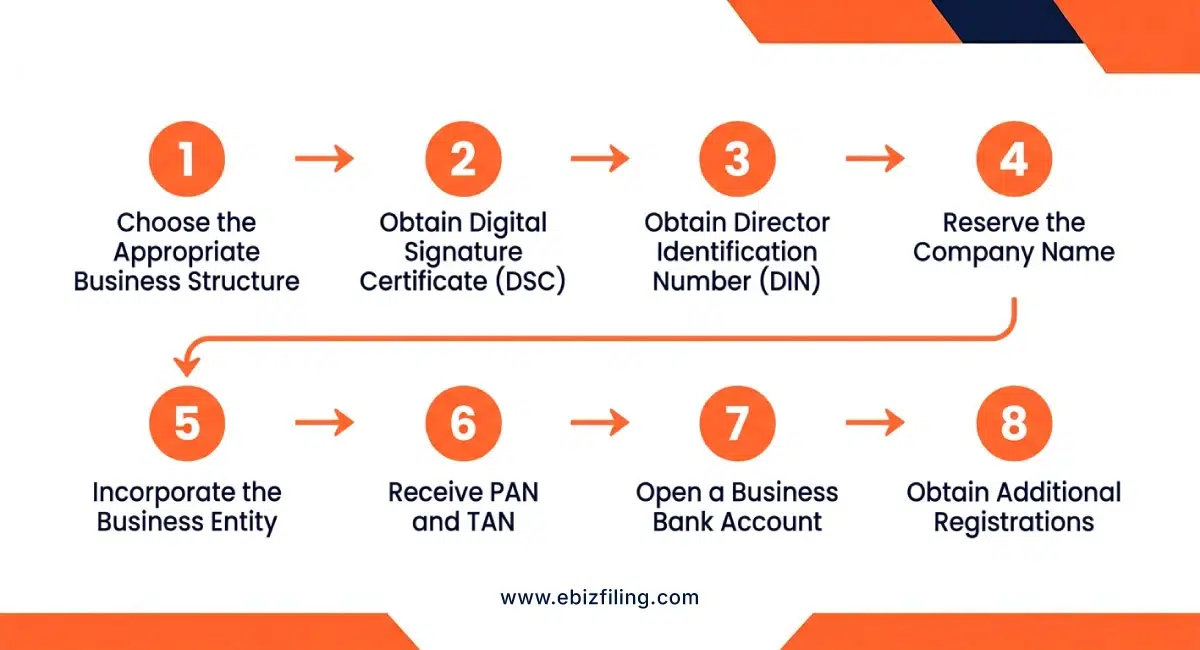
Step 1: Choose the Appropriate Business Structure
Select the entity based on ownership, funding requirements, liability concerns, and future growth plans.
Step 2: Obtain Digital Signature Certificate (DSC)
A Digital Signature Certificate (DSC) is required for electronic filings with the Ministry of Corporate Affairs (MCA).
Step 3: Obtain Director Identification Number (DIN)
Director Identification Number (DIN) is mandatory for proposed directors of a company.
Step 4: Reserve the Company Name
Apply for approval of the desired business name through the MCA registration process.
Step 5: Incorporate the Business Entity
Submit incorporation documents and declarations through the MCA portal.
Step 6: Receive PAN and TAN
PAN and TAN are generally allotted during the incorporation process.
Step 7: Open a Business Bank Account
A corporate bank account is required to conduct business transactions.
Step 8: Obtain Additional Registrations
Depending on business activities, additional registrations may include:
- GST Registration
- Import Export Code (IEC)
- FSSAI Registration
- Professional Tax Registration
- Shops and Establishment Registration
Completing these steps successfully forms the foundation of a compliant NRI Business Setup.
FEMA and RBI Regulations for NRI Business Setup 2026
Compliance with FEMA regulations is one of the most important aspects of NRI Business Setup.
Automatic Route
Most sectors allow foreign investment without prior government approval.
Government Approval Route
Certain sectors require approval from the relevant authorities before investment can be made.
Sectoral Caps
Some industries may have investment limits or additional conditions.
Reporting Requirements
Companies receiving foreign investment must comply with RBI reporting requirements and FEMA regulations.
Proper FEMA compliance is essential for avoiding penalties and ensuring lawful NRI Business Setup operations.
NRI Business Compliance Checklist 2026
After incorporation, businesses must fulfill various legal and regulatory obligations.
|
Compliance Requirement |
Applicability |
|
Annual ROC Filing |
Companies and LLPs |
| Income Tax Return Filing |
Applicable entities |
|
GST Return Filing |
GST-registered businesses |
| TDS Compliance |
Businesses deducting tax |
|
Maintenance of Bookkeeping and Accounting |
Applicable entities |
| Financial Statement Filing |
Companies and LLPs |
|
Annual General Meeting |
Companies |
| Director KYC Compliance |
Directors |
Maintaining an effective NRI Business Compliance Checklist helps avoid penalties and legal complications.
Benefits of NRI Business Setup in 2026
The advantages of NRI Business Setup extend beyond market access and investment opportunities.
Access to India’s Growing Economy
India continues to attract global investment and business expansion.
Limited Liability Protection
Corporate structures help protect personal assets from business liabilities.
Business Credibility
Registered entities often enjoy greater credibility among customers, suppliers, and investors.
Global Expansion Opportunities
Businesses can use India as a base for regional and international growth.
Access to Skilled Talent
India offers a large workforce with expertise across industries.
Long-Term Wealth Creation
Strategic investment through NRI Business Setup can contribute to long-term business growth and asset creation.
Challenges Faced in NRI Business Setup
Although the process is increasingly streamlined, some challenges remain.
Understanding Regulatory Requirements
FEMA, RBI, tax, and corporate regulations may be complex for first-time investors.
Documentation Issues
International documentation requirements can sometimes delay incorporation.
Banking Formalities
Opening corporate bank accounts may involve additional verification procedures.
Managing Operations Remotely
Overseas business owners may require local management support.
Compliance Monitoring
Ongoing compliance obligations require regular attention and timely filings. Understanding these challenges helps entrepreneurs plan a more successful Business Setup for NRI’s.
Best Business Setup Ideas for NRIs (2026)
Examples:
- IT & Software Services
- Consulting Busines
- Import Export Business
- E-commerce Brand
- Digital Marketing Agency
- Manufacturing Unit
- Education & Training Services
How Ebizfiling Can Help with NRI Business Setup?
Ebizfiling helps simplify the NRI Business Setup process by providing expert guidance on business registration, regulatory requirements, and post-incorporation compliance. With a dedicated team and extensive experience in business registrations, we assist NRIs in establishing and managing their businesses in India smoothly and in compliance with applicable laws.
Our Ebizfiling services include:
- Company Registration in India for NRIs
- LLP Registration
- FEMA and filing FC-TRS for RBI compliance support
- GST Registration
- Import Export Code Registration
- Annual ROC Compliance
- Tax Compliance Assistance
- Ongoing Business Advisory
With expert guidance and dedicated support, Ebizfiling helps entrepreneurs complete the business setup process efficiently while maintaining compliance with applicable laws.
Looking to start your business in India? Connect with Ebizfiling for professional assistance with your NRI Business Setup journey.
Conclusion
NRI Business Setup offers a valuable opportunity for Non-Resident Indians to participate in India’s dynamic and rapidly expanding economy. With multiple business structures available, investor-friendly policies, and access to a vast market, India remains a preferred destination for NRI entrepreneurs and investors.
However, successful business setup requires careful planning, proper documentation, compliance with FEMA and RBI regulations, and adherence to ongoing legal obligations. Understanding the applicable rules, selecting the right business structure, and maintaining a proper NRI Business Compliance Checklist can help ensure long-term success.
By seeking professional support and following the correct registration process, NRIs can establish and grow compliant, sustainable, and profitable businesses in India.
Suggested Reads:
NRI Income Tax Return Filing in India
How to file Income Tax Return for NRI in a few simple steps
Company formation and its fees
Frequently Asked Questions
1. Can an NRI fully own a company in India?
Yes, in most sectors NRIs can hold 100% ownership in a private limited company under the automatic route, depending on FDI policy.
2. Do all NRI business setups require RBI approval?
No, RBI approval is needed only in specific restricted sectors. Most investments fall under the automatic route and don’t need prior approval.
3. What is the minimum requirement for directors in an NRI-owned company?
A private limited company must have at least two directors, and one of them must be a resident in India.
4. Can an NRI start a business without being physically present in India?
Yes, most incorporation processes can be completed remotely with proper documentation and digital signatures.
5. Are NRI documents required to be notarized or apostilled?
Yes, foreign-issued documents usually need notarization or apostille depending on the country of execution.
6. Can NRIs invest in an LLP in India?
Yes, NRIs are allowed to invest in LLPs in sectors where 100% FDI is permitted under the automatic route.
7. Is profit repatriation allowed for NRI-owned businesses?
Yes, profits can be repatriated after complying with FEMA rules and applicable tax obligations.
8. What compliance starts after NRI company registration?
Post incorporation, companies must handle ROC filings, GST (if applicable), income tax returns, and FEMA reporting where required.
9. How does Ebizfiling support NRI Business Setup in India?
Ebizfiling assists NRIs with incorporation, FEMA compliance, documentation, and post-registration regulatory requirements in India.
10. Why is Ebizfiling useful for NRIs setting up a business in India?
Ebizfiling helps simplify the entire setup process by managing registrations, compliance, and regulatory requirements so NRIs can operate smoothly from abroad.





Start Your Business in India as an NRI
Register your company in India with expert guidance. Get end-to-end assistance with documentation, compliance, and business setup.
About Ebizfiling -



October 6, 2026 By Srishti M
October 5, 2026 By Srishti M
October 3, 2026 By Srishti M
Revised ITR Under Old Tax Regime: Change Rules Explained Overview A salaried taxpayer may file an Income Tax Return under the new tax regime and later realise that the old tax regime could be more suitable because of eligible deductions […]