


-
September 26, 2026
-
BySteffy A
Annual Information Statement: Complete Overview
Introduction
The Annual Information Statement (AIS) is an important tax information tool introduced by the Income Tax Department to provide taxpayers with a comprehensive view of financial transactions linked to their PAN. It helps individuals and businesses review income, investments, taxes, and other reported transactions before filing their Income Tax Return (ITR).
The AIS has significantly improved transparency in tax compliance by consolidating information received from banks, employers, mutual fund houses, stock exchanges, and other reporting entities. By reviewing this information before filing an ITR, taxpayers can identify discrepancies, verify reported data, and reduce the chances of errors in tax reporting.
With the implementation of the Income Tax Act, 2025 and the Income Tax Rules, 2026, taxpayers should also be aware that Form 26AS has been renumbered as Form 168 from 1 April 2026. However, AIS continues to remain an important source of financial information for tax compliance and return filing.
In this guide, we will discuss the meaning, contents, features, benefits, and importance of AIS, along with its relationship with TIS and Form 168.
What is Annual Information Statement?
The Annual Information Statement is a comprehensive statement available on the Income Tax Department’s e-filing portal that displays financial information associated with a taxpayer’s PAN during a financial year.
The purpose of the AIS is to provide taxpayers with a detailed record of information reported by various entities. This enables taxpayers to verify income details, reconcile financial transactions, and ensure accurate reporting while filing their returns.
The statement is available in PDF, CSV, and JSON formats, making it easy to view, download, and analyze information as required.
Why was Annual Information Statement Introduced?
The AIS was introduced to provide taxpayers with a broader view of financial information than what was available through traditional tax statements.
Some key objectives include:
- Improving transparency in tax administration.
- Encouraging voluntary tax compliance.
- Helping taxpayers verify information before filing returns.
- Supporting pre-filed Income Tax Returns.
- Reducing discrepancies between reported income and available records.
- Enabling better data reconciliation.
By providing access to information already available with the Income Tax Department, AIS helps taxpayers maintain accurate financial records and avoid reporting mistakes.
Information Available in Annual Information Statement
The AIS is divided into two sections: Part A and Part B.
Part A: General Information
Part A contains basic taxpayer details such as:
- Name of the taxpayer
- PAN application details
- Masked Aadhaar number
- Date of birth (for individuals)
- Date of incorporation or formation (for non-individuals)
- Contact information
Part B: Financial Information
Part B of the Annual Information Statement contains financial information received from various reporting entities.
- TDS and TCS Information
- This section includes:
- Tax Deducted at Source (TDS)
- Tax Collected at Source (TCS)
- Details of deductors and collectors
- Tax amounts reported to the department
Also Read: Key changes in Income Tax Act 2025
Specified Financial Transactions (SFT)
Specified Financial Transactions are high-value transactions reported by designated institutions.
Examples include:
- Large cash deposits
- Credit card payments above prescribed limits
- Property transactions
- Mutual fund investments
- Purchase and sale of securities
Demand and Refund Details
Taxpayers can also view:
- Outstanding tax demands
- Refunds issued by the Income Tax Department
Other Information
AIS may contain:
- Interest income
- Dividend income
- Salary information
- Foreign remittance details
- Purchase of foreign currency
- Securities transactions
- Mutual fund transactions
- Other information received from reporting sources
Types of Transactions Reported in Annual Information Statement
The AIS provides a detailed record of multiple financial transactions that may be relevant for tax reporting.
|
Transaction Category |
Examples |
|
Interest Income |
Savings account and fixed deposit interest |
| Dividend Income |
Dividends received from shares |
|
Securities Transactions |
Purchase and sale of shares and securities |
| Mutual Fund Transactions |
Investments and redemptions |
|
Foreign Remittances |
Outward remittances and foreign currency purchases |
| Tax Information |
TDS, TCS, refunds, and tax payments |
|
High-Value Transactions |
Transactions reported under SFT |
This wide coverage makes AIS a valuable tool for verifying information before filing an Income Tax Return.
Key Features of Annual Information Statement
The AIS offers several features that improve tax reporting and compliance.
Comprehensive Financial Information
The statement provides information from multiple reporting entities in a single place.
Feedback Facility
One of the most useful features of the Annual Information Statement is the ability to submit feedback if information appears incorrect, duplicated, or does not belong to the taxpayer.
Multiple Download Formats
Taxpayers can download AIS in PDF, CSV, and JSON formats.
Reported and Processed Values
The statement displays both the information reported by entities and the values processed after considering taxpayer feedback.
Better Data Reconciliation
AIS helps taxpayers compare reported information with their own records and identify discrepancies before filing returns.
Benefits of Annual Information Statement for Taxpayers
The Annual Information Statement offers several benefits that support accurate tax reporting and compliance.
Improved Transparency
Taxpayers can review financial information available with the department and compare it with their own records.
Better Accuracy in Return Filing
Reviewing the Annual Information Statement before filing returns helps ensure complete disclosure of income.
Identification of Errors
Taxpayers can identify incorrect, duplicate, or missing information and take corrective action.
Reduced Chances of Notices
Accurate reconciliation of financial information may reduce the possibility of notices arising from mismatches.
Simplified Compliance
The statement provides a consolidated view of information, making tax compliance easier and more efficient.
Annual Information Statement vs Form 168 (Earlier Form 26AS)
Many taxpayers confuse AIS with Form 168. Although both contain tax-related information, they serve different purposes.
|
Particulars |
Annual Information Statement (AIS) |
Form 168 |
|
Purpose |
Comprehensive financial information | Consolidated tax statement |
| Scope | Income and financial transactions |
Tax credits, TDS, TCS, tax payments, and refund information |
|
Feedback Facility |
Available | Limited |
| Coverage | Extensive |
Primarily tax information |
|
Use |
Income verification and reconciliation |
Tax credit verification |
Note:
Under the Income Tax Act, 2025 framework and Income Tax Rules, 2026, Form 26AS has been renumbered as Form 168 with effect from 1 April 2026. Taxpayers should review both the Annual Information Statement and Form 168 while preparing their returns.
Understanding the Concept of TIS and AIS
The Taxpayer Information Summary (TIS) is a summarized version of information available in the Annual Information Statement.
While AIS provides transaction-level details, TIS presents category-wise information that can be useful during return preparation. It also displays processed values after considering taxpayer feedback.
The AIS and TIS work together to help taxpayers verify information and improve the accuracy of return filing.
How to Access Annual Information Statement?
Taxpayers can access the AIS through the Income Tax e-filing portal by following these steps:
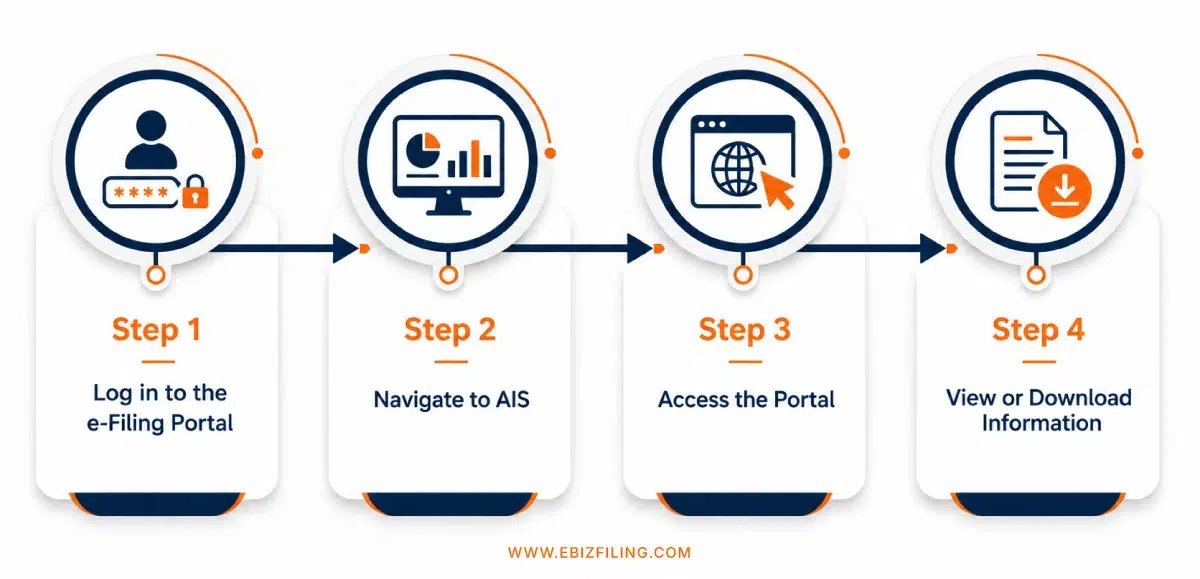
Step 1: Log in to the e-Filing Portal
Visit the Income Tax e-filing portal and log in using your credentials.
Step 2: Navigate to AIS
Select the AIS option available under the relevant services section.
Step 3: Access the Portal
You will be redirected to the AIS dashboard.
Step 4: View or Download Information
The Annual Information Statement can be viewed online or downloaded in PDF, CSV, or JSON format.
How to Submit Feedback in AIS?
If taxpayers identify discrepancies, they can submit feedback through the portal.
Feedback can be provided when:
- Information is incorrect.
- Information is duplicated.
- Information belongs to another taxpayer.
- Information relates to a different year.
- Information is partially incorrect.
The feedback mechanism available in the Annual Information Statement helps improve data accuracy and ensures better reporting.
Errors that are Commonly Found in AIS
Some common issues taxpayers may encounter include:
|
Issue |
Suggested Action |
|
Duplicate entries |
Submit feedback |
| Incorrect transaction values |
Verify records and provide feedback |
|
Missing information |
Contact the reporting entity |
| Incorrect PAN mapping |
Request correction and submit feedback |
|
Information for another year |
Report the discrepancy through AIS |
Regular review of the Annual Information Statement can help identify and resolve such issues before filing returns.
Things to Check Before Filing ITR
Before filing an Income Tax Return, taxpayers should verify:
- Interest income details
- Dividend income records
- Securities transactions
- Mutual fund transactions
- Foreign remittance informationTDS and TCS entries
- Refund details
- High-value transactions reported under SFT
Reconciling information available in the Annual Information Statement with bank statements, investment records, and other supporting documents can help avoid reporting errors.
How AIS Helps in Accurate Tax Compliance
The Annual Information Statement plays a significant role in ensuring accurate tax compliance. It enables taxpayers to compare financial information reported to the Income Tax Department with their own records.
By reviewing the AIS, taxpayers can:
- Verify income from multiple sources.
- Detect omissions and discrepancies.
- Improve reporting accuracy.
- Reduce the risk of mismatches.
- Strengthen overall tax compliance.
As tax administration becomes increasingly data-driven, AIS has become an essential tool for taxpayers seeking to maintain transparency and accuracy in financial reporting.
Don’t Let AIS Errors Affect Your Tax Return
The Income Tax Department uses information available in the Annual Information Statement (AIS) to verify income reported in your return. Even a small mismatch in interest income, securities transactions, mutual fund investments, or foreign remittances may lead to compliance issues.
Ebizfiling helps taxpayers review AIS data, verify reported transactions, and file accurate Income Tax Returns backed by proper reconciliation and expert guidance.
Connect with Our Tax Professionals today.
Conclusion
The Annual Information Statement is a valuable resource that provides taxpayers with a comprehensive view of financial information reported to the Income Tax Department. It helps individuals and businesses verify income, review transactions, and improve the accuracy of tax reporting.
Regular review of the AIS, along with TIS and Form 168, can help taxpayers identify discrepancies, submit feedback where necessary, and ensure smooth Income Tax Return filing. As compliance requirements continue to evolve, AIS remains an important tool for promoting transparency and supporting accurate tax reporting.
Suggested Reads:
Documents Required for Income Tax Return: Complete Checklist
Capital Gains on Crypto Transactions in India 2026
Things to Keep in Mind During the ITR Filing Process
Frequently Asked Questions
1. Does the Annual Information Statement replace Form 168?
No. The Annual Information Statement (AIS) does not replace Form 168. AIS provides detailed financial and transaction-level information reported against a taxpayer’s PAN, whereas Form 168 (earlier Form 26AS) primarily serves as a consolidated statement of tax credits, TDS, TCS, tax payments, and refunds. Both should be reviewed while filing an Income Tax Return.
2. What is the difference between Reported Value and Processed Value in AIS?
The Reported Value reflects the information submitted by reporting entities such as banks, employers, mutual fund houses, and stock exchanges. The Processed Value is generated after considering taxpayer feedback and is reflected in the Taxpayer Information Summary (TIS).
3. Can income appear in AIS even if tax has not been deducted on it?
Yes. AIS may display income such as savings account interest, fixed deposit interest, dividends, capital gains transactions, or foreign remittances even if no TDS has been deducted. Taxpayers must evaluate the taxability of such income independently while filing their returns.
4. Why do securities and mutual fund transactions appear in AIS?
AIS captures information received from depositories, mutual fund registrars, stock exchanges, and other reporting entities. These transactions are reported to improve transparency and help taxpayers reconcile investment-related income and capital gains before filing their returns.
5. What should a taxpayer do if a transaction in AIS belongs to another person?
If a transaction displayed in AIS does not belong to the taxpayer, feedback can be submitted through the AIS portal by selecting the appropriate feedback category. The Income Tax Department may use such feedback while processing information in the Taxpayer Information Summary (TIS).
6. Are high-value transactions reported under Specified Financial Transactions (SFT) reflected in AIS?
Yes. AIS includes information reported under the Specified Financial Transactions (SFT) framework, such as certain high-value cash deposits, property transactions, mutual fund investments, and other reportable financial activities as prescribed under the Income-tax Act.
7. Can AIS be used as the sole document for filing an Income Tax Return?
No. AIS should be treated as a reconciliation and verification tool. Taxpayers should also review Form 168, bank statements, salary records, investment statements, books of accounts, and other supporting documents before filing their Income Tax Return.
8. Why is there a mismatch between AIS and my financial records?
Mismatches may arise due to delayed reporting by financial institutions, incorrect PAN reporting, duplicate entries, reporting errors, or timing differences between transaction execution and reporting. Taxpayers should verify the source documents and submit feedback where necessary.
9. How can Ebizfiling help if there is incorrect information in my Annual Information Statement?
Ebizfiling assists taxpayers in reviewing AIS entries, reconciling reported transactions with supporting records, identifying discrepancies, and guiding them through the feedback submission process. Our experts also help ensure accurate reporting of income while filing Income Tax Returns.
10. Can Ebizfiling help reconcile AIS, TIS, and Form 168 before ITR filing?
Yes. Ebizfiling’s tax professionals can help compare information available in AIS, TIS, and Form 168 with your financial records, identify mismatches, verify tax credits, and ensure that your Income Tax Return is filed accurately and in compliance with applicable tax provisions.





Income Tax Return
File your Income Tax Return at affordable price with Ebizfiling.
About Ebizfiling -



Reviews
Devang Panchal
09 Sep 2018They helped me with my company’s name change and I was quite satisfied with the way they served me. I am surely coming back to you in case of any compliance problem.
Jinal Vora
27 Feb 2018They make GST returns easier and fuss-free.
Krisha Chadda
29 Aug 2018I was amazed to see the great offers for women entrepreneurs. It was a delightful experience working with you and your team.
October 21, 2026 By Srishti M
Tax Planning for NRI Returning to India Before Becoming ROR Introduction Tax planning for NRI returning to India should start before the person becomes Resident and Ordinarily Resident, also known as ROR. Under the Income-tax Act, 2025, residential status decides […]
September 30, 2026 By Srishti M
September 29, 2026 By Srishti M
Income Tax Compliance Calendar October 2026: Filing Guide Introduction The Income Tax Compliance Calendar October 2026 highlights important income tax obligations applicable to taxpayers, businesses and entities covered under audit and transfer pricing provisions. October 2026 includes key compliance […]