


Documents Required for FSSAI Registration for Dairy Units
Introduction
FSSAI registration for dairy units is important because it helps ensure compliance with food safety, hygiene, and documentation requirements. Dairy facilities, milk chilling units, milk collection centers, and processing plants must apply for the necessary FSSAI registration or license based on their turnover, capacity and kind of operation.
Why is an FSSAI License Important for Milk Chilling Units?
The Food Safety and Standards Authority of India (FSSAI) is a government body that regulates and supervises food hygiene and safety in India. It mandates that any business or industry related to food must get an FSSAI registration or license. These industries include food preparing, food handling, delivering, serving and retailing businesses.
Milk chilling units collect and cool milk before further processing or distribution, making them part of the food handling sector. Therefore, milk chilling units must obtain FSSAI registration or the applicable FSSAI license. FSSAI registration or license will help your business to stand out from your competitors. Failing to get FSSAI registration may lead your business to lose the credibility of your clients. It may lead to regulatory action, penalties, or suspension of operations in certain cases. To avoid such issues, obtaining FSSAI registration is essential.
There are a lot of benefits you will be availing with an FSSAI registration or license. Those are,
- Helps establish your milk chilling unit as a reliable and trusted service provider.
- FSSAI registration for dairy units will make any legal process regarding your business easy and effective.
- You can expand and scale your Milk chilling units to various places without hassle.
- You can use the FSSAI license logo to establish your concern on quality to clients.
- An FSSAI license can improve business credibility and support funding or loan applications.
Documents Required for FSSAI Registration for Dairy Units
The documents required for FSSAI registration depend on the license type and business activity. However, the following documents are commonly required.
Basic Documents Required
If the annual turnover of your milk chilling unit is below ₹12 lakh, you may be eligible for Basic FSSAI Registration as a small food business operator. For small businesses, a basic food license is enough. You have to register for Form A for basic registration. As the business turnover reaches Rs. 12 lakhs, you have to upgrade the food license from basic registration to state FSSAI registration.
Documents required :
- Address proof
- Passport size photos
- Business details
- FSSAI declaration form.
Small dairy businesses that qualify for Basic FSSAI Registration can also understand How FSSAI Basic Registration is Beneficial for Your Food Product? before applying.
State FSSAI Food License Registration
If the annual turnover of your milk chilling unit is between ₹12 lakh and ₹20 crore, a State FSSAI License may be required. For this food license, you have to fill up Form B to get FSSAI food registration. The applicable FSSAI license depends on annual turnover, milk handling capacity, and the nature of business operations.
Documents Required:
- Documents of business premises (Rental/Lease agreement)
- ID proof of the owner (Aadhar/ Voter ID/ Driving License/ Passport)
- Incorporation Certificate/ GST Registration/ Trading License
- MOA and AOA
- Any one of the following is compulsory (Trade license or Establishment registration or Panchayat License or Corporation License or Municipality License)
- Business details
- FSSAI declaration forms
Central FSSAI Food License Registration :
If the annual turnover of your milk chilling unit exceeds ₹20 crore, a Central FSSAI License may be required. If your mid-cap business crosses Rs.20 crores, you must upgrade from a state food license to a Central food license.
Documents Required:
- Documents of business premises (Rental/Lease agreement)
- ID proof of the business owner (Aadhar/ Voter ID/ Driving License/Passport)
- Incorporation Certificate/GST Registration/Trade License
- Import and Export code
- MOA and AOA
- Any one of the following documents is compulsory (Trade license/ Establishment registration/ Panchayath License/ Corporation License/ Municipality License)
- Business details
- FSSAI declaration forms
Who Needs FSSAI Registration for Dairy Units?
The following dairy businesses generally need FSSAI registration or license:
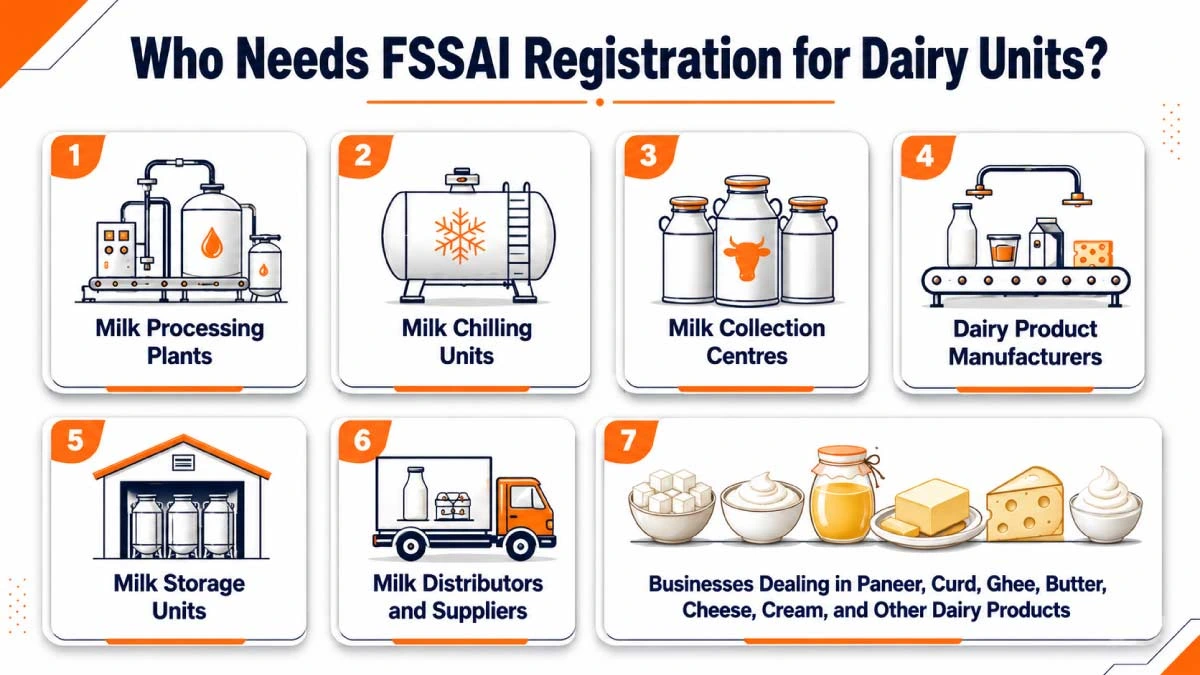
- Milk processing plants
- Milk chilling units
- Milk collection centers
- Dairy product manufacturers
- Milk storage units
- Milk distributors and suppliers
- Businesses dealing in paneer, curd, ghee, butter, cheese, cream, or other milk products
Such businesses may also need GST registration depending on turnover, supply structure, and business model.
Milk chilling centers and bulk milk cooling centers are also covered in dairy-related licensing details, as FSSAI forms require information about their location and installed capacity.
FSSAI Registration for Dairy units Support from Ebizfiling
- Ebizfiling helps you choose the correct FSSAI registration or license category for your dairy unit.
- We review your documents before submission to reduce the chances of rejection or delay.
- Our experts assist with online application filing through the FoSCoS portal.
- We guide you on dairy-specific documents for milk chilling, processing, or manufacturing units.
- Our team supports you until your FSSAI registration or license application is completed.
For more Information about FSSAI registration for Dairy Units you can read our blog on FSSAI Registration process for Dairy Units including Milk chilling units.
Final Thoughts
FSSAI registration for dairy units is required for dairy related businesses in India. Dairy products have a direct impact on public health, which is why FSSAI requires businesses to maintain proper food safety and hygiene standards. Preparing the required documents for FSSAI registration in advance can help avoid delays and compliance issues.
FAQs
1. Is a FSSAI license mandatory for milk products?
Yes, businesses that manufacture, process, store, distribute, or sell milk and milk products are normally required to have an FSSAI registration or license. This comprises establishments that sell paneer, curd, ghee, butter, cheese, and other dairy products. The sort of approval required is determined by the size of the activity and its annual turnover.
2. How can I renew my FSSAI license for a dairy unit?
An FSSAI license can be renewed visiting the FoSCoS portal before it get expired. The renewal process usually includes updating business information, providing the necessary documents, and paying the required fees. Timely renewal helps dairy enterprises avoid penalties and maintain business without any problems.
3. Which dairy unit business is exempted from the FSSAI license?
Most food businesses require either FSSAI Registration or an FSSAI license. Small petty food businesses required a Basic FSSAI Registration, while larger businesses require a State or Central FSSAI License. However, most dairy firms that process, store, or distribute milk commercially must first apply for the necessary FSSAI registration or license.
4. What are the three categories of FSSAI licenses?
FSSAI provides three types of approvals: basic FSSAI registration, state FSSAI license, and central FSSAI license. Annual turnover, production capacity, and the type of the dairy firm all contribute to determining the appropriate category.
5. What is the difference between FSSAI license and registration certificate for dairy units?
An FSSAI Registration Certificate is usually provided to small food firms with limited turnover and operations. Medium and large firms with higher revenue, larger production capacity, or more extensive activities must obtain an FSSAI License, whether at the state or central level. Dairy firms should apply for the appropriate category based on their size.
6. Which form of FSSAI license is necessary for dairy operations?
The type of FSSAI license is determined by annual turnover, manufacturing capacity, and business activity. Small dairy businesses may need Basic Registration, but medium and large dairy operations may require a State or Central FSSAI License. Choosing the appropriate category is crucial for avoiding application issues.
7. Which type of FSSAI registration is required for a small dairy business?
Small dairy firms can apply for Basic FSSAI Registration for dairy units provided they meet the required revenue and operating constraints. If the firm grows, it may need to upgrade to a State or Central FSSAI License. Ebizfiling can assist you in selecting the appropriate license category and completing the registration process smoothly.
8. Can a dairy facility operate while its FSSAI application is being processed?
Dairy businesses are generally required to obtain the applicable FSSAI registration or licence before commencing food-related operations. Operating without the required approval may attract penalties under the Food Safety and Standards Act. Ebizfiling can facilitate timely filing and application tracking.
9. Do Dairy units and milk chilling unit require FSSAI Annual Filing?
Milk processing plants, milk chilling units, milk collection centers, dairy product manufacturers, milk storage facilities, and businesses dealing in paneer, curd, ghee, butter, cheese, and other dairy products generally require FSSAI annual return filing.
10. What happens if a dairy unit operates without FSSAI registration?
Operating a dairy unit without an FSSAI registration or license may result in notices, penalties, or other legal action under food safety rules. It may also affect customer trust and corporate reputation. Ebizfiling assists dairy firms in obtaining the right FSSAI registration and complying with regulatory requirements prior to starting operations.




FSSAI Registration
Start your food business with complete confidence—FSSAI registration made simple with Ebizfiling.
About Ebizfiling -



October 3, 2026 By Srishti M
Revised ITR Under Old Tax Regime: Change Rules Explained Overview A salaried taxpayer may file an Income Tax Return under the new tax regime and later realise that the old tax regime could be more suitable because of eligible deductions […]
October 2, 2026 By Siddhi R
September 30, 2026 By Srishti M