


-
September 7, 2026
-
BySteffy A
Startup India Recognition: Everything You Need to Know
Overview
Startup India Recognition is a government initiative that helps eligible startups access various benefits and growth opportunities. It enables startups to improve their credibility and become eligible for government support, intellectual property (IP) assistance, networking opportunities, and other startup-focused initiatives.
However, many entrepreneurs are unsure about the eligibility criteria, registration process, required documents, and benefits of it. Understanding these aspects before applying can help avoid delays and improve the chances of approval.
In this guide, you’ll learn everything about Startup India Recognition, including who can apply, the documents required, the registration process, and the benefits available to eligible startups.
What is Startup India Recognition and Why is it Important?
Startup India Recognition is granted by the Department for Promotion of Industry and Internal Trade (DPIIT) under the Startup India Initiative. To apply for such Recognition, a business must first be incorporated as a Private Limited Company, LLP, or Registered Partnership Firm. After approval, the startup receives a DPIIT Recognition Certificate.
It is different from business incorporation, as recognition provides access to government schemes, support for patent and trademark filings, and eligibility to apply for tax benefits, subject to prescribed conditions. Overall, the recognition helps startups build credibility, attract investors, and support long-term business growth.
Who Can Apply for Startup India Recognition?
Not every newly incorporated business automatically qualifies for Startup India Recognition. The applicant must satisfy the eligibility conditions prescribed by DPIIT.
Eligible entities include:
- Private Limited Companies
- Limited Liability Partnerships (LLPs)
- Registered Partnership Firms
Sole proprietorships, Hindu Undivided Families (HUFs), trusts, and societies are not eligible for Startup India Recognition under the Startup India scheme.
Eligibility Criteria for Startup India Recognition
A business must meet the following conditions to obtain Startup India Recognition.
|
Eligibility Criteria |
Requirement |
|
Entity Type |
Private Limited Company, LLP, or Registered Partnership Firm |
| Age of Startup |
Not more than 10 years from the date of incorporation or registration |
|
Annual Turnover |
Turnover should not have exceeded ₹100 crore in any financial year since incorporation |
| Innovation / Improvement / Scalable Business Model |
Business should work towards innovation, development, improvement of products, services, or processes, or have a scalable business model with potential for employment or wealth creation |
|
Formation |
The entity should not have been formed by splitting up or reconstructing an existing business |
Meeting these eligibility conditions does not automatically guarantee approval. The authorities evaluate the information and supporting documents submitted during the application process before granting Startup India Recognition.
Documents Required for Startup India Recognition
To apply successfully, startups should keep all required documents ready before initiating the online application.
|
Document |
Purpose |
|
Certificate of Incorporation or Registration |
Proof of legal existence |
| PAN of the Entity |
Tax identification |
|
Details of Directors, Partners, or Authorized Signatory |
Identity verification |
| Brief Description of the Business |
Explains innovation, scalability, and business model |
|
Website or Company Profile (if available) |
Additional business information |
| Pitch Deck or Presentation (if available) |
Supports business concept |
|
Funding Details (if applicable) |
Investor information |
| Authorization Letter (if applicable) |
Authorizes representative to apply |
Providing complete and accurate documentation improves the chances of obtaining Startup India Recognition without unnecessary delays.
Step-by-Step Startup India Recognition Registration Process
Applying for Startup India Recognition is an entirely online process. Entrepreneurs should ensure that all information submitted is accurate and supported by relevant documents.
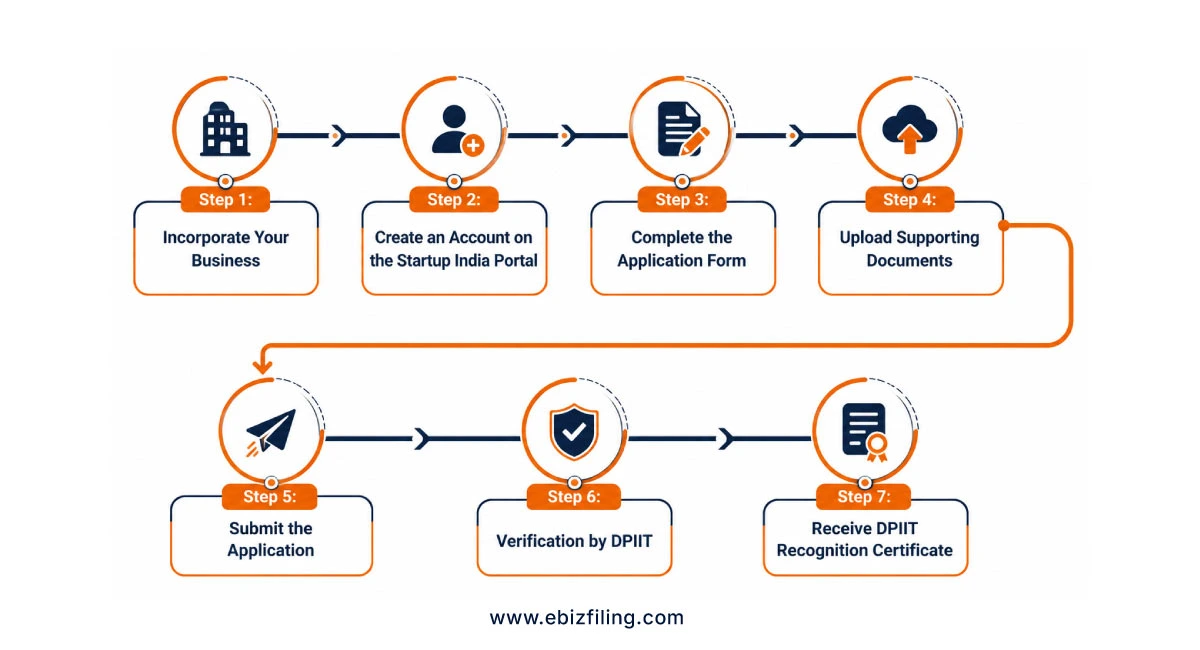
Step 1: Incorporate Your Business
Before applying, register your business as a Private Limited Company, LLP, or Registered Partnership Firm.
Step 2: Create an Account on the Startup India Portal
Visit the Startup India Portal and create a user account using the required details.
Step 3: Complete the Application Form
Enter business information such as:
- Entity details
- Industry sector
- Nature of innovation
- Business activities
- Contact information
Step 4: Upload Supporting Documents
Upload all mandatory documents and provide a clear description explaining how your business meets the eligibility criteria for Startup India Recognition.
Step 5: Submit the Application
Review the application carefully before submission. Incorrect or incomplete information may delay processing.
Step 6: Verification by DPIIT
The authorities examine the application and supporting documents to determine whether the startup satisfies the prescribed eligibility conditions. DPIIT may seek additional clarification or supporting documents wherever required.
Step 7: Receive DPIIT Recognition Certificate
If approved, the startup receives the DPIIT Recognition Certificate confirming Startup India Recognition.
Benefits of Startup India Recognition
Obtaining Startup India Recognition offers several advantages to eligible startups by providing access to government support, regulatory benefits, and opportunities to accelerate business growth. While some benefits are available immediately after recognition, others are subject to additional eligibility conditions under the respective laws or government schemes.
The major benefits include:
1. Tax Benefits (Subject to Eligibility)
A startup with Startup India Recognition may apply for tax benefits available under the Income-tax Act, 1961, provided it satisfies the prescribed conditions. For example, eligible startups may apply for deduction under Section 80-IAC of the Income-tax Act, subject to satisfying the prescribed conditions and obtaining approval from the Inter-Ministerial Board (where applicable under the prevailing framework), subject to obtaining the necessary approvals and fulfilling the applicable requirements.
Note: Startup India Recognition alone does not automatically grant tax exemptions.
2. Self-Certification Under Specified Labour and Environmental Laws
Recognized startups can self-certify compliance under certain specified labour and environmental laws for a prescribed period, reducing the compliance burden while encouraging ease of doing business.
3. Intellectual Property (IPR) Support
Startups with Startup India Recognition can benefit from government support for protecting their intellectual property through:
- Fast-track examination of patent applications
- Facilitation support for filing patents, trademarks, and designs
- Eligible startups can avail rebates on statutory patent filing fees as prescribed under the applicable Patent Rules.
Protecting intellectual property helps startups safeguard their innovations and strengthen their market position.
4. Access to Government Schemes
Recognized startups may become eligible to apply under various government initiatives, depending on the specific scheme’s eligibility criteria, such as:
- Startup India Seed Fund Scheme
- Credit Guarantee Scheme for Startups
- Incubation and mentorship programs
5. Easier Participation in Government Procurement
Eligible recognized startups may receive relaxations in certain government procurement requirements, subject to the procurement policies applicable to the concerned government department or public sector undertaking.
6. Improved Credibility
Receiving Startup India Recognition enhances the credibility of a startup among:
- Investors
- Venture capital firms
- Incubators
- Accelerators
- Banks and financial institutions
- Business partners
Government recognition often increases investor confidence, especially for early-stage startups.
7. Better Networking Opportunities
The Startup India ecosystem regularly organizes:
- Startup events
- Innovation challenges
- Mentorship sessions
- Workshops
- Investor connects
Recognized startups can participate in these initiatives to build valuable business relationships.
8. Funding Opportunities
Although Startup India Recognition does not guarantee funding, it improves visibility before government-supported initiatives, incubators, angel investors, and venture capital firms looking to invest in innovative startups.
Startup India Recognition vs DPIIT Recognition
Many entrepreneurs believe these are two different registrations. In reality, they refer to the same recognition granted through the Startup India initiative.
|
Basis |
Startup India Recognition |
DPIIT Recognition |
|
Meaning |
Recognition granted to eligible startups under the Startup India initiative | Official recognition issued by the Department for Promotion of Industry and Internal Trade (DPIIT) |
| Issuing Authority | DPIIT through the Startup India Portal |
DPIIT |
|
Application Platform |
Startup India Portal | Startup India Portal |
| Recognition Certificate | DPIIT Recognition Certificate |
Same DPIIT Recognition Certificate |
|
Purpose |
Enable eligible startups to access government benefits and schemes | Official recognition confirming startup eligibility under the Startup India initiative |
| Difference | Commonly used public term |
Official administrative recognition issued by DPIIT |
In simple terms, Startup India Recognition and DPIIT Recognition refer to the same recognition. The application is submitted through the Startup India Portal, and upon approval, the startup receives a DPIIT Recognition Certificate.
How Ebizfiling Helps You Obtain Startup India Recognition
Applying for Startup India Recognition requires accurate documentation, eligibility clarity, and a properly prepared application to avoid delays or rejection. At Ebizfiling, we provide complete end-to-end support, from eligibility check and document preparation to filing and follow-up until you receive your DPIIT Recognition Certificate.
Our experts also guide you in drafting your business and innovation details and support you even after recognition with compliance, GST, trademark registration, and other regulatory needs. With Ebizfiling, the entire process becomes simple, smooth, and stress-free, so you can focus on growing your startup with confidence.
Get started today with Ebizfiling and apply for Startup with confidence.
Conclusion
Startup India Recognition helps eligible startups get official government recognition under the Startup India initiative. It improves credibility and allows access to various government schemes, funding support, and startup benefits, depending on eligibility.
Before applying, startups should ensure they meet the eligibility criteria, have proper documents, and clearly explain their innovative business idea. Some benefits like tax relief or funding are subject to separate conditions, so rules must be checked carefully.
Overall, it helps startups build trust, attract investors, and support business growth in a structured way.
Suggested Reads:
How to Start an IT Startup in India
Frequently Asked Questions
1. What happens if a startup's annual turnover exceeds ₹100 crore after receiving DPIIT recognition?
If a startup’s turnover exceeds ₹100 crore in any financial year, it ceases to qualify as a startup under the applicable DPIIT definition from that point onward. Consequently, it may no longer be eligible for startup-specific benefits available under the Startup India framework, subject to the conditions of each scheme.
2. Can an existing business converted into an LLP or company obtain DPIIT recognition?
No. An entity formed by splitting up or reconstructing an existing business is generally not eligible. The business must be a genuinely new entity that satisfies the prescribed innovation and eligibility requirements.
3. Does obtaining DPIIT recognition automatically make a startup eligible for tax benefits?
No. Tax benefits are not granted automatically. A recognized startup must separately satisfy the conditions prescribed under the Income-tax Act, 1961, including the requirements applicable to the specific tax incentive being claimed.
4. Can a startup update its business information after obtaining DPIIT recognition?
Yes. If there are changes in business details, authorized signatories, contact information, or other relevant particulars, the startup should update the information through the Startup India portal wherever permitted and maintain consistency with its statutory records.
5. Can foreign shareholders or NRIs be part of a DPIIT-recognized startup?
Yes. A company or LLP with foreign shareholders or Non-Resident Indian (NRI) investors can obtain recognition, provided the entity satisfies the prescribed eligibility criteria and complies with the applicable FEMA and FDI regulations.
6. Can one founder obtain recognition for multiple startups?
Yes. There is no restriction on a founder being associated with more than one recognized startup, provided each entity independently satisfies the eligibility conditions and is not formed by splitting or reconstructing an existing business.
7. What documents are examined while evaluating an application for DPIIT recognition?
The authorities typically review the incorporation documents, PAN, business description, details demonstrating innovation or scalability, and any additional supporting documents or clarifications requested during the evaluation process.
8. Can a recognized startup lose its recognition status?
Yes. Recognition may be revoked if the entity is found to have provided false information, submitted misleading documents, or no longer satisfies the applicable eligibility conditions under the Startup India framework.
9. How can Ebizfiling help in obtaining DPIIT recognition?
Ebizfiling assists businesses with eligibility assessment, document preparation, application filing, drafting the business and innovation description, responding to clarification requests (if any), and end-to-end support until the recognition certificate is issued.
10. Does Ebizfiling provide compliance support after obtaining DPIIT recognition?
Yes. Apart from assisting with the recognition process, Ebizfiling also provides post-recognition services such as company compliance, LLP compliance, GST registration and compliance, trademark registration, accounting, and other regulatory support to help startups remain compliant as they grow.





Private Limited Company
Register your business as a Private Limited Company with Ebizfiling at an Affordable Price.
About Ebizfiling -



May 13, 2026 By Ishita Ramani
August 24, 2026 By Ishita Ramani
Everything You Should Know About MSME Registration Certificate The Micro, Small, and Medium Enterprises (MSME) sector is a vital pillar of the Indian economy. It fosters innovation, generates employment opportunities, and acts as a critical supplier for larger industries. Recognizing […]
February 22, 2024 By Dharmik Joshi
How is GIFT City Transforming India? Introduction GIFT City, formally referred to as Gujarat International Finance Tec-City, is a visionary project that aims to revolutionize India’s monetary landscape and make contributions to its worldwide management. Located in Gujarat, this smart […]