


Abandoned Trademark Application: Reasons & Consequences
Introduction
A trademark helps businesses protect their brand identity, including names, logos, symbols, and other marks used to identify their goods or services. However, trademark registration involves multiple stages where applicants must complete formalities and respond to communications issued by the Trademark Registry.
During this process, failure to take required action may result in an Abandoned Trademark Application.
The term Abandoned Trademark is commonly searched by applicants looking for information about this status. However, legally, abandonment applies to a trademark application and not to a registered trademark.
An Abandoned Trademark Application refers to an application that is no longer proceeding through the registration process due to the applicant’s failure to complete required actions or comply with applicable requirements.
Businesses should understand the reason behind abandonment, its consequences, and available options before deciding whether to restore, refile, or take any other action.
Quick Insights
- An Abandoned Trademark Application occurs when an applicant fails to complete required trademark compliance actions.
- Abandonment applies to a trademark application and does not mean cancellation of a registered trademark.
- Failure to respond to objections or attend hearings may result in trademark application abandonment.
- An abandoned application does not provide registered trademark protection rights to the applicant.
- Businesses should monitor trademark status regularly to avoid abandonment and protect their brand.
What is an Abandoned Trademark Application?
An Abandoned Trademark Application refers to a trademark application that is treated as abandoned by the Trademark Registry due to the applicant’s default in progressing the application.
Under Section 132 of the Trade Marks Act, 1999, where the Registrar considers that an applicant is in default in the prosecution of an application, the applicant may be required to remedy the default within the specified period. If the default is not remedied, the application may be treated as abandoned.
Common situations that may lead to an Abandoned Trademark Application include:
- Failure to respond to examination objections
- Failure to complete required procedural steps
- Failure to attend a scheduled hearing
- Failure to provide required documents or information
An abandoned application does not mean that the trademark was rejected. Rejection and abandonment have different legal implications.
What Does Trademark Status “Abandoned” Mean?
When a trademark application status shows “Abandoned”, it generally indicates that the application is no longer moving forward in the registration process.
For an applicant, this may mean:
- The application has not resulted in registration
- No registered trademark rights are granted
- The applicant should review the reason for abandonment
- Available options should be evaluated based on the circumstances
- Applicants should review the application history before deciding the next step.
Businesses can perform a Trademark Status Check to track their application progress and identify pending actions. Registered trademarks may be challenged through legal remedies such as Trademark Rectification under applicable trademark laws.
Reasons Why a Trademark Application Becomes Abandoned
An Abandoned Trademark Application usually occurs because the applicant fails to complete required actions during the trademark registration process.
Failure to Respond to Examination Report
One of the common reasons for abandonment is failure to respond to objections raised by the Trademark Registry.
During examination, the Registry may raise objections requiring the applicant to submit clarification, documents, or arguments.
If the applicant does not take the required action, the application may be treated as abandoned according to the applicable procedure.
Applicants facing examination objections may consider filing a Trademark Objection Reply to address the concerns raised by the Registry.
Failure to Attend Trademark Hearing
In certain cases, the Trademark Registry may schedule a hearing regarding objections or pending issues.
If the applicant fails to appear or does not complete required follow-up actions, the application may face abandonment consequences.
Applicants should monitor hearing updates and complete required formalities to avoid an Abandoned Trademark Application.
Failure to Submit Required Documents
During trademark proceedings, applicants may be required to submit additional documents, information, or explanations.
Failure to provide required documents may prevent the application from progressing further.
Failure to Monitor Trademark Application Status
Applicants who do not regularly monitor their trademark application may miss important communications from the Trademark Registry.
Regular monitoring helps identify:
- Examination reports
- Hearing notices
- Compliance requirements
- Application updates
Incorrect Handling of Trademark Proceedings
Trademark proceedings require proper understanding of legal requirements and applicable procedures.
Failure to properly handle objections, hearings, or Registry communications may result in an Abandoned Trademark Application.
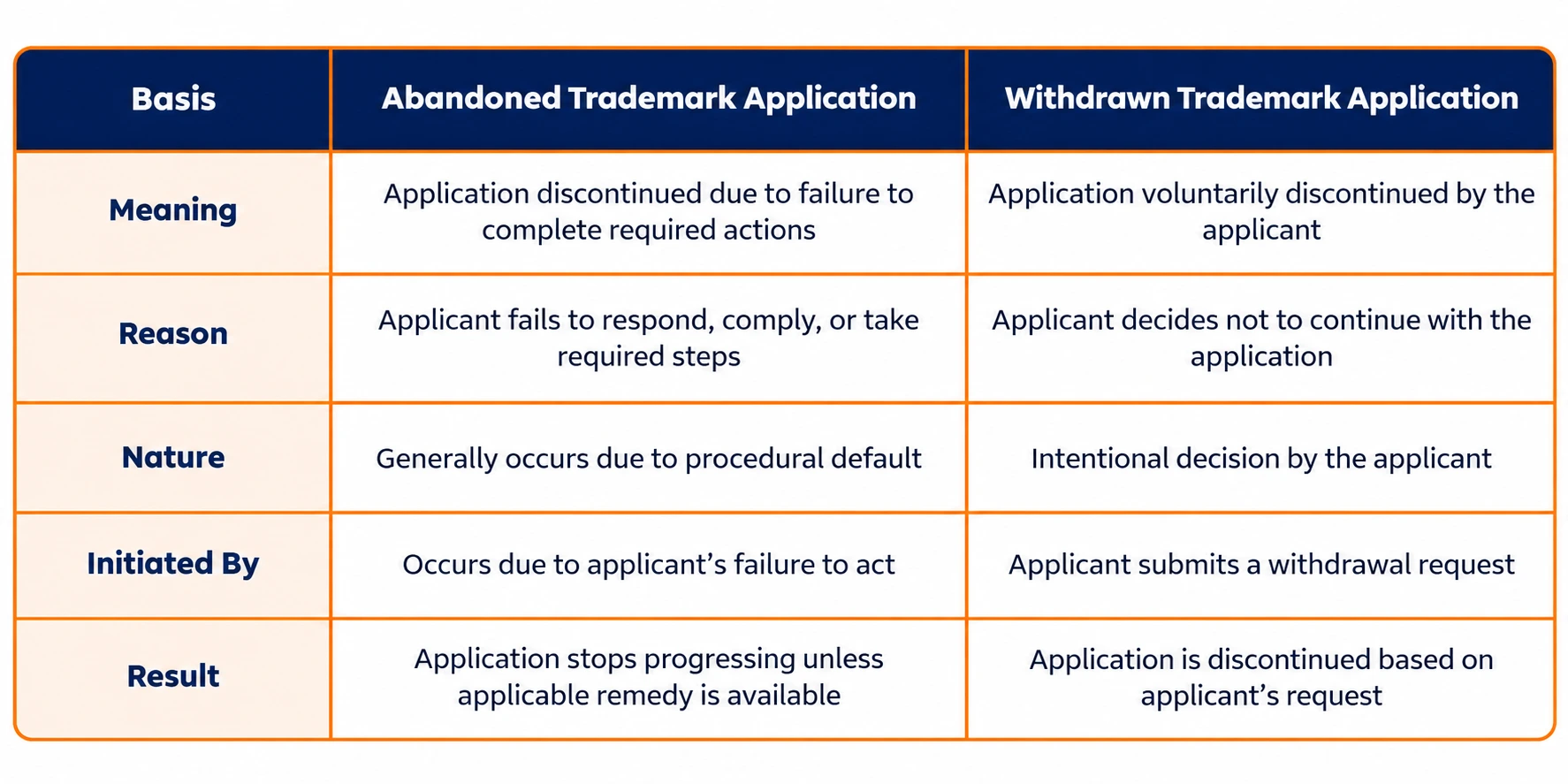
Abandoned Trademark Application vs Withdrawn Trademark Application
Applicants often confuse an Abandoned Trademark Application with a withdrawn trademark application. However, both have different meanings and consequences.
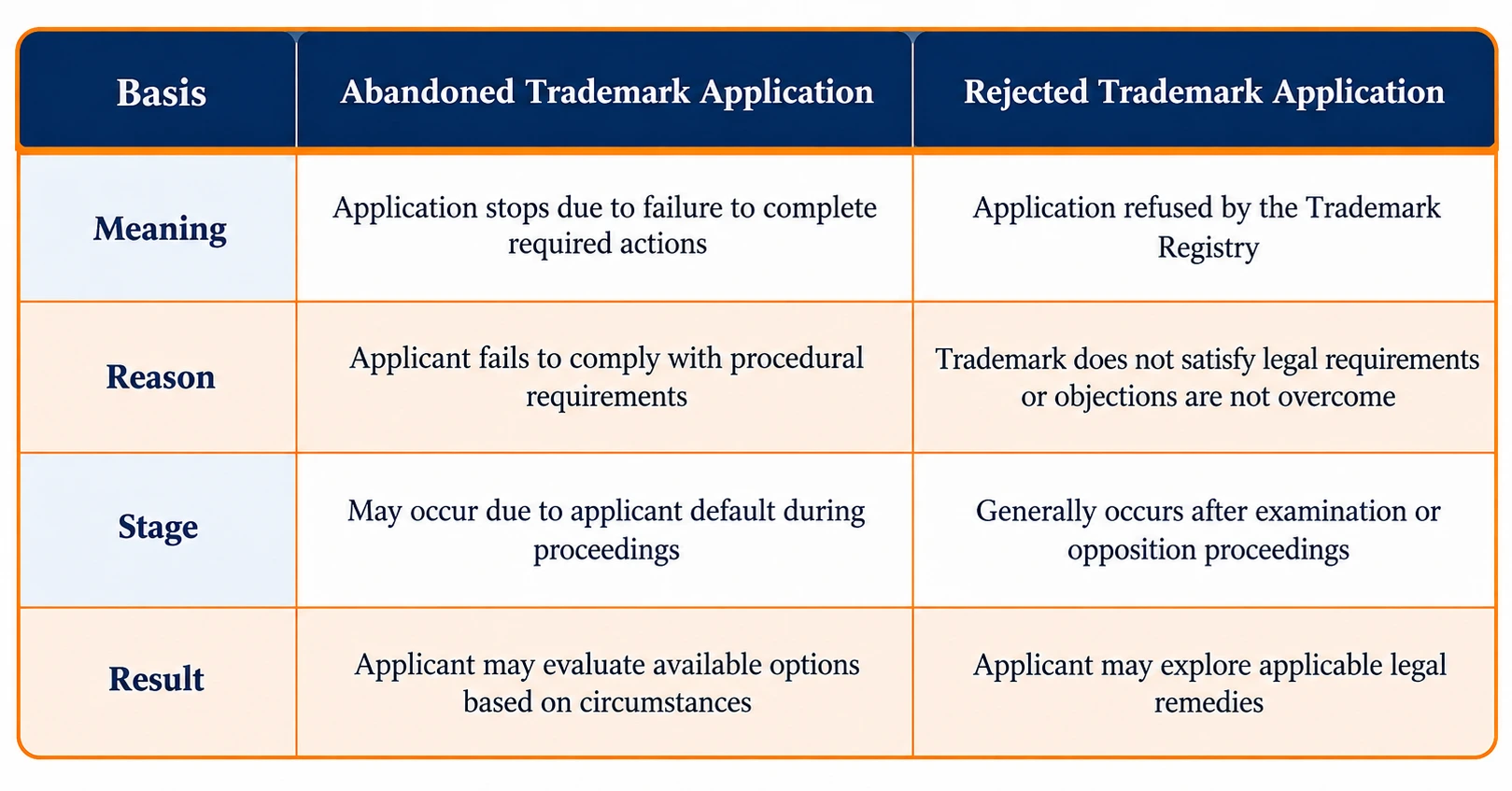
Abandoned Trademark Application vs Rejected Trademark Application
An Abandoned Trademark Application should not be confused with a rejected trademark application. Both situations occur during the trademark registration process but have different legal meanings.
Consequences of an Abandoned Trademark Application
An Abandoned Trademark Application can affect the applicant’s brand protection strategy and may require further evaluation.
1. No Trademark Registration Protection
An abandoned application does not result in trademark registration. Therefore, the applicant does not receive the statutory rights available to a registered trademark owner.
Registered trademark protection is available only after successful completion of the registration process.
2. Loss of Application Progress
Once an application is marked abandoned, the progress made during the registration process does not automatically continue.
The applicant needs to review the reason for abandonment and determine whether any available remedy or fresh filing option is appropriate.
3. Additional Time and Cost
If the applicant still requires protection for the brand, a fresh trademark application may be required.
This may involve:
- New filing requirements
- Additional professional assistance
- Fresh examination process
Applicants can review the Trademark Registration Process before proceeding with a new application.
4. Delay in Brand Protection
An Abandoned Trademark Application may delay the applicant’s ability to obtain registered protection for their brand.
This can affect businesses that rely on trademark registration for brand security, licensing, or expansion plans.
Can an Abandoned Trademark Application Be Restored?
An Abandoned Trademark Application may have limited options depending on the reason for abandonment, stage of application, and applicable legal provisions.
Restoration is not automatic and cannot be assumed for every abandoned application.
The applicant should evaluate:
- Reason for abandonment
- Application history
- Applicable legal remedy
- Supporting documents and explanations required
The appropriate action depends on the facts and circumstances of each application.
How to Restore an Abandoned Trademark Application?
The steps to address an abandoned application depend on the reason why it was treated as abandoned.
Step 1: Review Trademark Application History
The applicant should review:
- Trademark application status
- Examination reports
- Hearing details
- Communications issued by the Trademark Registry
This helps identify the reason for abandonment.
Step 2: Evaluate Available Legal Options
After identifying the reason, the applicant should evaluate whether restoration, review, appeal, or fresh filing is suitable.
The available option depends on:
- Nature of default
- Stage of proceedings
- Applicable provisions
Step 3: Submit Required Request or Application
Where applicable, the applicant may need to submit the required request with:
- Explanation for non-compliance
- Supporting documents
- Application details
- Relevant records
The request should address the reason for abandonment and provide necessary justification.
Step 4: Trademark Registry Review
The Trademark Registry reviews the request based on applicable provisions, documents submitted, and circumstances of the case.
The outcome depends on the facts and legal requirements applicable to the application.
How to Avoid Trademark Application Abandonment?
Businesses can reduce the risk of an Abandoned Trademark Application by following proper compliance practices.
Regularly Monitor Trademark Status
Applicants should regularly check updates related to their trademark application.
Using Trademark Watch Services can help businesses monitor similar trademark filings and take timely action for brand protection.
Respond to Examination Reports
Applicants should carefully review examination objections and submit appropriate responses within the applicable process.
Attend Trademark Hearings
If a hearing is scheduled, applicants should ensure proper representation and complete required formalities.
Businesses can take assistance for Trademark Hearing Support to manage hearing-related requirements.
Maintain Updated Details
Applicants should ensure that their contact and application details are updated to avoid missing important Registry communications.
Take Professional Assistance
Trademark procedures involve multiple stages and legal requirements. Professional guidance can help businesses manage documentation, responses, and compliance requirements.
Can You File a New Trademark Application After Abandonment?
Yes, an applicant may file a fresh trademark application after an Abandoned Trademark Application if protection for the mark is still required.
However, the new application will be treated separately and will undergo the regular trademark examination process.
The earlier abandoned application does not automatically transfer:
- Earlier filing date
- Priority benefits
- Registration progress
Before filing a new application, businesses should conduct a proper Trademark Search to identify possible conflicts with existing trademarks.
How Ebizfiling Helps With Abandoned Trademark Applications?
An abandoned trademark application can create uncertainty for businesses trying to protect their brand identity. At Ebizfiling, we help businesses understand their trademark status and evaluate suitable options through:
- Reviewing trademark application history and status
- Identifying reasons behind abandonment
- Guiding businesses on available remedies
- Assisting with documentation and trademark compliance
- Providing business advisory for brand protection strategy
Our experts help businesses make informed decisions based on their trademark requirements and long-term business objectives.
Conclusion
An Abandoned Trademark Application generally occurs when an applicant fails to complete required actions during the trademark registration process. While abandonment can delay brand protection, businesses should carefully review the reason behind abandonment and evaluate available options based on their circumstances.
Timely monitoring of trademark status, proper response to Registry communications, and compliance with applicable procedures can help businesses avoid abandonment and protect their brand effectively.
Frequently Asked Questions
1. Can a trademark application be treated as abandoned for not responding to an examination report?
Yes. Under Rule 33(4) of the Trade Marks Rules, 2017, if the applicant does not respond to the examination report within the prescribed period, the Registrar may treat the application as abandoned. The abandonment arises from the applicant’s failure to prosecute the application after the examination objection has been communicated.
2. Does failure to attend a trademark hearing result in abandonment of the application?
It can. Under Rule 33(7), where the applicant fails to appear at the scheduled hearing and has not filed a reply to the office objection, the Registrar may treat the application as abandoned. Rule 50 also provides for abandonment in specified opposition-related hearing circumstances. Therefore, the exact provision applicable depends on the stage and nature of the proceeding.
3. Can an abandoned trademark application be restored by simply filing a restoration request?
No. An abandoned trademark application cannot be restored merely by filing a generic restoration request. The applicant must identify the specific provision and procedural stage under which the application was abandoned and determine whether any extension, review, appeal or other remedy is legally available.
The restoration provisions applicable to a registered trademark removed for non-payment of renewal fees are different from the consequences of abandonment of a pending trademark application.
4. Can Section 131 of the Trade Marks Act be used to revive an abandoned trademark application?
Not automatically. Section 131 allows the Registrar to extend certain periods for doing an act where sufficient cause is shown, subject to the conditions prescribed by the Act and Rules. It is not a general power to revive every application that has already been treated as abandoned. The applicant must establish that the particular statutory period and circumstances fall within the scope of the extension mechanism.
5. What is the legal difference between an abandoned and a refused trademark application?
An abandoned trademark application generally ceases to proceed because of a procedural default or failure to prosecute the application. A refused trademark application, on the other hand, results from a decision of the Registrar refusing registration after considering the applicable legal objections or proceedings.
The two outcomes have different procedural backgrounds and should not be treated as interchangeable.
6. Does an abandoned trademark application give the applicant the rights of a registered trademark owner?
No. An abandoned application does not result in registration and therefore does not confer the statutory rights available to the proprietor of a registered trademark under the Trade Marks Act, 1999.
An applicant should distinguish between rights arising from a pending application and the statutory rights associated with registration.
7. Does filing a fresh trademark application after abandonment preserve the earlier application's filing date?
No. A fresh trademark application is a separate application and does not automatically carry forward the filing date, priority position or prosecution history of the abandoned application.
The new application is considered independently, and the applicant should assess the availability of the mark against existing and pending trademark rights before refiling.
8. Can an applicant file a new trademark application after the earlier application is abandoned?
Yes. An applicant may generally file a fresh application if protection for the mark is still required. However, the fresh application does not revive the earlier application and must undergo the applicable registration process independently.
Before refiling, the applicant should review why the earlier application was abandoned and conduct an updated trademark search to identify possible conflicts.
9. Can Ebizfiling help determine why a trademark application has been marked abandoned?
Yes. Ebizfiling can assist in reviewing the trademark application status and available application records to identify the procedural reason associated with the abandoned status. Based on the application history, the appropriate next step may involve evaluating an available legal remedy, addressing a pending procedural issue where possible, or considering a fresh application.
10. Can Ebizfiling assist when abandonment is connected with an examination objection or hearing?
Yes. Ebizfiling provides trademark objection and hearing support for matters involving examination objections and trademark hearings. Assistance may include reviewing the examination objection, preparing the required response or supporting documentation, and providing procedural support for hearing-related matters. The appropriate course of action depends on the application’s current status and the proceedings recorded by the Trademark Registry.





Renew Your Trademark
Renew your Trademark for further 10 years and enjoy the benefits. Prices starting at INR 11999/- only.
About Ebizfiling -



Reviews
Akshay Sharma
18 Apr 2022I took a TM service for my Tea Brand, wonderful service with humble staff, and provided solutions on time. Recommended for all
Dev Desai
19 Nov 2021Loves their services
Mansi Mehra
14 Jul 2018I really appreciate the selfless support shown by your team. Cheers!
October 14, 2026 By Srishti M
GST Compliance Calendar November 2026: Key Due Dates & Filings Introduction The GST Compliance Calendar November 2026 highlights the major GST return filing, tax payment, invoice reporting and year-end adjustment deadlines applicable during the month. It covers regular taxpayers, QRMP […]
October 13, 2026 By Srishti M
October 12, 2026 By Srishti M