


-
September 26, 2026
-
BySiddhi R
Things to Keep in Mind During the ITR Filing Process
Introduction
The ITR Filing Process involves reporting applicable income, deductions, taxes paid and other required information accurately. Using the correct ITR form and checking tax records before filing can help prevent errors or mismatches. Taxpayers should also know the applicable due date and complete return verification after filing.
Quick Insights
- Check the applicable ITR filing deadline before preparing the return.
- Select the correct ITR form according to taxpayer type and income sources.
- Keep income, tax, deduction and investment records ready.
- Reconcile Form 26AS and AIS with personal financial records.
- Verify the filed ITR within the prescribed 30-day period.
What Should You Check During the ITR Filing Process?
Income Tax Return or ITR forms are prescribed forms used for reporting income, deductions, taxes paid, losses, refund claims and other applicable details to the Income Tax Department.
The appropriate form depends on factors such as the taxpayer’s legal status, residential status, nature of income and other applicable conditions. The Income Tax Department provides different ITR forms for AY 2026-27 based on taxpayer category and income profile.
Taxpayers can also refer to the ITR Forms Guide before selecting a return form.
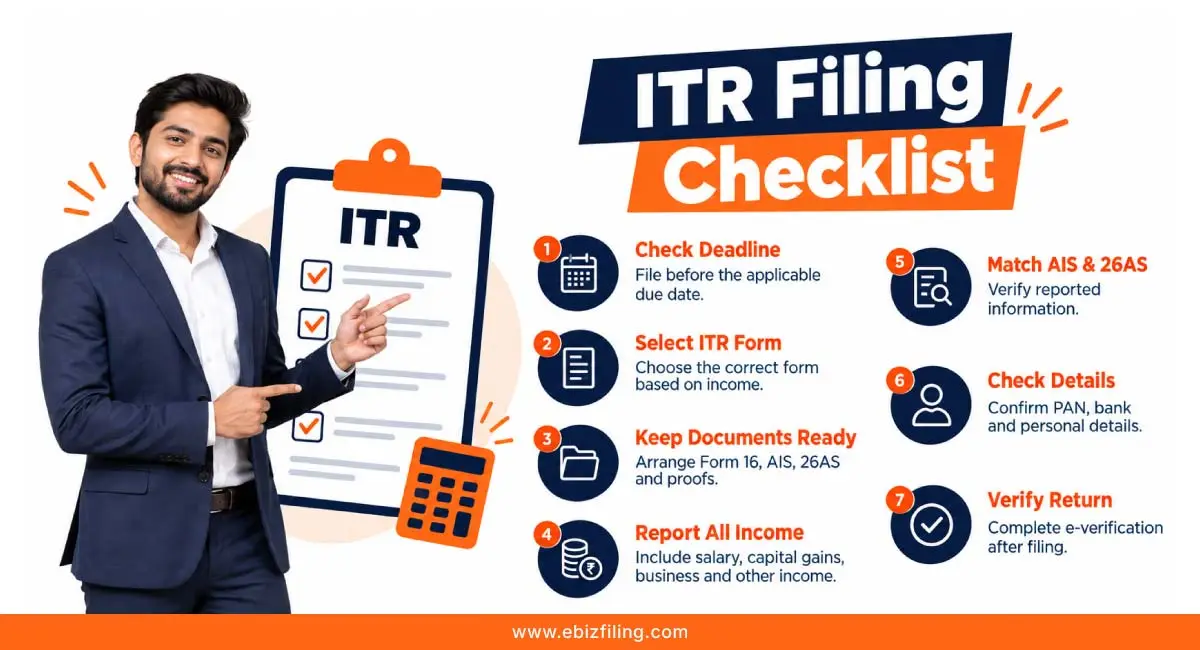
1. Check the Applicable ITR Filing Deadline
The first step in the ITR Filing Process is identifying the correct due date. A single filing deadline does not apply to every taxpayer.
For income earned during FY 2025-26, the return is filed for AY 2026-27 under the Income-tax Act, 1961.
|
Taxpayer category |
Due date for AY 2026-27 (FY 2025-26 income) |
|
Taxpayers falling under the general non-audit category |
31 July 2026 |
| Certain taxpayers required to furnish prescribed reports under the Income-tax Act or applicable provisions (other than audit cases) |
31 August 2026 |
|
Cases requiring audit |
31 October 2026 |
| Cases requiring a transfer pricing report |
30 November 2026 |
The applicable category should be checked before Income Tax Return filing. Filing after the applicable due date may result in consequences such as a late filing fee, interest or restrictions relating to certain losses.
2. Choose the Correct ITR Form
Different ITR forms apply to different taxpayers and income profiles. For example, salary income, capital gains, business income and foreign assets can affect which form can be used.
Using an inapplicable form may result in the return being treated as defective or requiring correction. The taxpayer’s complete income profile should therefore be reviewed before ITR form filing.
3. Keep the Required Documents Ready
Collecting the documents required for ITR filing before starting can help avoid errors and ensure complete information is provided.
Depending on the taxpayer’s circumstances, relevant documents may include:
- Form 16 and Form 16A
- Form 26AS
- Annual Information Statement or AIS
- Bank and interest statements
- Capital gains statements
- Home loan interest certificates
- Records supporting eligible deductions
- Advance tax or self-assessment tax details
These records should be checked against the information being entered during the ITR Filing Process.
4. Report All Applicable Sources of Income
Taxpayers should identify income from all applicable sources, including salary, house property, capital gains, business or profession, interest and other income.
If a person changed jobs during the financial year, income from both the previous and current employer should be considered. Exempt income should also be disclosed in the applicable ITR schedules wherever such disclosure is required.
Complete income reporting is an important part of accurate ITR filing in India.
5. Reconcile Form 26AS and AIS
Form 26AS and the Annual Information Statement should be reviewed before filing the return.
From AY 2023-24 onwards, Form 26AS primarily displays TDS and TCS-related information. AIS provides a broader view of information reported about the taxpayer, including TDS/TCS, specified financial transactions, tax payments and other reported information.
Taxpayers should compare AIS and Form 26AS with their own records before completing the ITR Filing Process. If a transaction shown in AIS is incorrect, the AIS system also allows taxpayers to provide feedback.
6. Check Personal and Bank Details
Incorrect personal or bank information may cause problems during filing, verification or refund processing.
Before e-filing ITR, check:
- Name and PAN details
- Aadhaar details, where applicable
- Mobile number and email address
- Residential and contact information
- Bank account details
- Pre-validation of the bank account where required for refund-related purposes
The information entered in the return should match the taxpayer’s available records.
7. Verify the ITR After Filing
Uploading the return does not complete the ITR Filing Process. The return must also be verified.
If verification is completed after the prescribed period, the return may be treated as furnished on the date of verification, and applicable provisions of the Income-tax Act may apply depending on the circumstances. An unverified return can be treated as invalid.
Taxpayers can therefore complete e-verification soon after filing instead of leaving this step pending.
Professional Help for Income Tax Return Filing
Ebizfiling provides professional assistance with the ITR Filing Process based on the taxpayer’s income and filing requirements.
Ebizfiling can assist with:
- Reviewing income sources and applicable filing requirements
- Identifying the appropriate ITR form
- Reconciling Form 26AS, AIS and available tax records
- Preparing and filing the Income Tax Return
- Assisting with return verification
- Supporting eligible revised, belated or updated return filing requirements
Taxpayers seeking professional support can explore Income Tax Return filing services.
Conclusion
A correct ITR Filing Process involves more than entering income figures in a return form. Taxpayers should check the applicable deadline, select the correct form, reconcile tax information and review personal details before filing. Completing verification within the prescribed period is also necessary to finalise the return filing process.
Frequently Asked Questions
1. What should a taxpayer do if AIS shows income that does not match personal records?
The taxpayer should first compare the AIS entry with bank statements, TDS certificates and other supporting records. If the information reported in AIS is incorrect or only partly correct, feedback can be submitted through the AIS facility before completing the ITR Filing Process.
2. Can ITR form filing be completed if Form 16 contains an error?
A taxpayer should not blindly use incorrect information from Form 16. The salary, deductions and TDS details should be compared with Form 26AS, AIS and supporting records. Any genuine discrepancy should ideally be addressed before ITR form filing.
3. Are e-filing ITR and paying income tax the same process?
No. E-filing ITR means electronically submitting the Income Tax Return, while e-payment refers to paying the applicable tax liability online. A taxpayer may need to pay self-assessment tax before submitting the return if additional tax is payable.
4. What can be done if a mismatch is found during the ITR Filing Process?
The mismatch should first be identified by comparing the return data with AIS, Form 26AS, income records and tax-payment details. Depending on the issue, the information may need correction before filing. Ebizfiling can assist with reviewing these records and preparing the Income Tax Return based on the available supporting documents.
5. Can a person with foreign assets use ITR-1 for Income Tax Return filing?
Taxpayers required to report foreign assets generally cannot file ITR-1. The appropriate ITR form should be selected after considering the taxpayer’s complete income profile and disclosure requirements.
6. What happens if the Income Tax Department treats an ITR as defective?
A return may be treated as defective where required information is incomplete or inconsistent. The Income Tax Department may issue a notice under Section 139(9) requiring the taxpayer to rectify the defect within the prescribed time. The taxpayer can respond by correcting the identified defect through the e-Filing portal.
7. Can a filed Income Tax Return be corrected after discovering an error?
Yes. Subject to applicable conditions and timelines, a taxpayer can file a revised return to correct eligible errors or omissions. Taxpayers should check the applicable provisions and deadlines for the relevant assessment year before filing a revised return. Subject to the conditions and timelines prescribed under Section 139(5) of the Income-tax Act, a taxpayer can file a revised return to correct eligible errors or omissions.
8. What happens if ITR verification is completed after 30 days?
If verification or submission of ITR-V takes place after the prescribed 30-day period, the date of verification may be treated as the date of furnishing the return. Applicable consequences under the Income-tax Act may apply depending on the circumstances. Where a return remains unverified, it can be treated as invalid, subject to the applicable condonation process.
9. Should pre-filled information be accepted without checking during ITR filing in India?
No. Pre-filled information is provided to make ITR filing in India easier, but taxpayers remain responsible for checking its accuracy and completeness. Income, deductions, bank information, TDS and other relevant details should be compared with supporting documents before submitting the return.
10. How can professional assistance help when ITR filing requirements involve multiple income sources?
Cases involving salary from multiple employers, business income, capital gains, house property or other income may require additional reconciliation and selection of the appropriate return form. Ebizfiling can assist with reviewing applicable ITR filing requirements, required documents, return preparation and submission based on the taxpayer’s information and records.





File Income Tax Returns
Filing of Income Tax return is necessary if you have earned any income.
About Ebizfiling -



Reviews
Akshay Apte
16 Apr 2018They have managed my Company’s Annual Filling in a way no one could. We are really happy with their services. Great going!
Deepika Khan
29 Sep 2018I would rate 5/5 for their services, pricing and transparency.
madhu mita
24 Aug 2021It's an awesome experience with Ebizfiling India Pvt Ltd. My special thank you to LATA Mam and i really appreciate her for the services she provide. LATA Mam is so cooperative always and always ready to help and solve any query related to their services.The way they communicate as per the time schedule is really awesome and satisfying, This is second financial year we are connected with Ebizfiling for Annual Returns filing as I really like their work culture, every employees are so cooperatives and available to respond any query whenever needed.Thank you so much to Ebizfiling Team!
October 21, 2026 By Srishti M
Tax Planning for NRI Returning to India Before Becoming ROR Introduction Tax planning for NRI returning to India should start before the person becomes Resident and Ordinarily Resident, also known as ROR. Under the Income-tax Act, 2025, residential status decides […]
October 19, 2026 By Srishti M
October 21, 2026 By Srishti M
TDS and TCS Compliance Calendar November 2026: Compliance Guide Introduction The TDS and TCS Compliance Calendar November 2026 covers important tax deduction, collection, payment, certificate and reporting requirements applicable during the month. It helps businesses, government offices and other responsible […]