


TDS on Sale of Property by NRI: Complete Guide
Introduction
When an NRI (Non-Resident Indian) sells an immovable property located in India, the buyer is required to deduct tax before making payment or crediting the sale consideration to the seller.
TDS on Sale of Property by NRI refers to the tax deduction obligation applicable to the buyer when consideration is paid to a non-resident seller for the transfer of immovable property in India.
The tax treatment for property transactions involving an NRI seller is different from transactions involving a resident seller. The buyer must verify the residential status of the seller and comply with the applicable provisions under the Income-tax Act, 2025. The buyer is responsible for deducting, depositing, and reporting the applicable TDS within the prescribed timelines. Taxpayers can also take professional support for TDS return compliance assistance.
Under the new tax framework, payments made to non-resident sellers for transfer of immovable property are covered under Section 393(2), Table Sl. No. 17 of the Income-tax Act, 2025. The buyer is responsible for deducting, depositing, and reporting the applicable TDS within the prescribed timelines.
From 1 October 2026, eligible resident individuals and HUFs purchasing immovable property from an NRI seller can complete TDS reporting through Form 141 with Schedule E using a PAN-based mechanism without obtaining TAN. However, the requirement to deduct TDS continues.
Quick Insights
- TDS on Sale of Property by NRI applies when a buyer purchases immovable property in India from an NRI seller.
- The buyer is responsible for deducting TDS before making payment or crediting the consideration.
- NRI property transactions are governed by provisions applicable to payments made to non-residents under the Income-tax Act, 2025.
- Such transactions are covered under Section 393(2), Table Sl. No. 17 of the Income-tax Act, 2025.
- From 1 October 2026, eligible resident individuals and HUFs can report specified NRI property transactions through Form 141 without obtaining TAN.
- Correct verification of PAN, residential status, property details, and payment records helps avoid compliance issues.
What is TDS on Sale of Property by NRI?
TDS on Sale of Property by NRI means the tax deducted by the buyer when purchasing an immovable property from a seller who qualifies as a non-resident under the Income-tax Act. When an NRI sells property located in India, the income arising from such transfer may be taxable in India. To ensure tax collection at the time of payment, the buyer is required to deduct TDS from the amount payable to the NRI seller.
The buyer must determine the applicable TDS provisions based on the residential status of the seller. A property transaction with an NRI seller cannot be treated in the same manner as a property purchase from a resident seller. For resident seller transactions, separate property TDS provisions apply. However, when the seller is a non-resident, the buyer needs to follow the applicable non-resident TDS framework under the Income-tax Act, 2025.
Applicability of TDS on NRI Property Sale
Who is Required to Deduct TDS?
The person responsible for making payment or crediting consideration to a non-resident seller is required to comply with TDS provisions under the Income-tax Act, 2025.
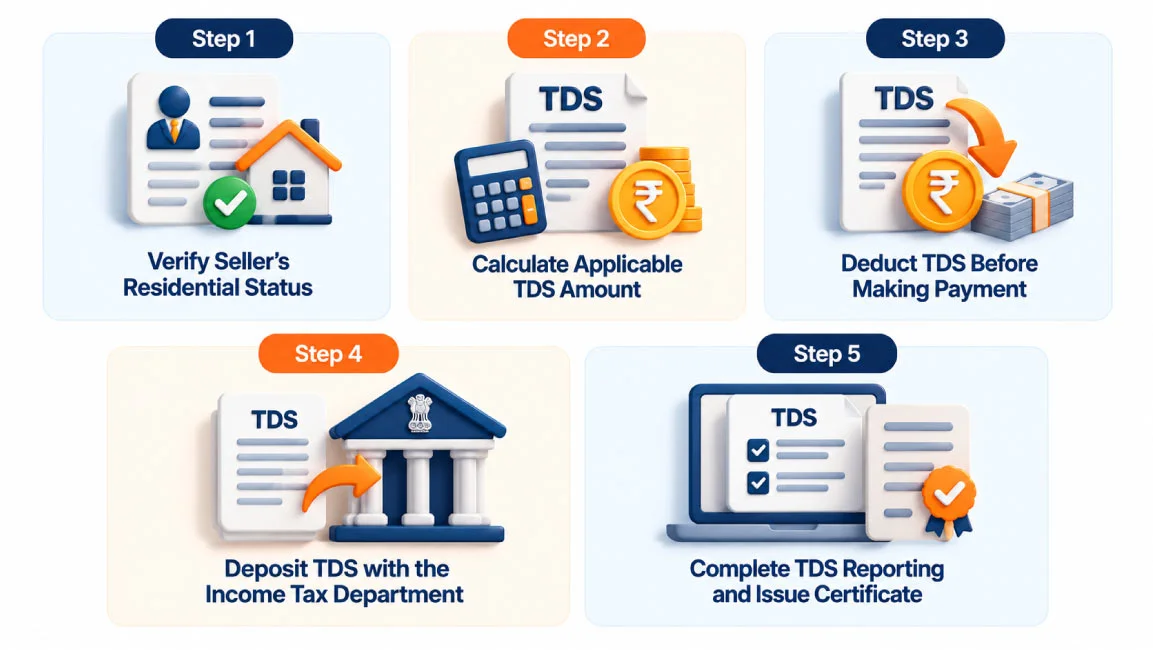
In case of purchase of immovable property from an NRI seller, the buyer must:
- Verify the residential status of the seller
- Obtain PAN details of the buyer and seller
- Calculate the applicable TDS amount
- Deduct TDS before making payment
- Deposit the deducted amount within the prescribed timeline
- Complete the applicable reporting requirements
The PAN-based Form 141 mechanism without TAN, applicable from 1 October 2026, is specifically available to resident individuals and HUFs purchasing immovable property from a non-resident seller under the specified provisions. Other persons responsible for making payments to non-residents must comply with the applicable TDS requirements based on their transaction details and legal obligations.
Buyers should ensure that correct PAN details of both parties are available before completing TDS compliance. Assistance for PAN application services can be taken where required.
Section 393(2) of Income-tax Act, 2025 for NRI Property Transactions
The TDS on Sale of Property by NRI is covered under Section 393(2), Table Sl. No. 17 of the Income-tax Act, 2025, where consideration is paid or credited for transfer of immovable property by a non-resident seller. Under this provision, the buyer is responsible for deducting tax at the applicable rates before making payment or crediting the consideration to the NRI seller.
The residential status of the seller plays an important role in determining the applicable TDS provisions. The buyer should not apply resident seller property TDS provisions to an NRI property transaction because the tax treatment differs based on the status of the seller.
The difference can be understood as:
|
Particulars |
Resident Seller |
NRI Seller |
|
Applicable Framework |
Resident property TDS provisions | Non-resident payment provisions |
| Applicable Provision | Section 393(1) |
Section 393(2) |
|
Seller Status |
Resident | Non-Resident |
| Reporting Mechanism | Applicable resident framework |
Form 141 mechanism for specified cases from 1 October 2026 |
TDS Rate on Sale of Property by NRI
The applicable TDS rate for purchase of immovable property from an NRI seller is determined according to the provisions applicable to payments made to non-residents under the Income-tax Act, 2025.
The buyer must calculate TDS at the applicable rate after considering relevant factors, including:
- Nature of income arising from the transaction
- Applicable tax rates under the Income-tax Act, 2025
- PAN availability of the seller
- Surcharge, wherever applicable
- Health and Education Cess, wherever applicable
Unlike property transactions involving resident sellers, where a specific threshold-based property TDS mechanism applies, transactions involving NRI sellers are governed separately under the non-resident TDS provisions. Since the applicable rate depends on transaction-specific factors, taxpayers may seek Income Tax Consultancy to understand the correct tax treatment.








Reviews
Mamta Tanna
20 Dec 2017More power to the Ebizfiling team for being so generous and systematic in the whole process of ESIC registration.
Mario Dsilva
22 Jan 2020Thank you very much for the valuable information. Certainly it can be a great help for us and people like us who are starting a new company. I am satisfied with EbizFiling’s services and promptness of it’s efficient staff. How to go a long way together.
Prachi Joshi
27 Aug 2018Ebizfiling is a company where you can directly head to for all your compliance problems. You get solutions from the experts and they are very reasonable.
October 2, 2026 By Siddhi R
September 30, 2026 By Srishti M
September 30, 2026 By Srishti M
Compliance Calendar October 2026: Key Filing Dates Introduction The Compliance Calendar October 2026 provides a consolidated view of important statutory deadlines applicable to businesses and taxpayers across GST, income tax, TDS/TCS, ROC, LLP, OPC, PF, and ESI compliances. October […]