


-
September 3, 2026
-
BySteffy A
Right Issue of Shares Under Companies Act 2013: Process & Rules
Introduction
Companies can raise fresh equity from their existing shareholders through a Right Issue of Shares. Section 62(1)(a) of the Companies Act, 2013 governs this method and generally gives existing equity shareholders a proportionate opportunity to subscribe to further shares.
A rights issue helps shareholders maintain their ownership percentage while allowing the company to raise additional funds. This article explains the Right Issue of Shares under Companies Act 2013, including its process, timelines, forms and compliance requirements.
What is Right Issue of Shares Under Companies Act 2013?
A Right Issue of Shares is an offer by a company to its existing equity shareholders to subscribe to additional shares in proportion to their existing paid-up shareholding.
Under Section 62(1)(a) of the Companies Act, 2013, when a company proposes to increase its subscribed share capital by issuing further shares, it must first offer those shares to its existing equity shareholders, subject to the applicable provisions.
Key features of a rights issue include:
- The company offers shares to existing equity shareholders on a proportionate basis.
- Existing shareholders receive the first opportunity to subscribe to additional shares.
- The issue gives shareholders an opportunity to maintain their ownership percentage.
- The company can raise additional equity capital without making a public offer.
- Private and public companies can undertake a rights issue subject to applicable legal requirements.
Listed companies must also comply with applicable SEBI laws and regulations in addition to the Companies Act, 2013.
Section 62 of Companies Act 2013 for Right Issue of Shares
Section 62(1)(a) of the Companies Act, 2013 governs the further issue of share capital through a rights issue.
The main requirements include:
- The company must offer new shares to existing equity shareholders in proportion, as nearly as circumstances permit, to the paid-up share capital on their existing shares.
- The company must make the offer through a notice specifying the number of shares offered.
- The offer must generally remain open for at least 7 days and not more than 30 days.
- Unless the Articles of Association provide otherwise, shareholders have the right to renounce all or part of their entitlement in favour of another person.
- The offer notice should clearly mention the shareholder’s right of renunciation.
- After the offer period expires, or after receiving an earlier refusal from a shareholder, the Board may dispose of the declined shares in a manner that is not disadvantageous to the shareholders and the company.
Rule 12A of the Companies (Share Capital and Debentures) Rules, 2014 prescribes a minimum acceptance period of seven days. A private company may use an offer period shorter than the otherwise applicable minimum period, and may also shorten the three-day dispatch period, where at least 90% of its members give consent in writing or through electronic mode, subject to the applicable MCA exemption notification.
Procedure for Right Issue of Shares
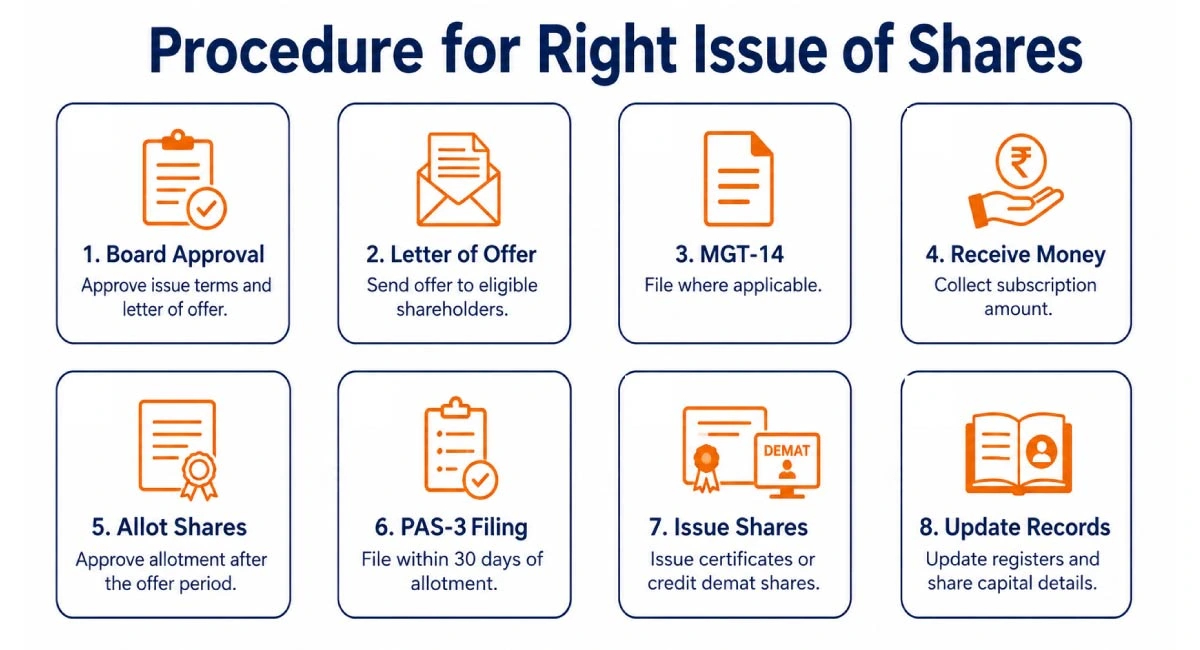
1. Conduct Board Meeting and Approve the Issue
The Board should approve the Right Issue of Shares, including the number of shares, issue price, rights ratio, offer period and letter of offer. A separate shareholders’ resolution is generally not required unless another action, such as increasing authorised share capital, requires member approval.
2. Issue the Letter of Offer
The company should send the offer to eligible equity shareholders stating the number of shares, issue price, rights ratio, payment terms, offer period and renunciation rights.
The offer should generally remain open for at least 7 days and not more than 30 days. The company should dispatch the offer notice to existing shareholders at least three days before the opening of the issue through registered post, speed post, electronic mode, courier or another mode having proof of delivery, subject to applicable exemptions.
3. File Form MGT-14, Where Applicable
For a public company, the Board Resolution approving the issue of securities should generally be filed with the ROC in Form MGT-14 within 30 days under Sections 117 and 179 of the Companies Act, 2013.
Private companies generally do not need to file MGT-14 for Board Resolutions passed under Section 179(3), provided they have not defaulted in filing financial statements under Section 137 or annual returns under Section 92, as required under the applicable MCA exemption notification.
4. Receive Subscription Money
Shareholders accepting the offer should submit their applications with the required amount. The company should maintain records of subscriptions, payments, renunciations and declined offers.
5. Allot the Shares
After the offer period, the Board should approve the allotment of shares. The Board may also dispose of unsubscribed shares in a manner that is not disadvantageous to the company or its shareholders, as permitted under Section 62(1)(a)(iii).
6. File Form PAS-3
The company should file Form PAS-3 with the Registrar of Companies within 30 days from the date of allotment, along with the prescribed allotment details and applicable documents.
7. Issue Share Certificates or Credit Demat Shares
Where physical certificates are permitted, the company should issue share certificates in Form SH-1 within two months from allotment. For dematerialised securities, the company should complete the required depository-related compliances.
8. Update Statutory Records
The company should update its statutory registers, shareholding details, paid-up share capital and relevant Board records after completing the allotment.
Dematerialisation Requirements for Right Issue of Shares
Companies should check whether the dematerialisation provisions apply before starting the Rights Issue Process. Private companies covered by Rule 9B of the Companies (Prospectus and Allotment of Securities) Rules, 2014 must comply with the applicable dematerialisation requirements.
For a private company, other than a Producer Company, that was not a small company as on 31 March 2023, the extended Rule 9B compliance deadline of 30 June 2025 has already passed. Private companies that become subject to Rule 9B based on a later financial year should determine their compliance date under the applicable 18-month timeline prescribed in Rule 9B(2).
Where Rule 9B applies, the company must issue securities in dematerialised form. Before making a rights offer, it must also ensure compliance with the prescribed dematerialisation requirements relating to the securities held by its promoters, directors and key managerial personnel.
A security holder subscribing through a rights offer must ensure that all securities already held in the company are in dematerialised form before such subscription, where Rule 9B applies. Unlisted public companies must separately check the dematerialisation requirements applicable under Rule 9A.
Forms and Documents Relevant to Right Issue of Shares
|
Form/Document |
Purpose |
|
MGT-14 |
Filing specified resolutions with the ROC, where applicable |
|
PAS-3 |
Filing the return of allotment after allotment of shares |
|
SH-1 |
Prescribed format for share certificates, where physical certificates are applicable |
|
SH-7 |
Filing alteration or increase in authorised share capital with the ROC, where required before the rights issue |
|
Letter of Offer |
Communicating the rights entitlement, issue terms and acceptance period to eligible shareholders |
|
Board Resolutions |
Recording approval of the rights issue and subsequent allotment |
Penalty for Non-Compliance With Rights Issue Provisions
Non-compliance with a rights issue may attract different penalties depending on the nature of the default.
For example, where a company fails to file the return of allotment as required under Section 39(4), Section 39(5) provides a penalty of ₹1,000 for each day during which the default continues, subject to a maximum of ₹1 lakh, for the company and the officer in default.
Where the Companies Act, 2013 or the applicable rules do not provide a specific penalty for a particular contravention, Section 450 may apply. Under Section 450:
- The penalty is ₹10,000.
- A continuing contravention may attract an additional ₹1,000 for each day after the first day.
- The maximum penalty is ₹2 lakh for the company.
- The maximum penalty is ₹50,000 for an officer in default or any other person.
Companies should therefore identify the specific provision that has been violated before determining the applicable penalty.
Assistance With Right Issue of Shares Compliance
Ebizfiling assists companies undertaking a Right Issue of Shares with documentation and corporate compliance requirements under the Companies Act, 2013.
Ebizfiling can assist with:
- Reviewing the proposed rights issue and applicable compliance requirements
- Preparing the letter of offer, Board Resolutions and allotment documents
- Checking applicable ROC filings, including Form MGT-14 and Form PAS-3
- Assisting with share capital updates and statutory records under Section 62
Companies can also use Ebizfiling’s Business Advisory and Management Consulting Services for compliance planning and support in corporate decision-making related to the rights issue.
Conclusion
A Right Issue of Shares allows a company to raise additional capital while giving existing equity shareholders an opportunity to maintain their ownership interest.
Section 62(1)(a) of the Companies Act, 2013 sets out the main legal framework for making the offer.
Companies should carefully follow the offer period, dispatch requirements, allotment procedure, PAS-3 filing and applicable dematerialisation requirements. Proper documentation throughout the Rights Issue Process can help the company complete the transaction in compliance with applicable law.
Frequently Asked Questions
1. Can a company proceed with a rights issue if some shareholders do not subscribe?
Yes. A company can proceed even if some shareholders decline or do not subscribe to the offered shares. After the offer period expires, or after receiving an earlier refusal, the Board may dispose of the declined shares in a manner that is not disadvantageous to the shareholders and the company.
2. Is shareholder approval required before issuing shares through a Right Issue of Shares?
Generally, the Board of Directors can approve a rights issue under Section 62(1)(a), and a separate shareholders’ resolution is not required merely for making the rights offer. However, shareholder approval may become necessary if the company needs to increase its authorised share capital, alter its Articles of Association, or take another action that independently requires member approval.
3. Can a company issue rights shares below their market value?
Yes. A company may determine the rights issue price below the prevailing market value, subject to applicable laws. However, Section 53 of the Companies Act, 2013 generally prohibits issuing shares at a discount to their face value, except in cases specifically permitted by law, and listed companies must also comply with applicable SEBI requirements.
4. What happens if a shareholder does not respond to the letter of offer?
If a shareholder does not accept the offer within the stated acceptance period, the company may treat the rights entitlement as declined. The Board may then deal with the unsubscribed shares in accordance with Section 62(1)(a)(iii) and the terms of the offer.
5. Does a company need to increase its authorised share capital before a rights issue?
A company needs to increase its authorised share capital only if the proposed allotment would cause its issued share capital to exceed the existing authorised share capital limit. The company should also check whether its Articles of Association permit the proposed increase.
6. Can rights shares be issued in dematerialised form?
Yes. Rights shares can be issued in dematerialised form, and companies covered by applicable dematerialisation provisions may be required to issue securities only in demat form. Private companies covered by Rule 9B and unlisted public companies covered by Rule 9A should check the applicable requirements before proceeding with the rights issue.
7. What records should a company maintain during the Rights Issue Process?
The company should maintain records relating to the letter of offer, shareholder communications, applications received, subscription money, renunciation details, Board approvals, allotment details, statutory registers and ROC filings to support compliance with the Rights Issue Process.
8. Can a rights issue be offered only to selected existing shareholders?
No. A rights issue under Section 62(1)(a) must initially provide eligible existing equity shareholders with a proportionate opportunity to subscribe to the further shares. The company should not selectively exclude shareholders who are legally entitled to receive the offer, although shareholders may decline or renounce their entitlement where permitted.
9. What happens to the ownership percentage of a shareholder who does not participate?
A shareholder who does not subscribe to the offered shares may face dilution in their ownership percentage if the company allots additional shares to other eligible subscribers or persons entitled to receive them. Participating in the rights issue gives existing shareholders an opportunity to maintain their proportionate ownership.
10. How can Ebizfiling assist with Right Issue of Shares compliance?
Ebizfiling can assist companies with rights issue documentation, Board Resolutions, offer documents, ROC filing requirements, Form PAS-3 and other corporate compliances relating to the further issue and allotment of shares under the Companies Act, 2013.





Increase in Authorise share capital
Get the complete procedure for the increase in share capital with Ebizfiling
About Ebizfiling -



Reviews
Ajay kumar
14 Jun 2019Good service provided by ur staff.
Jayesh Tejani
28 Aug 2017It is a very professional set up and a really dedicated team. You guys did a great job for my Trademark application in a really short time. All the best to you and your team.
Dhruvi Agarwal
27 Feb 2018They have it all! You tell them your problem and they will have you covered with their services and support. Great going, Ebizfiling.
July 9, 2026 By Steffy A
AML obligations for Practicing CS under FIU-IND Framework Introduction AML obligations for Practicing CS are becoming increasingly important in today’s evolving regulatory environment, where the role of Practicing Company Secretaries has expanded beyond traditional compliance functions into areas involving corporate […]
June 26, 2026 By Steffy A
Why Online Legal Services Are Growing in India? Introduction The legal industry is evolving rapidly as technology reshapes how legal assistance is delivered. In India, online legal services are growing because they address historical challenges such as court backlogs, complex […]
June 26, 2026 By Steffy A
Why More Businesses Are Choosing Outsourcing Legal Work? Introduction Businesses are increasingly turning to outsourcing legal work to manage compliance, contracts, and regulatory responsibilities more efficiently. Through Legal Process Outsourcing, companies can reduce operational costs while gaining access to experienced […]