

-
July 15, 2026
-
BySteffy A
Legal Grounds for Trademark Rectification in India
Overview
The legal grounds for trademark rectification arise when a registered trademark is wrongly registered, contains incorrect details, conflicts with an earlier mark, or is not being used in the market. Under Sections 47 and 57 of the Trade Marks Act, 1999, an aggrieved person can file for trademark rectification to correct, cancel, or remove such entries from the Trademark Register and protect genuine trademark rights. This article explains the meaning of trademark rectification, the relevant legal provisions, the legal grounds for trademark rectification, the filing procedure, and the applicable time limits.
Meaning of Trademark Rectification
Trademark rectification refers to the legal process of correcting, varying, cancelling, or removing an entry in the Register of Trade Marks when a registered trademark contains an error, was wrongly registered, or no longer complies with the provisi Trademark rectification may be necessary for various reasons, such as changes in the business’s name, address, or ownership. To understand the process in detail, you can also read our guide on trademark rectification.
Legal Grounds for Trademark Rectification in India
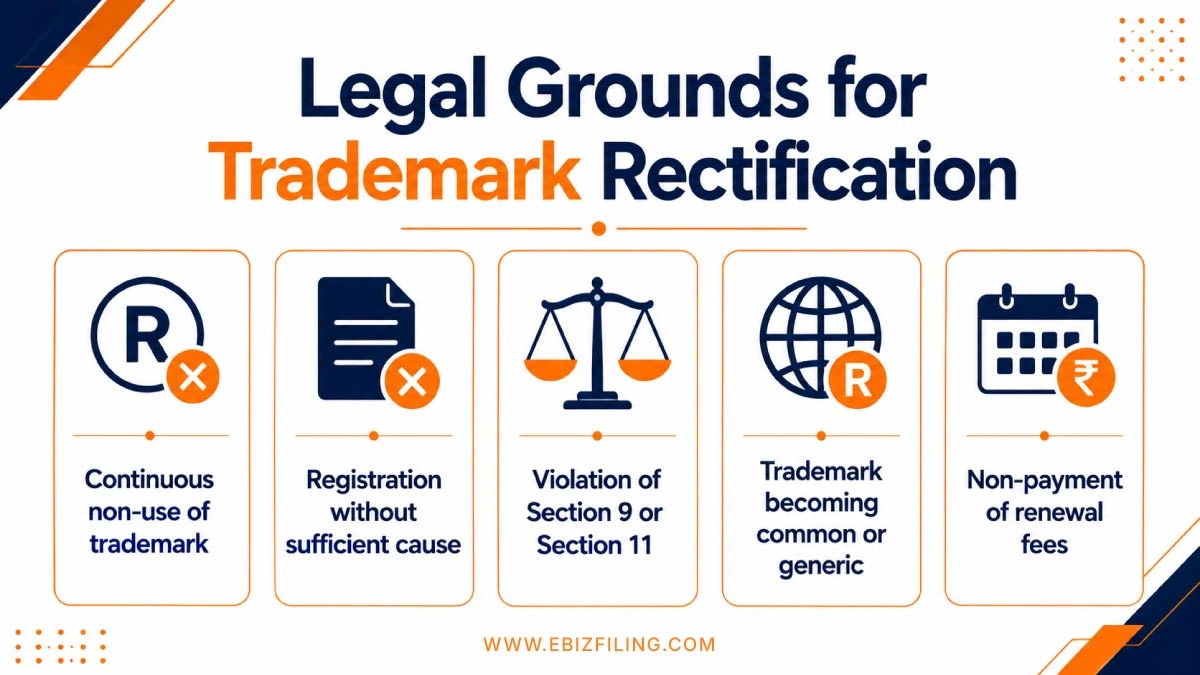
The primary legal grounds for Trademark Rectification in India are provided under Section 57 of the Trade Marks Act, 1999 along with Section 47, Section 9 and Section 11 of the Trade Marks Act, 1999. The detailed understanding of these legal grounds for trademark rectification is as follows:
1. Continuous Non-Use of the Mark
Under Section 47 of the Trade Marks Act, 1999, there are two situations in which a trademark may be removed:
- The mark was registered without a genuine commercial intent to use it, and no actual business transactions have taken place.
- The trademark has not been used for a continuous period of five years and three months from the date on which it was entered in the Register immediately before the filing of the rectification application.
2. When Registration is Obtained Without Sufficient Cause
Section 57 of the Trade Marks Act, 1999 provides the legal grounds for rectification of the Register of Trade Marks.
Clause (1) and clause (2) of Section 57 of the Act provide that the tribunal may cancel or vary a trade mark registration on the grounds of contravention or failure to observe a condition of registration. A party who feels wronged by an entry recorded in the register has a statutory right to request correction under Section 57. The said right is circumscribed by certain requirements, such as:
- Contravention or failure to observe the requirement listed in the register about the trade mark registration. [Section 57(1)].
- Rectification may also be sought where the register contains omissions relating to disclaimers, conditions, or limitations attached to the registered mark.
- The registration was obtained by fraud or false representation of facts; the registered mark was identical to an existing registered mark; or there is another reason why the inclusion in the register is made without sufficient justification. [Section 57(2)].
- Error or defect in any entry made in the register [Section 57(2)].
- The mark wrongly remains on the register, i.e., it is contrary to some of the provisions of the Act or is likely to confuse the public and trade; for example, the mark is in contravention of Section 9 and Section 11 of the Act. [Section 57(2)].
- The renewal fee has not been paid.
- Clause (4) of Section 57 states that following notification and an opportunity for the parties involved to be heard, the Registrar or the High Court, may either cancel, vary, make, or remove the entry in question.
- Section 31(1) of the Act provides that the original registration of the trade mark shall be prime facie evidence of the validity of the mark in all the legal proceedings relating to a trade mark, including in an application under Section 57.
- An application for rectification of a registered trade mark is required to be filed before the same Trade Mark Registry where the application for its registration was filed. The procedure before the Registrar is prescribed under Rules 97 to 100 of the Trade Marks Rules, 2017. In the event of a collective mark or certificate mark, an application pursuant to Section 57 must be submitted in duplicate on Form TM-O. A statement of the case outlining the facts supporting the application, the relief sought, and the nature of the applicant’s interest must be submitted with the application.
- Although the Registrar of Trade Marks has the authority to hear rectification petitions, matters involving pending infringement suits are generally handled by the jurisdictional High Court.
3. Contravention of Absolute and Relative Grounds
A rectification petition can be filed when the Trademark Registry has approved a mark that should not have been registered in the first place.
- Section 9: This applies when the trademark is too common, descriptive, or not unique enough to identify one business.
- Section 11: This applies when the trademark is too similar to an earlier registered or well-known mark and may confuse customers.
In such cases, the trademark can be cancelled or removed from the register.
4. When a Brand Name Loses Its Uniqueness
One of the legal grounds for Trademark rectification is when the trademark loses its protection and becomes common. For example, if people start using a brand name as a general term, the mark may become weak. However, the owner can protect it by actively using, promoting, and enforcing the brand name.
5. No Payment of Fees for renewal
A trademark is registered for a ten-year cycle. If the proprietor fails to renew the mark within the prescribed statutory timelines and ignores the subsequent grace periods, the registration becomes legally vulnerable. The entry can be rectified or entirely removed from the register due to the failure to maintain statutory compliance.
Procedure for Trademark Rectification
After understanding the legal grounds for trademark rectification, it is important to understand the procedure for filing a trademark rectification application.
Drafting of an application
The first step in rectification is drafting the application and including all necessary information accurately. The document should be properly drafted since any mistake in it may lead to rejection of the application.
Form filling
The applicant must file Form TM-O before the Registrar of Trade Marks along with the prescribed fee and supporting documents. The applicant cannot proceed further before applying for rectification of the relevant trade mark without completing this step.
Documents submission
The necessary supporting documents need to be submitted before the Registrar or the jurisdictional High Court, wherever applicable in proper form with all supporting documents after all the requisition information is provided on the form. The applicant must submit all supporting documents relevant to the grounds for rectification, along with identity or authorization documents wherever applicable.
Documents verification
During this stage, the submitted documents are verified by the concerned authority. If satisfied, the application proceeds further; otherwise, objections may be raised or the application may be rejected.
Final order
After giving both parties an opportunity to be heard and considering the evidence on record, the Registrar or the High Court may pass an appropriate order to rectify, vary, cancel, or remove the relevant entry from the Register of Trade Marks.
If you are unsure about the right filing steps, we can help you understand the trademark rectification process and prepare the application properly.
Time Limit for Trademark Rectification
The time limit for filing a trademark rectification application depends on the legal grounds for trademark rectification. Under Section 57 of the Trade Marks Act, 1999, no fixed limitation period is prescribed for every case. However, under Section 47, a trademark can be removed for non-use if it has not been used for a continuous period of five years and three months from the date of registration.
For a better understanding of practical timelines and expenses, you can also read our guide on the timeframe and cost of trademark rectification., the filing procedure, and the applicable time limits.
Ebizfiling’s Practical Approach to Trademark Rectification
Our team adopts a detailed legal approach toward trademark rectification matters. We first understand why the trademark record needs correction, whether it is due to a wrong entry, non-use, ownership change, or an issue in the register. This helps us suggest the right course of action instead of filing without proper review.
- We begin with a clear review of the trademark record
- Then identify the exact legal issue before preparing the application
- Our experts guide you on whether rectification, cancellation, or removal is suitable
- We assist with application filing and follow-up
Trademark record showing wrong details?
Let Ebizfiling help you file a proper trademark rectification application and fix errors before they affect your brand rights.
Conclusion
Legal grounds for trademark rectification help business owners fix trademark records that do not match the real details of the brand. If a record has the wrong owner name, missing information, unused mark status, or any issue under Section 57 of the Trade Marks Act, 1999, it should not be ignored. Timely rectification can prevent problems during renewal, transfer, or brand protection. Since the process depends on facts and documents, proper legal guidance can help avoid mistakes during filing.
FAQs on Trademark Rectification
1. Is there any form for Trademark Rectification?
Yes, Form TM-O is used for filing a trademark rectification, cancellation, or removal request. The form should be supported with facts, legal grounds for trademark rectification, relief sought, and relevant documents.
2. Where to file for trademark rectification application?
A trademark rectification application is usually filed in the same Trade Marks Registry where the original trademark registration application was filed. You may also seek professional assistance from Ebizfiling before filing a trademark rectification application.
3. What should be checked before filing for trademark rectification?
Before filing, check whether the issue needs trademark rectification or only a simple correction. The legal grounds for trademark rectification, documents, trademark details, and facts should match properly because wrong filing may delay the process or lead to rejection. Ebizfiling can review the record, identify the right legal grounds for trademark rectification, and help prepare the application with proper supporting documents.
4. How is trademark rectification different from trademark opposition?
Trademark opposition is filed before a trademark is registered, and Trademark rectification is filed after the registration, when the mark is already on the register and needs correction, cancellation, or removal.
5. Is trademark rectification required if a registered trademark has not been used for a long time?
Yes. Section 47 of the Trade Marks Act,1999, provides that a registered trademark may be removed if it was registered without genuine intention to use or has not been used for a continuous period of five years and three months.
6. How Ebizfiling can help in choosing the right filing option?
Ebizfiling can review the trademark record and identify whether the matter needs a simple correction, trademark rectification, cancellation, or removal. This helps in choosing the correct filing route and avoiding unnecessary delay or rejection.
7. When is it required to file a Trademark rectification application?
A trademark rectification application can be filed when a mark has incorrect details, was wrongly registered, conflicts with an earlier mark, was obtained by fraud, or is not being used as required under law.
8. What does Trademark rectification mean under Section 57 of the Act?
Section 57 of the Trade Marks Act, 1999 explains that the Registrar or the High Court has the power to cancel, vary, or rectify the trademark register. It allows any “aggrieved person” to request the removal or correction of a registered mark if it contains errors, lacks use, or was registered improperly
9. What type of documents are required for trademark rectification?
The documents for trademark rectification requires trademark registration details, identity and address proof, authorization letter, statement of case, proof of non-use, proof of wrong entry, or evidence showing conflict with an earlier mark.
10. How Ebizfiling Experts can help in making the process easier?
Expert help from Ebizfiling can make the process easier by checking the trademark records, identifying the legal grounds for trademark rectification, filing Form TM-O, arranging documents, and assisting with filing.





Rectify Your Trademark
Trademark Rectification, Grounds of Trademark Rectification, Filing Trademark Rectification, Indian Trademark Act 1999 Ebzifiling.
About Ebizfiling -



Reviews
Akshay Shah
17 Jun 2017I would give them 4 stars for their efficiency and pricing.
arti ittannavr
18 Apr 2022Took trademark registration from Ebizfiling india private limited service was excellent thank you 😊
Govindaraju H S gopi
29 Mar 2022I took my company registration from Ebizfiling india private limited and also other service... Good platform to any online services as work shall be done with most effient manner
September 9, 2026 By Srishti M
Trademark Royalty to Foreign Parent Company: Complete Guide Introduction Multinational groups often operate through subsidiaries across different countries, where intellectual property (IP), including trademarks, brand names and logos, may be owned or managed by different entities. A common cross-border […]
September 11, 2026 By Steffy A
Top 10 CA Firms in India- 2026 updated list Introduction Many Indian businesses suffer tax penalties due to the strict tax deadlines and the many confusing tax laws. As a business owner in India, the best option is to find […]
January 30, 2026 By Steffy A
How to Trademark a Brand Name in the USA ? Introduction Many founders believe that registering a company in the USA automatically protects their brand name. Unfortunately, that is not true. A brand name is protected only when it is […]