


-
September 5, 2026
-
BySteffy A
How to Start a Trading Company for Wholesale Business in India?
Introduction
Starting a trading company for Wholesale Business can be a practical way to enter India’s B2B supply chain. A wholesale trader generally purchases goods in bulk from manufacturers, importers, or distributors and resells them to retailers, dealers, institutions, or other businesses.
In this article, the phrase trading company for Wholesale Business is used in a commercial and SEO sense. Legally, the business may operate as a sole proprietorship, partnership firm, Limited Liability Partnership (LLP), or incorporated company, depending on the structure selected.
Before starting operations, promoters should identify the products they intend to trade, choose the right legal structure, check applicable registrations, and determine whether product-specific licences are required.
Quick Insights
- A trading company for Wholesale Business generally purchases goods for resale rather than manufacturing them.
- Wholesale businesses commonly operate on a B2B model.
- The business can operate as a proprietorship, partnership, LLP, or company.
- GST registration depends on turnover and other applicable provisions.
- Certain products may require FSSAI, drug, Legal Metrology, import, or other regulatory approvals.
What Is a Trading Company for Wholesale Business?
A trading company for Wholesale Business acts as a link between suppliers and business buyers. It purchases goods from manufacturers, importers, or large distributors and supplies them to retailers, resellers, institutional customers, or industrial buyers.
For example, a wholesale trader may purchase electrical products directly from a manufacturer and supply them to retailers across multiple cities.
Depending on the business model, a trading company for Wholesale Business may operate as a wholesaler, distributor, stockist, merchant trader, or importer. The model selected can affect inventory requirements, working capital, pricing, logistics, customer credit, and compliance obligations.
Who Should Start a Trading Company for Wholesale Business?
A trading company for Wholesale Business may be suitable for entrepreneurs who want to:
- Purchase goods in bulk and resell them to businesses
- Supply retailers, dealers, distributors, or institutions
- Build a regional or national distribution network
- Become an authorised distributor or stockist
- Import goods into India for commercial resale
- Formalise an existing wholesale trading activity
Before starting, promoters should assess the proposed product category, expected turnover, target customers, geographical market, and working-capital requirements.
Best Business Structures for a Wholesale Trading Business
The legal structure affects ownership, liability, compliance, taxation, and future scalability.
Sole Proprietorship
A proprietorship may suit a small business owned and managed by one person. It is relatively simple to operate, but the proprietor and business are not separate legal persons. The proprietor may therefore be personally responsible for business liabilities.
Partnership Firm
A partnership can be suitable where two or more persons want to carry on the wholesale business together. The partnership deed should clearly specify capital contribution, profit sharing, responsibilities, and management rights.
Limited Liability Partnership
An LLP provides a separate legal identity and generally offers limited liability to its partners. It can be useful for promoters seeking a structured business form with partnership-style management.
Businesses considering this structure can explore LLP Registration Online.
Private Limited Company
A private limited company may be suitable for a trading company for Wholesale Business planning to expand, add shareholders, raise investment, or create a wider distribution network.
It provides limited liability and perpetual succession but also involves regular corporate compliance.
Businesses considering incorporation can explore Private Limited Company Registration.
Promoters comparing these structures can also read our detailed guide on LLP vs Private Limited Company.
Registrations Required for a Trading Company for Wholesale Business
There is no single registration that authorises every wholesale activity. The registrations required for a trading company for Wholesale Business depend on its legal structure, turnover, location, products, and business model.
Business Registration
The first step is to establish the selected business structure.
Companies and LLPs are incorporated through the Ministry of Corporate Affairs, while proprietorships and partnership firms follow different establishment and registration procedures.
The proposed wholesale or trading activity should also be appropriately reflected in the relevant incorporation or business documents.
PAN and Business Bank Account
The business should use the applicable PAN and maintain a suitable business bank account.
Keeping personal and business transactions separate also helps maintain proper accounting, tax records, and financial reconciliation.
GST Registration for Wholesale Trading Businesses
GST is particularly relevant for a trading company for Wholesale Business because wholesale purchase and sale transactions commonly involve taxable supplies.
For persons engaged exclusively in the supply of goods, the GST registration exemption threshold may generally extend up to ₹40 lakh in applicable States and Union Territories, subject to prescribed conditions and exclusions.
The applicable registration threshold may be lower in specified States or Union Territories. Compulsory-registration provisions and other exclusions should also be considered.
Therefore, GST applicability should not be determined only on the basis of turnover.
Once registered, a wholesale business should:
- Issue proper tax invoices
- Apply correct GST rates
- Use appropriate HSN classification
- Maintain purchase and sales records
- File applicable GST returns
- Reconcile input tax credit
- Review e-way bill requirements where applicable
Businesses requiring registration can explore GST Registration Online.
Udyam Registration for Wholesale Traders
A trading company for Wholesale Business engaged in eligible wholesale activity can obtain Udyam Registration.
Wholesale and retail trade have been included within the Udyam Registration framework. However, benefits available to such trading activities are restricted to Priority Sector Lending.
Therefore, wholesale traders should not assume that obtaining Udyam Registration automatically provides every MSME benefit available to other eligible enterprises.
Businesses can review MSME/Udyam Registration before applying.
IEC Registration for Import and Export Wholesale Businesses
A trading company for Wholesale Business planning to import goods into India or export goods outside India should review Importer Exporter Code requirements.
Persons intending to import or export goods generally require an IEC, subject to specified exemptions.
Businesses involved in cross-border trade can explore IEC Registration.
However, IEC may not be the only compliance requirement. Depending on the goods, importers may also need to check customs rules, product standards, labelling requirements, quality-control orders, or other sector-specific approvals.
Does a Wholesale Trading Business Need Product-Specific Licences?
Yes, depending on the products being traded.
Registering a business or obtaining GST registration does not automatically permit a trading company for Wholesale Business to deal in every type of product.
Food Products
A wholesale business dealing in food products must obtain the applicable FSSAI registration or licence based on the nature and scale of its food business and the prescribed eligibility criteria.
Businesses dealing in food products can review the appropriate FSSAI Registration requirements before commencing operations.
Pharmaceutical Products
Businesses trading in pharmaceutical products should examine the applicable requirements under the Drugs and Cosmetics framework.
Wholesale sale, stocking, distribution, or offering certain categories of drugs for sale may require an appropriate drug licence.
Packaged Commodities
Legal Metrology requirements should also be reviewed where packaged commodities are involved.
Rule 27 of the Legal Metrology (Packaged Commodities) Rules specifically deals with registration of manufacturers, packers, and importers.
A wholesale trader does not become liable for Rule 27 registration merely because it resells packaged goods. Applicability depends on the actual role performed by the business.
Documents Required to Start a Trading Company for Wholesale Business
The exact documents depend on the legal structure and registrations involved. A trading company for Wholesale Business may commonly require:
- PAN of promoters
- Identity proof
- Address proof
- Registered office or business-premises proof
- Rent agreement or ownership document, where applicable
- No Objection Certificate from the owner, where required
- Email ID and mobile number
- Incorporation or partnership documents
- Business activity details
- Product details
- Bank-related documents
- Licence-specific supporting documents
For a broader checklist, read our guide on documents required for business registration.
How to Start a Trading Company for Wholesale Business in India?
The process of starting a trading company for Wholesale Business can broadly be divided into the following stages:
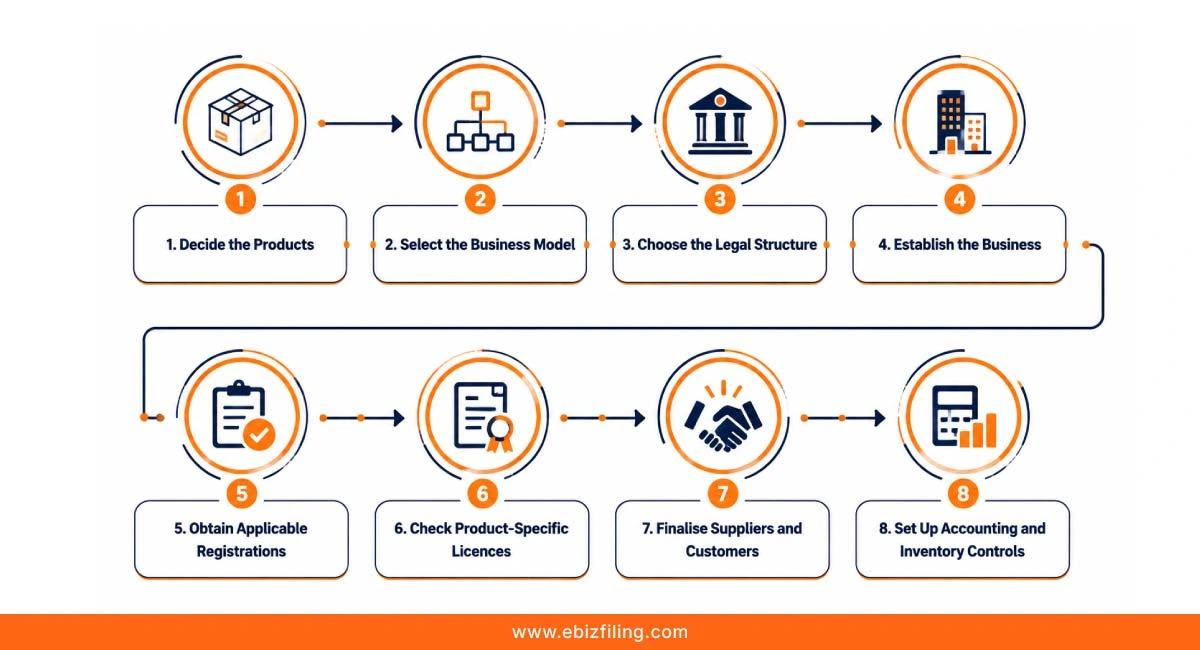
1. Decide the Products
Identify the products you intend to trade, expected margins, suppliers, storage requirements, and whether any sector-specific regulations apply.
2. Select the Business Model
Decide whether the business will operate as a wholesaler, distributor, stockist, importer, or merchant trader.
3. Choose the Legal Structure
Select a proprietorship, partnership, LLP, or private limited company after considering liability, ownership, compliance, and future expansion.
4. Establish the Business
Complete the incorporation or other establishment requirements applicable to the selected structure.
5. Obtain Applicable Registrations
A trading company for Wholesale Business should review GST, Udyam, Shops and Establishments, IEC, and other applicable registrations.
6. Check Product-Specific Licences
Identify whether FSSAI, drug licensing, Legal Metrology, import controls, or other sector-specific approvals are required.
7. Finalise Suppliers and Customers
Clearly document pricing, payment terms, credit periods, minimum order quantities, delivery responsibilities, warranties, and return policies.
8. Set Up Accounting and Inventory Controls
Maintain purchase invoices, sales invoices, inventory records, receivables, payables, and tax reconciliations from the beginning.
GST and Tax Compliance for Wholesale Trading Companies
Regular tax compliance is important for a trading company for Wholesale Business because wholesale operations often involve high transaction volumes.
Businesses should regularly review:
- HSN classification
- Applicable GST rates
- Tax invoices
- Input tax credit
- Purchase and sales reconciliation
- Interstate transactions
- E-way bills, where applicable
- GST returns
- Credit and debit notes
- Income-tax compliance
A proper accounting system also helps monitor inventory, outstanding customer payments, supplier liabilities, and cash flow.
Benefits of Starting a Trading Company for Wholesale Business
A properly structured trading company for Wholesale Business can provide several commercial advantages, including:
- Higher-volume B2B transactions
- Repeat retailer and institutional customers
- Opportunities to work with multiple manufacturers
- Expansion through dealer and distributor networks
- Interstate business opportunities
- Import and export potential
- Scope for warehousing and distribution
- Ability to expand the product portfolio
However, profitability depends on more than sales. Inventory turnover, supplier pricing, logistics costs, credit periods, customer defaults, and operating expenses should also be closely monitored.
Mistakes to Avoid in Wholesale Trading Business
Promoters starting a trading company for Wholesale Business should avoid:
- Choosing a business structure without considering liability
- Trading regulated products without applicable licences
- Applying incorrect GST rates or HSN codes
- Maintaining poor inventory records
- Providing excessive customer credit
- Mixing personal and business transactions
- Ignoring state-specific compliance
- Assuming Udyam Registration provides all MSME benefits
- Importing regulated products without checking applicable approvals
Reviewing these areas before commencing operations can reduce compliance and operational risks.
How Can Ebizfiling Help Start a Wholesale Trading Business?
Starting a wholesale trading business involves more than choosing products and finding suppliers. The right legal structure, tax registrations, licences, and ongoing compliance can directly affect how smoothly your business operates and expands. Depending on your activities, you may need company or LLP registration, GST Registration, Udyam Registration, IEC Registration, and product-specific approvals.
Ebizfiling helps entrepreneurs set up a trading company for Wholesale Business with the registrations and compliance support relevant to their business model. Our team can also help identify additional requirements for food, imported goods, pharmaceuticals, or other regulated products.
Ready to start your wholesale trading business? Connect with Ebizfiling today and get professional assistance with registration, licensing, and compliance.
Conclusion: Setting Up a Trading Company for Wholesale Business
A trading company for Wholesale Business can be a scalable business model for entrepreneurs looking to connect manufacturers and suppliers with retailers, distributors, and institutional buyers.
A compliant setup starts with selecting the right legal structure, obtaining applicable registrations, checking product-specific licences, and establishing proper accounting, tax, inventory, and credit-control systems. Businesses should also review compliance whenever they introduce new products, enter new markets, or begin import or export activities.
Frequently Asked Questions
1. Can a wholesale trader sell goods below the purchase price under GST?
Yes. GST does not generally require goods to be sold above their purchase price. Where the supplier and recipient are unrelated and price is the sole consideration, the transaction value can ordinarily be accepted as the taxable value under Section 15. Different valuation rules may apply to related-party or other specified transactions.
2. How are free samples distributed by a wholesale trader treated under GST?
Goods supplied completely free of cost generally do not constitute a taxable supply unless the transaction falls under Schedule I. However, input tax credit attributable to goods disposed of as gifts or free samples is generally blocked under Section 17(5)(h). This should be distinguished from “buy one, get one free” offers, where consideration is effectively charged for the combined supply.
3. What happens to input tax credit if a wholesaler does not pay a supplier within 180 days?
Where a registered recipient has availed ITC but fails to pay the supplier the value of the supply along with tax within 180 days from the invoice date, the applicable ITC amount must be reversed or paid with applicable interest in accordance with Section 16 and Rule 37. The credit can generally be re-availed after the supplier is subsequently paid.
4. Can year-end or volume discounts reduce the taxable value under GST?
A discount given after supply can be excluded from the taxable value only when the conditions under Section 15 are satisfied. Broadly, the discount should arise from an agreement made at or before the supply, be specifically linked to relevant invoices, and the recipient should reverse the corresponding ITC. A later commercial discount that does not satisfy these conditions may not reduce the original GST taxable value.
5. What happens to ITC when wholesale stock is damaged, destroyed, expired, or written off?
Section 17(5)(h) restricts ITC on goods that are lost, stolen, destroyed, written off, or disposed of by way of gift or free samples. Therefore, where ITC has already been taken on stock that is subsequently written off or destroyed, the business should examine the corresponding reversal requirement.
6. How does GST work in a Bill-to, Ship-to transaction?
In a Bill-to, Ship-to arrangement, a buyer may instruct the supplier to deliver goods directly to another person. GST law recognises deemed receipt of goods by the person giving the delivery instruction for ITC purposes, subject to applicable conditions. The place-of-supply provisions should also be checked separately to determine the correct IGST or CGST/SGST treatment.
7. Can a wholesale trader under the composition scheme make interstate outward supplies of goods?
No. A person paying tax under the composition scheme cannot make interstate outward supplies of goods. A wholesaler intending to sell goods to customers in other states should therefore assess whether the regular GST scheme is more appropriate before opting for composition.
8. How are goods sent to customers on an approval or sale-or-return basis treated under GST?
Where goods are sent on approval before an actual supply takes place, the tax invoice must generally be issued before or at the time the supply takes place or within six months from the date of removal, whichever is earlier. Such movements should also be supported by the appropriate documentation, including a delivery challan where applicable.
9. Can Ebizfiling help a wholesale business correct earlier GST compliance errors?
Yes. Ebizfiling can assist a wholesale business in reviewing issues such as missed returns, incorrect GST reporting, ITC discrepancies, invoice-related errors, and other past compliance gaps. The available correction mechanism depends on the nature of the error, relevant tax period, filing status, and applicable GST provisions.
10. Can Ebizfiling review compliance when a wholesale business changes its product category or business model?
Yes. Ebizfiling can help a trading company for Wholesale Business review the compliance impact of adding new products, changing its distribution model, beginning imports or exports, or entering a regulated product category. The review can help identify whether additional GST, licensing, registration, or sector-specific requirements need to be considered before the new activity begins.





Private Company Limited Registration
Simplest and a very popular form of Company Registration in India.
About Ebizfiling -



Reviews
Ajay kumar
14 Jun 2019Good service provided by ur staff.
Chander Verma
01 Oct 2019Ebiz Filling team did all filling conveniently, team is flexible, approachable. I highly recommend EbizFilling to startups like for all financial services.
July 9, 2026 By Steffy A
AML obligations for Practicing CS under FIU-IND Framework Introduction AML obligations for Practicing CS are becoming increasingly important in today’s evolving regulatory environment, where the role of Practicing Company Secretaries has expanded beyond traditional compliance functions into areas involving corporate […]
June 26, 2026 By Steffy A
Why Online Legal Services Are Growing in India? Introduction The legal industry is evolving rapidly as technology reshapes how legal assistance is delivered. In India, online legal services are growing because they address historical challenges such as court backlogs, complex […]
June 26, 2026 By Steffy A
Why More Businesses Are Choosing Outsourcing Legal Work? Introduction Businesses are increasingly turning to outsourcing legal work to manage compliance, contracts, and regulatory responsibilities more efficiently. Through Legal Process Outsourcing, companies can reduce operational costs while gaining access to experienced […]