

-
July 6, 2026
-
BySteffy A
GST LUT Verification: A Complete Guide for Export Businesses
Introduction to GST LUT Verification
GST LUT Verification refers to the internal process of reviewing the details mentioned in an LUT and cross-checking them with the GST portal and other business records. Although there is no official “GST LUT Verification” service under GST law, businesses often perform this review as part of their due diligence before processing export transactions, onboarding exporters, or preparing compliance documents.
Businesses involved in exporting goods or services under the Goods and Services Tax (GST) regime must ensure that their compliance documents are accurate and up to date. One such important document is the Letter of Undertaking (LUT), which allows eligible registered persons to export without paying Integrated GST (IGST), subject to the conditions prescribed under Rule 96A of the Central Goods and Services Tax (CGST) Rules, 2017.
Reviewing an LUT helps businesses identify discrepancies between the information furnished in the LUT and the GST registration details available on the GST portal. Understanding GST LUT Verification can help exporters and businesses maintain accurate documentation, reduce compliance risks, and support smooth export operations.
What is GST LUT Verification?
GST LUT Verification is the process of reviewing the information contained in a Letter of Undertaking and comparing it with the details available on the GST portal. It is not a statutory verification procedure under GST law but an internal compliance practice followed by many businesses before export transactions.
A Letter of Undertaking (LUT) is furnished by eligible registered persons under Rule 96A of the CGST Rules, 2017, to export goods or services or make supplies to a Special Economic Zone (SEZ) without payment of Integrated GST (IGST), subject to the prescribed conditions. The LUT generally contains details such as:
- GSTIN
- Legal name of the business
- Principal place of business
- Financial year
- Authorized signatory details
- Application Reference Number (ARN)
Businesses review these details to ensure consistency with GST records and export documentation.
Businesses that are new to exports can also understand What is LUT under GST? and explore All you need to know about GST LUT before proceeding with export transactions.Also, businesses generally complete GST LUT Filing at the beginning of every financial year through the GST portal. Once furnished, exporters can continue eligible exports without paying IGST upfront.
Exporters should also review the GST LUT renewal checklist for exporters to ensure uninterrupted compliance for every financial year.
Why is GST LUT Verification Important?
Performing GST LUT Verification helps businesses improve the accuracy of their export documentation and compliance records. Since export transactions involve multiple documents, even minor inconsistencies may lead to delays or additional clarification during compliance reviews.
Some key benefits include:
- Helps cross-check exporter information before transactions.
- Supports accurate export invoice preparation.
- Reduces documentation errors.
- Improves internal compliance procedures.
- Assists in maintaining consistent business records.
- Supports GST refund documentation where applicable.
It is important to remember that reviewing an LUT does not confirm the current GST registration status. Businesses should always verify the GSTIN through the GST portal.
What Information Should Be Reviewed During GST LUT Verification?
During GST LUT Verification, businesses generally review the following information:
GSTIN: The GST Identification Number mentioned in the LUT should match the GST registration details available on the GST portal.
Legal Business Name: The legal name appearing in the LUT should be identical to the registered name of the business.
Principal Place of Business: The registered business address mentioned in the LUT should correspond with the GST registration records.
Financial Year: Since an LUT is generally furnished for a financial year, businesses should ensure that the document is valid for the relevant export period.
Authorized Signatory: The name and designation of the authorized signatory should be reviewed for consistency with business records.
ARN Details: The Application Reference Number helps identify the LUT filed on the GST portal.
Businesses that regularly export goods or services can also understand How GST LUT simplifies GST compliance and explore the Benefits of using GST LUT for GST compliance. For exporters, maintaining accurate GST registration information also supports successful GST LUT Filing and export documentation.
How to Perform GST LUT Verification?
Businesses can follow these simple steps for GST LUT Verification:
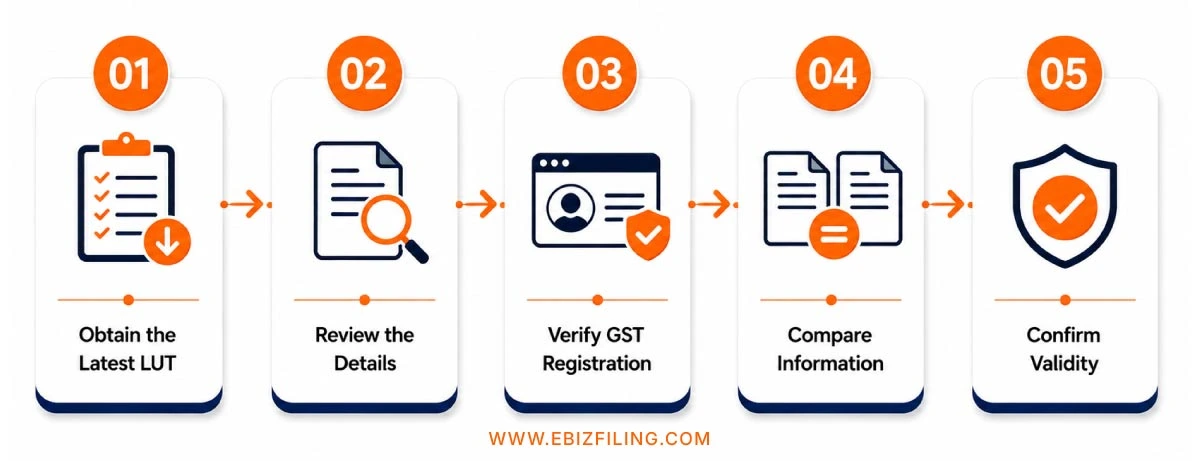
Step 1: Obtain the Latest LUT
Request the latest Letter of Undertaking from the exporter or supplier.
Step 2: Review the Details
Check the GSTIN, legal business name, principal place of business, financial year, and authorized signatory.
Step 3: Verify GST Registration
Visit the GST portal and use the Search Taxpayer facility to verify the GSTIN.
Step 4: Compare Information
Cross-check the GST portal details with the information mentioned in the LUT.
Step 5: Confirm Validity
Ensure that the LUT relates to the applicable financial year and supports the proposed export transaction.
The Situations Where Businesses Conduct GST LUT Verification
Businesses commonly perform GST LUT Verification in the following situations:
- Before onboarding a new exporter.
- Before processing export invoices.
- During internal compliance reviews.
- Before submitting export-related documentation.
- While reviewing records for GST refund applications.
- Before executing high-value export transactions.
Conducting these checks helps maintain consistency across compliance documents.
GST LUT Verification vs GSTIN Verification
Although these terms are sometimes used together, they serve different purposes.
|
GST LUT Verification |
GSTIN Verification |
|
Internal review of LUT details |
Official verification through the GST portal |
| Helps cross-check exporter information |
Confirms current GST registration status |
|
Reviews information contained in the LUT |
Verifies whether GST registration is active, suspended, or cancelled |
| Supports internal compliance |
Official method prescribed for GST registration verification |
Businesses should always rely on GST portal verification to confirm the latest GST registration status. Businesses may also review How GST LUT affects invoicing and accounting to better understand the impact of LUT on export documentation and financial records.
Best Practices for GST LUT Verification
To maintain accurate export compliance, businesses should:
- Review the latest financial year’s LUT.
- Verify GST registration through the GST portal before export transactions.
- Match the GSTIN, legal name, and address with GST records.
- Check that the LUT is complete and properly furnished.
- Maintain copies of the LUT for audit and compliance purposes.
- Periodically review exporter details for consistency.
Following these practices helps businesses strengthen internal compliance procedures and reduce documentation-related issues.
How Ebizfiling Helps with GST LUT Filing and GSTIN Verification
Ebizfiling helps businesses manage GST LUT filing, GST verification, and export compliance documentation smoothly. Our team assists businesses in filing GST LUT applications, reviewing compliance records, and helping businesses file letter of undertaking online without confusion.
We also help businesses verify GST registration details, review export compliance documentation, and support businesses involved in GST-related export procedures. Whether it is GST verification, LUT filing, or assistance to generate E-way bills, Ebizfiling provides practical compliance support for businesses handling export transactions.
Conclusion
GST LUT Verification is an internal compliance process that helps businesses review the information contained in a Letter of Undertaking before export transactions. While the LUT provides important business and registration details, it should be used only as a supporting document for cross-checking information.
The GST portal remains the official platform for verifying the current GST registration status. By combining GST LUT Verification with GST portal verification, businesses can improve documentation accuracy, strengthen compliance, and facilitate smoother export operations.
Whether you are a new exporter or an established business, maintaining accurate LUT records and reviewing them regularly can help reduce compliance risks and support efficient international trade.
Suggested Reads:
Frequently Asked Questions
1. Is GST LUT Verification an official verification process under GST law?
No. GST LUT Verification is not an official verification mechanism prescribed under the CGST Act or the CGST Rules, 2017. It refers to an internal compliance process in which businesses review the details contained in a Letter of Undertaking (LUT) and cross-check them with the GST portal and other business records. The GST portal remains the official platform for verifying the status of a GST registration.
2. Which legal provision governs the furnishing of a Letter of Undertaking (LUT)?
The furnishing of a Letter of Undertaking is governed by Rule 96A of the Central Goods and Services Tax (CGST) Rules, 2017. It allows eligible registered persons to export goods or services or make supplies to a Special Economic Zone (SEZ) without payment of Integrated GST (IGST), subject to the prescribed conditions.
3. What details should businesses review during GST LUT Verification?
During GST LUT Verification, businesses should review the GSTIN, legal business name, principal place of business, financial year, authorized signatory details, and the Application Reference Number (ARN). These details should then be cross-checked with the GST portal to ensure consistency.
4. Can an expired LUT be used for export without payment of IGST?
No. An LUT is generally valid for the financial year for which it is furnished. Exporters intending to continue exports without payment of IGST in the next financial year should furnish a fresh LUT before undertaking eligible exports.
5. Does GST LUT Verification confirm that a GST registration is active?
No. Reviewing an LUT does not confirm the current status of a GST registration. Businesses should always verify the GSTIN through the Search Taxpayer facility available on the GST portal to determine whether the registration is active, suspended, or cancelled.
6. Is an LUT mandatory for all exporters under GST?
No. An LUT is not mandatory for every exporter. It is required only for eligible registered persons who choose to export goods or services or make supplies to an SEZ without payment of IGST. Alternatively, exporters may export on payment of IGST and claim a refund, subject to the applicable provisions.
7. What is the difference between GST LUT Verification and GSTIN Verification?
GST LUT Verification involves reviewing the information contained in the Letter of Undertaking and comparing it with business records. GSTIN Verification is the official process of confirming the validity and current status of a GST registration through the GST portal. Businesses should perform both activities as part of a robust export compliance process.
8. Can businesses rely solely on an LUT while onboarding an exporter or supplier?
No. An LUT should be treated as a supporting compliance document. Businesses should also verify the GST registration status on the GST portal and review other documents, such as the GST registration certificate and relevant business records, before completing vendor onboarding or export transactions.
9. How can Ebizfiling help businesses with GST LUT filing?
Ebizfiling assists eligible businesses with the preparation and filing of the Letter of Undertaking (LUT), annual LUT renewal, document review, and export-related GST compliance. Our experts help ensure that LUT applications are filed accurately and within the applicable timelines, reducing the risk of compliance issues.
10. Does Ebizfiling provide assistance with GST verification and export compliance?
Yes. Ebizfiling supports businesses with GST registration, GST return filing, LUT filing, GST compliance advisory, and export-related documentation. Our team also assists businesses in reviewing GST registration details and maintaining accurate compliance records to facilitate smoother export operations.





File GST LUT
All registered tax payers who export the goods or services have to furnish Letter of Undertaking (LUT) in GST RFD-11. File with Ebizfiling.
About Ebizfiling -



Reviews
Ashish Paliwal
29 Sep 2018Let me be honest and tell you that I did not choose eBiz filing after my initial LLP company registration did to pricing. A lot of companies contact me with better rates so I generally choose them. However, I will still rate eBiz filing 10/10 on work ethics. You guys are professionals in true sense.
Hemanshu Mahajan
01 Apr 2018I registered my LLP company, from eBizfilling. Great team and very competitive pricing. Will definitely use their services again.Thanks for work well done.
Kalla swathi
09 Apr 2022Excellent service indeed.. I appreciate the entire team for incorporating my company very well
October 14, 2026 By Srishti M
GST Compliance Calendar November 2026: Key Due Dates & Filings Introduction The GST Compliance Calendar November 2026 highlights the major GST return filing, tax payment, invoice reporting and year-end adjustment deadlines applicable during the month. It covers regular taxpayers, QRMP […]
September 30, 2026 By Srishti M
GST Appeal Against NIL Demand Now Allowed on GST Portal Introduction The Goods and Services Tax Network (GSTN) has introduced a portal-level update allowing eligible taxpayers to file appeals against GST demand orders where the demand amount is reflected as […]
September 28, 2026 By Srishti M
GST Section 74 Notice: Key Supreme Court Guidelines for Valid SCNs Overview A GST Section 74 notice is a serious GST communication because it may involve allegations of fraud, wilful misstatement or suppression of facts to evade tax. For tax […]